Shed a tear for the whinging banks

whinging Cypriot banksCYPRIOT banks will have problem with their capital if parliament votes in favour of the bill to secure title deeds to the trapped property owners.

The bill gives discretionary powers to the Director of the Land Registry, under certain conditions, to discharge and/or eliminate and/or transfer and/or cancel the mortgage and/or encumbrance and/or prohibition that encumbers the property or part thereof, with the purpose of transferring the property in the name of the purchaser, provided that the purchase price has been fully paid, or the balance is deposited in a special temporary account.

Speaking before the joint session of the House Finance and Interior Committees, the representative of the banks’ association Demetra Valianti Plati expressed reservations about the bill, noting that many trapped owners will not secure a title deed.

She said the banks cannot be responsible for the fact that when some land developers, rather than using the money to repay their loan, they used it for another purpose.

She noted that land developers should have informed banks on the sales made, stressing that the banks cannot undertake a 100% share of the law enforcement.

The representative of the banks also expressed reservations for the transfer of the mortgage of land developers to other properties or their guarantors, noting that “if they do not own property we will be left exposed” and wondered how the Land Registry will decide if the collateral is of the same value.

She stressed that it is difficult to find a property that gives the same coverage and banks will remain exposed.

A representative of the Central Bank noted that banks were asked to analyse the impacts from the implementation of the bill, stressing that the banks did not send the relevant data.

Interior Minister Socrates Hasikos said that banks are not convincing and “it is not enough to have knowledge, they should have known where the money went. They did not do that”.

He stressed that the bank ought to monitor every sale made by the land developers.

The representative of the bank, in response to Mr. Hasikos’ argument, said that the only way the bank could know about the sales was to be outside of the office of the land developers.

The Finance Ministry representative said that a new bill will be filed in October according to which sales will not be permitted if the buyer is not guaranteed.

Insolvency action plan

insolvencySPEAKING to the Cyprus News Agency, Head of the Insolvency Service Giorgos Karotsakis said that the action plan for implementing the insolvency framework was being evaluated by the by the Ministry of Finance and that it should ensure the full functioning of the Insolvency Service, the IT infrastructure and the licensing of insolvency consultants.

The action plan due to be discussed when the troika next visits Cyprus. (Under the updated Memorandum of Understanding, the Action Plan should have been ready by the end of June.)

Mr Karotsakis stressed the importance that the International Monetary Fund (IMF) places on the framework in contributing to the restructuring of loans and restoring investment and development in Cyprus.

“The IMF report makes it clear that the insolvency framework will help reducing non-performing loans (NPLs) to a large extent, in order to reset the financial system through the effective reduction of NPLs,” he said.

However he didn’t comment about the IMF’s estimate that the insolvency framework would reduce private sector debt by between 3% and 12% of GDP. Based on an assessment carried out by the banks, NPLs that may be eligible for the insolvency process could range between €1–3 billion (6% to 7% of GDP).

Mr Karotsakis pointed out that the Insolvency Service will take all measures and actions necessary to ensure the implementation of the insolvency process including a system to monitor and evaluate its effectiveness in reducing NPLs.

Betrayed by the fourth estate

fourth_estateTHE RECENT developments in Greece have created a sense of uncertainty as to what lays ahead. Uncertainty causes concern about how the status quo will change, but it also creates opportunities if one chooses to embrace this change.

Who is at fault for allowing things to reach the point they have? Everyone. No one. Me. You.

Everyone is at fault because half of us choose to spend time lounging around, rather than embracing our civic duties or going to vote for those who govern us. No one, because what is happening is not due to the actions or inaction of one person – it has taken years and required the input of multiple culprits to come to this. I am to blame because I should have shouted louder when I disagreed with certain actions, and been less dismissive of those who did. You are to blame because you sat in idle apathy, expecting everyone else to change around you whilst you continued doing what you always did.

Above all the Greek and the Cypriot people were let down by the Fourth Estate. In Medieval Europe, France had a three-estate system that was used until the French Revolution: the clergy (first estate), the nobility (second estate), and commoners (third estate). The Estates General was used as a means of providing all sections of society equal representation, although the first two estates were chosen by the King. More recently, the term Fourth Estate is used in reference to forces outside the established power structure, typically the independent press or media.

Can one really blame the press and the media for what is unfolding in Greece and Cyprus? Yes. The Fourth Estate dropped the ball long ago, focusing on entertaining and informing rather than providing insight and educating. This has left the first and the second estates, the elite, to run unchecked, as the third estate grew addicted to gadgets, engaged in voyeurism, and became increasingly self-centred. Now that push has come to shove, the Fourth Estate is trying to explain what is happening and offer some comfort to the third estate. However, asking the same person who writes the fashion, gossip and politics columns, to also provide valuable insight into the economy and banking, is equal to expecting that your tablet will also double-up as a babysitter when you are on vacation.

Where do we go from here? For the relationship between Greece and Europe, I offer a segment of “Free bird” by Lynyrd Skynyrd – a fantastic rock ballad.

If I leave here tomorrow
Would you still remember me?
For I must be traveling on now
There’s too many places I’ve gotta see
If I stay here with you girl
Things just couldn’t be the same

As to how things will play out, take comfort in the inscription on the ring that humbled the Persian king – “This too shall pass”.

Pavlos Loizou
Partner Greece & Cyprus
Resolute Asset Management

Property transfer fee reduction

Cyprus Property Transfer FeesTHE GOVERNMENT intends to promote a regulation for the reduction of the property transfer fees by 50%, which had been previously announced by the Cyprus Interior Minister but was not promoted due to objections of the troika, within the framework of the bill for the single property taxation.

In statements on his way out of the Cabinet meeting, Interior Minister Socrates Hassikos said it was considered that the draft law on the single tax is better to be submitted to the Cabinet at its next meeting, next week, indicating however that this does not mean that it will be abandoned.

“This bill and the reduction of transfer fees by 50%, an announcement that had been made by the Interior Minister but had been rejected by the troika, are going to be implemented with the agreement of the troika”, he added.

Cabinet approves hidden mortgages bill

Cabinet approves hidden mortgages billFOLLOWING today’s meeting of the Cabinet (Council of Ministers), Interior Minister Socrates Hasikos explained some of the key points of the ‘hidden mortgages’ bill designed to enable several thousand people to get the Title Deeds to the property they purchased.

“The bill covers several thousand citizens who have paid the full purchase price for their house or apartment but who cannot get its Title Deed either because the vendor (property developer) had mortgaged the property to the bank, or because the vendor has not paid the monies due to the state such as VAT, income tax, social insurance etc.”

He noted that the bill would guarantee that purchasers affected would be able to obtain the property’s Title Deed and, having done so, they will be able to sell, transfer or mortgage the property.

Asked to clarify, Mr Hasikos made it clear that the law will cover all cases where the buyer paid the full purchase price for the property and those who have paid a sizeable proportion of the purchase price who may pay the remainder into a special account through the Land Registry when they have the money.

The main provisions of the bill

  • With the proposed changes, for the purpose of issuing ownership titles to the benefit of the entrapped buyer, authority is granted to the director of the land registry department to exempt, eliminate, transfer, cancel mortgages and or other encumbrances, depending on the case and under conditions.
  • Specifically, the sale price must have been paid in full by the buyer. In case of an outstanding amount, the buyer can deposit it in a special temporary account managed by the land registry director.
  • The director will have the power to transfer mortgages to other property belonging to the seller. If no such property is available, the director can transfer the encumbrances on individuals who guaranteed the seller’s obligations and, at the time the agreement was signed, had acted as board members, or owned over 10 per cent of the seller’s share capital.
  • The bill concerns the seller’s obligations to banks and the state.
  • To benefit from these provisions a sales contract for the property or part thereof, must have been submitted to the land registry department by December 31, 2014.

Cyprus property sales falter in May

CYPRUS property sales fell 27% in May compared with the numbers sold in May 2014 according to the latest official statistics from the Department of Lands & Surveys.

In May a total of 405 contracts for the sale of commercial and residential properties and plots of land were deposited at Land Registry offices across Cyprus, compared with the 551 contracts deposited in May last year.

Of those 405 contracts 61% (248) were deposited on behalf of domestic buyers, while 36% (157) were deposited in favour of overseas buyers.

Famagusta was the hardest hit with sales falling 55% compared to the same period last year. Sales in Paphos were down 27%, while those in Nicosia, Limassol and Larnaca fell by 36%, 27% and 17% respectively.

Speaking to Stockwatch Vice Chairman of the Cyprus Real Estate Agents Association Solomon Kourouklides, said that people are forced to sell some properties to pay off the banks but there is also lack of liquidity in the market. He noted that “Many are interested in selling properties but few are interested in buying.”

Meanwhile property valuator Polys Kourousides said that property sales have stabilized and this is reflected in the figures for recent months. “The decrease in May is due to last year’s high base” he said.

I spoke with an estate agent at the eastern end of the island who said they had several Assignment Contracts waiting to be deposited, but that they were waiting for the Tax Office to issue Tax Clearance certificates.

Cyprus property sales - May 2015

During the first five months of 2015, total property sales have risen 4% compared with the same period last year to reach 1,884 compared with 1,810.

Domestic sales

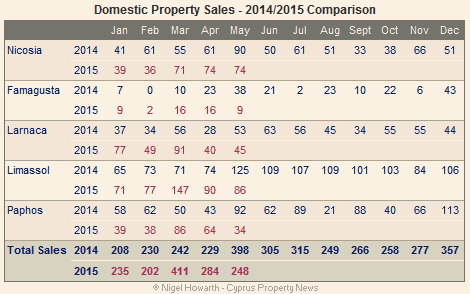
Domestic property sales in May tumbled 38% compared with May 2014, falling to 248 from 398 last year, with sales falling in all districts.

Famagusta took the brunt of the fall with sales dropping 76%. Sales in Paphos fell 38%. While those in Limassol, Nicosia and Larnaca were down 31%, 18% and 15% respectively compared to last year.

Cyprus: Domestic property sales May 2015

During the first five months of 2015, property sales to the domestic market have risen 6% compared with the same period last year having increased to 1,380 from 1,307.

Overseas sales

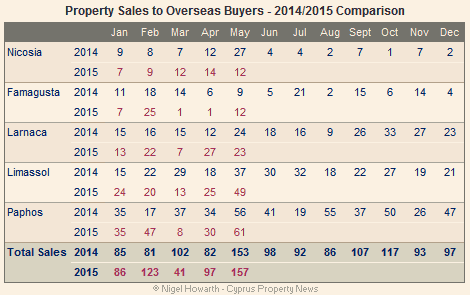
Sales to the overseas market in May rose 3% compared with May 2014.

The 56% drop in sales in Nicosia and the 4% drop in Larnaca were more than offset by an increase in sales in Famagusta (up 33%), Limassol (up 32%) and Paphos (up 3%).

Cyprus: Overseas property sales May 2015

During the first five months of 2015, sales to the overseas market are up just 0.2% compared with the first five months of 2014 having increased to 504 from 503.

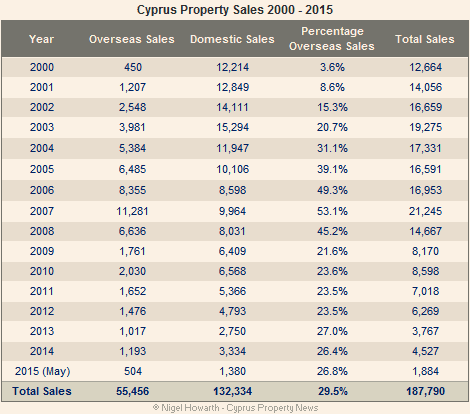
Cyprus property sales 2000 – 2015 summary