Foreclosures legislation effective from Friday

Foreclosures lawPARLIAMENT passed the regulations on Thursday governing properties in foreclosure, enabling the activation of repossessions-related legislation.

The ordinances passed after much horse-trading between MPs, along with a number of additional clauses as well as amendments tabled by the parties.

The regulations were approved with 33 votes in favour (DISY, DIKO, EDEK, EVROKO) and 21 against (AKEL, the Greens and independent MP Zacharias Koulias).

It means that banks may now – after months of the issue stuck in limbo – initiate foreclosure proceedings.

At the same time, it removes one of the last remaining hurdles in the way of international lenders to complete a pending sixth review of the island’s economic adjustment programme, paving the way for the resumption of bailout payments.

Implementation of new, effective foreclosures legislation is a key condition of a €10bn bailout deal struck with the European Commission, the European Central Bank and the International Monetary Fund.

At the House plenum, EDEK proposed postponing the vote for a week, but eventually withdrew after pleas from ruling DISY that any further delay would be detrimental to the economy.

Under a proposal tabled by AKEL, the owner of a property in foreclosure, or a first-degree relative, may take part in the auction. Initially the ordinances, as submitted by the government, prohibited the owner from participating.

In addition, if the property owner or a first-degree relative are able to match the highest bid, the property will be sold to them.

Moreover, the owner or their first-degree relatives have the right to make the winning bid, including when the highest bid is less than the debt owed to the bank.

For example, where the outstanding debt – the balance of the mortgage plus any penalties – comes to €120,000, but the highest bid placed at the auction is only €100,000.

In this case, the property will revert to the original property owner or a first-degree relative, and the remaining amount (€20,000) must be paid to the bank within two years. During these two years, the lender may not move against the property, such as serving a foreclosure notice.

The ordinances also incorporate a proposal by EVROKO, where property valuators as well as up to fourth-degree relatives, are barred from bidding.

Auction costs will be borne by the bank and not the debtor.

The ordinances on foreclosures provide that auctions will take place from Monday through Friday, 9am to 5pm, except for public holidays.

Auctions will be held at designated premises, one in each district, to be selected by the interior ministry or the banks. The process will be streamed live online, with auctioneers picked at random by computer.

Legislators also approved a bill tabled by DIKO, which extends to June 26 a ban on the sale or transfer of bank loans to third parties, such as hedge funds.

Back in January, parliament passed an amendment to the Banking Law (1997 to 2013), inserting a clause by which banks licensed in Cyprus may not sell a loan portfolio to credit institutions – such as hedge funds – operating here but licensed elsewhere. This was in fear that defaulting mortgages, and in effect large swathes of property, could fall into foreign hands, with political implications.

MPs focus on foreclosure regulations

foreclosure regulationsMPS ON Monday continued discussion of the regulations governing the auctioning of properties in foreclosure, with the aim of voting them into law at Thursday’s House plenum.

Passage of the ordinances will enable new repossession laws, cleared in April after months of political wrangling, to come into force.

In turn, the implementation of effective foreclosures legislation is a condition set by international creditors for completing their latest review of Cyprus’ bailout programme. This would pave the way for the resumption of bailout payments, as well as signal the island’s eligibility for the European Central Bank’s borrowing programme known as Quantitative Easing.

As they stand, the government ordinances on foreclosures – which require the nod from parliament – provide that auctions will take place from Monday through Friday, 9am to 5pm, except for public holidays.

As reported by CyBC, auctions will be held at designated premises, one in each district, to be selected by the interior ministry or the banks. The process will be streamed live online, with auctioneers picked at random by computer.

The principal debtor or guarantor will be given the opportunity to pay the outstanding amount before the auctioneer starts taking bids.

Additionally, auctioneers are not permitted to sell more immovable properties than what are needed to cover a debt. Where multiple properties of a debtor are being auctioned off, the last property to be sold will be the primary residence.

Successful bidders are required to cover all auction costs as well as fees for registering a property in their name. The winning bidder must immediately pay 20 per cent of the sale amount, with the remainder paid over the next 20 days.

Under the same regulations, auctioneers’ fees will not exceed 0.1 per cent on the sale price, for properties under €100,000. For properties worth up to €500,000, the fee is set at no more than 0.25 per cent, excluding the first €100,000. In any case, the fee must not exceed €300.

During the same joint session on Monday, the House finance and interior committees also debated a bill, drafted by the Central Bank (CBC) and concerning the sale and transfer of bank loans to third parties.

Opposition MPs have raised a red flag that debts might be sold off to financial companies controlled by Turkish interests.

CBC officials reassured deputies the bill features a number of safeguards against this.

Back in January, parliament passed an amendment to the Banking Law (1997 to 2013), inserting a clause by which banks licensed in Cyprus may not sell a loan portfolio to credit institutions – such as hedge funds – operating here but licensed elsewhere.

As the law stands, banks may dispose of loans (in whole or in part) only with credit institutions that have been licensed in the Republic.

The ban applies until June 26, by which time the government hopes to finalise and table the CBC bill, which needs to be green-lighted by the troika of lenders.

Yiangos Demetriou, head of the CBC’s bank supervision and regulation, told MPs that financial companies licensed in Cyprus would also be required to be based here in order to buy up loans from banks.

Additionally, the companies would come under full CBC supervision, and their owners subject to ‘suitability control’.

According to Demetriou, the CBC was now waiting for the troika’s feedback on these clauses.

Positive review from the troika

Positive review from the troikaTHE European Commission, European Central Bank and International Monetary Fund issued the following statement on their latest mission to Cyprus on 8th May 2015:

“Staff teams from the European Commission (EC), European Central Bank (ECB), and International Monetary Fund (IMF) visited Nicosia during April 28 to May 8 to review Cyprus’s economic reform programme.

“Cyprus’s programme aims to support the economic recovery and job creation by restoring financial sector stability, strengthening public finances, and implementing reforms to increase long-run growth.

“The teams welcomed the authorities’ continued progress on their reform programme, including the strong improvement in the public finances and the implementation of important reforms, including the recent adoption of modern insolvency and foreclosure legislation.

“This legislation is a critical step aiming at reducing the high level of non-performing loans, which is essential to restoring growth and job creation in Cyprus. Significant progress towards staff-level agreement on the review has been made and the teams look forward to a swift conclusion as soon as all elements of the insolvency and foreclosure framework are available.”

Before the next tranche of the bailout loan is released, two actions must be completed:

  • The Cyprus government has to approve the draft bills concerning the packaging and selling of loans to third parties. (The troika will examine the legislation in July.)
  • The Cyprus government has to resolve the problem of ‘hidden mortgages’ where those who bought property that the developer had previously mortgaged are unable to obtain its Title Deed because the developer has defaulted. (Interior minister Socratis Hasikos has stated that the government’s top priority is to protect all those people who paid up fully for their homes, or up to 80 per cent but are unable to get the title deed. Draft legislation is being vetted by the Attorney General’s office.)

It is anticipated that the next tranche of the bailout loan will be released by the end of June; the amount will be settled once the troika have completed examining the insolvency and foreclosure frameworks.

Troika to conclude review today

troika Memorandum of Understanding (Cyprus)CYPRUS` international lenders, the European Commission, the ECB and the IMF, are set to conclude the island`s sixth economic programme review today.

The heads of the three institutions, collectively known as the Troika, will meet with the Central Bank of Cyprus Governor Chrystalla Georghadji with whom they are expected to agree the updated Memorandum of Understanding concerning the financial sector.

On Thursday, the Troika heads held a six-hour meeting with Minister of Finance Harris Georgiades and Undersecretary to the President Constantinos Petrides, covering all issues concerning the fiscal sector and the structural reforms.

Reliable sources have told CNA that the authorities have agreed that the landmark for loan securitization (sale of banking loan portfolios to non-banking third parties) is set for July.

Other sources have told CNA that the Troika was satisfied with the progress achieved on public sector reforms and that all government proposals concerning the promotion and mobility of civil servants will be incorporated in the updated Memorandum. The government proposals on the reform of the civil service should be approved by the Cabinet by the end of June, according to the timetable set by the international lenders.

Moreover, the budgetary and macroeconomic commitments of Cyprus for 2015 were also agreed during the discussions and the assessment of the European Commission for 0.5% recession in 2015 was adopted, despite the fact that the Finance Ministry expects marginal growth. At the same time the aim for primary surplus was brought forward a year, to 2015, from 2016.

The target for the budget deficit in 2015 was set at 1.5% of GDP, while the target for the primary surplus was set at 1.5% of GDP.

Regarding the insolvency framework, the lenders agreed for its implementation as it was voted by the House of Representatives in order to decide later whether there is a need for some changes.

In March 2013, Cyprus concluded a €10 billion bailout with the Troika, to avert the collapse of its banking sector and cover its refinancing needs.

– Cyprus News Agency

Aristo boss denies fraud

Theodoros Aristodimou denies fraud
Photo credit: ? ????????????

PROMINENT developer Theodoros Aristodemou, on trial in connection with a land zoning case in Paphos, denied on Thursday that he defrauded the state and claimed that his company has been ruined because of the negative publicity.

Aristodemou testified before the Paphos Criminal Court after it ruled last week that there was a prima facie case against him and three others, including his wife, in connection with the demarcation of land in Skali, Paphos.

Aristodemou, his wife Roulla, former municipal engineer Savvas Savva, and Aristo Developers designer Christos Solomonides, have been charged in the case.

The charges include forgery, circulation of a forged document, conspiracy, abuse of authority, and obtaining property under false pretences.

Aristodemou, Roulla, and Savva, have been acquitted of an attempted money laundering charge.

The company had been granted a permit for 177 plots but this was allegedly falsified later by replacing the approved architectural plans with amended ones, which ceded the company an additional area of 2,730 square metres for development at the expense of the legally mandated green space and road network.

The land was estimated to be worth around €1.1m.

He told the court on Thursday that his company never defrauded the state and that it employs experienced personnel who would not engage in illegal acts.

Aristodemou claimed that the publicity surrounding the case, in and out of Cyprus, ruined his company, which was one of the biggest on the island.

He told the court that sales tumbled after the issue emerged in September 2014.

The court heard that the Chinese market was not showing an interest and that his company had been blacklisted.

Aristodemou said his company recorded €160m in profit annually. Sales of real estate in the past ten years reached €800m, he said, with around 30 per cent paid to the state in the form of taxes.

He also said that despite being the chairman of Bank of Cyprus, he never tried to take money abroad when a decision was made to seize deposits to recapitalise the stricken lender.

Aristodemou said he lost deposits, bonds, and shares worth around €80m.

Of the case in question, he said his company had ceded thousands of square metres it could have claimed, with double the value of the land it is accused of taking.

Aristodemou also categorically denied bribing Savva and sought to explain why he had issued two cheques to his own name, worth €5,000 and €20,000, which were cashed in €500 notes.

The businessman was trying to counter the position of the state which said that at around the same time, the former municipal engineer had deposited to his account €20,000 in €500 notes.

Aristodemou told the court that €5,000 were paid so that his terminally ill sister could travel to the UK while the €20,000 was used for holidays with his family.

He added that he asked his employee, who cashed the cheques, to get €500 notes and that he never used plastic and only worked with cash.

The case continues on Monday with Aristodemou’s cross examination by the prosecution.

Property sales continue upward trend

THE NUMBER of properties sold in Cyprus during April increased 23 per cent compared with April 2014 with sales improving in all districts with the exception of Famagusta.

Industry pundits consider that sales will continue to increase while the banks put pressure on delinquent borrowers to repay their loans.

Speaking to StockWatch Solomon Kourouklides, the Vice Chairman of the Cyprus Real Estate Agents Association (CREAA), said that the foreclosures law is putting pressure on people sell their property to repay their loans.

He said “Prices are being pushed downwards and people with liquidity are taking advantage of the situation to buy property.”

“When they receive letters from banks and lawyers people panic and rush to sell their property.

“People, unfortunately, are not aware of their rights in the foreclosures process and the partial protection granted to borrowers and guarantors under the new framework for insolvency.”

Commenting on the effect on the market of lower interest rates Mr Kourouklides noted that “the decline is slight and does not contribute to the increase in demand.”

Property sales

In April a total of 381 contracts for the sale of commercial and residential properties and plots of land were deposited at Land Registry offices across Cyprus, compared with the 311 contracts deposited during the same period last year.

Of those 381 contracts 75% (284) were deposited on behalf of domestic buyers, while 25% (97) were deposited in favour of overseas buyers.

Although sales fell 41% in Famagusta in April, they increased in all the other districts.

Sales in Larnaca rose 68% to reach 67 compared to the 40 sold in April 2014. Sales in Limassol went up 25%, while those in Paphos & Nicosia increased by 22% and 21% respectively.

Cyprus property sales - April 2015

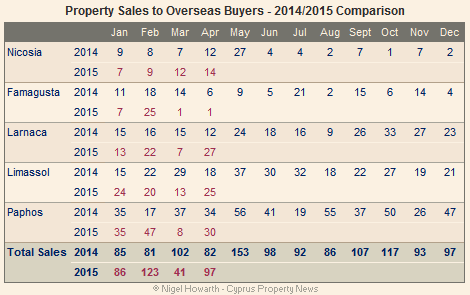
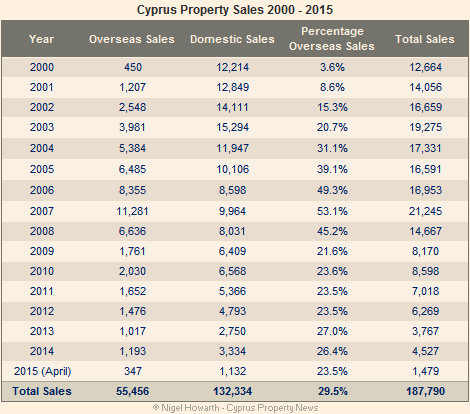
Overall sales during the first four months of 2015 are up 18% compared with the first four months of last year with sales reaching 1,479 compared to 1,259 last year.

Domestic sales

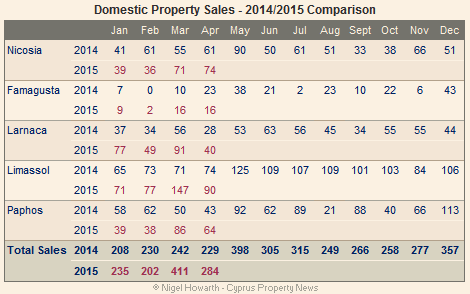
Domestic sales in April increased 24% compared with the same month last year, rising from 229 to 284.

With the exception of Famagusta, where the number of sales fell 30% compared to last year, their number increased in all the other districts.

Paphos saw the largest increase, with sales increasing 49% to reach 64 compared with the 63 sold during April last year. Sales in Larnaca went up 43%, while those in Limassol and Nicosia rose by 22% and 21% respectively.

Cyprus: Domestic property sales April 2015

During the first four months of 2015, domestic sales are up 25% compared to the first four months of 2014 increasing to reach 1,132 compared to 909 last year.

Overseas sales

Following a disastrous 60% drop in overseas sales during March, sales during April were much more encouraging, with sales up 18% compared with April 2014.

With the exception of Famagusta and Paphos, where the number of sales fell 83% and 12% respectively, they improved in the three remaining districts.

Sales in Larnaca rose 125% to reach 27 compared to the 12 sold in April 2014, while in Limassol and Nicosia sales rose 39% and 17% respectively.

Cyprus: Overseas property sales April 2015

During the first four months of 2015, sales to the overseas market have fallen 1% compared to the first four months of 2014 having dropped to 347 from 350.

Cyprus property sales 2000 – 2015 summary