Strong growth in home construction

THE NUMBER of building permits issued in February 2015 stood at 401 compared with the 409 issued in February last year; a fall of 2 per cent, according to figures released yesterday by the Cyprus Statistical Service.

Compared with February 2014, the total area of these permits increased by 26% to 97,685 square metres from 77,633, while their value increased 6% to €108.9 million from €102.9 million.

During February, building permits were issued for:

  • Residential buildings – 270 permits
  • Non-residential buildings – 82 permits
  • Civil engineering projects – 14 permits
  • Division of plots of land – 24 permits
  • Road construction – 11 permits

New home construction

The 270 residential building permits approved in February provided for the construction of 384 new homes comprising 123 single houses and 261 multiple housing units (such as apartments, semis, townhouses and other residential complexes).

This is an increase of 68% compared with February 2014 when building permits were issued for the construction of 229 new homes.
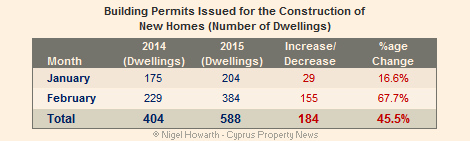
Cyprus new home construction February 2015 vs 2014

According to the Cyprus Statistical Service, building permits constitute a leading indicator of future activity in the construction sector.

Banking system corruption

CDorruption in the banking systemINVESTIGATORS probing reasons that resulted in the meltdown of the Cyprus economy in 2013 have uncovered unprecedented bad practices by banks, which lead to the squandering of billions of Euros.

Sources close to the team of investigators told state broadcaster CyBC that large loans were approved by the banks without due appraisal of collateral values.

In some cases the banks did not ask borrowers to provide proof of their economic situation, while in other cases uncovered by the investigators banks accepted forged guarantee documents.

Many large loans were given at an ‘unusually low interest rate’ and in one of the cases uncovered so far, the bank granted the borrower a 3-year grace period.

Investigators have requested the British, Greek and Italian authorities to provide information on loan guarantees.

The sources revealed that some of the investigations are close to the stage where charges can be filed against people involved in the banking malpractices.

Case against Aristo stands

PAPHOS Criminal Court ruled on Thursday there is a prima facie case against prominent developer Theodoros Aristodemou and three others, including his wife, in connection with a land zoning case.

However, the court acquitted Aristodemou, wife Roulla, and former municipal engineer Savvas Savva of attempted money laundering charges.

The three, along with Aristo Developers designer Christos Solomonides, have been charged in connection with the demarcation of land in Skali, Paphos.

The charges included forgery, circulation of a forged document, conspiracy, abuse of authority, and obtaining property under false pretences.

The company was granted a permit for 177 plots but this was allegedly falsified later by replacing the approved architectural plans with amended ones, which ceded the company an additional area of some 2,730 square metres for development at the expense of the legally mandated green space and road network.

The land was estimated to be worth around €1.1 million.

The accused must now present their defence. They have three choices: remain silent, testify under oath and face cross examination, or give a statement from the dock without cross examination.

The only choice essentially taken into consideration by the court is the sworn testimony.

Either way they can call defence witnesses to back their case.

The next hearing was scheduled for May 7.

Fraudster Gary Robb brought to justice

Gary Robb
Robb at AGA’s notorious Amaranta Valley project

PROPERTY fraudster Gary Robb, who was sentenced to ten-months in jail in connection with a case involving the appropriation of Greek Cypriot property in the northern Turkish occupied area, has had £1.3 million of his assets returned to scam victims.

In an interview with GazetteLive Donald Toon, director of economic crime command for the National Crime Agency who worked on the case, said: “This case is the first time that this legislation has been used to both disrupt serious criminal activity, and enable victims to reclaim funds.

“Achieving today’s result has taken a determined effort over several years.

“The NCA will be patient and persistent, and will continue to use every tool at its disposal to disrupt criminals like Robb and deprive them of the assets they acquire through crime.”

Robb, a convicted drug dealer and former nightclub boss, was one of the managers of a Turkish Cypriot development company “AGA Development Ltd” which aimed to build 335 luxury properties in the occupied village of Klepini, in northern Kyrenia.

Construction began in January 2005 and by the end of April some 85 per cent of the properties had been sold to mainly British buyers for between CYP 50,000 (€85,500) and CYP 100,000 (€171,000), but the project was never completed.

In September 2011 the Nicosia District Court convicted Robb on 11 charges relating to the appropriation of exploitation of Greek Cypriot owned property in the occupied areas and sentenced him 10-months in jail. Although Rob appealed to have his sentence reduced, the island’s Supreme Court rejected it in April 2012.

At that time British police thought that around 400 Britons collectively lost over €40 million in deals with AGA Development.

EU says ‘No’ to Limni golf courses

No to Limni golf coursesCYPRUS is once again in hot water with the EU regarding conservation parks, after the European Commission sent an official letter to Nicosia on Wednesday telling the government to cancel building permits for two golf courses, scheduled to be built at the Limni area near the Akamas national park.

The Limni project Polis Chrysochous, developed by the Shacolas Group, also includes a five star hotel, a wellness centre, luxury residences, a historical museum and an information centre on the turtles, cycle paths, and a helipad.

The EU commission opposes the project, saying that the Limni area overlooking Morphou Bay is part of the Natura 2000 network of nature protection areas.

Cyprus was cautioned to respect the Natura 2000 guidelines and asked for a conservation study to be commissioned on the effects of the project to the surrounding area, something that was bypassed by the state during the final days of the Christofias administration in order to speed up the process.

According to the letter, Cyprus has two months to comply, or face the possibility that the case being sent to the European court.

NAMA Mia here we go again (maybe)

AS WE reported in 2012, one of the proposals in the draft Memorandum of Understanding (MoU) at that time was the establishment of an “Asset Management Company” (AMC) or ‘bad bank’.

A ‘ bad bank’ is a bank set up to purchase bad loans from financial institutions with non-performing assets. By selling its bad assets, the financial institution clears its balance sheet of toxic debts and  enables it to focus on its core business of lending. The bad bank focuses its attention on maximizing the return from the high risk assets it has purchased.

The MoU suggested that “Transfers will take place at the real (long-term) economic value of the assets as established on the basis of a thorough asset quality review process, drawing on the individual valuations used in the due diligence exercise.”

The most notable bad bank in the EU is NAMA (National Asset Management Agency), which was set up by the Irish government 2009. Its aim was to address serious problems that hit the country’s banking sector as the result of excessive property lending. NAMA acquired land and development and loans with a nominal value of €74 billion and was funded by the government.

However, the Cyprus government didn’t and still doesn’t have the financial resources to set up a bad bank and purchase non-performing assets.

But the government has not rejected the idea of a bad bank completely.

On Tuesday Cyprus finance minister Harris Georgiades said that he considers a bad bank “useful” but there are a number of unanswered questions on how it would be funded, adding that “Right now there is private-sector funding, and perhaps the prospect of raising private cash to fund such a vehicle should be explored.”
