Strong opposition to 30 foreclosure law proposals in Cyprus

The Cyprus banking sector has voiced strong concerns over roughly 30 proposed amendments to the country’s foreclosure framework, which are scheduled for discussion on Monday at the Parliamentary Finance Committee.

In a briefing note, Michalis Kronides, Senior Director of the Cyprus Banks Association, warned that passing the proposed legislation could have negative consequences for credit institutions, the stability of the financial system and potentially the credit rating of the Cypriot economy. The proposals could suspend or significantly delay property foreclosure procedures.

According to Kronides, the existing legal framework already includes reliable mechanisms allowing borrowers to challenge foreclosure proceedings. Debtors can seek court injunctions to suspend a sale and may also turn to the Financial Ombudsman for disputes relating to charges, unfair contract terms and mediation.

Foreclosure delays may raise credit risk

He warned that repeated attempts to amend the foreclosure framework risk making the process ineffective, particularly given the already lengthy delays in the court system.

International organisations, including credit rating agencies, the European Commission and the International Monetary Fund, have consistently identified Cyprus’ high private debt as the country’s main economic challenge. Kronides stressed that this issue requires a comprehensive solution rather than repeated legal amendments.

He noted that most problematic loans date back decades and have already been terminated, subject to court proceedings or even court judgments. Simply suspending foreclosures, he argued, does not solve the problem but prolongs uncertainty and keeps borrowers outside the banking system.

Data from the Financial Ombudsman also raised questions about borrower engagement. In 2025, around 200 applications were submitted to suspend foreclosures, yet only six requests were made to review the outstanding debt amount.

Question of constitutional validity

The banking association also questioned the constitutionality of several proposals. Some provisions would give additional procedural rights to mortgaged borrowers while restricting creditors’ property and contractual rights under the Constitution.

Warning of increased cost of borrowing

Banks are particularly opposed to proposals that would halt interest charges once a debt reaches twice the original loan amount. According to Kronides, such a measure could increase borrowing costs, encourage strategic defaults and weaken loan portfolios.

Additional concerns relate to proposed changes affecting guarantors and the possibility of writing off remaining debt after a property auction if sale proceeds do not cover the outstanding balance.

European supervisory authorities, including the European Central Bank and the European Banking Authority, have previously warned that changes to foreclosure timelines can increase credit risk and raise capital requirements for banks.

The association concluded that approving the proposals could increase the risk profile of Cyprus’ banking system, create legal uncertainty and potentially lead to a downgrade of the country’s creditworthiness.


 

Property restrictions on non-EU nationals could hit foreign investment

Proposed legislation in Cyprus aimed at tightening rules on real estate purchases by non-EU nationals is raising significant concern among industry bodies, who warn it could undermine a key driver of the island’s economy.

The bills currently under discussion in Parliament propose amendments to the legal framework governing property acquisitions by non-EU nationals. The measures would increase oversight by the Land Registry and introduce new restrictions on both individuals and companies involved in property transactions.

Proposed rules for non-EU nationals

Among the most notable provisions is a rule limiting non-EU nationals to purchasing just one house or apartment. The proposals would also ban them from acquiring agricultural or forest land. Additionally, companies wishing to acquire property would need at least 51% of their share capital or voting rights held by Cypriot or EU/EEA citizens.

While the proposals are framed as efforts to strengthen transparency and protect the public interest, industry bodies argue that the cumulative effect could slow transactions, increase bureaucracy and discourage international investment.

Warnings from industry bodies

In a joint memorandum to Parliament, the Cyprus Chamber of Commerce and Industry, the Association of Large Investment Projects and the Cyprus Real Estate Agents Association warned that the legislation represents a major shift in policy. They argue that new layers of approval and restrictions could create uncertainty for large developments, which often rely on complex international corporate structures and foreign capital.

Market representatives caution that reduced investment could directly affect major projects such as hotels, business centres and mixed-use developments. Given the sector’s importance to employment, construction activity and government revenues, any slowdown could have wider economic implications.

The Cyprus Property Developers Association has also urged a more balanced approach. While supporting the need for updated legislation and transparency, the association argues that excessive restrictions could damage investment without addressing the housing shortage.

Developers suggest allowing non-EU nationals to acquire up to two residential properties and limiting residential land purchases to a maximum of 4,000 square metres. They also propose excluding commercial property, such as offices and retail units, from the restrictions, noting that this segment is not directly linked to housing affordability.

Warnings from lawyers

Meanwhile, the Cyprus Bar Association has raised legal concerns, warning that some provisions may create issues relating to constitutional rights, legal certainty and proportionality.

Industry stakeholders broadly agree that housing affordability challenges should instead be addressed through policies that expand supply, accelerate planning approvals and encourage new development.

As the debate continues, many in the sector stress that Cyprus’ reputation as a stable and predictable investment destination is crucial for attracting international capital in an increasingly competitive global market.

Cyprus property sales analysis February 2026

As reported yesterday, property sales in Cyprus increased in February 2026, continuing the steady momentum seen in the property market over the past year.

According to the latest official figures released by the Department of Lands and Surveys, total property sales rose by 11% compared with February 2025. The data breaks down transactions by buyer type: domestic (Cypriot) purchasers, European Union citizens, and non-EU citizens.

Market segment overview

Domestic buyers continued to dominate the market in February.

  • Cypriot buyers: 866 sales (56.3% of all transactions)
  • EU citizens: 231 sales (15.0%)
  • Non-EU citizens: 430 sales (28.6%)

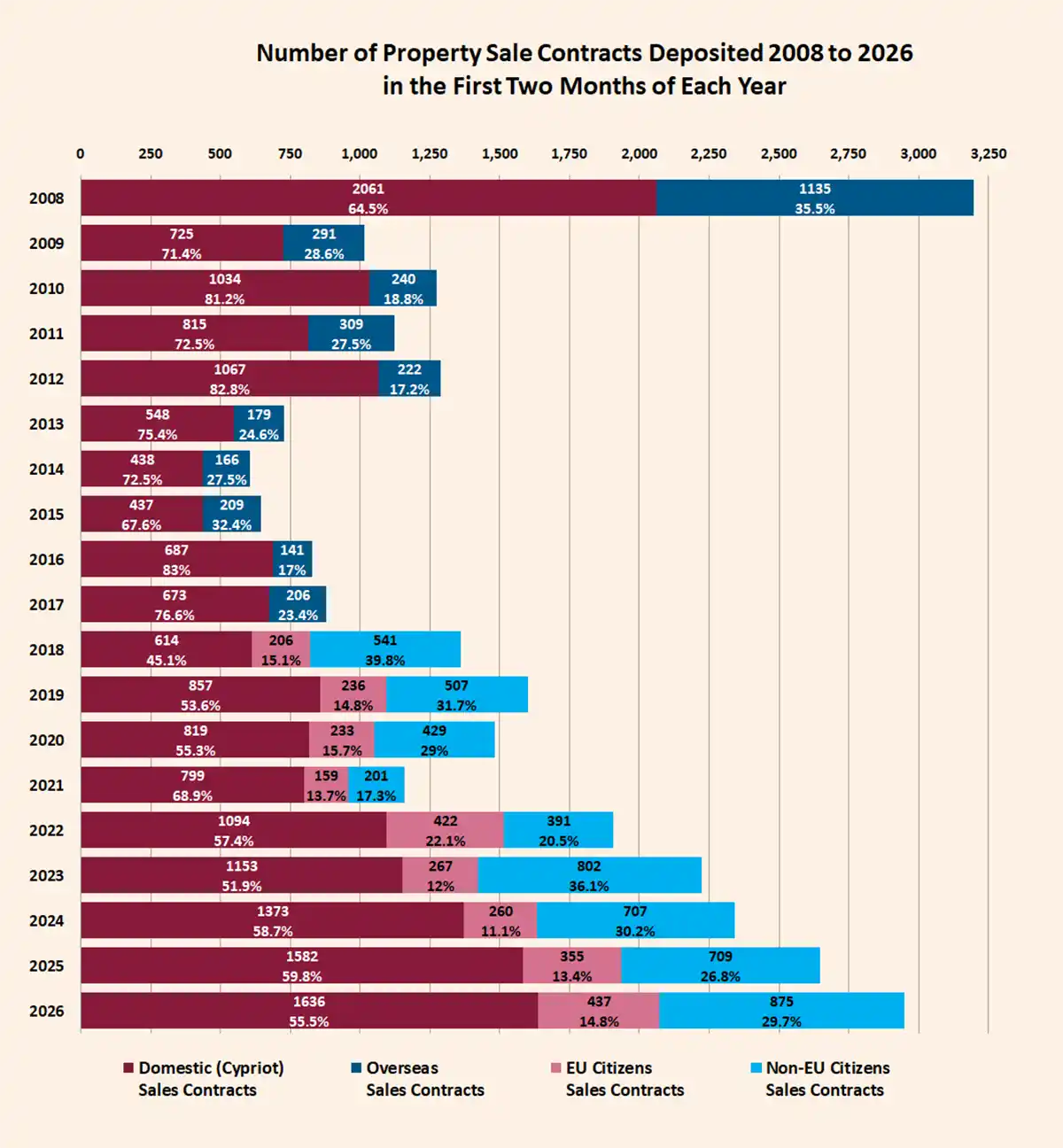
The chart below shows the year-to-date position of each market segment dating back to 2008. Note that it wasn’t until 2018 that the Department of Land & Surveys produced separate figure for EU and Non-EU buyers. Before 2018, all foreign purchases were recorded together as “Overseas Sales Contracts” combining both groups.

Jan-Feb-sales

Domestic property sales increase by 6%

Cypriot buyers deposited 866 sales contracts in February 2026, compared with 817 in February 2025, marking a 6% increase.

However, activity varied significantly across districts.

Sales declined in:

  • Paphos: 82 sales (down 20% from 103)
  • Larnaca: 178 sales (down 10% from 197)

Sales increased in:

  • Famagusta: 42 sales (up 100% from 21)
  • Limassol: 295 sales (up 26% from 235)
  • Nicosia: 269 sales (up 3% from 261)

Limassol recorded the strongest domestic growth, while Famagusta saw the sharpest percentage increase due to lower volumes last year.

Domestic contracts of sale deposited – 2025/2026 Comparison (Feb)

EU property purchases rise by 20%

EU citizens filed 231 property contracts in February, compared with 192 in February 2025, representing a 20% year-on-year increase.

Sales fell in:

  • Famagusta: 10 sales (down 55% from 22)
  • Larnaca: 42 sales (down 7% from 45)

Sales increased in:

  • Nicosia: 36 sales (up 50% from 24)
  • Limassol: 51 sales (up 46% from 35)
  • Paphos: 92 sales (up 39% from 66)

Paphos remained the most popular location for EU buyers, accounting for a significant share of the segment’s activity.

Contracts deposited by EU Nationals – 2025/2026 Comparison (Feb)

Non-EU property sales increase by 22%

Non-EU buyers also played a major role in the market’s growth.

They deposited 440 sales documents in February 2026, compared with 362 in February 2025, marking a 22% increase.

Sales fell in:

  • Nicosia: 27 sales (down 10% from 30)

Sales increased in:

  • Paphos: 145 sales (up 31% from 111)
  • Larnaca: 121 sales (up 30% from 93)
  • Famagusta: 11 sales (up 22% from 9)
  • Limassol: 136 sales (up 14% from 119)
Contracts deposited by non-EU Nationals – 2025/2026 Comparison (Jan)

Overseas buyers continue to drive demand

The figures highlight the continuing importance of overseas buyers in the Cyprus property market.

In Paphos, EU and non-EU buyers continue to dominate the market with non-EU nationals buying more than double the number of properties than Cypriots, while sales to EU nationals also outstripped sales to Cypriots.

Meanwhile in Larnaca, EU and non-EU nationals together purchased more properties than Cypriot buyers, confirming growing interest from international buyers in the region.

Overall, February’s results underline the resilience of the Cyprus property market, with strong demand from both domestic and overseas buyers supporting continued growth.

Market Segment Summary Analysis 2026 Year to Date

Property market outlook

The escalating conflict in the Middle East has cast a shadow over one of the most important global real estate gatherings, the PERE Asia Summit 2026 in Singapore, raising concerns that geopolitical uncertainty could jeopardise new investment deals.

Several senior executives warned that prolonged instability could damage investor sentiment across the property sector.

Industry leaders acknowledged that the conflict is already affecting the investment climate, although most said it is still too early to assess the long-term consequences.

Fund managers attending the conference expressed particular concern that a prolonged war could push inflation and borrowing costs higher, undermining property returns and reducing appetite for new investments. Such a scenario could also influence global interest rates, especially in the United States, which are closely monitored by international markets.

Cyprus property market Q4 2025: Apartments lead growth

The latest RICS Cyprus Property Index with KPMG in Cyprus (Q4 2025) saw mild price fluctuations across all categories of real estate in Cyprus.

While the Office sector outperformed all other categories, Apartments registered the second highest gain, demonstrating a long-term resilience. Retail remained again the weakest performer, showing negligible price movement.

A year-on-year comparison shows that Apartments are still the preferred type of investment, followed at a small distance by Houses, Offices and Warehouses. Retail showed once again the smallest increase and remains the least favourable asset.

Overall, the quarter shows mostly positive price movements across districts, with variations in both property type and location.

By district, the strongest increase is in Paphos’ Offices, followed by Larnaca’s Warehouses then Offices, while the weakest is in Paphos’ Warehouses.

Retail remains stable in most areas; the biggest gain for this asset class, albeit a modest one, is in Limassol.

As far as Apartments and Houses are concerned, Paphos recorded the strongest gain in Apartments while Limassol recorded the strongest gain in Houses.

Residential leads the property market year-on-year

Annual comparisons reinforce the dominance of the residential sector:

  • Apartments and houses posted the strongest YoY increases of 5.03% and 4.63% respectively.
  • Warehouses and Offices followed with more moderate gains of 4.11% and 4.22% respectively.
  • Retail continued its position as the weakest performer, with only a marginal annual growth of 0.62%.

This trend aligns with the long-term track, where residential property, particularly apartments, have shown the greatest resilience over time.

Holiday properties

Holiday homes remain among Cyprus’ strongest year-on-year performers:

  • Holiday Apartments led the way at 4.31%, reflecting ongoing strong demand from the tourism sector.
  • Holiday Houses posted annual increases of 2.45%, supported by consistent interest in lifestyle-driven investments.

District-level analysis shows that the biggest quarterly increases came from Larnaca’s Apartments and Paphos’ Houses, while Paphos Apartments delivered only marginal gains and Larnaca Houses remained flat.

Rental values: apartments drive growth

Rental values continue to grow, with the largest gain in Apartments, followed by solid increases in Holiday Apartments and Offices. The smallest gain was noted in Retail.

  • Apartments – 5.79%
  • Holiday Apartments – 3.39%
  • Offices – 3.13%
  • Warehouses – 2.48%
  • Houses – 2.34%
  • Holiday Houses – 2.24%
  • Retail – 0.43%

Rental yields

Yields generally edged lower over the year across most property categories. The exception was Apartments, which recorded a marginal increase, further underlining their strong market position.

  • Apartments 5.45% (+0.04%)
  • Holiday Apartments 5.66%. (-0.05%)
  • Offices 5.58% (-0.06%)
  • Houses 2.96% (-0.07%)
  • Holiday houses 2.79% (no change)
  • Retail 5.78% (-0.01%)
  • Office 5.58% (-0.06%)
  • Warehouse 4.19% (-0.07%)

Yields were little changed when looking at the final three months of 2025 as against the same period a year earlier.

Statements by KPMG and RICS

On behalf of KPMG in Cyprus, Christophoros Anayiotos, Board Member and Head of the Real Estate Industry Group, stated:

“During the fourth quarter of 2025, Cyprus’s property market recorded mostly positive movements across districts and asset categories. Paphos led the quarter with a strong increase in Office values, while Larnaca posted solid gains in Warehouses. The only noted decline was observed in Paphos Warehouses, slightly differentiating a positive trend of the category.

“Rental values rose moderately, with Apartments posting the largest annual increases, followed at a distance by Holiday Apartments. Retail remained the weakest performer, showing the smallest yearly change.

“Overall, the quarter reflects a resilient market environment, with residential and office assets maintaining momentum, while Retail continued to demonstrate limited demand.”

On behalf of RICS, Simon Rubinsohn, RICS Chief Economist, commented:

“The generally resilient economic picture is reflected in the latest property price data as well as in the sentiment feedback received through the RICS Cyprus Commercial Property Monitor. In particular, the strong trend in tourist arrivals is captured clearly in the RICS Cyprus Property Price Index with KPMG in Cyprus with holiday apartments as well homes showing solid price gains. Strong demand for good quality offices is also very evident in the latest results “.

Read the full RICS Cyprus Property Index with KPMG in Cyprus for Q4 2025

Renting in Cyprus: Tenant rights, deposits, contracts & common rental scams

0

Renting in Cyprus in 2026 remains competitive, particularly in cities such as Limassol and Larnaca. Rising demand for apartments and houses has increased rental prices, making it essential for tenants to understand their legal rights, rental contracts, deposits, and communal fees before signing a lease.

If you are renting or about to rent in Cyprus, this guide outlines the key legal protections and common pitfalls to avoid.

Rental contracts in Cyprus

A rental contract in Cyprus is legally binding once signed by both parties. Most agreements are fixed-term contracts, typically 12 months, though open-ended agreements may arise if tenants remain after expiry.

What should a Cyprus tenancy agreement include?

A properly drafted lease should clearly state:

  • Monthly rent and payment terms
  • Rental deposit amount
  • Duration of tenancy
  • Notice period for termination
  • Responsibility for repairs and maintenance
  • Allocation of communal fees
  • Terms for rent increases

Rental deposits in Cyprus

How much is the rental deposit?

The standard rental deposit in Cyprus is one or two months’ rent. Luxury properties may request more.

When can a landlord withhold a deposit?

A landlord may legally deduct from the deposit only for:

  • Unpaid rent
  • Damage beyond normal wear and tear
  • Outstanding communal charges (if contractually assigned to tenant)

Arbitrary withholding is unlawful. Tenants should document the property condition with photos at move-in and move-out.

Deposit disputes

If a dispute arises, tenants may file a claim before the District Court. Written agreements, receipts and bank transfers are critical evidence.

Tenant rights in Cyprus

Understanding tenant rights in Cyprus is essential for legal protection.

Eviction rules in Cyprus

A landlord cannot evict a tenant because he changed his mind or he has now decided to sell his property provided the tenant does not breach the rental contract.

In some older properties governed by rent control legislation (enikiostastasio, for buildings built before 2000), eviction is made even more difficult and requires specific statutory grounds.

For non-rent-controlled properties, eviction typically requires proper notice and, if contested, a court order that can take up to 5 years!!

Rent increases

Rent increases must follow the terms of the tenancy agreement. In rent-controlled properties, statutory limits apply. Otherwise, increases depend strictly on contractual provisions.

Repairs and maintenance

Generally:

  • Landlord: structural repairs, plumbing, electrical systems
  • Tenant: minor maintenance and daily upkeep

What landlords cannot legally do

Landlords in Cyprus cannot:

  • Change locks without a court order
  • Disconnect electricity or water
  • Enter the property without reasonable notice (except emergencies)
  • Harass tenants to force them to leave

Such actions may give rise to legal claims.

Communal fees in Cyprus jointly-owned buildings

Lift maintenance cyprus rental apartments

If you live in an apartment, lift maintenance may be included in communal fees even if you live on the ground floor

What are communal fees?

Communal fees in Cyprus jointly-owned buildings typically cover:

  • Cleaning of shared areas
  • Lift (elevator) maintenance
  • Electricity for common areas
  • Building insurance
  • General building repairs

Who pays communal fees?

Legally, the property owner is responsible. However, many tenancy agreements transfer this obligation to the tenant. The contract wording is decisive.

Disputes usually arise when tenants are unaware of the amount or frequency of these charges. Always clarify this before signing.

Common rental scams in Cyprus

As rental demand grows, so do scams. Common examples include:

Fake property listings

Fraudsters advertise non-existent properties and request deposits before viewings.

Deposit fraud

Avoid paying cash without receipts. Use bank transfers for traceability.

Illegal subletting

Confirm the person renting the property is the registered owner or authorised agent.

Final advice for tenants renting in Cyprus

Before signing a rental contract in Cyprus:

  • Read the agreement carefully
  • Confirm deposit return conditions in writing
  • Clarify communal fees
  • Document the property’s condition
  • Keep all payment records

Understanding your tenant rights, rental deposit rules, eviction procedures and communal fee obligations provides essential legal protection when renting in Cyprus in 2026.

CM

Cyprus property sales jump 11% in February

Property sales in Cyprus continued their solid start to 2026, with the number of sales contracts deposited at Land Registry offices across the island rising by 11 per cent in February compared with February 2025.

According to official statistics published by the Department of Lands & Surveys, total of 1,537 property sale contracts were deposited at Land Registry during the month, up from 1,371 in February 2025. This month’s total is just 44 short of the record number of February sales (1,581) recorded in 2008.

All districts recorded increases in property sales:

  • Limassol: 482 vs 389 (+24%)
  • Famagusta: 63 vs 52 (+14%)
  • Paphos:  319 vs 280 (+25%)
  • Nicosia: 332 vs 315 (+5%)
  • Larnaca: 341 vs 335 (+2%)
Total contracts of sale deposited – 2025/2026 Comparison (Feb)

Property sales year to date

In the first two months of 2026, the total number of property sales contracts deposited at Land Registry offices reached 2,948; an 11% increase compared to the 2,646 deposited in the first two months of 2025, with all districts recording gains.

Total contracts of sale deposited – 2025/2026 Year-to-Date Comparison

Property market outlook

As US President Donald Trump and Israel’s Prime Minister Benjamin Netanyahu press ahead with their pre-emptive strike on Iran, the situation remains extremely volatile. It is impossible to say with any confidence how Cyprus’ property market may be impacted.

A number of drones, reportedly launched by Iran and/or their proxy Hezbollah in Lebanon, have been directed at Cyprus. All were intercepted except one, which caused minor damage to a runway at RAF Akrotiri without resulting in any casualties.

Should the conflict escalate and spread across the Middle East, as some analysts suggest, the repercussions could be catastrophic.