Cyprus drops in Top of the Props chart

THE POPULARITY of Cyprus as a destination for overseas property investors fell to fifteen place in the May 2014 edition of the ‘Top of the Props’ published by the TheMoveChannel.com, accounting for 1.18% of on-line searches on the property portal.

In its latest chart the USA remains the most popular real estate market (a position it has held for eleven months in a row) accounting for 14.63% of all enquiries during May.

French property remained the second most popular destination, accounting for 6.54% enquiries. Brazil, which was undoubtedly influenced by World Cup fever, jumped six places to number 3, while Spain moved up one place to number 4.

Portugal slipped one place to number 5 and Thailand moved up 2 places to number 6. Turkey slipped one place to number 7, while Italy fell five places to number 8.

The United Arab Emirates moved up 3 places to take the number 9 position and the final position in the May top 10 was taken by Canada.

The full breakdown of the May 2014 edition of the Top of the Props chart is as follows:

Rank
Country
Share (%age)
Change
1 USA 14.63 No change
2 France 6.54 No change
3 Brazil 5.9 Up 6
4 Spain 5.8 Up 1
5 Portugal 5.28 Down 1
6 Thailand 4.15 Up 2
7 Turkey 3.39 Down 1
8 Italy 3.18 Down 5
9 UAE 2.61 Up 3
10 Canada 2.32 Down 3
11 Bahamas 1.61 Up 4
12 Germany 1.59 Up 4
13 Greece 1.53 No change
14 Bulgaria 1.52 Down 4
15 Cyprus 1.18 Down 4
16 Ecuador 0.85 Up 3
17 Panama 0.81 Up 15
18 Hungary 0.65 Up 2
19 Argentina 0.64 Up 2
20 Croatia 0.56 Down 2
21 Switzerland 0.51 Up 8
22 Austria 0.5 No change
23 Australia 0.46 Up 22
24 Cape Verde 0.45 Down 10
25 Barbados 0.41 Down 2
26 Cayman Islands 0.4 Down 4
27 Northern Cyprus 0.4 No change
28 Poland 0.35 Down 4
29 St Lucia 0.31 Down 2
30 India 0.22 Up 4
31 Morocco 0.15 Down 1
32 Dominican Republic 0.14 Up 6
33 Sierra Leone 0.14 Up 15
34 Philippines 0.14 Up 12
35 Jamaica 0.14 Down 10
36 Belize 0.12 Up 3
37 Malta 0.12 Down 11
38 Grenada 0.1 No change
39 Romania 0.1 Down 11
40 Pakistan 0.09 Down 7

TheMoveChannel.com is a privately-owned property portal that has been helping international estate agents, developers, investors and private owners to buy and sell homes, holiday villas, investment apartments, land and commercial property since 1999.

Its Top of the Props chart is based on the number of on-line enquiries for property in different countries around the world.
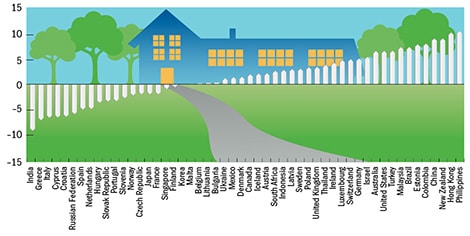
Fourth highest fall in house prices

house-prices
Sources: OECD, Global Property Guide, Haver, and IMF calculations

CYPRUS recorded the fourth highest fall in house prices during the 4th quarter of 2013, according to IMF’s Global House Price Index.

The index is based on data from the Organisation for Economic Cooperation and Development (OECD), the International Monetary Fund (IMF), Global Property Guide and Haver Analytics.

According to the report, the highest percentage fall was recorded in India with -9.1%, followed by Greece with -7.0%, Italy with -6.5%, Cyprus with -6.5% and Croatia with -6.3%.

The highest increase in house prices during the fourth quarter of 2013 were recorded in Philippines (10.6%), Hong Kong (10.3%), New Zealand (9.1%), China (9.1% ) and Colombia (8.1%).

The index shows also data for house prices historical averages in relation to incomes and rents.

House prices remain well above the historical averages in relation to incomes in Belgium (+49.5%), in Canada (+33.2%), in Australia (31.6%) in New Zealand (29, 7%) and in France (28.6%).

The cheapest houses in relation to the income recorded in Japan (-40.6%), Korea (-39.6%) and Germany ( -16.8%). .

The highest increases in house prices in relation to the total cost of renting were record in Canada (86.8%), New Zealand (80%) and Norway (66.5%). The highest decreases were recorded in Japan (-37.8 %), Estonia (-17.7%) and Greece (-16.3%).

– Cyprus News Agency

Further reading

International Monetary Fund Global Housing Watch

Distressed borrowers threaten to revolt

revoltASSOCIATIONS representing distressed borrowers have threatened to freeze all loan payments by the end of June in protest over the banks’ practice of taking defaulting borrowers to court before exhausting loan restructuring options.

According to the head of the Borrowers’ Association, Kostas Melas, banks are failing to comply with the directives issued by the Central Bank (CBC) on loan restructuring procedures. .

Following a meeting this week with House president Yiannakis Omirou, during which he briefed Omirou on borrowers’ complaints, Melas said the problems faced by borrowers remain unresolved and relate to lenders’ hostile attitude towards distressed borrowers. He named the Bank of Cyprus, Alpha Bank and the co-operatives as systematically failing to comply with the directives.

“Banks continue to engage courts and arbiters in order to secure the amounts they claim they are owed before attempting to restructure loans,” he said. “The cooperative banks have recently created a restructuring department, but what can they tell us about the cases they refer to arbitration? It is outrageous that the co-ops claim to have started restructuring loans, while referring cases to arbitration as late as June.”

Melas explained that despite a CBC directive urging banks to consider every restructuring option when handling distressed borrowers, they have tried to circumvent due process.

“Let them explain how many borrowers were referred to arbitration since the beginning of the year and why,” he insisted.

Borrowers made loans in good faith based on their income and other circumstances at the time, but the state’s negligence and the banks’ lack of accountability caused the financial meltdown that borrowers are, once again asked to repay, according to Melas.

“This has to stop,” he warned. “All the associations have agreed that unless banks’ attitudes change by the end of June, we will start taking action, and that will be painful, especially to the banks.”

Asked what measures might be taken, Melas revealed that the prevailing thought at this point is to withdraw all cooperation by borrowers, leaving the banks with no option than to take them all to court individually.

“I can assure you, borrowers will be the winners of such an exchange,” Melas said.

Acknowledging this would be far from an ideal solution, he said it was only one of the measures being considered in order to put pressure on the government and the CBC to set the banks straight. Melas argued that failure to comply with the CBC’s directives is against the law and banks could be prosecuted, while the Central Bank also has the power to impose administrative fines.

On his part, Omirou said that the views of the borrowers’ association echo those of the Cyprus Consumer Association, the Bondholders’ Association, the Association for the Protection of Primary Residences, and the Small Business Coalition.

“All these groups feel that banks are not compliant with the CBC’s directives on arrears management and loan restructurings,” Omirou said. “Banks cannot continue to act unchecked.”

Distressed borrowers

Sweeping powers for taxman

New powers for taxmanNEW government legislation grants the taxman sweeping powers, including the seizure of tax debtors’ bank accounts and assets as well as prohibiting the sale of real estate while a person is in arrears.

The bill, amending the core tax law of 1962, has been submitted to parliament, and its passage is a precondition for the release of the next bailout tranche by Cyprus’ international lenders.

Under its provisions, the director of the Inland Revenue Department (IRD) is empowered, having first secured a written consent from the Attorney-general, to request banks to freeze an amount in the holder’s account corresponding to what the person owes in taxes, including interest and late penalty fees. The frozen amount will be transferred to tax authorities.

A person has the right to appeal the action, in which case the IRD director must decide on the appeal within 15 days. Alternatively, an individual may take to the courts to have their frozen funds released.

The IRD – which by law has been merged with the VAT service – will also be able to order the confiscation of a person’s movable property, without going through the courts system, although a taxpayer may still legally challenge the seizure.

Currently the courts may, at the request of the IRD, summon before them tax debtors, investigate their financial means and possessions and order them to pay the amount in arrears. If debtors disregard the court order, the court may order the seizure and sale of their movable property, such as cars, furniture, etc.

Moreover, under the new legislation the IRD can now place a lien (legal claim) on a tax debtor’s tax debtors’ bank accounts without the prior need to secure a court order.

The action relates to tax arrears that are considered both final and recoverable, with the courts having no say on whether the amount owed to is fair or not.

Under this clause, the IRD director instructs the Department of Lands and Surveys to place a lien on a person’s immovable property as security for owed taxes that are final and recoverable. Once a property is in lien, the owner cannot alienate (sell or transfer) the property until the tax debt is settled.

The property may then be seized and sold to recover the amount due.

A person may appeal the move to have his or her property registered as lien, in which case the IRD director must within 15 days decide on the appeal.

Alternatively the affected person may apply to the court to have the lien registration lifted.

As the law now stands, prior to its amendment, only the courts may order the blocking, seizure and sale of immovable property.

It is not entirely clear whether mortgages and sales documents already filed with the land registry will be exempted.

The bill aims to strengthen powers by the tax authorities to ensure payment of outstanding tax obligations. It is set to be discussed at the House finance committee on Monday, where MPs will offer their final remarks, with the aim of bringing the bill to the plenum for a vote on Thursday.

Around €605 million in overdue taxes was owed to the state in 2012, with over half concerning unpaid income tax.

Sweeping new powers for taxman

Building permits down 10% in the first quarter

THE NUMBER of building permits authorised in March 2014 stood at 448 compared with the 428 authorised in March last year; an increase of 5%, according to figures released by the Cyprus Statistical Service.

However, compared with March 2013, the total area of these permits fell by 33% to 58,870 square metres from 87,251, while their value fell 36% to €61.2 million from €82.4 million.

During March, building permits were issued for:

  • Residential buildings – 304 permits
  • Non-residential buildings – 98 permits
  • Civil engineering projects – 15 permits
  • Division of plots of land – 23 permits
  • Road construction – 8 permits

Building permits for new home construction

The 304 residential building permits authorised in March provided for the construction of 193 dwelling units comprising 129 single houses and 64 multiple housing units (such as apartments, semis, townhouses and other residential complexes).

This is a drop of 36% compared with March 2013 when building permits were issued for the construction of 303 new homes.

Cyprus building permits March 2014

Year to date

During the first quarter of 2014, a total of 1,253 building permits were authorised; a decrease of 10.3% compared to the 1,397 permits authorised during the same period last year. The total value of these permits has fallen by 37% and their total area by 44%.

According to the Cyprus Statistical Service, building permits constitute a leading indicator of future activity in the construction sector.

China Glory deal for Venus Rock terminated

Secret Valley golf course at Venus Rock
View over hole 9 of the Secret Valley golf course

DOLPHIN Capital Investors, which owns a 49.8% stake in Aristo Developers Ltd has announced the collapse of the deal for the sale of Venus Rock to China Glory Investment Group.

The news broke yesterday in an announcement to the London Stock Exchange.

Under the agreement, which was announced last year by the former chairman of the Bank of Cyprus and founder and MD of Aristo Developers Ltd, Theodoros Aristodemou, China Glory was to buy the Venus Rock development for €240 million.

In efforts to facilitate the sale the Cyprus Government relaxed the citizenship scheme for investors in March by reducing the amount necessary for foreign investors to secure a Cypriot passport to €2.0 million for someone participating in a collective investment worth more than €12.5 million. However, this relaxation expired on 1st June 2014.

In its announcement, Dolphin said:

“On 17 May 2013, shortly after the March Cypriot economic collapse, Aristo Developers Ltd (“Aristo”, the Company’s 49.8% affiliate) entered into a binding agreement with CGIG for the sale of the Venus Rock project for a fixed consideration of €241.5 million, plus €48.5 million in conditional deferred consideration, plus interest for any payment delays (the “Venus Rock Disposal Agreement”).

“Subsequent to the signing of the Venus Rock Disposal Agreement, CGIG has not met the contractually agreed payment deadlines for the project consideration under the Venus Rock Disposal Agreement, despite extensive renegotiations with Aristo to amend certain payment terms. As a result, Aristo sent a termination notice under the Venus Rock Disposal Agreement to CGIG which became effective as of today (Wednesday).

“Aristo is contractually entitled to retain the deposit payments received to date from CGIG, totalling €5 million, in the form of liquidated damages for CGIG’s breach of the Venus Rock Disposal Agreement, and has reserved its right to pursue further legal action against CGIG.

“Aristo has already been approached by two other interested parties for the absolute or partial sale of the Venus Rock project and is now advancing the discussions with them.

“Most importantly, Aristo will now recommence the sale of Venus Rock plots and homes, a major component of Aristo sales, which have been halted for the past year due to the transaction with CGIG.”
