Cyprus: Dealing with a crisis

THE Republic of Cyprus became a member of the European Union in 2004 and joined the Eurozone, the group of countries that have the Euro as their currency, in January 2008.

During this period the economy of the country grew faster than that of other European countries; credit expanded rapidly and the banking industry became very large relative to the size of the economy.

In the video Delia Velculescu, IMF Mission Chief for Cyprus says: “If you looked at Cyprus in the period between Eurozone entry or even before, to the run-up to the crisis around 2008, what you saw was Cyprus growing at a very brisk pace of about 4% per year, which was much better than many other countries in Europe; so everything seemed well.

“However, under this seemingly good performance there were very large economic imbalances building up.”

Following the onset of the global crisis and then the European periphery crisis, growth slowed down and the Cyprus economy entered into a prolonged recession in 2012.

Ms Velculescu adds: “What happened in Cyprus at the time was a slowdown in growth, the property market turned around and prices were declining rather than increasing, banks started lending less.

“The culmination of all of this was a loss of market confidence in Cyprus itself and the Government essentially lost market access – it meant that it could not borrow any more to finance its spending and its obligations.

The nine and a half minute HD video below includes comments and expectations from ordinary citizens who have been hit by the crisis.

[youtube=https://www.youtube.com/watch?v=A8ca7sQAlzw&w=470&rel=0;&showinfo=0]

The original video may be viewed on the IMF website.

Further reading

The Economic Adjustment Programme for Cyprus Third Review – Winter 2014

Property sales record strong growth

PROPERTY sales during May recorded a strong growth compared to May 2013 according to figures published by the Department of Lands and Surveys giving hope that a recovery in the island’s property market may be underway.

During May a total of 551 contracts for the sale of commercial and residential properties and plots of land were deposited at Land Registry offices across Cyprus; an increase of 157% on the 214 contracts deposited during the same period last year.

Of those 551 contracts 72% (398) were deposited on behalf of domestic buyers, while 28% (153) were deposited in favour of overseas buyers.

Sales in all districts made significant gains

In percentage terms, Nicosia led the field with sales increasing by 388% to reach 117 compared to the 24 sold in May 2013. Sales in Famagusta went up 327% and sales in Limassol increased 157%, while sales in Paphos and Larnaca increased by 121% and 57% respectively.

Cyprus property sales - May 2014

Overall sales during the first five months of 2014 have increased 20% compared with the same period last year.

However, this increase should be treated with some caution. Much of the improvement may result from the drop in sales last year following the decisions of the Eurogroup that resulted in the closure of the banks for several days and the restrictions imposed on trade.

Domestic sales

Domestic sales in May increased by 178% compared with the same month last year, rising to 398 from 143, with sales improving significantly in all districts.

In percentage terms, Famagusta experienced the greatest improvement with domestic sales up 533% compared to May 2013. Sales in Nicosia went up 329% and sales in Paphos increased 188%, while sales in Limassol and Larnaca increased by 178% and 36% respectively.

Cyprus: Domestic property sales May 2014

During the first five months of 2014, domestic sales are up 22% compared to the first five months of 2013, having increased to 1,307 from 1,073.

Overseas property sales

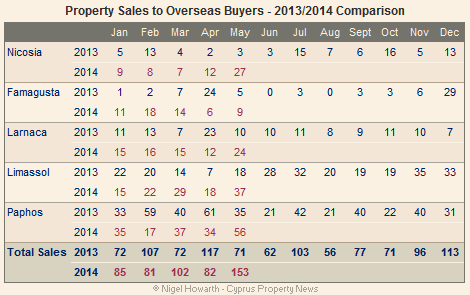
Property sales to the overseas market in May performed strongly with sales more than doubling compared to May last year rising to 153 from 71; sales were up in all districts.

In percentage terms, Nicosia led the charge with sales increasing 800% to reach 27 compared with 3 in May last year. Sales in Larnaca increased 140% to reach 24 compared with the 10 sold last year. Sales in Limassol rose 106%, while those in Famagusta and Paphos rose by 80% and 60% respectively.

Cyprus: Overseas property sales May 2014

During the first five months of 2014, sales to the overseas market are up 15% compared to the same period last year having increased to 503 from 439.

Creating and issuing Title Deeds

Title Deed Gordian KnotTHIS ARTICLE is designed to shed more light on the often-opaque process of creating and delivering title deeds in Cyprus.

The general frame of reference used is that of a property that is being subdivided in one way or another such as a developer creating a new development on one or more plots of land whereby new title deeds must be created for each newly created property.

This article tries to provide more visibility into the actual work that goes on specifically within the Land Registry to generate a new title deed. It will cover the departments and steps involved from when an application is received until it is ready to be delivered to the buyer. The intention is to provide buyers and sellers with more knowledge about the steps necessary to be completed accurately and completely in order for the title deed process to proceed as smooth and as quickly as possible. At this point in time the whole process of creating title deeds is in flux given the many pressures now on Cyprus to deliver title deeds at a much faster pace. Given that, please consider this a work in progress.

The main content for this paper comes from interviews conducted at the Paphos District Land Office and is published with permission of those involved. It is not known if all Land Registry offices follow exactly the same sequence of steps outlined here. But it seems reasonable to assume at this time that the work needing to be accomplished start to finish would be more or less the same even if the actual steps or order vary slightly.


Title Deed Creation Process – Land Registry Steps

Once construction work is declared complete the developer will apply to the local District Office for a Certificate of Completion to be issued. This involves a number of final inspections and reviews to be signed-off by different district authorities and appropriate licenses received, fees paid, etc. When this has all been accomplished successfully a Division of Properties permit and Certificate of Completion will be issued to the developer of the property involved.

The developer can then make an application to the Land Registry to start the process of creating the actual title deeds that are to be attached to the newly created properties.

Note that it is the responsibility of the developer as seller to move this process forward, not the District Office.

The main steps involved at the Land Registry are as follows:

The developer will file the Certificate of Completion at the Land Registry along with all other relevant documents and the Registry will then begin the multi-step process of creating the separate title deeds for each of the individual properties on a project.

The Application Department receives all of the appropriate documents from the developer and opens a ‘division’ file giving it an AX number (ex: AX 123/01). This AX number will be the case number that follows the file throughout the entire title deed creation process. ‘Division’ means that an existing property or plot of land will be subdivided and new title deeds created.

If the project consists of several different plots of land being combined into one, the Land Registry must first officially combine the multiple plots into one plot. Depending upon the terms of the license for division of properties this might be accomplished under the same AX number so that only one file is opened. However sometimes it will be a separate file with its own AX number. Only once combined can this newly created single plot then be divided up into the individual properties each with newly created title deeds. This likely occurs at different stages in different projects depending upon project circumstances. But it is a precondition for any subsequent subdivision of title deeds.

Survey Department: After a file is opened and AX number assigned by the Application Department, the file moves on to the Survey Department. The basic action here is for surveyors to go out to the site and complete an accurate survey of each new property which will become the basis for the official property boundaries and subsequent maps, plans, valuations, etc.. However with the recent push to shorten the overall time needed to create a title deed and also to work faster through the current backlog, there have been some changes in the procedure regarding how this work might be accomplished. If the developer or seller has their own qualified surveyor (as some larger developers do) they may now be approved to accomplish the survey themselves rather than relying on those from the Survey Department, and then deliver the results back to the Survey Department for review and approval. This in effect increases the number of resources that can be brought to bear on this critical part of the chain.

Checking the Survey Results: Once all of the survey work has been done, the Checking Department within Survey double checks all of the survey results to ensure everything is accomplished correctly.

The result of the work of the Survey Department step is that all of the new individual properties requiring title deeds are now officially defined and mapped. From here the file is passed onto the next step in the chain – The Schedule Department.

Schedule Department: Here two main things happen:

  • All of the survey and property data is entered into the computer;
  • Official plans/maps are drawn up showing the newly created properties as defined by the survey.

Local Enquiry Department: This is the step where things start to come together. First, the plans as received from the Schedule Department’s work are matched-up with the list of purchase agreements already on file with the Land Registry showing the new buyers. These purchase agreements are normally registered with the Land Registry at the time of sale where they are held until the task to actually create new title deeds comes in. This is the step where the necessary match-up occurs.

Secondly, all mortgages on the existing property are properly matched up and/or divided over the newly created properties and the necessary written agreements to allow these mortgages to be cleared or transferred are obtained from the banks, the seller/developer, and new buyer. This can be a complicated process to determine what portion (fraction) of any existing debt is to be assigned to which new properties such that all funds are fully accounted for.

Thirdly, a person from this department goes out and checks each property to ensure all licenses, certificates, survey information, etc. are all in place and everything is OK. Also, all fees due to be paid must be taken care of. The developer is notified if anything is not yet settled and is given a reasonable time in which to complete all paperwork and payments.

Note:   If the paperwork and/or payments are not received in the allotted time the Land Registry will simply put the file on the shelf, notify the developer that no further work will be done on the title deeds, and there it would sit until the developer acts. It is not the Registry’s job to put pressure on the developer to complete the process. Such pressure can only be exerted by the new buyers awaiting their title deeds, a provision for which has recently been put into law. See this article for more specific information on this. In summary, part of this new law implies that developers are not allowed to delay the title deed delivery process. Non-payment of fees or missing deadlines set by the Land Registry might possibly be considered sufficient grounds to bring a judgement against the developer through court action initiated by buyers. But this has yet to be fully tested.

When all of the required details are accomplished the new title deeds will be prepared. These are then passed on to the next step in the process.

Valuation Department: Here official values are established for each property that then becomes the basis for taxation.

Back to Local Enquiry for checking and closure: After the valuations have been assigned, all of the files are passed back to Local Enquiry for a double check that everything previously has been accomplished correctly. If so, at this stage the file is officially ‘Closed’ which means that it is OK for new title deeds to be issued. The new deeds are then finalised.

Back to Schedule Department for checking and closure: The file is then sent back to this department to officially ‘Close’ the plans/maps related to these new properties.

Store Room: After everything is closed out, the file with new title deeds is moved to the Store Room where the whole file is officially finished and the developer is notified that the title deeds are ready to be issued.

Note:   It is the seller/developer that is responsible for ensuring the title deeds are actually distributed, not the Land Registry. The seller/developer must notify the buyers when they are ready to be issued and organise the next steps necessary to complete the transfer.

The developer notifies the new buyers that the title deeds are ready and dates/times are agreed with each buyer to finalise the transfer.

Declaration Department: The developer/seller and buyer meet at the Declaration Department within the Land Registry where the buyer pays the Property Transfer Fees and the developer/vendor has to provide receipts confirming Immovable Property Tax (IPT), Capital Gains Tax, Sewage Board Tax, Town and Communal rates, etc. have been paid. The property transfer is then officially finalized. It is only at this point in time that the buyer of the property becomes the absolute legal owner of his/her property. The Land Registry will then send out the new title deeds within a few months.

Summary

As one can see there are a number of steps to the work that must be accomplished when creating and documenting an entirely new piece of property where none before existed. And since this work is the basis for all future transfers, property taxation, planning, provision of services, etc. it must be checked and double-checked to ensure accuracy.

Hopefully this will give the reader more insight into this process along with a better understanding of what work is being done at whatever step their particular purchase is at when they go to check progress at the Land Registry, as many do.

© 2014 All Rights Reserved

Land Registry defies court judgement

defy court judgementNEFARIOUS property developers are not the only ones who have a disregard of the law. We heard this morning that the Land Registry refused to act on an order for Specific Performance issued by a District court.

A British couple purchased a property in 2005 at the eastern end of the island – a resale apartment with Title Deeds. Their contract was duly stamped and lodged at the Land Registry for Specific Performance and there were no prior mortgages or any other claims lodged against; the title was ‘clean’.

At that time non-Cypriots buying property had to obtain permission from the Council of Ministers to own any property they purchased. This permission was duly granted to the couple two years later in November 2007.

However, the transfer of ownership of the apartment to the couple was never achieved due to the vendor’s inability and/or refusal to pay the Capital Gains Tax and Immovable Property Tax owed to the Inland Revenue.

Frustrated by the lack of progress, the couple instructed their lawyer to file an action at the District Court. This he did with the consent of the vendor who was named in the action as the defendant.

The court issued its judgement in early 2012 which, amongst other things, included an order for Specific Performance of the Contract of Sale. The vendor was granted a stay of execution on the judgement for a period of nine months to enable her to resolve her financial predicament and pay the Immovable Property Tax and Capital Gains Tax she owed.

After the nine month period had elapsed and armed with the court judgement, the lawyer applied to the Land Registry to implement the Specific Performance Order.

However, the Land Registry effectively refused to implement the judgement of the court. In a letter to the law firm acting on behalf of the British couple it wrote:

“I wish to inform you that the application can be accepted provided that the following documents shall be produced:

  1. Application signed by the purchasers or their agent.
  2. Form N.313 from the Income Tax Office, concerning the payment of the Capital Gains Tax.
  3. Certification from Paralimni Sewerage Board.
  4. Certification from the Municipality of Paralimni, that the immovable tax is paid.

We are at your disposal for any further clarifications you may need.”

Perhaps it would be appropriate to sue the Land Registry for contempt of court. Contempt of court is the offence of being disobedient to a court of law by defying its authority, which is often behaviour that is illegal because it does not obey or respect the rules of a law court.

What hope is there for anyone wanting the deeds to the property they purchased if the Land Registry disobeys the judgement of a court?

Revised Memorandum of Understanding full text

Memorandum of Understanding (Cyprus)CYPRUS and its international lenders have agreed an updated 42 page Memorandum of Understanding (MoU) following the troika’s fourth assessment of the island’s economic adjustment programme.

A summary of the key points relating to property are as follows:

The authorities established a Task Force to prepare a study assessing the magnitude of registered, but untitled, land sales contracts and underlying mortgages and to develop recommendations by end-June.

The legal framework in relation to foreclosures and the forced sales of mortgaged property will be amended in consultation with the EC and the IMF and informing the ECB and the ESM, and adopted by end-June, with immediate effect for all mortgaged properties except primary residences (for which provisions will enter into effect by end-December, in line with the adoption of the insolvency legislation), to allow for private auctions to be conducted by mortgage creditors, without interference from government agencies.

Immovable property tax reform

The Cypriot authorities will reform the immovable property tax with the objective to improve the fairness of the tax burden and to increase the efficiency of the tax administration.

To this end, the authorities will:

  • implement a General Valuation (GV) for all immovable properties. The new values of immovable properties shall be determined on the basis of tangible building- and plot related characteristics by Q2-2014;
  • implement the recurrent immovable property tax based on the updated valuations for the tax year 2015, at the latest. The design of the immovable property tax shall ensure progressivity and proceeds consistent with measure I.27 of Annex 1.

Necessary legislative changes should be adopted by the House of Representatives by early July 2014, following consultation with programme partners. Legislation specifying the frequency of the mandatory update of the values in line with international best practices should be enacted by Q1-2015, following consultation with programme partners.

In order to ensure a smooth and timely implementation of the new immovable property tax and to minimise the operational risks, the authorities will present to the programme partners by end-June 2014:

  • a communication strategy aiming at informing of the goals of the property tax reform, the implications for citizens and the procedures of the new reform;
  • a comprehensive objections’ management strategy to effectively and timely deal with possible valuation complaints.

The strategies need to be clear and practical, explicitly defining the required steps and resources, and the envisaged timelines.

In addition, the authorities will:

  • by Q4-2014, conduct an assessment of the relevance of the parameters used in the Computer Assisted Mass Appraisal (CAMA) model for the GV and identify possible missing parameters. Refine, if needed, the CAMA in light of this assessment by Q2- 2015;
  • conduct an assessment of the variance between GV assessed values and market price by Q4-2014; and
  • implement by Q2-2015 the recommendations of a study on the scope for consolidating the collection and administration of the municipal recurrent property tax and sewage tax. The study will also review existing exemptions and derogations from property taxation. It will also report on the scope for shifting revenues from transaction fees and taxes to recurrent taxation. The study will also provide an initial review of the tax regulations relevant for the foreclosure process, with a view to minimising the cost of foreclosure and subsequent sale of foreclosed property by Q2-2014.

Housing market and immovable property regulation

Action is required to ensure property market clearing, efficient seizure of collateral, and restoring demand. A particular risk arises from legal disputes, which may be due to incomplete documentation of ownership and property rights and the slow pace of judicial procedures.

The Cypriot authorities will:

  • define binding administrative deadlines for the issuance of title deeds upon receipt of the certificate of final approval by Q2-2014. Moreover to ensure the enforcement of the deadlines for issuance of certificates of completion by the supervisor engineers, an amending bill concerning the Street and Building Permit Law will be submitted to the House of Representatives by Q3-2014, after consultation with the programme partners;
  • prepare a joint action plan to streamline the processes within the DLS and between the DLS, the Local and District Authorities and the Ministry of Interior Technical Services by Q2-2014; This plan should detail the resources required across authorities, streamlined processes if needed, set clear deadlines for any consultations required for issuing a certificate of final approval, as well as means to enforce those deadlines;
  • ensure that the title deed issuance backlog drops to less than 2,000 cases of immovable property units with title deed issuance pending for more than one year by Q4-2014 (backlog refers to (i) applications, (ii) units that are eligible for the “ex-officio” issuance of title deeds, required certificates and permits). The ex-officio cases will automatically be counted in the backlog from the date the certificate of final approval is being issued by the respective Local or District Authority. To that end, by mid-July, provide to programme partners granular data on the stock of backlogs of permits, deeds, and certificates and a strategy identifying ways to reduce this backlog and continue publishing the quarterly progress reviews, starting in Q3-2014;
  • implement electronic access to the registries of title deeds, mortgages, sales contracts and cadastre for the monetary financial institutions and for all government services by Q4-2014; and
  • improve the pace of court case handling, in order to eliminate court backlogs by Q1-2016. To that end, provide detailed statistics on court backlogs and duration of court proceedings to programme partners on a quarterly basis starting in Q4-2014, submit a draft action plan for the elimination of court backlogs, including the electronic filing of new documents by end-October 2014, and enact legislation to establish an Administrative Court by Q4-2014.

Further reading

Memorandum of Understanding on Specific Economic Policy Conditionality (May 2014)

Banks need tools to pressurise delinquent borrowers

Cyprus Finance Minister Harris GeorgiadesTHE BANKS needs to have the necessary tools to pressure non-cooperative and viable borrowers to service their loans, Minister of Finance Harris Georgiades said on Thursday, noting however that the average borrower and house owner who faces financial problems should not be the primary target.

Cyprus received a €10 billion bailout from the EU and the IMF in March 2013 which prevented the meltdown of its financial system and covered the island’s financing needs. However the haircut of deposits over €100,000 to recapitalise the island’s largest bank, while Cyprus’ second largest lender has been wound down. One year after the bailout the main problem in the banking system is non-performing loans with the island’s lender noting that debt restructuring is a key element for the success of the adjustment programme.

Banks, as well as the international lenders say that the Cyprus insolvency framework should be reformed to assist the banks to pressure borrowers and to avert strategic defaults.

“We do indeed have to give the necessary tools to the banks to be able to move against non-cooperative or valuable borrowers,” Georgiades said, speaking in a conference organised by PWC titled “building trust, the next steps.”

He added that “it should be equally clear that an average borrower a home owner who is facing difficulties, is currently unemployed, or has seen family incomes go down should not and will not be the primary target for this enhanced capability and that will be established through insolvency framework.”

The Minister pointed out however that the problems concerning rising non-performing loans will not go away simply because we will have a new more thorough insolvency framework.

“The banks need to do their best”, he said.

Insolvency framework reform is one of the conditions included in the adjustment programme and is expected to be implemented by the year-end.

Furthermore, speaking to the conference, Demetra Kalogerou, Chairwoman of the Cyprus Securities and Exchange Commission said that lack of robust supervision impedes confidence in the markets.

“Without a robust supervision there will be no confidence,” she said, adding “we are trying to build confidence through enhanced supervision.”

Source: Cyprus News Agency