Investment opportunities in Cyprus

investment opportunitiesWhat kind of institutional investors are likely to invest in Cyprus?

The type of investors that demonstrated interest to invest in big real estate projects, in which Emergo Wealth has acted for both the buy and sell side of the investment, includes mainly foreign High Net Worth Individuals (HNWI) and institutional investors (i.e. private equity firms, financial/investment companies and hedge funds).

For commercial and mixed use real estate projects (depending on the size of the investment), the interest is primarily from foreign investors. Some local investors are seemingly willing to invest but mainly in ‘distressed assets’ with significant market value discount.

For residential real estate properties, in the Q1 2014, almost 30% of the sale and purchase agreements involved foreign buyers (mainly from Eastern Europe, Middle, Far East and the UK). There has been an increase of interest from local buyers but again such investors are always looking to invest in ‘distressed assets’.

Local sources of funding investments are limited as there has been a significant flight of private capital and the domestic institutional investors (pension and provident funds) are already over-invested in local real estate properties.

Earlier this quarter, the government has announced changes to the criteria by which the citizenship is granted to investors. The amount necessary for foreign investors to secure a Cypriot passport is reduced to €2.5 million for someone participating in a collective investment worth at least €12.5 million. This program has proven to be effective and we believe that the new criteria will be welcomed by investors from the Eastern Europe and the Far East (China).

How realistic is it to expect investments from institutional investors in the above fields?

It is realistic. In the next few months, we do expect that some more deals will be announced mainly concerning hotel/tourism real estate investments. As Emergo Wealth, we believe that Cyprus has started regaining the international investment community confidence vote, as we have seen an increase in interest from institutional investors.

We represent numerous foreign investors that have already arrived in Cyprus. Together, we review specific assets and projects, looking at opportunities to invest in anything from large-scale real estate projects (mainly in the tourism/hotel industry), to operating hotels and/or acquiring non-performing loans/assets, etc.

As previously mentioned, these sophisticated investors have seen this scenario play-out elsewhere (Spain, Ireland, Germany) and they know that in two or three years the economy will start growing again, provided that the country streamlines its public sector, strengthens its supervisory bodies, and restructures its banking industry.

What do institutional investors want to see? What will they take into consideration when making investment decisions?

Obviously, these investors are here (or want to come) to make money, some short-term and some long-term. They are interested in investments that are at a discount in terms of market value and they are also keen to acquire assets that have some form of an ‘exit’ strategy in place. The problem in Cyprus, is that due to the limited demand and liquidity (especially during the last few years), investors are particularly worried as to how they could possibly exit from specific investments, i.e. dispose assets in the near future. Today, it is very easy to get in (acquire), but tough to get out (sell).

Furthermore, foreign investors are increasingly cautious when it comes to actual asset due diligence, thus, thoroughly investigating both the underlying financial and legal aspects of a transaction (i.e. the title deeds and charges on the estate has been one of their major priorities).

We recommended that all investors take into consideration the actions outlined below:

  1. Formulate a specified strategy and define assessment criteria.
  2. Review of individual projects/assets against the predefined strategy.
  3. In-depth examination of projects that meet return and risk profile (reviewing risks and exit strategy).
  4. In-depth due diligence.

What kind of returns are the foreign institutional investors are expecting from investing in real estate projects in countries like Cyprus?

In Cyprus, investment yields is a term not frequently used. It is widely acknowledged, that yields are a useful analysis tool demonstrating the relationship between rent and property prices.

At the end of Q4 2013 (RICS, 2014), average gross yields stood at 3.8% for apartments, 1.9% for houses, 5.3% for retail, 4.5% for warehouses, and 4.3% for offices. The parallel reduction in capital values and rents is keeping investment yields relatively stable and at very low levels (compared to yields overseas). This suggests that there is still room for re-pricing of capital values to take place, especially in the commercial real estate.

What is your advice (bullet points) to project owners in Cyprus such as Real Estate Developers, Hotel Owners, and other Entrepreneurs? What do they need to do to be considered eligible and to have a reasonable chance at least to be considered by institutional investors?

  1. Rational pricing – adjust asset prices to reflect market conditions.
  2. Those who have a mortgage on their assets need to review asset pricing with their bankers to ensure the lowest pricing that the banks might be willing to accept in order to release the mortgaged assets. Companies are urged to do so before entering negotiations with institutional investors.
  3. Obtain professional advice to prepare investment presentations and highlighting project attractiveness (i.e. ROI, unique selling points that could provide the edge needed to make an asset stand out from the crowd).
  4. Evaluate the local market with comparable project characteristics and values (forget about 2012 pricing, institutional investors are not interested in purchasing assets at historic top-of-the market valuations).
  5. Coordinate the preparation of disclosures and other required documentation (i.e. title deeds, building permits for any work done, etc.).
  6. Perform roadshows to major investment destinations (again professional advice might be needed).
  7. Create bundles or portfolios of properties that can be collectively sold to investors (Government incentives are provided for such collective schemes).

Cyprus programme remains on track

IMF-buildingA STATEMENT issued by the European Commission on Saturday reports that although the Cyprus economic programme remains on track, three key challenges remain; namely: to reduce non-performing loans, to maintain sustainable public finances, and to strengthen institutions.

The full text of the statement from the Troika.

Statement by the European Commission, ECB and IMF on the Fourth Review Mission to Cyprus

Staff teams from the European Commission (EC), European Central Bank (ECB), and the International Monetary Fund (IMF) visited Nicosia 6-17 May 2014 for the fourth review of Cyprus’s economic programme, which is supported by financial assistance from the European Stability Mechanism (ESM) and the IMF. Cyprus’s programme seeks to ensure the recovery of economic activity to preserve the welfare of the population by restoring financial sector stability, strengthening public finance sustainability, and adopting structural reforms to support long-run growth.

Cyprus’s programme remains on track. Fiscal targets for the first quarter of 2014 were met with a considerable margin, reflecting better-than-projected revenue performance and prudent budget execution. Progress has been made with the recapitalisation and consolidation of the cooperative credit sector, and banks are advancing with their restructuring plans. This has allowed for a significant liberalisation of domestic payment restrictions, in line with the government’s roadmap. The authorities have also taken steps toward implementing their ambitious structural reform agenda.

While the recession this year is expected to be somewhat less severe than anticipated, the outlook remains challenging. The contraction of output for 2014 has been revised down to 4.2 percent from 4.8 percent, given the better-than-expected outturn for 2013 and other recent indicators pointing to gains in confidence.

Unemployment remains very high, and large non-performing loans are constraining the ability of banks to supply credit to the economy. As a result, the recovery is now expected to be more subdued than previously forecast, with growth projected at 0.4 percent in 2015 and gradually improving thereafter, as domestic demand is weighed down by the need to reduce very high levels of indebtedness.

The first key challenge is to effectively reduce non-performing loans. This is essential to allow for a resumption of credit to the private sector to support growth and job creation. Reforming the legal framework for foreclosure and insolvency is paramount in order to provide balanced incentives to borrowers and lenders to negotiate and reach agreement on restructuring of non-performing loans, while avoiding undue hardship. At the same time, the supervisory authorities need to intensify their monitoring of banks’ effective action to collect and restructure debt in compliance with the existing Code of Conduct and arrears management framework. The authorities are also strengthening supervision and regulation and the implementation of the Anti Money-Laundering framework.

A second challenge is to maintain public finances on a sustainable path. The authorities are making progress in this area, having consistently exceeded programme fiscal targets. Still, prudent budget execution should be maintained, given still high macroeconomic uncertainty and downside risks which may weigh on fiscal outcomes. Over the medium term, the authorities will need to steadily reduce the fiscal deficit and gradually achieve a primary fiscal surplus of 4 percent of GDP in order to put public debt on a sustained downward path.

The third challenge is to strengthen institutions. The authorities are preparing to launch the reform of the welfare system, introducing a guaranteed minimum income scheme to protect vulnerable groups during the current downturn. They are also making progress with reforming the revenue administration to increase its effectiveness and efficiency; they need as well to strengthen collection powers to resolutely address tax evasion and non-compliance. Along with efforts to improve public financial management, they will need to take steps to address the management of fiscal risks. Firm implementation of the government’s privatisation plan remains essential to increase economic efficiency, attract investment, and reduce public debt.

Continued full and timely policy implementation remains essential for the success of the programme, given still high risks.

Conclusion of this review is subject to the approval process of both the EU and the IMF. The matter is expected to be considered by the Eurogroup, the ESM Board of Directors, and the Executive Board of the IMF by early July. Their approval would pave the way for the disbursement of €600 million by the ESM, and about €86 million by the IMF.

Further reading

Statement/14/161 – Statement by the European Commission, ECB and IMF on the Fourth Review Mission to Cyprus

Non-performing loans key to economic recovery

Cyprus: Troika non-performing loansTHE TROIKA of international lenders has completed its fourth review of Cyprus economic adjustment programme and a positive outcome will result in Cyprus receiving a new tranche of aid of about €686 million by the end of June.
Although the Troika anticipates a shallower recession in 2014 than had been anticipated, future recovery of the island’s economy is likely to be more subdued due to high unemployment, lack of liquidity resulting from the high level of non-performing loans and indebtedness.

Several media reports over the past week have touched on the issue of non-performing loans. There seems to be a general recognition that some borrowers have stopped making payments and are defaulting on their debts, despite having the financial ability to service them.

As we reported on Wednesday, the Troika wants to contain these strategic defaults by bringing forward the dates agreed for implementing the legal framework dealing with the forced sales of mortgaged property and foreclosures.

At an economic conference senior bankers also called for the reform of the legal framework to be expedited to help the commercial banks put pressure on their borrowers to repay their loans.

John Hourican, CEO of the Bank of Cyprus was reported as saying “The NPLs in Cyprus are the worst in Europe by a mile, they are greater than 40%. NPLs might represent the single impediment to the recovery of not just the banking sector but the economy.”

Regarding the reform of the law on repossessions, Hourican said “we would not and could not and should not repossess collateral and flood the market with it that would cause a death spiral,” adding “it is important in order to create moral hazard.”

“We need to put that in place because that is an important part of a proper functioning arrangement between customers and their lenders,” he added.

What are the banks going to do with properties they are forced to repossess?

  • The banks need liquidity (not homes) to build up their reserves and be able to lend at a reasonable rate of interest.
  • Repossessed homes will need to be maintained to keep them in a marketable condition and that’s money the banks can ill afford to spend.
  • Flooding the market will put further downward pressure on prices – resulting in what Mr Hourican refers to as ‘a death spiral’.

Meanwhile, a source from the European Commission has said “We feel strongly that every reasonable attempt must be made to recoup that money.”

The Troika has also requested that banks directly affected by the bailout assess any connected lending practices by past or present board members or managers which may have caused “disproportionate losses”.

Property developers owe the banks over €6 billion in loans, most of which are considered to be non-performing. Commenting on the situation one prominent developer said “When the situation is not normal in Cyprus’ banking system, we cannot all demand the rest to behave normally.”

Troika seeks to contain strategic defaults

CYPRUS’ international lenders, the European Commission, the European Central Bank and the IMF, are considering expediting the timeframes with regard to foreclosure and insolvency framework in a bid to contain strategic defaults in Cyprus.

Cyprus received a €10 billion bailout from the Troika March last year which featured a haircut on deposits over €100,000. However amid the continuing contraction of the economy and the burst of the housing bubble, non-performing loans soared above €26 billion, worsening the problems facing the banking sector.

The Troika mission, which is currently conducting the fourth review of the financial adjustment programme, will submit the updated Memorandum of Understanding containing the progress so far.

The contraction of the economy in 2013 reached 5.4% of GDP outperforming the bleak projections for a downturn of 8.7%.

Sources from the Troika said Cyprus’ lenders believe that the increase in NPLs is not justified by the macroeconomic and fiscal developments on the island. The increase in the NPLs is attributed to the current deadlines for the reform to the framework covering the seizure of properties pledged as collateral and the personal and corporate insolvency believed to enable borrowers to strategically opt not to service their loans. Under the current framework a bank may need up to 20 years to seize collateral.

The current MOU provides that the insolvency legislation will be reformed by June and the new framework also covering foreclosure will be implemented by end 2014.

“We are considering a change in the time frames and front-loading the reforms, if this is possible,” a Troika source told CNA.

The reform in the whole framework will enable the banks to pressure borrowers to start servicing their loans, alleviating the acute liquidity problem currently observed in the banking sector.

Furthermore, the same source told CNA that the lenders are considering amendments in the time frames with regard to the implementation of the National Health Scheme. However he did not elaborate on the changes to the MOU provisions as this is being discussed with the Cypriot authorities.

The updated MOU will be discussed next Friday with the Finance Minister Harris Georgiades and the Central Bank Governor Chrystalla Georghadji.

Source: Cyprus News Agency

Editor’s note

For those who may be unfamiliar with the term ‘strategic default’ – it is the decision by a borrower to stop making payments (i.e. to default) on a debt, despite having the financial ability to make the payments.

Can the overseas property market recover?

AS we reported last week, the total number of contracts for the purchase of property rose 9 percent in April compared to the same period last year following a 20 percent increase in March.

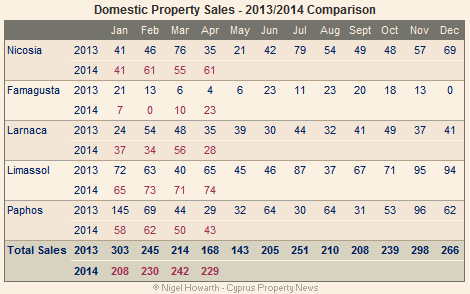
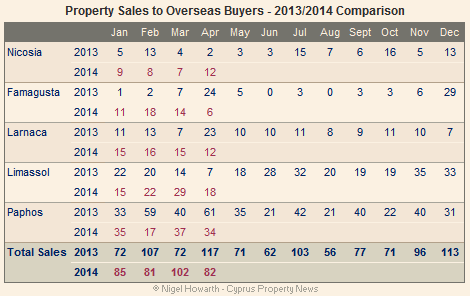
But now that the Department of Lands and Surveys has published a breakdown of those numbers, last month’s increase was exclusively a result of a 13 percent increase in domestic sales; overseas sales last month fell 30 percent.

Of the 311 contracts deposited at the Land Registries, 229 (74%) were deposited in favour of Cypriot buyers, while 82 (26%) were deposited in favour of overseas buyers.

Domestic property sales

With the exception of Larnaca, where sales fell 20% compared to April last year, sales were up in all other districts.

With the numbers being so small, percentages can be misleading. But for the statisticians amongst you:

Sales in the free areas of Famagusta rose by 475% in April following a ‘disappointing’ performance in January and February, while sales in Nicosia improved 74% over last year. Sales in Paphos and Limassol rose by 48% and 14% respectively.

domestic property sales (Cyprus)

During the first four months of 2013 a total of 909 domestic sales have been achieved, down just 2% on the 930 sold during the corresponding period last year.

Overseas property sales

In theory you would expect that the overseas market had a better chance of recovery with tax incentives and residency permits for those who qualify – plus the fact that overseas buyers with foreign bank accounts haven’t had those accounts raided.

However, although sales improved in the mainly commercial districts of Nicosia and Limassol by 500% and 157% respectively in April, sales in the tourist hot-spots once favoured by overseas buyers looking for a holiday home fell last month.

Overseas sales in the free areas of Famagusta fell 75% followed by Larnaca, where sales fell 48%. Surprisingly in Paphos, once the favourite location for Britons looking for a holiday home in the sun, sales fell 44%.

Overseas property sales (Cyprus)

During the first four months of 2013 a total of 350 overseas sales have been achieved, down 5% on the 368 sold during the corresponding period last year.

Anecdotal evidence suggests that Britons are continuing to buy. However they are being much more careful in the choice of their purchase and the lawyers they instruct to represent them; most are restricting their search to properties with ‘clean’ Title Deeds.

Developers demand lifting of bank restrictions

arrogant developersTHE CYPRUS Land and Building Developers Association has demanded the normalization of the situation in the banking financial system by lifting the restrictions in the transactions in order to facilitate the performing of the loans. At the same time, the Association has asked its members to perform their loans.

A delegation from the Land and Building Developers Association held a meeting on Monday in Nicosia with Troika representatives, during which they discussed the situation on the real estate sector.

Speaking after the meeting and called to comment on Troika’s demand on the non-performing loans, the President of the Association Pantelis Leptos stated that the situation with the banking sector should be first normalized.

“Today we still have restrictions on the export of currency and blocked deposits and if the right time will be given, all these loans will be performing”, he said.

He also pointed out that the directions of the Association towards their members is to perform their loans.

Leptos said that Troika is convinced that the real estate sector can make a big difference during the next three years.

“The next three years is the time during which we need new investments and the professionals of the sector have demonstrated in the past, that they can attract foreign investments”, he said from abroad and brought investments around 500 million euro in place. This dynamic Troika wants to build,” he said.

Leptos referred to the foreign investors who recognized the attractiveness of Cyprus and wants to invest. “There is a great interest for individual investments, as well as for big investments”, he pointed out.

Finally, he said that the prices are much higher than those referred to the stress tests, and this is a positive development.

Cyprus is currently implementing a 3-year fiscal adjustment program, following a bail-in deal, reached last year with its international lenders, known as the Troika (European Commission, ECB, IMF).

– Cyprus News Agency