Nigel Howarth meets the Troika

LAST Thursday I received an email from a member of the troika delegation asking if I could spare the time to attend “a short informal meeting…”. How could I possibly refuse!

The meeting went ahead on Sunday at a hotel in Nicosia; in attendance myself and nine delegates from the Troika; the European Commission, the European Central Bank and the International Monetary Fund.

The ‘short’ meeting continued for nearly four hours during which time we discussed many of the problems faced by those who have bought property on the island and who have yet to receive their Title Deeds.

The delegation understood the issues very well and I felt I was there as ‘the voice of the buyers’ to improve their understanding of the impact of those problems and to offer my opinion on possible ways they could either be alleviated or removed completely.

Although I cannot reveal the details of our discussion, I can perhaps outline some of the areas we considered.

The main topic, not surprisingly, was the delay in issuing Title Deeds and the many complications and problems faced by those who have been waiting to secure ownership of ‘their’ property for many years.

We spoke about possible ways that the issuance of Title Deeds could be streamlined, the problems of hidden developers’ mortgages and how these and other claims, prevented the transfer of title to the property’s rightful owner – and the banks’ practice of double-lending on the same collateral and their reluctance to chase developers who failed to repay their debts.

We also talked about development companies in receivership. Their customers are facing ‘requests’ from liquidators for contributions to help pay the developers debts or face the prospect of their losing homes even though they have paid for them in full or are maintaining their home loan repayments. (The Daily Express has published yet another horror story today.)

Other topics we covered included Immovable Property Tax, Certificates of Completion, the Town Planning Amnesty and the lack of demand for housing.

Although we could have continued our discussions throughout the night, I left convinced that the troika is truly engaged with property issues having spent nearly four hours of their evening with me discussing the many problems and possible solutions.

Decline in building permits continues

THE NUMBER of building permits authorised in February 2014 stood at 409 compared with the 483 authorised in February last year; a fall of 15%, according to figures released by the Cyprus Statistical Service.

Compared with February 2013, the total area of these permits tumbled 53% to 77,636 square metres from 164,902, while their value fell 48% to €102,907 million from €196,751 million.

During February, building permits were issued for:

  • Residential buildings – 274 permits
  • Non-residential buildings – 71 permits
  • Civil engineering projects – 27 permits
  • Division of plots of land – 32 permits
  • Road construction – 5 permits

Building permits for new home construction

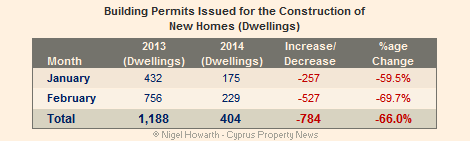
The 274 residential building permits authorised in February provided for the construction of 229 new homes comprising 125 single houses and 104 multiple housing units (such as apartments, semis, townhouses and other residential complexes).

This is a drop of 58% compared with February 2013 when building permits were issued for the construction of 756 new homes.

Cyprus building permits new homes February 2014 vs 2013

Year to date

During January and February 2014, a total of 805 building permits were authorised; a decrease of 16.9% compared to the 969 permits authorised during the same period last year. The total value of these permits has fallen by 41% and their total area by 48%.

According to the Cyprus Statistical Service, building permits constitute a leading indicator of future activity in the construction sector.

Does the Troika have the guts to push with NPLs

gutsTHE inspectors from the Troika of international lenders could not have come at a better time to get a true picture of what is really going on in Cyprus (or, who is kidding whom).

First, the House Ethics Committee report revealed that senior officials at the Bank of Cyprus, most of whom have since left, duped shareholders and customers all these years and have been rewarding each other with truckloads of loans with little or no cost and minimal security. The same report found equally ghastly abuses at Popular Laiki with millions of euros worth of loans going unaccounted for and, once again, with little or no security.

Secondly, the snail’s pace of the recovery process at Bank of Cyprus does not bode well for the bank’s efforts to reduce its non-performing loans, which have been creeping up, instead of going down. The problem there is the unwillingness of loan and mortgage holders to pay back their dues and in a regular manner, something which has drained the bank’s new lending capability, ultimately strangling SMEs many of whom are resorting to closure. In other words, there is no hope of any growth in any sector, as long as large borrowers continue to laugh in the face of the government, the banks and the Troika.

Can the international lenders do anything? Well, with all parties now having digested the fact that the Eurogroup experiment last year was a total failure, it’s time to make amends by tweaking and pushing the adjustment programme to force the government and the banks to cash in on the naughty borrowers. Or else…

Talk of ‘large scale development’ is nothing more than a smokescreen by a handful of entrepreneurs who insist on proving their manliness by refusing to repay their loans, many of which are long overdue. It’s not that they can’t – they just won’t.

So, if these fat cats refuse to cooperate, then the Troika should punish the government, that is in denial and refuses to deal with the problem, despite statements that there is no intervention of any kind at any level. No progress on NPLs, no clean bill of health, they should say.

What this past year has proven, yet again, is that a handful of entrepreneurs, their smart lawyers and their creative accountants, continue to call the shots and politicians are only too keen to bend over backwards (or any other way) to satisfy these crooks, perhaps because of their own crookedness, or downright stupidity.

Troika non-performing loans

Troika hears construction sector concerns

DELEGATES from the troika’s Cyprus mission resumed their meetings with various government officials and other stakeholders on Wednesday, day two of the representation’s fourth review of Cyprus’ adjustment programme.

Wednesday’s schedule included a 2 pm meeting with the Federation of Building Contractors (OSEOK), who laid out the critical challenges faced by the construction sector. A key driver of economic growth over the previous decade, the construction industry suffered a serious hit over the last five years, with a reported contraction of 40 per cent in the last year. Sector leaders have variously made dramatic calls to the government, asking it to take measures in support of the struggling industry.

After the meeting, OSEOK chairman Kostas Roushias said that the construction industry employs 28,000, down from over 40,000 in previous years.

He expressed the need for growth incentives in the construction sector and the absorption of European funds.

“There can be no growth without incentives, like a temporary reduction in the VAT rate to 5 per cent for transactions relating to construction projects and the reduction of capital gains taxation,” he said.

Roushias also reported that one in five businesses in the construction industry had suspended its operations, and reiterated his view on the need for the creation of the post of Deputy Minister for Economic Growth.

Later on Wednesday, the troika delegates saw the management of the Bank of Cyprus. The 3 pm session revolved around the burning issue of non-performing loans (NPLs), which threatens the bank’s prospects and has garnered talk of creating a ‘bad’ bank which would buy up the lender’s toxic assets at a discount, thus taking some of the pressure off the BoC’s balance sheet. The move, however, has stalled in search of the necessary funds to purchase the assets.

The issue of NPLs dominated the troika delegation’s meeting with bank employees’ union ETYK, with the union defending its members’ sacrifices and focusing on the need for employers to repay their loans so that banks can return to health.

Speaking after the meeting, ETYK’s vice president Christos Charalambous said the troika had been briefed on the 40 per cent cuts on banks’ payrolls, bonus payments and the need to repay NPLs.

Charalambous said that the union had asked the banks to impose a three-year moratorium on bonuses but was snubbed on the grounds of this being an exclusive management decision. He argued that salary slashes reached 50 per cent at the Bank of Cyprus and roughly 45 per cent in other banks, “the sacrifices that needed to be made by bank employees have been made, and now management is expected to act decisively in collecting non-performing loans.”

Charalambous also attacked employers’ association OEV and said that employers need to start repaying their loans in order to help the banks return to normalcy.

“At last, OEV must pressure its members into paying their NPLs, instead of pressuring ordinary citizens into repaying their loans,” he said. “The largest amounts are owed by OEV members, and that is why the effort should focus on OEV.”

The delegation started its review on Tuesday with a focus on economic issues – NPLs topping the list as the hottest item on the agenda – as well as health issues, where implementation of the long-delayed National Health Scheme (NHS) has become an imperative for the troika. Monday’s kick-off review meeting with Health Minister Philippos Patsalis was rumoured to have produced moderate results as the Ministry’s roadmap to implementation of the NHS – submitted last Friday – left the troika unconvinced as the level of detail on some key points was deemed weak. As confirmed by official stakeholders, additional meetings with the Health Ministry have been scheduled for further deliberations on the issue.

On Thursday, a troika delegation will meet with Labour Minister Zeta Emilianidou regarding the issue of the Minimum Guaranteed Income policy, the introduction of which is part of Cyprus’ adjustment programme obligations.

According to Emilianidou, Thursday’s meeting has been scheduled for 2pm.

This week’s troika meetings focus on the technocratic level, while next week will see political consultations and negotiations in order to finalise the revised Memorandum of Understanding.

construction sector woes

Property sales up for second consecutive month

FIGURES released by the Department of Lands and Surveys yesterday report that the number of contracts for the purchase of property deposited at Land Registry offices across Cyprus during April stood at 311 compared to the 285 deposited in April 2013; an increase of 9 percent.

This is the second successive month that the number of property sales has risen, following an increase of 20 percent in March.

But it is likely that the improvement over last year’s figures is due to the drop in sales last year following the decisions of the Eurogroup that resulted in the closure of the banks for several days and the imposition of restrictions on trade.

During April, the main commercial centres of Nicosia and Limassol fared best with the number of sales rising by 97% and 28% respectively, while sales in Famagusta rose by 4%.

However, these increases were almost offset by a fall in sales of 31% in Larnaca and a 14% fall in Paphos.

Cyprus property sales – April 2014

Overall sales during the first four months 2014 are down 3% compared with the same period last year. However, it looks as if the property market may be improving from last year’s record low.

Armou family defy house ban order

DESPITE AN ORDER banning them from their home which has been condemned as unsafe, a defiant Paphos family of four is still living at a stricken development in Armou. They say they have no alternative and are looking to the state for compensation.

The plight of Simon Phillips and his family and other buyers was first highlighted in the Sunday Mail almost two and a half years ago. The luxury development built in 2004 is slipping down the hillside, having been constructed on land locals had long warned was unsafe.

The Phillips’ family are now the only permanent inhabitants and continue to defy an order banning them from their home, saying they have no alternative but to stay put.

“This is our home and it is bought and paid for. I have been told that I don’t qualify for state aid and even with reduced rents, we wouldn’t be able to afford to live anywhere else,” Phillips said:

“After all, we have a four bedroom house which was supposed to be a home for my family. All of our money has gone into this house.”

Four of the homeowners at the development are British and have described how their dreams of owning a home in Cyprus turned sour more than two years ago. A spate of bad weather on top of a persistent water leak caused substantial earth movement which badly damaged the houses in the development. Many houses looked as if they had been hit by an earthquake.

Phillips and his family are now the only permanent residents and say daily life is a massive strain, especially for the children.

“My 14-year-old daughter is afraid to be on her own in the house and the situation is obviously affecting her badly. We can’t have friends over – neither our kids’ friends nor ours – as it’s not safe and it’s embarrassing the way we have been forced to live.”

Built by JNM developers a decade ago, all of the houses have serious structural problems, from slanting floors, to the partial collapse of stairs, walls, swimming pools and patio areas. Huge gaping holes surround Phillip’s house and outside drains are exposed in one garden and retaining walls have split.

JNM has never responded to any requests for a comment on the Armou homes, despite repeated telephone calls and emails since the Mail first reported on the case two and a half years ago.

Phillips bought his house in June 2008. Just four years later, his garden, pool area and exterior retaining walls were covered by gaping holes and wide cracks.

A report by the chairman of Paphos’ Architects and Civil Engineers Association, Chrysostomos Italos was completed in June 2012. Italos places the blame firmly on the developer.

A number of the homeowners, including Phillips, have issued court proceedings against the developer.

Armou ban order
