Mortgage-to-rent scheme will be selective

THE mortgage-to-rent, under consideration as a means of protecting primary residences, will be effectively financed by the state budget and will only apply to specific cases, Finance Minister Harris Georgiades said yesterday.

It will allow the owners to continue to live in the house by paying lower rent instead of a prohibitively high instalment, the minister said in an interview with the Cyprus News Agency.

“In some cases there will not be a scheme with taxpayer money that will support cases that do not fulfil the strict social and income criteria that will be set,” Georgiades said.

Georgiades said the return to growth amid the ongoing credit crunch was linked to restoring the banks’ capability to lend. That in turn was connected with the issue of the crippling non-performing loans (NPLs), which had to be dealt with.

“This handling and management cannot be general, generalised, and sweeping,” he said. “It should maintain different handling for different cases.”

NPLs have reached 50 per cent of total loans – at €22bn, or 135 per cent of GDP.

The International Monetary Fund urged Cypriot legislators to put in place a “strong legal framework to facilitate foreclosures.”

Georgiades said non-viable loans and uncooperative borrowers could be dealt with by an asset management company, like in other countries with the same problem.

“It should be in the banks’ options,” the minister said.

He said this was not a matter that must be decided at a political level.

“It is mainly, and it should be, a decision based on the banks’ operational plans and not something that will be decided by political decisions, political interventions, or much worse, third party interventions, possibly by those affected trying to secure their interest on the back of the public interest,” Georgiades said.

The minister acknowledged that banks’ capability to collect debt had been limited and that laws should be enacted to bolster their potential.

Procedures against uncooperative borrowers could have taken 15-20 years, the minister said.

“This was certainly a serious drawback, which must be corrected,” he said.

Editor’s notes

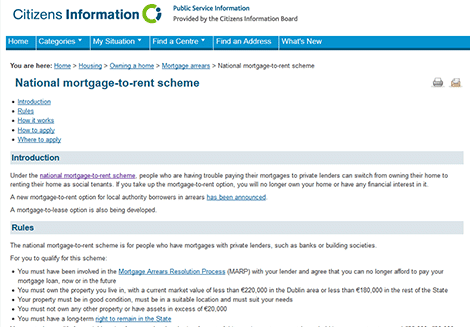
The Cyprus Land Development Corporation (CLDC) has been instructed by the government to study the Irish mortgage-to-rent scheme. To qualify for the mortgage-to-rent scheme in that country, the applicant’s mortgage, property and household must meet the following strict criteria:

Mortgage

a. You must be unable to make the repayments on your Mortgage Loan and your lender must have decided that this situation is unlikely to change in the future.

b. You must be engaging with your lender to try to find a solution to your situation.

c. You must be in or have completed the Mortgage Arrears Resolution Process (MARP) with your lender.

Property

d. Your property must be in negative equity.

e. You must not own any other property.

f. You must be living in a property that suits your needs i.e. not be over or under-accommodated, in accordance with Local Authority guidelines.

g. You must be living in a property of a value no more than €220,000 in the Greater Dublin area and €180,000 in the rest of the country.

Household

h. You must be eligible for Social Housing Support in the local authority in whose area your house is located.

i. Your net household income must not exceed €25,000*, €30,000* or €35,000* a year, depending on what part of the country you live in (net household income is the household income after taxes and social insurance (PRSI) have been taken off). (*Additional allowances for children).

j. You cannot have capital assets worth in excess of €20,000.

k. You must have a long-term right to remain in Ireland.

Further reading: A Guide to the Mortgage to Rent Scheme (Ireland)

Second largest price fall in EU

price fallsRESIDENTIAL property prices in Cyprus fell by 9.4% in the fourth quarter of 2013 compared to the corresponding period of 2012 according to a report published by Eurostat yesterday.

The report shows that the fall in prices accelerated as the end of the year approached, having fallen by 8% in the third quarter. (Eurostat employs a different methodology to assess price movements to that used by the Cyprus Central Bank).

On an annual basis, prices across the European Union fell by an average of 0.1%, while in the Eurozone they fell by an average of 1.4%.

The largest annual house prices falls in the European Union on an annual basis were recorded in Croatia (-14.4%), Cyprus (-9.4%) and Italy (-4.8%), while the highest increases were to be found in Estonia (+15.6%), Latvia (+7.9%) and Sweden (+7.0%).

For countries in the Eurozone, the largest annual price falls were reported in Cyprus (-9.4%), Italy (-4.8) and the Netherlands (-4.5%), while the highest increases were to be found in Estonia (+15.6%), Ireland (+6.3%) and Luxemburg (4.8%).

Further reading

Eurostat newsrelease 55/2014 – 10 April 2014

Getting your Title Deed issued

Title Deed Gordian KnotINTRODUCED in 2011, changes to the law enable those who have bought property and have deposited their sale contract at the Land Registry are able to request the Land Registry to issue its Title Deed.

Here is an extract from the Department of Lands and Surveys Citizens Charter, which gives an overview of the process of updating title:

Updating of Title Deed

Updating of title, means the registration of immovable property, resulting from replacement of existing registration or registrations with a new registration or registrations, due to the alteration of the immovable property (such as erecting or demolishing buildings or if a borehole has been drilled) and it includes the registration of jointly owned buildings and jointly owned building units.

According to the amendments of the law, in 2011, updating of title may be carried out upon an application of the registered owner(s), either compulsorily by the Director, who may act voluntarily or upon an application of the Competent Authority, or upon an application by a person having an interest in the property, including a mortgagor or purchaser who has deposited the sale contract, pursuant to the Sale of Immovable Property (Specific Performance) Law 81(I) of 2011.

Where the applicant is the registered owner, the application is filed by the registered owner or his attorney at any District Lands Office, regardless of the district where the immovable property is situated. Such application must include the reason for requesting an updating of the title (e.g. to be based on the plans made to scale, for registering or striking off a building from the land register, etc) and the following documents must be attached thereto:

  • certificate of registration (title) of the property,
  • building permit with all plans and terms attached thereto,
  • certificate of approval of building,
  • permit for partition,
  • permit for the well and plan attached thereto, and
  • demolition permit etc.

All prescribed fees must be paid upon filing of the application (refer to the Fees and Charges leaflet).

The consideration of the above application presupposes the carrying out of a local enquiry in the applicant’s presence and often in the presence of the President of the Community Council or Mukhtar or any representative thereof. The time for consideration of the application varies depending on the particularity of each case, the accumulated volume of work and available personnel.

Where the Director proceeds to a compulsory updating of title, then the registered owner or owners are called, within 60 days from the date of posting the notice, to either submit the required documents to the appropriate Lands Office for the required updating of the title, or to give sufficient reasons for not updating thereof.

If the owner complies with the Director’s notice, the updating process continues with the owner being the applicant. Where the owner, fails to comply with the Director’s notice, or the reasons for not updating is not deemed as sufficiently justified, then the Director proceeds with the compulsory updating and at the same time he may impose on the owner an administrative fine up to €10,000. During the examination of the compulsory updating, the Director may request the owner, or any person having an interest in the property or from any competent authority, to produce any documents, plans or other data deemed necessary for the examination of the case.

A significant amendment with respect to the issuing of an updated title is the possibility to issue title deeds with notes in relation to building irregularities, and titles with notes prohibiting voluntary transfers, but this does not in any way legitimise the irregularities or unauthorised works.

It is noted that, in the case of partition of jointly owned buildings, a separate title may be issued for remaining, non-utilised development rights (unlimited building coverage ratio).

In all cases of title updating, the new titles are issued in the name/names of the owner/owners of the initial registration, in accordance to the distribution accepted and agreed by all.

Editor’s comments

Before you get wildly ecstatic about a change in the law enabling purchasers to request Title Deeds to be issued, please note:

  • Although a Title Deed may be issued, it could still be encumbered by a developer’s mortgage and/or other charges making the transfer of a property to its rightful owner impossible.
  • Even though the Title may not be encumbered by a developer’s mortgage or other claims, the developer may not have paid Immovable Property Tax and/or Capital Gains Tax, which would again prevent the transfer of a property to its rightful owner.
  • The ‘interested party’ (i.e. the purchaser) will have to produce any documents, plans or other data deemed necessary for the examination of the case. If the developer refuses to supply the information, what happens then?

I’m wondering just how many people will actually be able to take advantage of this change in the law?

Surely it would have been simpler just to instruct the Director to proceed with a compulsory updating of title in cases where a Certificate of Final Approval had been issued – or am I missing something?

State should buy non-performing loans say experts

buy NPLsTHE STATE should buy non-performing loans (NPLs) from banks and implement a mortgage-to-rent scheme, a senior government advisor said on Tuesday, as a way to protect primary residences and small business premises.
The matter was discussed during a meeting of the national council on the economy with President Nicos Anastasiades, which also looked into setting up a bad bank.

“What the president also agreed to is that we should not reject something before we know exactly what the consequences would be,” Christoforos Pissarides said, adding that studies were underway into the matter.

On protecting primary residences, Pissarides said they discussed a suggestion for the state to buy non-performing loans with the borrower remaining in the property and paying rent to the state, which will be the owner.

Pissarides said this solution could be used for specific sections of the population who cannot service their loans, like the unemployed.

“What we are trying to do is find a way to protect the primary residence without bringing more trouble on the banking system”, he said. “It is something difficult.”

Pissarides suggested that international lenders could contribute if the state could not afford such an endeavour.

He also suggested that non-performing loans could be bought by investment funds as long as people got to keep their homes.

“I do not see any risks provided there is assurance that the owner would not be thrown out of the house,” he said.

Pissarides warned that if banks were unable to use a house as collateral for a loan it would be a step backwards.

“We know very well that for the Cypriot economy to recover it needs healthy banks that can start lending to private individuals and businesses.”

Ruling DISY has managed to get an opposition bill protecting primary residences shelved for the time being.

NPLs – a key challenge

An International Monetary Fund report published last week argued in favour of facilitating asset seizures by banks as an effective remedy for spiralling NPLs.

The report diagnosed the issue of NPLs as a “key challenge” to the economy, reporting that they have reached 50 per cent of total loans – at €22 billion, or 135 per cent of GDP.

The IMF also called on legislators to put in place a “strong legal framework to facilitate foreclosures.”

Deputy government spokesman Victoras Papadopoulos said a sense of panic had been created that was not justified.

“No main residence foreclosure is expected to take place in the near future, no property recovery has taken place so far,” Papadopoulos said.

Papadopoulos said the government was preparing a series of bills to regulate the primary residence issue.

The bills concern the financial commissioner, rent for mortgage, and solvency of individuals and companies, an “exceptionally anachronistic” law.

Details will be announced in a few weeks, Papadopoulos said.

Mortgage-to-rent scheme study

mortgage-to-rent (Ireland)THE Cyprus Land Development Corporation (CLDC) has been instructed by the government to study the Irish mortgage-to-rent scheme, the House Finance committee was told on Tuesday.

The committee convened to discuss the budgets of semi-government organisations, including the Cyprus Broadcasting Corporation (CyBC), the Cyprus Theatre Organisation (THOC) and the State Fairs Authority.

DIKO MP and acting committee chairman Angelos Votsis explained the extraordinary session was called to discuss budgets submitted to the House late.

With regard to the CLDC’s budget, Votsis pointed out that out of 240 available properties (flats or houses) all but 70 had been sold, and stressed the fact that defaulting debtors who bought CLDC properties add up to only six to seven per cent of a total of 1,700 properties sold.

“The corporation is trying to find solutions for debtors who are facing problems with their loan repayments,” he said. “It seems that the issue is heading in the right direction.”

According to Votsis, the CLDC has been instructed by the government to study the Irish model and prepare recommendations on the ‘mortgage-to-rent’ scheme, as discussed in the President’s meeting with the National Council for the Economy on Tuesday.

At the same time, he said, the potential for transforming this semi-governmental organisation into an organisation that would manage state property was being examined.

Asked to clarify whether the CLDC’s transformation was in any way connected to the President’s strategy to prevent foreclosures, Votsis said that in the Finance committee’s view an effort is being made to avert repossessions through studying various options.

With regard to the CyBC’s budget, the committee’s acting chairman noted brutal budget slashes and a significant reduction in the level of state aid to the broadcaster.

He added that the CyBC’s budget fell to €30 million – from €50 million in 2009.

“From what the committee was told during the session, it is worth noting that while there appears to be no intention to reduce personnel – though this cannot be said for certain – the effort is for the CyBC to the perform the role that the law has entrusted it with,” he said.

Votsis expressed the hope that the broadcaster’s new board can strike a balance through which it can perform the duties of public broadcasting in the best and most cost-effective way.

Meanwhile, Votsis said the Privatisations Unit will be managing the State Fairs Authority’s assets as it is being wound down.

Curing the non-performing loans disease

non-performing loansCOUNTRIES under economic adjustment programmes have adopted various methods to tackle the problem of non-performing loans, giving over-indebted households and businesses the chance to pay down debt.

For example the Bank of Greece has announced a series of measures, which include: lower instalment payments, lower interest, considerable grace periods, temporary deferment of instalments, extending the loan repayment period for households and businesses, or allowing home-owners to turn tenants in their primary residence.

The main methods employed by the Bank of Greece to restructure loans are:

  • Short-term solutions (five years or less): Payment of interest only, or lower interest payments during a short-term period; grace periods; deferment of instalments; repayment of the balance that is in arrears; and debt rescheduling.
  • Long-term solutions: These are adjustments with a duration of over five years, and include a permanent reduction in the interest or on the contractual margin rate; switching the type of interest (e.g. from variable to fixed); and extending the loan repayment period.
  • Splitting a loan in two: The first portion of the loan is tied to physical collateral, where the borrower pays in instalments. For the second portion, or the balance on the loan (the unsecured amount), no interest is charged for a period agreed with the bank. On the latter, borrowers are subject to re-evaluation should their finances improve, otherwise they are required to take out a mortgage on another immovable property, that is to say, to put up other assets as collateral.
  • Operational restructuring: Concerns business loans for which a businessman is required to curtail spending and implement cost-cutting measures. Also debt/equity swaps.
  • Definitive restructuring: This involves drastic actions aimed at definitively tackling debt. Debtors voluntarily sign over to the bank their mortgaged property as part of a broader adjustment. Conversion into a leasing contract, whereby borrowers transfer ownership of immovable property to the bank and sign a leasing contract for a minimum duration (usually five years).

In Ireland, authorities have drawn up a list specifying the ‘reasonable living cost’ for households (families with children, couples etc.) This list outlines monthly expenses for food, housing, healthcare, education and so on. An average reasonable cost of living has been calculated, which lenders and borrowers refer to for debt settlement. The list cannot be questioned as it is based on data furnished by the country’s statistical agency.

In addition, Irish authorities have devised the concept of “cooperative borrowers” (i.e. borrowers who do not conceal information – such as income, assets etc. – from banks). By defining what a cooperative borrower is, a bank can no longer arbitrarily deem a borrower as being non-cooperative and therefore refuse to restructure his or her debt. Thus banks are obliged to examine each case separately, provided certain basic conditions are met. Moreover lenders may write off large chunks of debt once they find that a loan cannot be serviced due to the lack of income (or any prospect for income) on the part of the debtor.

In Spain, a house may be transferred to the bank, and the debtor may continue to reside in the house as a tenant for as long as it takes him/her to repay the debt. During the leasing period in question, ownership of the immovable property passes to the bank, and the borrower-tenant can repossess the house upon repayment of the loan at the period end. This is known as a leaseback.

The banks and the government have agreed a code of conduct, which all lenders have adopted. Eligible for these adjustments are persons whose income places them below the so-called ‘social exclusion’ line.

Spanish banks likewise grant grace periods, loan repayment extensions, etc. In addition, where the value of a property is currently lower than that at which it was purchased, the difference is split among the bank and the borrower. In the most extreme cases, a bank will take possession of a house but allow the borrower to keep residing there for two years as a tenant.

These are the sort of sensible solutions to which we here in Cyprus should look to if we really want to escape the vicious cycle of depression.

George Mountis BSc, MSc, Ph.D
Director, Business Development
Emergo Wealth
2, Demetrakopoulou str., 1090 Nicosia Cyprus
P.O. Box 25193, 1307 Nicosia, Cyprus
Tel.: +357 22 449122, Cell: +357 99 494142
Fax: +357 22 780589