Cyprus home construction nose-dives

THE NUMBER of building permits issued in January 2014 stood at 396 compared with the 486 issued in January last year; a fall of 19%, according to figures released earlier this week by the Cyprus Statistical Service.

Compared with January 2013, the total area of these permits declined 40% to 65,564 square metres from 109,957, while their value fell 28% to €78,586 million from €108,615 million.

During January, building permits were issued for:

  • Residential buildings – 256 permits
  • Non-residential buildings – 79 permits
  • Civil engineering projects – 20 permits
  • Division of plots of land – 38 permits
  • Road construction – 3 permits

New home construction

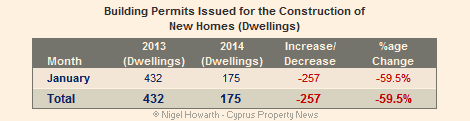
The 256 residential building permits approved in January provided for the construction of 175 new homes comprising 101 single houses and 74 multiple housing units (such as apartments, semis, townhouses and other residential complexes).

This is a dramatic fall of 60% compared with January 2013 when building permits were issued for the construction of 432 new homes.

Cyprus new home construction January 2014 vs 2013

According to the Cyprus Statistical Service, building permits constitute a leading indicator of future activity in the construction sector.

Shepherd jailed for building hut

CorruptionHOUSE Watchdog committee president Demetris Syllouris, speaking on a radio show yesterday morning expressed outrage about the news that a ‘poor’ shepherd had been sentenced to prison for illegally building a small hut on land belonging to the Forestry Department.

His outrage stemmed from the fact that the authorities were coming down hard on minor offenders while the people responsible for bankrupting the two biggest banks and sinking the economy were still roaming free.

Syllouris’ comment could have been interpreted as a call on the authorities not to enforce the law, but that would be missing the point. By highlighting the plight of the shepherd, he was touching a much broader issue – that there is no equality before the law which is enforced only in the case of the little people.

A wealthy businessman could violate a building permit by adding an extra floor to a building but would not end up in prison; neither would a well-connected individual be jailed for building a house on a bigger area of land than a permit stipulated.

But when a shepherd builds a small shack on state land the long arm of the law immediately grabs him. There could be another aspect to this case that we are not aware of. Perhaps the shepherd had been served with a court order to pull down the shack and ignored it, in which case the judge would have no choice but to impose a custodial sentence. But this still does not eliminate the perception that the law might not be applied in the same way for everyone.

It would be wrong to blame the judges for this perception, because it is the state legal services that might not pursue all cases with the same zeal. As Syllouris pointed out yesterday, not a single person had yet been charged for the collapse of the banks. Admittedly, these are complicated cases that require thorough investigations and going through hundreds of documents. The delays could be attributed to lack of expertise or know-how in the police and the Attorney-General’s office, in which case help should have been sought from abroad.

More than a month ago, the Attorney-General announced that the cases would have been prepared within a few weeks, but we are still waiting. Nobody knows the causes of the delays, but it would be a great embarrassment for the Attorney-General if, after all this build-up of expectations, there were no prosecutions. This would strengthen the suspicion that in Cyprus only the small-time crooks are brought to justice.

Non-performing loans continue to mount

non-performing loansACCORDING to the latest data from the Central Bank of Cyprus, non-performing loans at the end of January rose to €26.5 billion.

The Central Bank reports that non-performing loans with the commercial banks have reached 40.85% and the co-ops 47.47% of their total loan portfolios, while four of ten loans granted for home purchases are not being serviced.

At the end of January 2013, €14.7 billion of the €31.55 billion loans granted to companies were non-performing.

Property developers have amassed billions of debts that they are unable to pay. In construction 66.15% (€4.7 billion) of all loans granted are not being serviced, while elsewhere in the real estate sector 47.16% of loans are non-performing.

Meanwhile the Bank of Cyprus is reviewing its restructuring plans in a move that could result in billions of euros of its troubled assets being put into a “bad bank” and the Cyprus Government is grappling with legislation to prevent the seizure of “primary residences”.

Bank of Cyprus reviews restructuring plans

Bank-of-Cyprus-HQBAILED-OUT Bank of Cyprus BOC.CY is reviewing its restructuring plans in a move that could result in billions of euros of its troubled assets being put into a “bad bank”, chief executive John Hourican said.

Hourican took the top job at Cyprus’ largest bank in October after it was rescued during an international bail-out of the island, which had run into financial problems partly because of the exposure to debt-laden Greece.

At that time, a plan to put the bank’s 22 billion euros ($30.32 billion) of good and bad loans into one legal entity was just being finalized. This plan also envisaged the bank remaining reliant on some emergency funding from the Central Bank of Cyprus until 2017.

But Hourican, former investment banking head at Royal Bank of Scotland (RBS.L), wants to look again at all the options.

“We have appointed HSBC to help us look at our overall corporate finance agenda including the entire structure of how the group is organized,” Hourican told Reuters in an interview.

“What I’d like is to re-open the entire option list for the bank – do we continue with the plan we currently have? Is there a possibility of a more formal good bank/bad bank? Is there another set of options we could approach in terms of accelerating our restructuring plan?”

The creation of a bad bank would free Bank of Cyprus from its problem loans and make it easier to forge a “normal” bank better able to fund itself and support the country’s economy. The bad bank was considered as an option in the terms of Cyprus’ 10 billion euro bailout from the European Union and International Monetary Fund.

Bad banks have been used successfully to cleanse banking systems in Ireland and Spain, and one is being created in Slovenia.

The HSBC (HSBA.L) team is being lead by its head of European financial institutions group Tim Sykes, a former senior official at the UKFI which managed the UK’s banking stakes including its 82 percent share in Hourican’s former employer RBS. The HSBC review will take several weeks. HSBC confirmed its involvement but declined to comment further.

Rescued

Bank of Cyprus is now the country’s biggest bank after it merged last year with collapsed rival Cyprus Popular Bank CPBR.CY as a result of the EU/IMF bailout.

The bank was the first in the euro zone to force depositors to give up some of their savings to help to recapitalize it.

The original restructuring plan, which Hourican said was still its core ambition, focuses on actively managing non-performing loans, selling off non-core assets like its Ukrainian arm, and integrating Laiki, a rival bank wound down under the EU/IMF bailout deal.

So far, Hourican’s management team have stopped short of a full bad bank and instead split the bank internally into a “restructuring and recoveries division,” which is managed separately and is funded by about 10 billion euros of emergency liquidity assistance (ELA) from the Central Bank of Cyprus.

“At the end of the day, funding will be what determines whether you can separate out your good bank and your not so good bank,” Hourican said.

A fully-fledged bad bank would be a separate legal entity that would not qualify for central bank funding and so private cash – potentially bonds or shares – would be needed to back it.

“(Emergency liquidity) ELA is only available for deposit taking institutions,” Hourican said. “If you were to create an AMC (asset management company) you are not a deposit-taking institution … What we have to do is try and find a private solution that doesn’t further burden the Cyprus state.”

Hourican said that Bank of Cyprus’ small size would make it easier to find a private sector solution than much larger banks in the so-called periphery of Europe. He said investor interest had been building in the bank, which had a balance sheet of 30 billion euros at the end of 2013.

“Pre-Christmas, Cyprus and the Bank of Cyprus was just a ‘too hard to look at’ category of funding or investment for any external party,” he said. “Post-Christmas the incoming (feedback) has been quite significant in terms of people saying, this is now becoming very interesting, as opposed to being too difficult.”

Since the start of the year, financial markets have become more optimistic about the outlook for some of the weaker economies in the European Union. The lure of juicier investment returns has attracted investors back to Greece and Portugal.

Investors have also been attracted to crisis-stricken countries after watching the big wins reaped by those who invested early on, like investors from North America who trebled the value of their 2011 investment in Bank of Ireland (BKIR.I).

“I think a lot of possibilities and opportunities will open up over the coming few months on how we might go about tackling this problem,” Hourican said, referring to the bank’s reliance on emergency liquidity.

He said the bank was looking at lots of solutions including private finance solutions and issuing bonds.

“It is good to see the Greek banks back raising money at very tight spreads,” he said, referring to 500 million euros in bonds sold at a yield of 5 percent by Piraeus (BOPr.AT), which became the first Greek bank to issue debt in five years.

He pointed out that Greece was at a different stage in its bank restructuring than Cyprus and that the country does not have capital controls in place.

– Reuters

Taxman may raid bank accounts

A BILL allowing the taxman to seize personal property – including bank deposits to settle unpaid dues to the government without a court decision has caused a storm of protest.

The bill, empowering the Inland Revenue Department was just submitted to the House, has been met with a furious reaction within the business world.

According to the requirements of article 3.7 of the Memorandum of Understanding (MoU) agreed to between Cyprus and the International Monetary Fund, the European Central Bank and the European Commission in return for a €10 billion bailout loan in March 2013, the Cyprus government must submit a “comprehensive reform plan to improve the effectiveness and efficiency of tax collection and administration.”

The article goes on to explain various areas for improvement, including the need to “strengthen powers by the tax authorities to ensure payment of outstanding tax obligations.” Following the latest troika review, it was agreed that the bill must be passed by March 2014.

In compliance with the article, the Finance Ministry has prepared a bill that bestows on Inland Revenue the authority to seize the assets – excluding immovable property – in order to settle debts to the government without resorting to the courts to obtain a relevant order.

Such authority is already bestowed on the director of the Value added tax (VAT) department – poised to be merged with inland revenue, also as part of the MoU.

Prior to submission, the ministry had held informal consultations with the associations of chartered accountants, banks, lawyers, and the Central Bank of Cyprus, before it was reviewed and signed off by Attorney-general Costas Clerides.

Speaking on the public broadcaster, Finance Minister Harris Georgiades said the bill was a tool in the hands of the tax collection authorities so that evasion could be effectively dealt with.

“This concerns confirmed cases of tax evaders who possess assets but refuse to pay their dues”, he said.

The basic provision of the proposed legislation – the seizing of personal assets without requiring court order – has been met with strong disagreement from the associations of banks and accountants, who cite issues of data protection and separation of powers infringement, as well as the risk of further damaging trust towards the Cyprus financial services sector.

They also argue that the MoU article makes no mention of government access to citizens’ bank accounts without a court order, but concede that adjudications in Cypriot courts drag on due to case overloads and propose the creation of administrative courts to settle such requests speedily.

Ioannis Charilaou, president of the Association of Chartered Accountants, expressed the association’s disagreement and raised the concern that the fragile trust in Cyprus’ financial services industry would be further damaged.

“Foreign investors are a valuable part in the steam engine that is Cyprus’ economy,” he said. “We understand this is an MoU-related measure but the MoU makes no mention of seizing cash with no court order. The accused must be offered the chance to respond to their accuser, and this can only be done in court.”

Data protection commissioner Yiannos Danielides said that, while obvious privacy issues are raised by the bill, he was not consulted in its preparation.

“I was only informed today from the press,” he said. “There are obviously issues to look at.”

Asked whether similar data protection issues arose when authority to seize assets was granted to the VAT director, Danielides said he was unable to respond as he had not had time to study the relevant legislation yet, but offered a preliminary distinction between the VAT and income tax. The former, he said, is collected on the government’s behalf and must be paid on immediately – therefore withholding it is akin to stealing from the government – whereas income tax is a levy imposed on people’s own earnings.

Plans for luxury leisure project in Yeroskipou

Sándor Kenyeres plans leisure project in Teroskipou
Billionaire property developer Sándor Kenyeres

FOREIGN INVESTORS will reportedly be returning to the island this week to further discuss plans for a multi-billion luxury leisure project in Yeroskipou, Paphos.

Politis writes that a meeting has been scheduled for Wednesday at the ministry of the interior. The gathering – which it’s understood will be informal – will be presided over by the Town Planning Department.

The proposed venture includes a marina for 500 boats, an art academy, an aquarium, three large hotels, apartment complexes and other buildings. The real estate earmarked covers approximately one square kilometre, the majority of which is uncultivated government land and a small percentage belonging to the Church of Cyprus and private landowners.

Politis also identified the Hungarian national who has been described as the brains behind the scheme. He is Sándor Kenyeres, a billionaire property developer and currently a resident of Cyprus. Kenyeres is the owner of the Antara Spa resort that opened just outside Polis Chrysochous last October.

An associate of Kenyeres told the paper that the Hungarian would be using his contacts to try and raise capital for the project.

But he stressed also that, for the time being, the undertaking is a project on paper only. No money has been raised to date, the source said, adding that the project would most likely be executed in stages, and the entire development might be completed in ten years’ time.

Politis estimated that, even if the project does get off the ground, it would take about two years of red tape for all the permits to go through. That’s because several studies will be required by authorities, including a generic environmental impact assessment (EIA), but also a specialised EIA due to the fact that part of the proposed project borders Moulia, near the coast, which is designated as a protected area.

The venture is being talked up by the Archbishop and by Yeroskipou Mayor Michael Pavlides, who previously told the Mail that the construction phase would generate up to 6,000 jobs, and on completion the project would employ close to 10,000.

The Archbishop meanwhile went so far as to claim that the investment, should it materialise, would be enough to lead Cyprus out of the economic crisis.

But skeptics are taking the promises with a heavy grain of salt. Sources at the Chamber of Commerce and Industry told Politis that the project was “too big to be true”, while others warned of excessive town planning and building relaxations bordering on the scandalous. It’s understood that the government land will be leased for a period of 99 years.