Sales offer glimmer of hope for property market

PROPERTY sales in February fell 12 percent compared to February 2013, a 10 percent improvement on January’s figures which showed a fall of 22 percent compared with the same period last year.

During February a total of 311 contracts for the sale of commercial and residential properties and plots of land were deposited at Land Registry offices across Cyprus; a fall of 12% on the 352 contracts deposited in February 2013.

Of those 311 contracts 74% (230) were deposited on behalf of domestic buyers, while 26% (81) were deposited in favour of overseas buyers.

Sales in Famagusta increased by 20% to reach 18 compared to the 15 sold in February last year, while sales in Nicosia rose 17% to 69 compared to the 59 sold last year. Sales in Limassol went up 15% to reach 95 compared to the 83 sold in February 2013.

But these increases were more than wiped out by falls in Paphos and Larnaca of 38% and 25% respectively.

All Cyprus property sales February 2014

Domestic sales

Although domestic sales in January were down 6% compared with February last year, having fallen to 230 from 245, the fall was much less than the 31% experienced last month; an indication that confidence in the property market and the banking system may be returning.

Nicosia, the capital, experienced the greatest improvement with sales up 33% reaching 61 compared to 46 in February last year, while sales in Limassol rose 16% to reach 73 compared to 63 last year.

However, sales in the mainly tourist areas did not fare so well. Not a single property was sold in Famagusta, while domestic sales in Larnaca and Paphos fell by 37% and 10% respectively.
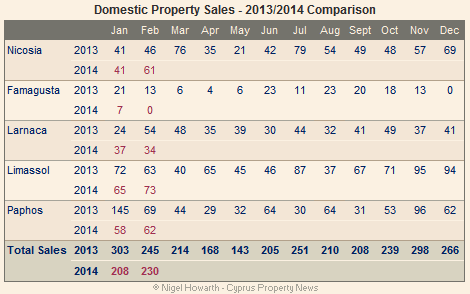
Domestic property sales February 2014

Overseas sales

Sales to the overseas market were down 24% compared with February last year falling to 81 from 107.

Eighteen properties were sold in Famagusta compared with two in February 2013, an increase of 800%. Sales also improved in Larnaca and Limassol, increasing by 23% and 10% respectively.

But sales in Paphos, the area most popular with overseas buyers, fell 71% compared with February last year, while those in Nicosia fell 39%.
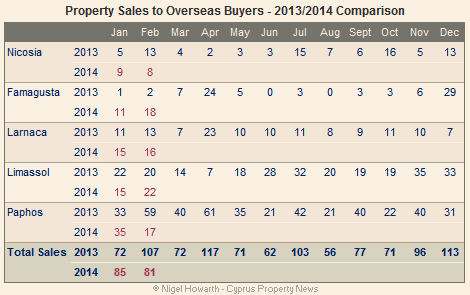
Overseas property sales February 2014

Famagusta Developers found guilty in fraud case

FM Famagusta Developers
Source: Cyprus Mail

FAMAGUSTA Developers and its director Kypros Kyprianou have been found guilty in a fraud case involving the double-selling of a maisonette near Paralimni lake.

The trial lasted some eight months and included testimony from 15 witnesses after Kypros Kyprianou entered a plea of not guilty. The offence took place between 2006 and 2010 and it was reported that Kyprianou made a profit of €85,000.

Kyprianou was remanded in jail and a mitigation plea will be heard today (Wednesday). It’s possible that the presiding judge, Evi Antoniou, will also pass sentence today.

Kyprianou and his company, ‘Famagusta Developers’ are facing further criminal cases in the district courts of Larnaca , Famagusta , Nicosia and Limassol, involving similar offenses including forgery and theft by proxy brought by various complainants. We understand that several of these cases have already started.

In August 2010, the police advised the public that the company was under investigation for several cases of alleged fraud. The following month, the company and its director filed a suit against Phileleftheros demanding over €2 million for “written slander and or libel and or damaging lies” for one particular report entitled “Famagusta in Court”. In the same month the Famagusta court awarded a British couple €100,000 in damages for losses incurred through breaches of their contractual agreement with FK & S (Varoshia) Properties Ltd, 40 percent of which was reportedly owned by Famagusta Developers.

The company’s office in Protaras was targeted by bombers twice in less than five months in 2010 and 2011.

In late 2011, an order was issued for the winding up of the company after it was deemed “unable to pay its debts” by the Famagusta District Court.

Kyprianou spent most of the 1990s in prison for fraud offences after his company, Kyprianou Estates, which operated throughout the 1980s, was reported for selling the same property twice.

He fled the island before the police investigation was complete but was arrested in Germany and extradited to Cyprus where he was jailed. He was released in 2000 and later went on to set up Famagusta Developers.

Property valuations rigged

property valuationsPROPERTY evaluations in relation to bank loans and the new property tax have caused a whirlwind of reaction from MPs who yesterday claimed that banks and the Land Registry both manipulate the value of real estate to serve their own interests.


According to MPs, banks underestimate the value of real estate used as loan collateral in order to pressure owners into mortgaging additional property, while the Land Registry overestimates the value so as to collect increased transfer fees.

Expert appraisers have pointed out that the situation may cause a vicious circle as banks and private evaluators use different approaches to estimate the same property, while the matter will result in benefiting lawyers and appraisers and not the state.

According to the appraisers, owners are expected to react to the new property tax in order to reduce the fee, as practice states that re-assessed values must be publicised and owners have the right to object within two months.

In case the objection is rejected, affected parties can resort to justice, but it is unknown whether the entire process can be completed in time for the Land Registry to re-evaluate all properties based on 2013 values by June 30, in accordance with the terms of the bailout agreement.

Appraisers have further stressed that during times of financial stability, some of their colleagues would not assess property based only on its value but also according to the amount of an applicant’s loan, resulting in fictitious values.

They also noted that in the past there had been significant discrepancies between Land Registry and private appraisals of the same property.

property valuations

Developers call for tax changes

IN A LETTER to the House Finance Committee and political parties, Aristodemou claimed that the way the legislation was implemented “created serious distortions among taxpayers”.

He also said that the government agreed with the Troika to collect €130 million from property tax and noted that the fact that €2.7 million or 2% of that amount was retrieved from Aristo Developers shows the injustice of the legislation.

“I wish our company owned 2% of property in Cyprus and we would have paid double taxes, but in reality 2,263 properties worth a total of €720 million for which we are charged property tax do not belong to us and this also proves the enormous damages from collecting transfer fees by the state due to the intentional delay of property transfers,” Aristodemou said.

He suggests that in order for the taxation to become fair, all the properties with the same parameters and characteristics should be registered and the buyer/user should be taxed, provided that the transaction documents have been submitted to the Land Registry.

There is also a suggestion to obligate the buyer to complete the transfer within a reasonable time period, provided that there are separate deeds, otherwise fines will be enforced. And that unsold housing stock should be exempt from taxation.

The Inland Revenue Department has proposed that property tax is calculated based on estimated prices in 1980, expressing serious doubts whether the state will be able to collect the amount of €130m if the tax is based on 2013 prices.

During a meeting between Inland Revenue and the Land Registry last week, officials said that it is unlikely that the estimations of property tax based on current prices can be completed in time and doubt that Cypriots will accept the new amount or be able to pay it. A Plan B has been proposed, whereby the same values as last year are implemented in order to reach €130m in accordance with the bailout terms. The proposal was presented to the international lenders during their last visit and officials report that there were no objections. Officials from the Land Registry are expecting the revised values to be available by the end of June as per the memorandum and point out that there will be no delays.

Inland Revenue also proposed that the Land Registry should include buildings that were developed in areas which were registered as fields or plots in 1980 when the prices were estimated, in order to make taxation fairer.

However, the Land Registry is said to have rejected the proposal claiming that it is not feasible.

call for tax changes

Central bank governor resigns

central bank governorCYPRIOT Central Bank governor Panicos Demetriades, whose testy relations with island’s government dogged a tumultuous tenure when Cyprus teetered on the brink of bankruptcy, resigned on Monday.

Demetriades’s resignation was accepted by President Nicos Anastasiades, an official statement from the Cypriot presidency said. Demetriades will work out his notice until April 10.

Anastasiades had said in September 2013 he might ask the Supreme Court to rule on whether Demetriades, an appointee of Cyprus’s former communist administration, could be sacked. Tensions between the two men have simmered for months, bursting into open animosity when the right-wing Anastasiades was elected Cypriot president a year ago.

There was no immediate official word on why Demetriades resigned. Two sources with knowledge of the matter said Demetriades submitted his letter of resignation to Cypriot Finance Minister Haris Georgiades, who was in Brussels for a Eurogroup meeting.

One source who saw the resignation letter said Demetriades cited “family and personal” reasons for his departure, and “difficulty in cooperating with the Board of Directors” at the Central Bank.

Demetriades was appointed in May 2012 for a five-year term by then President Demetris Christofias, a communist many blame for misguided policies which led Cyprus to near-economic collapse.

The Central Bank’s board of directors, many of whom were appointed by the present administration, had accused Demetriades of keeping them in the dark on several key issues. Aides to Demetriades said that was a thinly veiled attempt by the presidency to keep the governor in line.

But he was also disliked by key partners in Cyprus’s government for a perception that he undermined Cypriot banks before a chaotic bailout last year.

Anastasiades had openly accused Demetriades, a member of the Governing Council of the European Central Bank, of mishandling the Mediterranean island’s bailout by international lenders last March. But tensions appeared to have calmed somewhat in recent months.

Cyprus had to close a major bank and seize savings held in a second in return for 10 billion euros in international aid from the EU and the IMF.

A former economics professor who taught at Leicester, Demetriades faced constant brickbats for subsequent perceptions he was slow in restructuring the banking sector.

He has maintained that when he took over, less than a year before the bailout, he assumed a poorly regulated banking system which took excessive risks.

The ECB had issued repeated warnings to the Cypriot authorities not to interfere in his work.

Persons close to Demetriades had frequently complained that he was the target of a “well-orchestrated campaign undermining not only central bank independence but an attempt to force the governor to resign.”

The ECB had no immediate comment.

-Reuters

Kouris development under scrutiny

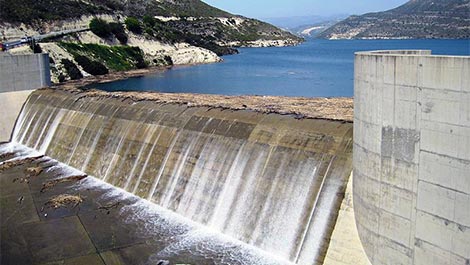
A FORMER Interior Minister had granted an exemption to a developer to build a large-scale project near the island’s biggest reservoir, putting the water supply at risk of contamination, the House Environment Committee heard on Friday.

The committee also heard that the Attorney-General would be looking into whether any irregularities had taken place.

Green Party MP Giorgos Perdikis charged that former Interior Minister Christos Patsalides, just before leaving office in 2008, had granted an exemption to extend the residential zone in Alassa some 60 metres from the Kouris reservoir.

Perdikis said the area was four times bigger than the current area occupied by the Alassa community.

The permit had been issued to Alpha Panareti, which submitted plans for a mixed development including a golf course, and 1,010 residences near the village that currently has 200 homes.

The golf course application was later rejected.

Perdikis said the water development department strongly opposed the development because it violated the protection zone around Kouris dam and there was a serious danger of the water being contaminated.

A water department official told the committee that town-planning had asked for their view on changing the zone.

On January 14, 2008, the department asked for additional information, considering the matter very serious.

In the meantime however, the minister signed the decree to change the zone, granting a 40 per cent building coefficient.

The project is also opposed by the island’s Scientific and Technical Chamber (????).

“Even though it is located within a residential zone, it still falls within the protection zone of the reservoir,” ETEK said recently. “Defining such protected zones is the duty of the Republic, arising from the European Directive 2000/60/EC, which essentially prohibits such developments in specific areas.”

The community says that their need to develop their properties must also be taken into consideration.

The developer suggested that the water department must find other ways to protect reservoirs, not through obstructing development.

The company said it was prepared to exchange the property next to Kouris with other land of equal value.

Kouris development