Famagusta developer jailed for two years

REAL estate broker and property investor Kypros Kyprianou, 55, was sentenced to two years in prison for fraud on Wednesday.

Kyprianou, the director of Famagusta Developers, had been charged with selling the same property – a flat – in Paralimni twice in June 2010, collecting the amount of €100.000 from one buyer and €30,000 from another.

The court ruled that the defendant’s criminal record – which included a 1990 conviction to six years in prison over a similar case – warranted little lenience and handed Kyprianou a two-year jail sentence while imposing a €1.000 fine on Famagusta Developers.

The offence of fraud and the repeated pattern of intentional double-selling for profit were driving factors in the ruling, according to Judge Evi Antoniou.

“His plan victimised the two plaintiffs, and many others, and his professional conduct has discredited Cyprus abroad”, the judge said in her ruling.

Kyprianou had made headlines in 2010, when police put him on the stop list – banned from leaving Cyprus – as eight complaints for fraud had been filed against him, according to a police spokesman at the time.

This was just one of several cases against Kyprianou, filed against him by Cypriot and foreign buyers of his properties.

He is also facing multi-million lawsuits from various construction companies he had used.

In 1980 the defendant had set up Kyprianou Estates, and was reported to police for selling the same property twice.

Kyprianou fled the island before the police investigation was complete but was arrested in Germany and extradited to Cyprus where he was jailed. He was released in 2000 and set up business again.

famagusta developer

Little progress on Immovable Property Tax debtors

Cyprus Immovable Property Tax debtorsACCORDING to information received by Phileleftheros, thirty two land development companies and hotels that owe the state €9.6 million Immovable Property Tax plus interest have paid a mere €215 thousand to date.

The Inland Revenue Department was reported as saying that only 18 of the 32 companies had responded to the Inland Revenue tax notices – and of those 18 only two have paid the full amount owed after errors in their tax assessments were corrected.

The same source reported that the majority of the companies have reached an agreement with the Inland Revenue to pay a proportion of the tax they owe when a property is transacted.

However, these agreements do not prevent the Inland Revenue from taking civil action through the courts to place ‘memos’ on properties owned by the company. Such ‘memos’ will prevent their properties being transacted until their tax debt is paid.

This move by the Inland Revenue Department to place ‘memos’ on properties owned by these companies will further delay the transfer of their titles to their rightful owners, if the companies do not pay their tax obligations promptly.

(We understand that the Inland Revenue has already placed ‘memos’ on properties owned by some of these companies for other unpaid taxes.)

Editor’s note

Where a Court has issued a judgment in favour of a creditor ordering a debtor to pay a specified amount of money to the creditor, the creditor may register a charge with the Department of Lands & Surveys against any immovable property registered in the name of the debtor as security for the recovery of the debt.

The encumbrance created by registering this judgment is known as a “memo” and it effectively prevents the transfer of property owned by the debtor, until such time as the debt has been repaid or the memo removed.

Knight Frank Global house price index

house-price-index1KNIGHT Frank’s Global House Price Index rose by 8.4 percent in 2013 compared with 4.6 percent in 2012, reflecting the upturn in the global economy.

Dubai, China and Taiwan recorded the largest annual increases in mainstream house prices ending the year 35%, 28% and 15% higher respectively.

However, despite Dubai’s outstanding performance in 2013, Knight Frank notes that mainstream prices remain 25% below their 2008 peak.

Thirty nine countries recorded a positive annual price growth in 2013, compared with twenty-seven a year ago.

Europe continues to dominate the lower half of the table but the rate of decline is slowing in countries such as France, Spain and the Netherlands.

Perhaps not surprisingly, the Cyprus housing market weakened 7.3% over the year placing it just outside the bottom four.

Knight Frank Global House Price Index

Rank
Country

12-month % change
(Q4 2012-Q4 2013)

6-month % change
(Q2 2013-Q4 2013)

3-month % change
(Q3 2013-Q4 2013)

Latest data
if not Q4
1 Dubai 34.80 15.30 NA
2 China1 27.50 10.80 5.00
3 Taiwan 15.10 2.90 2.00
4 Estonia 14.50 5.30 6.00
5 Turkey 13.80 5.70 2.90
6 Brazil3 12.70 6.60 3.50
7 Indonesia 11.50 4.10 1.80
8 Colombia 11.50 5.60 1.90 Q3
9 United States 11.30 2.80 -0.30
10 Poland 10.20 9.00 6.40
11 Malaysia2 10.10 5.10 1.30 Q3
12 Kazakhstan 9.40 4.80 3.30
13 Australia 9.30 5.90 3.40
14 New Zealand 9.20 4.40 1.80
15 Iceland 8.70 5.10 3.20
16 Israel 8.60 2.70 0.70 Q3
17 Hong Kong2 7.70 0.70 -0.20
18 United Kingdom 7.00 5.00 2.70
19 Ireland 6.40 6.70 2.60
20 Luxembourg 5.50 1.60 0.40 Q3
21 Switzerland 4.60 1.80 1.20
22 Russia 4.20 1.80 0.50
23 Austria 4.10 0.60 -0.50
24 Sweden 4.10 2.60 1.10
25 Mexico 4.10 0.90 0.10
26 Canada 3.80 1.50 0.10
27 India 3.40 3.40 2.40
28 Latvia 3.00 2.00 1.20
29 South Africa 2.80 2.30 1.40
30 Denmark 2.60 1.60 -0.60 Q3
31 Germany 2.50 -1.40 2.10
32 Singapore4 1.90 -0.30 -0.90
33 Belgium 1.80 2.30 2.10 Q3
34 Lithuania 1.80 -8.90 -5.40 Q3
35 Malta 1.10 0.50 2.00 Q3
36 Norway 1.00 -4.40 -2.60
37 Romania 0.80 -3.20 -2.40 Q3
38 Morocco 0.40 -0.40 -1.90 Q3
39 South Korea 0.30 0.60 0.50
40 Portugal -0.50 0.00 0.00
41 Finland -0.60 -3.80 -2.70 Q3
42 Czech Republic -0.90 -0.10 -0.70 Q3
43 Bulgaria -1.20 -0.20 -0.10
44 France2 -1.40 0.10 -0.70
45 Japan -1.60 -0.60 0.00
46 Slovenia -2.30 0.70 0.10 Q3
47 Slovakia -2.60 -1.30 -0.40
48 Jersey -2.70 -1.50 -4.80
49 The Netherlands -3.70 1.20 0.00
50 Spain -4.00 -2.20 -1.80
51 Italy -5.30 -1.80 -1.20 Q3
52 Cyprus -7.30 -4.80 -2.40 Q3
53 Hungary -7.60 -4.90 -3.50 Q3
54 Greece -9.30 -4.30 -3.00
55 Croatia -14.40 -0.80 0.00
56 Ukraine -25.90 -0.30 -2.90
1 Based on Beijing & Shanghai 2 Provisional data 3 Asking prices 4 Island-wide price index for non-landed properties

Established in 2006, the Knight Frank Global House Price Index is the definitive means for investors and developers to monitor and compare the performance of mainstream residential markets across the world. The index is compiled on a quarterly basis using official government statistics or central bank data where available.

Cyprus fifteenth in Top of the Props

CYPRUS slipped four places down to number fifteen in the February 2014 edition of the ‘Top of the Props’ published by the property portal TheMoveChannel.com, accounting for 0.88% of on-line searches on the property portal.

According to the portal, USA remains the most popular real estate market, accounting for more than one in five (21.07%) of all enquiries. This is the eighth month in a row that America has held its number one position and the country’s highest level of activity since November 2013, when it received 30.99% of enquiries.

Demand also rose for French property in February, overtaking Spanish property for only the second time since Top of the Props records began in 2011.

The remainder of the top five remained unchanged, with Portugal in fourth place Brazil in fifth.

Canada moved up one place to number six and Turkey moved up two places to take the number seven spot.

Australia was a surprise new entry with a tenfold increase in enquires over the previous month moving it up twenty-five places into the number eight position.

Italy moved up one place into number nine, while renewed demand for Bulgaria returned the country to tenth place.

The full breakdown of the February 2014 edition of the Top of the Props chart is as follows:

Rank
Country
Share (%age)
Change
1 USA 21.07 No change
2 France 8.06 Up 1
3 Spain 5.1 Down 1
4 Portugal 4.54 No change
5 Brazil 3.29 No change
6 Canada 2.54 Up 1
7 Turkey 2.09 Up 2
8 Australia 1.92 Up 25
9 Italy 1.71 Up 1
10 Bulgaria 1.62 Up 5
11 Thailand 1.51 Down 3
12 Bahamas 1.14 Down 6
13 Barbados 1.06 Up 1
14 India 0.98 Down 2
15 Cyprus 0.88 Down 4
16 Greece 0.81 Up 2
17 Germany 0.78 Down 4
18 Poland 0.78 Up 6
19 Hungary 0.74 Down 2
20 UAE 0.45 Down 4
21 Cape Verde 0.42 Up 10
22 Cayman Islands 0.36 Up 7
23 Egypt 0.35 Up 2
24 Croatia 0.35 Down 3
25 Malta 0.34 Up 7
26 Belize 0.32 Up 10
27 Northern Cyprus 0.26 No change
28 Iran 0.24 No change
29 St Lucia 0.24 Down 2
30 Dominican Republic 0.23 Up 12
31 Gibraltar 0.22 Down 3
32 Panama 0.22 Up 2
33 Montenegro 0.21 No change
34 Pakistan 0.19 Down 8
35 Jamaica 0.16 Up 5
36 Romania 0.16 Up 8
37 Ecuador 0.13 Down 14
38 St Vincent and Grenadines 0.13 Up 8
39 The Bahamas 0.12 No change
40 New Zealand 0.12 No change

Founded in 1999, TheMoveChannel.com is the leading independent website for international property, with than 400,000 listings in over 100 countries around the world, marketed on behalf of agents, developers and private owners.

Its ‘Top of the Props’ chart is based on the number of on-line enquiries for property in different countries around the world.

Property valuations could cause storm of appeals

Cyprus property valuation consultantsTHE prospect of a vicious cycle caused by differing property valuations conducted on the same property is a very real one, property valuers have warned.

Recent reports suggest that commercial banks, aiming at minimising the risk of bad-loan write-offs, employ the practice of undervaluing mortgaged properties in order to pressure mortgagees into offering other properties as additional collateral.

Conversely, the same reports indicated that the Lands and Surveys department tends to overvalue properties so that it can collect higher Property Transfer Fees in the event of sale.

Property valuers have been cited in local press as arguing that such practices can only create legal tangles, benefitting lawyers and property valuers themselves, but certainly not the government.

According to the same sources, the government’s troika-imposed decision to update all property valuations – thus far valued at 1980 prices for land registry purposes – to 2013 prices by the end of June for the purposes of taxation on immovable property is bound to cause a bottleneck of appeals and legal challenges.

That is because the revaluation rules stipulate the publication of any revised valuation and its acceptance as fair by the property owner – who may otherwise appeal it within two months of publication, with a further option of seeking legal adjudication if still not acceptable.

As the level of property tax levied will be calculated on the revalued worth of the property, owners will have an implicit incentive to secure as low a revaluation figure as possible, leading to a likely flurry of appeals and legal challenges.

Yet another practice in the property valuation market that is likely to come up in the near future, causing further distortions, is the fact that when the economy showed no signs of a meltdown, many valuers performed valuations based not on objective appraisal criteria but on the amount owners sought to borrow, the same sources said.

Wide discrepancies commonly observed between bank-commissioned property valuations and land-registry ones – on the same property – are indicative of such distortions.

The charges of questionable business practices were deemed groundless and irrational by the Cyprus property valuers’ association, who said they will be setting the record straight in the coming days.

“Banks don’t perform valuations – rather, they commission private valuers to perform them on their behalf,” association board member Stefanos Fintiklis said, explaining that since private valuers do not have a stake in the net worth of a property, they would have no incentive to undervalue – or overvalue, for that matter – properties.

Meanwhile, sources from the land registry suggest that the department is aware of the risk of mass appeals and plans to neutralise it by ensuring that moderate revaluations are performed.

“It’s what I would do,” Fintiklis said.

“Although historically the land registry has been known to overvalue properties, doing it in this case would make little – if any – sense as one can easily predict a storm of appeals by unhappy property owners that would choke the system,” he added.

Property valuations could cause storm of appeals

Property prices keep falling

THE SEVENTEENTH publication of the RICS Cyprus Property Price Index reports property price falls in almost all areas of the island and types of property, with significant falls being recorded in Nicosia.

Over the quarter, the average value of residential houses and apartments fell by 1.6% and 0.5% respectively.

Apartment prices in Paphos increased by 0.6%, while those in Limassol and Famagusta remained steady. However, apartment values in Nicosia fell by 6.3%, while those in Larnaca fell 0.8%.

Although house prices in Limassol and Famagusta remained steady, their values fell by 1.4% in Larnaca and by 0.6% in both Nicosia and Paphos.

RICS Cyprus commentary

During the fourth quarter of 2013 the Cyprus economy began stabilising from the impact of the decisions of the Eurogroup on 15 and 27 March to “bail-in” the depositors of two of Cyprus’ largest banks, to close down Laiki Bank, and to impose capital restrictions. The secondary implications of these decisions, mainly the reduction of bank staff, the increase in unemployment, and further decreases in salaries, were unfolding throughout the quarter.

Given prevailing economic conditions and the turbulence in Cyprus’ banking system, there was a lack of transactions during the quarter. Local buyers in particular were the most discerning as the increase in unemployment and the worsening prospects of the local economy led to a sharp reduction in interest. Furthermore, those interested were unable to access bank-finance or their deposits.

Property price changes over the past year

Compared to Q4 2012, the average price of a residential apartment has dropped by 13.3%, while the average price for a house has fallen 10.5%.

Commercial property prices have also fallen, with the price of retail units falling by 19.8%, while the prices of offices and warehouses have fallen by 12.8% and 15.4% respectively.

Gross rental yields

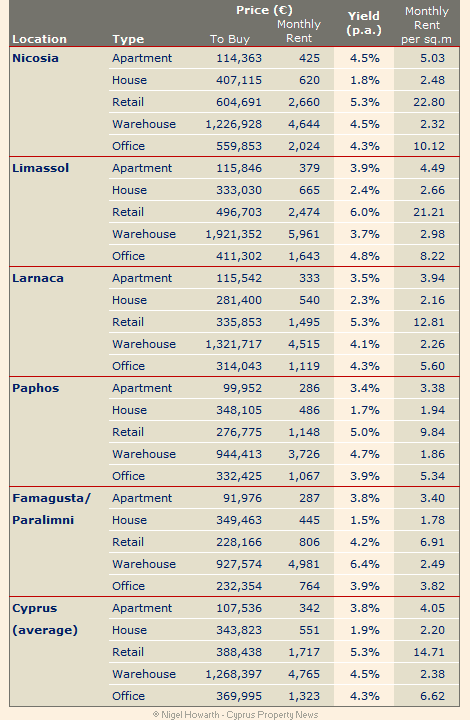
At the end of Q4 2013 average gross yields stood at 3.8% for apartments, 1.9% for houses, 5.3% for retail, 4.5% for warehouses, and 4.3% for offices.

RICS Cyprus Property Prices Index Q4 2013(Derived from the RICS Cyprus Property Price Index for Q4 2013)

The parallel reduction in capital values and rents is keeping investment yields relatively stable and at very low levels (compared to yields overseas). This suggests that there is still room for re-pricing of capital values to take place.

Outline of properties used to calculate the index

Apartments: Residential, two bedroom, 85sqm, Medium quality.

Houses: Residential, three bedroom with garden, Semi-detached, 250sqm, Medium quality.

Retail: High-street retail, 100sqm ground floor area with 50sqm mezzanine.

Warehouse: Light industrial area, 2,000sqm, which includes 200sqm office space.

Office: Grade A, City centre location, 200sqm

(All property types used to calculate the index are: freehold, have all licences and permits in place, have their Title Deeds, are subject to VAT and are in a good state of repair).

Monitoring Process

The estimation of price levels is carried out by accredited RICS property professionals who are active in the relevant markets.

Methodology

The methodology underpinning the RICS Cyprus Property Price Index was developed by the University of Reading UK and may be viewed by clicking here.