Cyprus slips out of the top 10

Cyprus sea caves at Pegia, north of PaphosCYPRUS moved out of the top 10 to number 11 in the latest ‘Top of the Props’ report published by the property portal TheMoveChannel.com, accounting for 1.39% of on-line searches on the property portal.

North America retained its number one spot for the seventh successive month with enquiries up to 18.56% of the overall total, while Spain kept its second position accounting for 8.55% of enquiries.

France moved up two places into the number three spot, followed by Portugal at number four and Brazil (which slipped two places) at number five.

The Bahamas cruised up 26 places to take the number six spot, followed by Canada, Thailand and Turkey.

Interest in Italy also increased, as the country climbed back into the top 10, pushing  Cyprus down one place to number eleven.

The full breakdown of the January 2014 edition of the Top of the Props chart is as follows:

Rank
Country
Share (%age)
Change
1 USA 18.56 No change
2 Spain 8.55 No change
3 France 5.94 Up 2
4 Portugal 3.74 No change
5 Brazil 2.51 Down 2
6 Bahamas 2.39 Up 26
7 Canada 2.01 No change
8 Thailand 1.97 Up 1
9 Turkey 1.54 Down 1
10 Italy 1.51 Up 1
11 Cyprus 1.39 Down 1
12 India 1.28 Up 1
13 Germany 1.20 Up 2
14 Barbados 1.08 Up 9
15 Bulgaria 1.07 Down 1
16 UAE 0.72 Up 4
17 Hungary 0.67 Down 5
18 Greece 0.65 Down 2
19 St Kitts and Nevis 0.62 Up 23
20 All Countries 0.36 No change
21 Croatia 0.35 Down 3
22 Argentina 0.29 Down 16
23 Ecuador 0.28 Down 6
24 Poland 0.27 Up 3
25 Egypt 0.27 Up 10
26 Pakistan 0.25 Down 4
27 St Lucia 0.24 Up 3
28 Gibraltar 0.24 No change
29 Cayman Islands 0.24 Up 1
30 Switzerland 0.22 Up 3
31 Cape Verde 0.22 Down 10
32 Malta 0.18 Down 6
33 Australia 0.18 Down 4
34 Panama 0.18 Up 11
35 Slovenia 0.16 Down 1
36 Belize 0.12 Down 5
37 South Africa 0.12 Down 18
38 Czech Republic 0.12 No change
39 Albania 0.11 Down 3
40 Jamaica 0.11 Up 4

Founded in 1999, TheMoveChannel.com is the leading independent website for international property, with than 400,000 listings in over 100 countries around the world, marketed on behalf of agents, developers and private owners.

Its ‘Top of the Props’ chart is based on the number of on-line enquiries for property in different countries around the world.

Property Developers: Run Forrest! Run!

Property developersMOST property developers still own a significant number of completed units (a figure of 50,000 unsold holiday homes was reported last October) and banks are putting under pressure to dispose of them as soon as possible.

Developers are overleveraged, and in their majority still own a considerable number of finished units and land. Banks are pressurising them to dispose of these assets as quickly as possible in order to pay back their loans. Developers are pushing back, asking for more time or for loans to be restructured by paying them back over a longer time period.

This article examines the dynamics between these two parties, through a simple mathematical example.

Andreas decides to build a multi-storey building comprising of ten apartments.

He has €200,000 in cash and needs €1,200,000 to buy the land and build the apartments. Andreas goes to a bank and borrows €1,000,000 with an interest of 6.0% per annum (€60,000) and a ‘bullet payment’ in three years (he has to pay back the €1,000,000 in three years and only the interest in the mean time). Andreas plans to sell the apartments for €180,000 each.

In the first year Andreas sells one apartment for €180,000. As he is very prudent, he pays the bank the €60,000 interest and keeps that other €120,000 on the side for the next two interest payments. Then the crisis happens. Andreas doesn’t manage to sell any apartments in years two and three, but he has the money to pay the interest from the sale of that one apartment.

At the end of the third year he goes to the bank and asks for an extension to his loan of €1,000,000. Property prices have now dropped by one third, they are at €120,000, and he has nine apartments to sell (a total potential income of €1,080,000 which is more than enough to cover his loan).

Andreas thinks that at these lower prices he can sell three apartments in the first year and two apartments per year after that. The bank is pushing him to sell all the apartments in a ‘fire sale’ for €108,000 each (a 10% discount). That means a total income of €972,000; €28,000 short of what they are owed. Is the bank crazy? Doesn’t it want its money back?

As things stand, Andreas owes €1,000,000 and has nine apartments. He sells three in the first year, and has an income of €360,000 and owes €60,000 in interest. Thus, he has a balance of €700,000 and six apartments left. He then sells two in the second year, has an income of €240,000 and owes €42,000 in interest (6% on €700,000). Thus, he has a balance of €502,000 and four apartments left. In the third year he sells two apartments, has an income of €240,000 and owes €30,120 in interest (6% on €502,000). Thus, he has a balance of €292,120 and two apartments left. In this final year he sells the last two apartments, has again an income of €240,000 and owes €17,527 in interest (6% on €292,120). Thus, after four years he still owes the bank €69,647 and has no apartments left.

The bank knows that the longer it takes Andreas to sell the apartments, the more interest payments are going to be biting into the amount it receives to pay back his outstanding loan. Thus, the bank wants to ensure that it minimises the amount of losses it has because it runs the risk of Andreas taking even longer to pay back the loan, which in turn means that the shortfall between what the bank is owed and what it will receive could be even greater.

The rate of sale matters almost as much as the price achieved. The bigger the loan and the higher the interest, the more important the rate of sale is. In the current environment where projects are overleveraged and interest rates are running high, the rate of sale becomes paramount.

Why should we care?

Well, the €1,000,000 borrowed by Andreas is the money that you and I deposited at the bank. If the bank doesn’t get its money back, then it won’t have any money to pay us back.

Pavlos Loizou MRICS VRS
Managing Partner
Leaf Research

Fugitive lawyer sentenced

Lawyer Marios Shiaeles MARIOS Shiaeles, a Limassol based lawyer, and his wife Niki Fasaria fled Cyprus in September 2006 after allegedly carrying out a series of property frauds on clients totalling in excess of 3.6 million Cyprus Pounds.

The alleged victims included at least seven different nationalities, with some investors losing hundreds of thousands of pounds.

International arrest warrants were issued and in June last year we reported that that the couple had been found and Shiaeles was apprehended. He appeared in court June 7 and was bailed to appear in the Limassol District Court on July 16.

It seems that Shiaeles and his original lawyer parted company, causing the trial to be adjourned while Shiaeles instructed another lawyer to represent him.

The trial has now been concluded and we have been advised by one of his victims that Shiaeles has been sentenced to 15 months in jail by a judge at the Limassol District Court.

Capital controls eased further

THE FINANCE ministry announced on Friday it was abolishing restrictions on fixed term bank deposits, introduced last year along with other capital controls to prevent a bank run.

The ministry also said it was increasing the current limit for monthly money transfers per person within the Republic, regardless of purpose, from €15,000 to €20,000.

The same applies to companies, which can now transfer €100,000 per month instead of €75,000.

Cyprus introduced capital controls last March to prevent a run on banks after a bailout shut down a major lender, and imposed losses on large deposits in a second.

It was conditional for €10 billion in aid from the EU and the International Monetary Fund.

Based on the plan for a gradual relaxation on transactions, domestic controls will be fully eased first, before transactions involving money transfers abroad are scrapped.

There has been an incremental easing of restrictions, but cash withdrawals are still limited to €300 per day and cashing of cheques is not allowed.

The ministry said on Friday that according to the roadmap, which was published in August 2013, all milestones of the second stage have been met – disbursement of funds under the macroeconomic adjustment program for the recapitalisation of co-ops, submission of the co-ops restructuring plan to the European Commission, recapitalisation of Hellenic Bank, approval of the Bank of Cyprus restructuring plan – therefore it is possible proceed with further easing of the restrictions.

Cyprus capital controls

Dramatic drop in building permits

THE NUMBER of building permits issued in December stood at 394 compared with the 471 issued in December 2012; a fall of 16%, according to the latest figures released by the Cyprus Statistical Service.

Compared with December 2012, the total area of these permits fell 26% to 67,192 square metres from 90,437, while their value fell 44% to €69,414 million from €124,874 million.

During December, the following building permits were issued:

  • Residential buildings – 262 permits
  • Non-residential buildings – 66 permits
  • Civil engineering projects – 25 permits
  • Division of plots of land – 35 permits
  • Road construction – 6 permits

During the whole of 2013 a total of 5,341 building permits were authorised; a drop of 26% compared with 2012. Their total value fell by 30% and their total area by 30%.

Building permits for new home construction

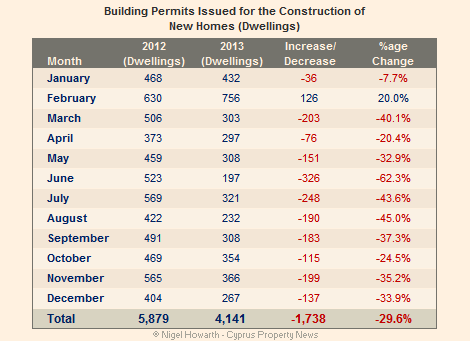
The 262 residential building permits approved in December provided for the construction of 267 new homes comprising 151 single houses and 116 multiple housing units (such as apartments, semis, townhouses and other residential complexes).

This is a fall of 34% compared with December 2012 when building permits were issued for the construction of 404 new homes.

During the whole of 2013, the number of new homes for which permits were authorised has fallen by 30% compared with the same period last year.

Cyprus building permits December 2013

According to the Cyprus Statistical Service, building permits constitute a leading indicator of future activity in the construction sector.

Troika back-tracks on Title Deed backlog

MANY who were hoping that agreement between the Cyprus Government and the troika of international lenders would result in their receiving their Title Deeds, pinned their hopes on the following statement contained in the Memorandum of Understanding issued on 12 April 2013:

“By Q4-2014, eliminate the title deed issuance backlog to less than 2,000 cases of immovable property sales contracts with title deed issuance pending for more than one year. The Cypriot authorities will enhance cooperation with the financial sector to ensure the swift clearing of encumbrances on title deeds to be transferred to purchasers of immovable property, and implement guaranteed timeframes for the issuance of building certificates and title deeds;”

However, this statement has been replaced in the latest Memorandum of Understanding issued following the troika’s recent visit to Cyprus (which I believe has yet to be ratified) with the following:

“Ensure that the title deed issuance backlog drops to less than 2,000 cases of immovable property units with title deed issuance pending for more than one year by Q4-2014 (backlog refers to (i) applications, (ii) units that are eligible for the “ex officio” issuance of title deeds, required certificates and permits).

“The ex-officio cases will automatically be counted in the backlog from the date the certificate of final approval is being issued by the respective Local or District Authority. Moreover, prepare a joint action plan to streamline the processes within the DLS and between the DLS, the Local and District Authorities and the Ministry of Interior Technical Services by Q2-2014;”

What this revised statement means is that:

It does not refer to all the reported 130,000 properties that have yet to be issued with Title Deeds, but only to those where:

  • An application has been made to the Land Registry to issue its Title Deed.
  • A Certificate of Final Approval has been issued.

Applications for Certificates of Final Approval and the issuance of Title Deeds are the responsibility of the developer and so any pressure that the original MoU placed on developers to act responsibly has been removed.

Furthermore, in this latest issue of the MoU the requirement: “The Cypriot authorities will enhance cooperation with the financial sector to ensure the swift clearing of encumbrances on title deeds to be transferred to purchasers of immovable property…” has been removed.

This apparent back-tracking by the troika will not be welcomed – questions need to be asked.

Perhaps the troika uncovered some hitherto unknown facts, in the same way that many property buyers uncovered a hitherto unknown fact when they discovered they’d been duped into buying a home built on mortgaged land?