Property sales going from bad to worse (updated)

WITH thousands of unsold properties littering the island, record levels of unemployment, lack of liquidity and fears over the state of the economy, the real estate market seems to be going from bad to worse.

Property sales last year fell to their lowest level since records began in 2000 and the January 2013 figures issued by the Department of Lands and Surveys show a large reduction from the already low base of recent years.

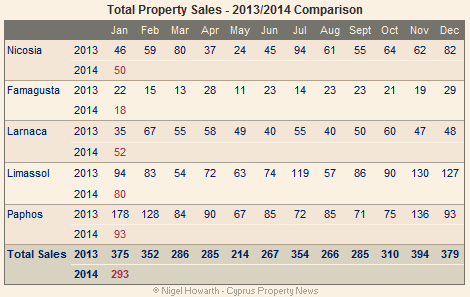
During January a total of 293 contracts for the sale of commercial and residential properties and plots of land were deposited at Land Registry offices across Cyprus; a reduction of 22% on the 373 contracts deposited in January 2013.

Of those 293 contracts 71% (208) were deposited on behalf of domestic buyers, while 29% (85) were deposited in favour of overseas buyers.

These latest figures show a fall of 82% since January sales reached their peak in 2008 when a total of 1,615 contracts were deposited.

With the exception of Larnaca and Nicosia, sales fell in all districts.

The largest fall was recorded in Paphos, where the number of properties sold fell 48% to 93 compared with the 178 sold in January 2013.

Sales in Famagusta were down 18%, falling to 18 from the 22 sold in January last year, while sales in Limassol fell 15% to 80 from the 94 sold last year.

On a more positive note, sales in Larnaca increased by 49% to reach 52 compared with the 35 sold last year and sales also increased in Nicosia, up 9% to reach 50 compared to the 46 sold in January 2013.

All Cyprus property sales January 2014

Banks are becoming increasingly stringent on the granting new loans and are demanding substantial collateral, while charging relatively high interest rates.

Domestic sales

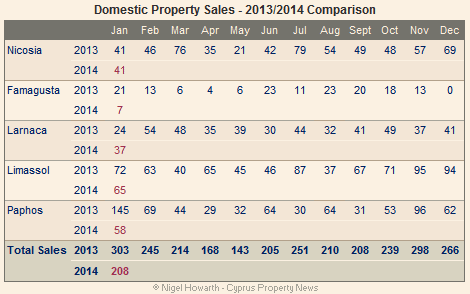
Domestic sales in January were down 31% compared with January last year, having fallen to 208 from 303.

Sales in Larnaca increased by 54% and those in Nicosia remained steady at last year’s level.

In contrast, sales in Famagusta fell 67%, while those in Paphos and Limassol fell by 60% and 10% respectively.

Domestic property sales January 2014

Overseas sales

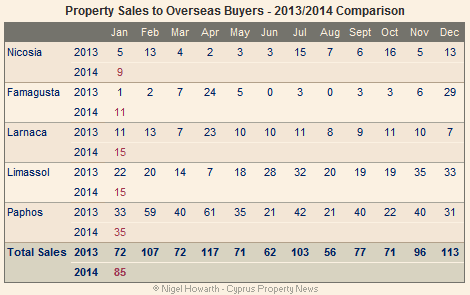
Sales to the overseas market improved 18% compared with January last year increasing from 72 to 85, giving some hope that a partial revival may be underway.

Although sales fell 32% in Limassol, they increased in all other districts.

Eleven properties were sold in Famagusta compared with just one in January 2013, an increase of 1000%! Sales in Nicosia increased 18%, while those in Larnaca and Paphos increased by 36% and 6% respectively.

Overseas property sales January 2014

Courts can amend foreign currency loans

foreign currency loansBUYERS of property in Cyprus are not the only ones who were advised to take loans denominated in Swiss Francs to fund their purchase.

A recent case in which a Hungarian couple challenged the system of exchange-rate margins used by lenders was referred the EU tribunal last year for guidance on the powers of national judges:

In 2008 a bank granted a couple a loan of 14,400,000 Hungarian Forints; its equivalent value in Swiss francs was fixed at CHF 94,240.84. According to the terms of the contract, the couple took note of the fact that in addition to the loan, related interest, administration fees and default interest and other charges would also be determined in CHF.

The couple challenged the term in their contract that allowed the bank to calculate their monthly instalments based on the selling rate for CHF in Hungary’s High Court. They claimed that the clause was unfair as it applied a different exchange rate to that used when the CHF loan was calculated in 2008. The High Court referred the matter to the EU Court of Justice, requesting its opinion on the matter.

According to Advocate General Niels Wahl of the EU Court of Justice, contractual terms that provide for the use of an exchange rate that differs from the exchange rate used calculating the loan repayments are not exempt from an assessment as to whether they are unfair.

In essence, Advocate General Wahl advice means that Hungary’s courts can force banks to replace unfair contract terms for customers holding foreign currency loans.

The news heralded a fall of 2.8 per cent in the share price of the OTP Bank, Hungary’s largest lender.

Although Advocate General Wahl opinion is non-binding, the EU Court of Justice follows the advice of its advocates general in most rulings, which usually come about 6 months later.

Further reading

Court of Justice of the European Union Press Release No 16/14

Capital controls could be lifted by year-end

Capital controlsCYPRUS could lift all capital controls by the end of this year if it makes sufficient progress adopting an international bailout programme and confidence is fully restored to the economy, its central bank governor said on Friday.

Citing a roadmap for the gradual relaxation of capital controls, Panicos Demetriades said the full easing would require “substantive progress” in implementation of its economic adjustment programme.

“That is expected to happen, if all goes well, by the end of the year,” he told journalists.

Cyprus introduced capital controls last March to prevent a run on its banks after a bailout shut down a major lender, and imposed losses on large deposits in a second. It was conditional for 10 billion euros in aid from the EU and the International Monetary Fund.

Based on the plan for a gradual relaxation on transactions, domestic controls will be fully eased first, before transactions involving money transfers abroad are scrapped.

There has been an incremental easing of restrictions, but cash withdrawals are still limited to 300 euros per day, cashing of cheques is not allowed, savers cannot break time deposits and large cash transfers have to be vetted.

Demetriades said he anticipated another round of easing on domestic transactions in coming weeks.

“I believe we will be able in the next few weeks to engage in the next set of relaxations which will essentially remove nearly, if not all, domestic restrictions,” he said.

– Reuters

Stemming the rise of non-performing loans

non-performing loansTHE CYPRIOT banking system, in common with those of many other EU countries, faces significant challenges, the greatest being the seemingly unavoidable increase in non-performing loans (NPLs).

Although there is obviously no ‘magic formula’ that can be applied to stop the rise of NPLs, the Cypriot banks will need to employ innovative approaches that can provide short and long-term solutions. These approaches are mostly new and outside the ‘normal’ banking processes.

Operationally, the banks have not had the experience of dealing with what is a very large portfolio of NPLs – both as a percentage of assets and as an absolute amount.

The traditional approaches, which include restructurings and write-offs (as per the Basel III guidelines) will of course always remain part of the solution. Disposing of the NPLs to specialised hedge funds is also a frequently used solution and could become part of the overall strategy here as well. But other, less “conventional”, methods will have to be considered too:

  • Debt restructuring with concurrent management by the bank of the collateral assets/businesses (under specific guidelines). Simply restructuring a NPL (without any other bank-driven action), in many cases merely provides for a postponement of the need for drastic action and in some cases exacerbates the problem.
  • Management of viable but insolvent businesses. Subject to the terms of specific loans, the bank could take an active role in managing (or co-managing) viable businesses that are heavily indebted. This could take place with or without the voluntary cooperation of the Company, with the former being the preferred route. One example of this approach would be the co-management of a revenue-generating real estate asset, like a hotel.
  • Converting debt to equity. In cases where the indebted Companies have a viable business model, converting part of the NPL into equity (with optional share buy-back scheme) could both enable the business to continue and maybe improve its profitable operations (thus paying off its debts in an orderly manner) and provide some upside for the bank as a shareholder. This strategy has been adopted in various cases across banks in Europe and it could be explored in Cyprus, especially in combination with other approaches such as the ones discussed above.

The banks will need to develop their technical competence and capacity in dealing with NPLs, as this will be a significant part of their operation for a number of years to come. Investment banking and venture capital approaches, tools and culture will be employed and the faster the banks move to tackle the NPL issues the more the already apparent return of confidence in the banking sector will accelerate. And with each NPL that will be resolved, activity and growth in the real economy will benefit.

Thankfully, the Cypriot bankers are well aware of the challenges and have lost no time in turning to experts that have the experience and technical know-how to help build a comprehensive system for dealing with NPLs. Take home message: The task of “cleaning up” the banks’ balance sheets will take time and a great deal of very specialised hard work.

Dr. George Mountis
Director, Business Development
Emergo Wealth

Cyprus Title Deeds bank extortion (updated)

FOLLOWING information received from Denis O’Hare of the Cyprus Property Action Group (CPAG), MEP Daniel Hannan has raised the following question in the European Parliament.

(CPAG has also assisted a number of Liasides clients to lodge cases at the European Court of Human Rights (ECHR) against the Cyprus Government for not protecting their property rights.)

Question for written answer E-012350-13
to the Commission

Rule 117
Daniel Hannan (ECR)

Subject: Cyprus title deeds bank extortion

In response to my previous question regarding Cypriot property title deeds (E?006305/2013), Commissioner Rehn stated that ‘The MoU [memorandum of understanding] therefore envisages a specific deadline for the elimination of the observed backlog. The swift clearing of encumbrances on title deed transfers constitutes an important element of this agreement’.

Is the Commission aware that receivers acting for banks are currently threatening buyers with selling their homes unless the buyers pay off the developers’ defaulted mortgages, their taxes and other creditors?

In the case of the now defunct Liasides developer, involving 230 properties, Alpha Bank’s receivers are informing the buyers that unless they pay off the developers’ mortgages and taxes on their homes, the properties will be sold. Due to the level of debt there will be no surplus funds to compensate the buyers, who will then be homeless. Mortgages, which go back to 2002 in some cases, have not been serviced during this period, yet Alpha Bank has taken no remedial action and these now stand at several times the initial mortgage advanced. Receivers’ fees at 11% of the purchase price are also payable by the buyers.

Most of these properties are illegal due to the lack of building permits or completion certificates, yet it is envisaged that the individual title deeds should be transferred to buyers through the courts. Moreover, the deeds will still be encumbered by the many other claims against the developer as a result of creditor court judgments.

Could the Commission please confirm that this extortion by the banks and their receivers is in direct conflict with the terms of the MoU?

More liquidations to follow

LIQUIDATORS acting on behalf of another bank have received permission from the court to commence proceedings to recover the assets of a bankrupt property development company in the Larnaca area.

Reports suggest that the liquidator has said that foreclosures have been put in place to ‘force property buyers’ to settle developer debts; a conservative estimate of their fees is €15,000 – €20,000 per household.

As well as the mortgage debt owed to the developer’s bank and the liquidators fees, to avoid the sale of their homes, those who purchased property from this developer will also be required to pay his unpaid taxes, which amount to some €540,000.

It is highly likely that more development companies will be forced into receivership as a result of the collapse in the island’s property market and an increase in non-performing loans. More liquidations will follow and assets belonging to those companies, including many homes, will be put under the hammer to repay their creditors.

Answer given by Mr Rehn on behalf of the Commission (added)

The Commission is well aware of the unresolved issue of pending title deeds in Cyprus and it attaches priority to resolving it in the interest of the Cypriot economy, the European taxpayer, and the EU citizens affected by the problem.

To this end, article 5.4 of the Memorandum of Understanding includes several policy actions such as

(a) guaranteed timeframes for the issuance of title deeds,

(b) decrease of the title deed backlog and

(c) acceleration of the swift clearing of encumbrances on title deeds to be transferred.

The leading competent authority is the Department of Lands and Surveys (Ministry of Interior). As the issue of the title deeds and the encumbrances attached to them is a complex one, the co-operation among a number of Cyprus’ public administration units is also required.

The Commission would also like to inform the Honourable Member that the Cypriot authorities have already created a specific framework for dealing with troubled borrowers. Concerns about such dealings should be addressed to the appropriate national authorities, including the Central Bank of Cyprus and the Financial Ombudsman.

Cyprus program remains on track says Troika

STAFF teams from the European Commission (EC), European Central Bank (ECB), and the International Monetary Fund (IMF) visited Nicosia during January 29-February 11, 2014 for the third review of Cyprus’s economic program, which is supported by financial assistance from the European Stability Mechanism (ESM) and the IMF.

The objectives of Cyprus’s program are to restore financial sector stability, strengthen public finance sustainability, and adopt structural reforms so as to support long-run growth, while protecting the welfare of the population. Discussions with the authorities during this visit focused on policies to restore confidence on the financial system and implementation of the structural reform agenda.

Cyprus’s program remains on track, with the macro-fiscal outturn better than expected. Fiscal targets for 2013 have been met with considerable margin, due to both continued prudent budget execution and a less severe recession than anticipated. Output in 2013 is estimated to have contracted by about 6 percent in real terms, which, while significant, is almost two percentage points better than forecasted at the time of the last review. Private consumption contracted, although by less than expected, while tourism and professional services have proven resilient. The financial sector is also showing signs of stabilization. The economy is adjusting flexibly as prices and wages are declining, helping to cushion the full impact of the recession on jobs. Still, unemployment remains very high.

The outlook remains challenging. Output is projected to contract by 4.8 percent in 2014, with domestic demand weighed down by the need for an adjustment of private and public sector debt from currently high levels. A return to positive but modest growth of around 1 percent is expected in 2015, led by non-financial services. Nonetheless, risks to the outlook are substantial.

In the financial sector, the first challenge is dealing with the high level of non-performing loans. With the two largest banks now recapitalized and the cooperative credit sector expected to be recapitalized shortly, the authorities need to ensure that banks and coops effectively implement their restructuring plans. This requires putting in place adequate arrears management frameworks and carefully monitoring progress toward reducing loans in arrears. For coops, it is also important to complete planned mergers and strengthen governance. To facilitate the clean-up of banks’ balance sheets and the reduction of private sector indebtedness—both of which are needed to restore credit and sustainable growth—an appropriate debt-restructuring framework is necessary. In this regard, the authorities need to reform the insolvency legislation to offer balanced incentives that can prevent strategic defaults while providing solutions for voluntary debt restructuring for viable borrowers.

A second challenge is the need to normalize payment flows in the economy while safeguarding financial stability. With key milestones in the authorities’ roadmap now completed, the second phase of gradual relaxations of restrictions is expected to start shortly. Finally, efforts also need to continue to strengthen implementation of banking sector regulation and supervision as well as of the anti-money laundering framework.

Building on the strong fiscal performance to date, the authorities will need to continue to implement their budget prudently. As agreed at the onset of the program, an additional adjustment will be necessary in the outer years to attain the long run objective of a sustained four percent of GDP primary surplus, which is needed to place public debt on a sustainable downward path.

The implementation of structural reforms needs to be accelerated. A key priority is the reform of the social welfare system. This will consolidate existing welfare benefits and introduce a guaranteed minimum income scheme, so as to provide adequate social protection of vulnerable households during the current downturn. To improve the efficiency of revenue administration the authorities need to take steps to advance the merger of the two main tax collection agencies. Moreover, efforts need to be intensified to protect revenue collections in the short term, including by fighting tax evasion. Public financial management should be strengthened by adopting without delay and implementing the fiscal responsibility and budget systems law. Finally, privatization of state-owned enterprises is essential to increase economic efficiency, attract investment, and as a means to reduce public debt. In this regard, the adoption of the framework law for privatization is a key step to kick-start the process.

While the program remains on track, Cyprus still faces significant risks. Continued full and timely policy implementation remains essential for the success of the program.

Conclusion of this review is subject to the approval process of both the EU and the IMF and is expected to be considered by the Eurogroup, the ESM Board of Directors, and the Executive Board of the IMF by early April. Its approval would pave the way for the disbursement of €150 million by the ESM, and about €86 million by the IMF.