Our top 10 stories from Cyprus in 2013

top_10_storiesUNLIKE last year, when our list of Top 10 stories was dominated by reports of those seeking justice for the alleged mis-selling of Swiss Franc Loans, this year we have quite a mixed bag for you.

Let’s start at the 10th most popular and work our way up to the most read article.

At number 10: BBC Money Box: Cyprus property troubles – The BBC Radio 4 program ‘Money Box’ reported on the problems faced by many British people who purchased property in Cyprus with loans denominated in Swiss Francs. In the program, Money Box reporter Bob Howard talked to ‘Tim’ who was tempted to buy off-plan in a Cyprus development after he was cold-called by a salesman in 2005.

At number 9: Property sales collapse as crisis deepens – Statistics from the Department of Lands and Surveys revealing how property sales had been badly hit as the financial crisis deepened as a consequence of the decisions taken by the Eurogroup to impose savage bailout conditions on the island.

At number 8: Revised property tax bill announced – Details of the proposed property tax bill were announced (and then changed a few months later), but government spokesman Christos Stylianides admitted that there were shortcomings in the data used to assess the new tax rates as houses valued at many millions of Euros had not been included in the calculations as they have not been properly registered, scotching claims made by the authorities that the Cyprus Land Registry is considered one of the most reliable in the world.

At number 7: Price falls loom in wake of bailout – Members of the Property Valuers Association were advised not to carry out valuations for banks or individuals until the terms of a financial bailout become clear and its chairman, Charalambos Petrides, warned of possible double-digit price drops in the wake of the bailout.

At number 6: Cyprus Title Deeds bank extortion – Daniel Hannan raised a question in the European Parliament concerning the activities of receivers acting for banks who are threatening buyers with selling their homes unless they pay off the developers’ defaulted mortgages, their taxes and other creditors. (A reply to this question is eagerly anticipated).

At number 5: Price falls continue as uncertainty grows – The property price index published quarterly by RICS Cyprus reported on price falls across the island amid the worsening state of the economy and growing uncertainty, with prices of residential apartments and houses falling by an average of 3.1% and 1.4% respectively during the fourth quarter of 2012.

At number 4: Property tax bill approved by parliament – In May, MPs approved an amended bill to increase the rate of Immovable Property Tax, which was part of the preliminary agreement between Cyprus and its international lenders. By revising the Immovable Property Tax framework, it was estimated that the government would collect approximately €136 million revenue from property taxation.

At number 3: Cypriot property Title Deeds – Daniel Hannan MEP raised a further question in the European Parliament seeking assurance that buyers who had paid in full for properties would have access to their deeds, without exception, and that these deeds would be free of any encumbrances.

At number 2: Alpha Bank Cyprus visited by bailiffs – private bailiffs engaged by a Nicosia-based law firm, instructed by a group of British buyers to pursue their claims of mis-selling loans denominated in Swiss Francs, served warning letters on the Alpha Bank. The Alpha Bank was given 21 days to respond.

And finally at number 1: Money off your Immovable Property Tax bill – After more than two months of hot air, speculation, rumour and debate, amendments to the Immovable Property Tax law for 2013 were finally passed by a slim majority of MPs at a plenary session of the House of Representatives.

May we take this opportunity to wish all of you a very Merry Christmas and health, happiness and success in the New Year.

??? ??????? ???? ???????????? ??? ??????????? ?? ???? ???? 2014.

Swiss Franc loan time bomb defused

IN JULY 2012 Cyprus introduced a new limitation law “The Limitations Law (66(1) 2012)”, which imposed time limits on which a party must bring a claim or give notice of a claim to the other party.

In May this year MPs decided that the transition period should be extended by six months and a further announcement has been made extending the transition period by a further 12 months until 31st December 2014.

Limitation periods impose time limits on which a party must bring a claim or give notice of a claim to the other party. Once the limitation period has expired, a party is prohibited from starting a claim against another party.

The 2012 law provides for different limitation periods depending of the nature of the actionable right. For example:

Actionable Right
Limitation Period
Breach of contract Six years
Damages for nuisance, negligence or breach of Statutory Duties Six years
Defamation or malicious falsehood One year
Tort Actions Three years
Action for remuneration of self-employed persons (e.g. lawyers, doctors, architects, etc.) Three years
Bills of exchange, Bonds in customary forms, cheques, promissory notes Six years

Among those set to benefit from the latest one year extension to the law are those who bought property in Cyprus with loans denominated in a foreign currency (most notably Swiss Francs). As many of these loans were arranged in 2006, time was running out for them to decide whether to bring a claim against the bank for mis-selling. This latest (final?) one-year extension gives them further time to ponder.

(When MPs debated the earlier extension in May, they were unwilling to extend it beyond December 2013. Previous limitation laws had been continually extended and postponed by a succession of laws since the 1974 invasion and MPs considered that a further extension beyond the end of 2013 would make the new law pointless).

Editor’s note

To avoid possible confusion, the law does not seek to prevent claims being made in actions which had not been started before the law was passed.

Furthermore, the time period runs from the date the cause of action arose, which is not necessarily the date the contract was entered in many cases.

Cyprus to remain in recession until 2017

recessionThe Cypriot economy will remain in recession until 2017, according to a December Eurozone Forecast published by EY (formerly Ernst and Young) in collaboration with Oxford Economics.

“After falling by an estimated 7.4% in 2013, GDP is forecast to shrink by a further 8% in 2014 and 2.7% in 2015, against a backdrop of shattered consumer and investor confidence, soaring unemployment, and a credit crunch.

The economy is not expected to return to growth until 2017, at which stage economic activity will be 20% lower than the pre-crisis peak.”

Household incomes are coming under enormous pressure from the impact of fiscal consolidation efforts, while the repercussions of the crisis in the private sector are likely to result in a sharp increase in unemployment to around 25% of the workforce by 2015. As a result, we expect consumer spending to continue to decline throughout 2013–17.”

The outlook for investment is even bleaker. Inevitably, much of the fiscal consolidation efforts have fallen on public investment, but private investment is also plunging in response to the near-meltdown of the banking sector in March 2013.

With deposits continuing to decline and non-performing loans at very high levels, it will be some time before conditions in the financial sector stabilize and the remaining capital controls can be lifted. Until conditions improve, banks will have very little appetite to lend new money to any but the very safest companies. Firms that do wish to invest their own cash will be unable to do so freely.”

Even with such dismal prospects, the downside risks remain considerable. Further household and corporate defaults would exert downward pressure on consumption and investment and create further capitalization needs for the financial system. Meanwhile, soaring unemployment could undermine fiscal consolidation efforts by cutting tax revenues and forcing up social transfers.”

In addition, the economy and financial system would be completely destabilized if Greece abandoned its efforts to remain in the Eurozone.”

However, a glimmer of hope is offered by the country’s gas reserves, which are expected to boost investment and exports in the long term. Preliminary reports place the gross value of these reserves at US$50b, approximately three times Cyprus’ GDP.”

Further reading

Eurozone Outlook for Cyprus

Cyprus Property News review of 2013

property-poolIT SEEMS like it was only yesterday that we were preparing ourselves for Christmas and New Year celebrations. But here we are once again approaching the end of another year with a brief summary of significant events that have taken place over the past twelve months.
Probably the most significant event that has taken place this year was the ousting of the Communist government led by Demetris Christofias and its replacement with a government led by Nicos Anastasiades of the right-wing Democratic Rally Party.

One of the first tasks the new Cyprus government undertook was to sign a Memorandum of Understanding (MoU) with the Troika for a €10 billion bailout contingent on it raising €5.8 billion from a bank deposit levy.

The previous government, under the leadership of Christofias, kept the country solvent by borrowing €2.5 billion from Russia. This enabled Christofias to avoid signing any bailout agreement – preferring instead to leave it to the incoming government to take the blame for the country’s economic collapse. The agreement was eventually signed almost a year after the Communist Christofias government had approached the EU for a bailout, by which time its terms had got significantly harsher!

The Troika recognised that Cyprus needed to resolve ‘issues’ with its property market and the MoU contains a number of targets that Cyprus must achieve to secure tranches of bailout funding.

The first of these targets, which the government achieved, was to ensure additional revenues from property taxation of at least €75 million – and our article on how to get a discount on your Immovable Property Tax bill was the most read editorial piece of the year.

The most worrying concern for many home buyers is the treatment of developer bankruptcies, which are on the increase, and non-performing loans.

People of all nationalities have been deceived – and are possibly still being deceived – into buying property built on land that developers had previously used as collateral to secure mortgages from their bank. Some of these developers have filed/been forced into bankruptcy and liquidators have been appointed by the courts to sell off the companies’ assets to repay their creditors. In a number of cases these assets include homes that people have purchased and paid for in full.

Although selling off peoples’ homes to repay defunct developer’s creditors may be legally ‘acceptable’, it is morally reprehensible – and I know from the worried and angry people who have contacted me, many would rather torch their homes than give in to the shameful demands of liquidators. As a consequence of the virtual collapse of the Cyprus property market, it is likely that more bankruptcies and liquidations will follow next year.

Non-performing loans are another worry. Last month Politis, a Greek-language newspaper, published the names of a number of well-known developers with risky loans with the Bank of Cyprus that had been refinanced even though it should have become obvious to the bank that these loans had become toxic (the technical term for this is ‘extend and pretend’). I would not be surprised if the ‘extend and pretend’ principle has been applied by some of the other banks to developers’ loans.

If the seizure and sale of non-performing loan collateral takes place within 1.5 years or 2.5 years in the case of primary residences (as required by MoU) many more people face the prospect of losing their homes even though they may have paid for them in full. As legislation needs to be in place by the end of 2014, property seizures will not start until mid-2015.

The government and the Troika will have to work out a solution to this problem otherwise the island’s property market will never recover if people have their homes seized and sold to repay their developers’ creditors or if they are forced to repay some of the developer’s debts to keep their homes.

The MoU also requires Cyprus to eliminate the title deed issuance backlog to less than 2,000 cases of immovable property sales contracts with title deed issuance pending for more than one year; progress is slow!

Property sales continued to fall during 2013, with the total number sold during the first 11 months of the year standing at 3,338; the lowest number on record.

Meanwhile prices have also continued their downward trend with the average price of a residential apartment falling by 14.6% and the price of an average house falling by 11.1% over the 12 months to the end of Q3.

Prospects for 2014

What are the prospects for 2014? They are not encouraging. The downturn in the island’s economy, much stricter borrowing criteria (based on an ability to repay rather than the value of collateral), a weakening demand from homebuyers and investors does not bode for the coming year.

We may take some comfort from the fact that the Troika has recognised that Cyprus needs to resolve problems with its property market. Perhaps we can cautiously look forward to some encouraging news in the New Year on how Cyprus intends to meet its bailout obligations without seizing the homes of those who have paid for them in full.

Property prices continue to fall in most areas

The SIXTEENTH edition of the RICS Property Price Index recorded significant falls across Cyprus’ major urban areas, with property prices and rents falling in most districts. Overall, Nicosia and Limassol fared worst as they were the least affected markets until the second half of 2012.

Over the quarter, prices of residential apartments and houses fell by an average of 2.7% and 1.0% respectively.

Although apartments and houses in the Famagusta district showed a marginal increase in their capital values over the quarter, increasing by 2.3% and 3.7% respectively, the prices of houses and apartments in other urban areas fell.

House prices in Limassol fell by 3.0%, followed by Nicosia (-2.5%), Paphos (-1.7%) and Larnaca (-1.3%).

Apartment prices in Larnaca fell by 5.2%, followed by Nicosia (-4.3%), Limassol (-2.5%) and Paphos (-2.4%)

Compared to Q3 2012, prices have dropped by 14.6% for apartments, 11.1% for houses, 20.2% for retail, 13.2% for office, and 16.2% for warehouses.

RICS Cyprus commentary

During the third quarter of 2013 Cyprus bore the consequences of the decisions of the Eurogroup on 15 and 27 March to “bail-in” the depositors of two of Cyprus’ largest banks, to close down Laiki Bank, and to impose capital restrictions. The implications of these decisions were unfolding throughout the quarter, with no bank finance being available and deposits being blocked in bank accounts.

Given prevailing economic conditions and the turbulence in Cyprus’ banking system, there was a lack of transactions during the quarter. Local buyers in particular were the most discerning as the increase in unemployment and the worsening prospects of the local economy led to a sharp reduction in interest. Furthermore, those interested were unable to access bank-finance or their deposits.

Price changes over the past year

Compared to Q3 2012, the average price of a residential apartment has dropped by 14.6%, while the price of an average house has fallen 11.1%.

Prices for commercial property have also fallen, with the price of retail units falling by 20.2%, while the prices of offices and warehouses have fallen by 13.2% and 16.2% respectively.

Gross rental yields

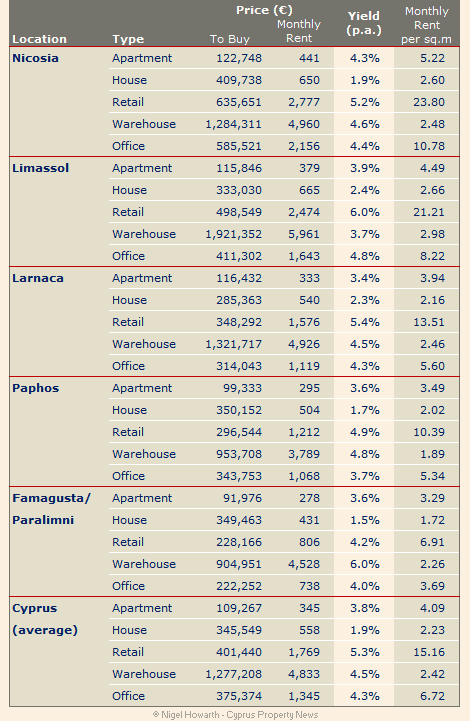
Yields are a useful tool showing the relationship between rent and property prices.  At the end of Q3 2013 average gross yields stood at 3.8% for apartments, 1.9% for houses, 5.3% for retail, 4.5% for warehouses, and 4.3% for offices.

RICS_Cyprus_Property_Price_Index-Q32013

(Derived from the RICS Cyprus Property Price Index for Q3 2013)

The parallel reduction in capital values and rents is keeping investment yields relatively stable and at very low levels (compared to yields overseas). This suggests that there is still room for re-pricing of capital values to take place.

Outline of properties used to calculate the index

Apartments: Residential, two bedroom, 85sqm, Medium quality.

Houses: Residential, three bedroom with garden, Semi-detached, 250sqm, Medium quality.

Retail: High-street retail, 100sqm ground floor area with 50sqm mezzanine.

Warehouse: Light industrial area, 2,000sqm, which includes 200sqm office space.

Office: Grade A, City centre location, 200sqm

(All property types used to calculate the index are: freehold, have all licences and permits in place, have their Title Deeds, are subject to VAT and are in a good state of repair).

Monitoring Process

The estimation of price levels is carried out by accredited RICS property professionals who are active in the relevant markets.

Methodology

The methodology underpinning the RICS Cyprus Property Price Index was developed by the University of Reading UK and may be viewed by clicking here.

MEP questions compliance with MoU (update)

UNDER the terms of the Memorandum of Understanding (MoU) agreed between Cyprus and the troika, the island’s government is obliged to publish quarterly reports of progress on a number of key parameters.

However, the first of these published progress reports (see Title Deed issuance progress and mortgages) fails to meet the requirements of the MoU.

In a written question to the European Parliament, MEP Daniel Hannan has asked the Commission what action it is taking, or proposing to take, to address this matter.

Question for written answer E-012351-13
to the Commission

Rule 117
Daniel Hannan (ECR)

Subject: Cyprus Memorandum of Understanding

The Cyprus bailout Memorandum of Understanding (MoU) states the following:

‘By [Q4-2014], eliminate the title deed issuance backlog to less than 2,000 cases of immovable property sales contracts with title deed issuance pending for more than one year. The authorities will enhance cooperation with the financial sector to ensure the swift clearing of encumbrances on title deeds to be transferred to purchasers of immovable property, and implement guaranteed timeframes for the issuance of building certificates and title deeds; publish quarterly progress reviews of the issuance of building and planning permits, certificates, and title deeds, as well as title deed transfers and related mortgage operations throughout the duration of the programme.’

Cyprus has just published the first quarterly progress review, which does not meet the requirements of the MoU.

For instance, title deeds transferred to purchasers, among other requirements, are simply not reported. Furthermore, given the reported 3,521 quarterly title deeds ‘issued’ for the second quarter, which are in any case issued in the developers’ names and cannot be transferred to the buyers until all encumbrances are removed, it is clear that the deadline of Q4-2014 for eliminating the backlog of over 100,000 cannot be met.

It would therefore appear that Cyprus currently has little intention of complying with the requirements of the MoU. What action is the Commission taking, or does it propose to take, to address this matter?

Answer given by Mr Rehn on behalf of the Commission (added)

It is correct that at July’s first review mission of programme conditionality, the Cypriot authorities met the MoU requirements only partially on the elimination of title deed backlogs, as reflected in the September Compliance Report:

http://ec.europa.eu/economy_finance/publications/occasional_paper/2013/pdf/ocp161_en.pdf

The Commission is currently working with the Cypriot authorities to improve the reporting so that the public is fully informed in the shortest feasible timespan.