Rich foreigners being fleeced over local taxes

RESIDENTS of two luxury developments in the Paphos village of Kouklia are refusing to pay their local taxes in protest at huge levies they say are being unfairly placed on them by the local council.

Residents of Aphrodite Hills and Ha Potami (Secret Valley) – developments within Kouklia’s municipal boundaries – say they are being penalised for being “rich foreigners” by Kouklia council, which is demanding massive taxes of up to 400 per cent more than for similar sized properties in the village itself.

Residents say this situation is a remnant of the previous council and also due to changes in who is responsible for the upkeep of common areas in five star developments.

Lanitis developers were responsible for all charges at Aphrodite Hills until 2010 when this passed on to Kouklia council. Aristo developers are now in the process of issuing title deeds for properties in Secret Valley – which means responsibility is being passed onto the local council to collect all taxes.

But residents of the developments say the council is made up mostly of villagers from Kouklia, who refuse to make taxes a set rate across the board.

Local resident Tony Raphael, 66, a British expat, and his wife retired to their two-bedroom ground floor apartment in Aphrodite Hills four years ago as permanent residents, after buying the property ten years ago.

Raphael says he has stopped tax payments for the coming year’s bill and lodged a formal complaint to the Paphos district office, claiming rates imposed on residents in Aphrodite Hills are inflated and illegal.

“We are expected to pay €275 council tax (plus our rubbish collection payments of €75) to Kouklia council and yet a similar two-bed flat in the village has a bill of just €50. All we are asking for is parity.”

An angry homeowner of a property in Secret Valley, who wished to remain unnamed, said she has taken a similar course of action.

“I have written a letter of complaint to the district office, noting my concerns over ridiculously high taxes being unfairly charged by the council,” she said. “The situation is deplorable and we are being penalised because we are seen to be rolling in cash. I am being discriminated against because I have worked hard all of my life in other European countries and chosen to retire here, make my life here and spend my hard earned cash here.”

Raphael says he was unable to complain about the charges when rates were paid to Lanitis developers. He also withheld his objections to give the current community leader Michael Solonos, elected in December 2011 municipal elections, the chance to get the council tax reduced as he had promised to do in his election manifesto.

Raphael accepts that there are a number of enormous villas in Aphrodite Hills but added that there are also a number of “fantastic” villas in Kouklia village proper. He says the authorities see foreign residents as an easy target.

“We love it here and we wouldn’t have bought here if we didn’t feel comfortable enough to make Cyprus our home. We don’t want to live in ‘little Britain,’ but there are undercurrents of racism here and I don’t think it will ever be eradicated,” he said.

“I sent my letter of complaint to the Paphos district office a month ago, and I’ve heard nothing at all. I have instructed the bank not to make any payments towards our tax bill.”

Raphael has also informed Solonos.

But according to one councillor, British expat Raymond Smith, it seems the community leader’s hands are tied, as seven of the eight council members are residents of Kouklia village who are opposed to substantial rises in taxes for villagers.

Describing himself as the lone voice on the council fighting for the rights of expat residents, Raymond Smith says the current impasse smacks of discrimination.

“Even with the mukhtar’s backing, we are outnumbered as the rest of the community board is made up of people who live in the village,” he said. “The village refuses to pay any increases in local taxes and they have the attitude that they are poor Cypriots and we are rich foreigners. It’s been like this for years and it’s time that things have to change.”

Smith added that British expats are nicknamed ATMs by the locals.

“The taxes need to be worked out fairly for everyone. Some taxes need to be raised – for example for those living in the village – and some need to be lowered, for people living in other areas of Kouklia.”

And in keeping with his election pledge, community leader Solonos is sympathetic to the concerns of his foreign residents.

“The communities’ law was fixed back in 1999 and legislation desperately needs to be updated. The guidelines are not exactly specific. It states that the council may charge an annual fee of up to €854 for community services to each property owner. This is calculated by the council and legislation says this depends on the value of the property,” he said.

Smith explained that Kouklia village had extremely low taxes for many years partly because previous councils received millions from building permits needed to build the Aphrodite Hills and Secret Valley developments.

“However, the previous council spent €3 million building a football stadium and €1.2 million funding the team. Consequently the current council inherited virtually nothing,” he said.

According to Smith, in 2012 taxes levied by the council on Aphrodite Hills were by far the highest. Apartment and town house owners were charged the same – some €350 – while villas were charged between €600 and €850. In addition, each property also had to pay €75 euros for rubbish collection. Villas in Secret Valley were taxed at €250.

Villagers only had to pay between €15 and €75, plus the €75 for garbage collection.

Taxes for 2013 have seen increases in many cases. At Aphrodite Hills apartment owners now have to pay between €150 and €400. Town-houses have been re-classified and are now charged €600, with villas now charged between €700 and €854. In Secret Valley, taxes have risen to €350 for villas.

The taxes for Kouklia village have also risen, by a meagre €5-10.

“I have objected in the strongest terms over the inequality of these taxes, but the other seven members of the council refuse to pay a fair share of taxes saying the village is a poor family village with many unemployed and so they cannot afford to pay,” said Smith.

“But there are many wealthy people living in Kouklia and many of the properties in Kouklia village are comparable with those found in Aphrodite Hills.”

Solonos explained that the final decision rests with the Paphos District office as they have the authority to oversee complaints.

The Paphos district office was unwilling to speak to the Sunday Mail, except to confirm that the complaints had been received and were being examined.

Cyprus councils fleece foreigners

No transparency in Land Registry system

IN 1981 I bought a new brick built three-bedroom house complete with garage, central heating and mains drainage on the outskirts of London. It cost £31,000 (€36,600). In 2002 I bought a brand new concrete villa in a small village in Cyprus. No garage, no central heating, no mains drainage with a 1980 value of €36,000, that is according to the Paphos Land Registry.

So both homes are worth roughly the same. Really? A house on the outskirts of London worth as much as a village house in Cyprus? I have tried to find out how the 1980 value was calculated but failed. I’ve been informed that is a secret formula used by the Land Registry which I wouldn’t understand. I can appeal the valuation by spending several hundred Euros on getting my own surveyor, but I’ve also been told that this will be a waste of time and money, so it’s cheaper to pay the IPT.

Today the house in the UK (according to Zoopla) is approaching £340,000 Sterling or €400,000. A resale Agent told me that if I wanted to sell my Cyprus villa it was worth about €230,000, but if I was offered €220,000 I should accept it. I wonder how much the Land Registry will value my villa for 2014?

Across the road are two similar properties built by Greek Cypriots on family land, I have no way of finding out what their 1980 value is.

There is no transparency in the system, and where there is secrecy there is always corruption. Close by is a small farm house, which is below the €12,500 threshold. It has been a family home for several generations. So whilst I pay my IPT having worked all my life to clear off a mortgage this house will contribute nothing, and has never had the onerous task of a mortgage. The land and property owned by the occupier way exceeds my income. What is fair about that? Why can some people be excused their share of support for our Government? Why should it be based on the value of a house?

I used all my savings and borrowed from our daughter to buy our title deeds, paying an inflated cost to the Land Registry well above the cost of the contract, and borrowing more to pay my developer’s tax bills.

My daughter lent us the money knowing we will never be able to repay it. Cyprus has it appears has always relied on foreigners to pay for the lifestyle of the many. With 70 per cent of the properties now excluded, having a 1980 value of €12,500 or less, the burden of reaching the troika threshold will fall on the remaining 30 per cent, mostly on the newly arrived expats. This amounts to both direct and indirect discrimination against foreigners and is contrary to EU Law. Our president says he wants a clean governance with responsibilities. Well as Huckleberry Finn said. “Just you saying it’s so, don’t make it so”.

Peter G Davis, Droushia

Lack of transparancy in the Land Registry system

New law enshrines rent reductions

A NEW law passed last night aims to slash residential and industrial rents for a period of one year, in a bid to ease the pressure on tenants and shopkeepers amid the financial squeeze.

Residential rents up to €300 will see a reduction of 15 per cent (up to €45). From €300 and above, a reduction of 20 per cent applies, with a maximum reduction in absolute terms of €120.

Commercial rents up to €600 will be slashed by 15 per cent (€90). For rents in the €600 to €2,000 bracket, there will be a 20 per cent decrease, but with a reduction cap of €250, including the €90 in the first bracket. Rents over €2,000 will see a reduction of 20 per cent with a cap of €400.

Any rent fluctuations agreed between the tenant and landlord during the period up to 24 months prior to the enforcement of the new law will be offset against the new arrangements. For instance, if a landlord has recently decreased your rent (initially set at €300) by 10 per cent, they must now cut it by a further 5 per cent only.

Moreover, in the event a landlord had the right under an initial contract with the tenant to raise the rent after a certain period of time (usually two years) but did not exercise this right, this will also be taken into consideration.

The law has force starting from November 1 this year and ending October 2014. It applies to all contracts (rents and leases) concluded prior to October 2012.

Any tenant or leaseholder with more than two rents in arrears must first settle the amount outstanding before being eligible for any of these reductions.

Lawmakers however have omitted to provide for a mechanism to resolve disputes, for example in the event a landlord refuses to comply with the provisions of the new law.

The legislation – voting on which was postponed several times – was authored by AKEL, despite opposition from business groups arguing that the market should be left to regulate itself.

New law enshrines rent reductions

Money off your Immovable Property Tax bill (updated)

immovable property tax savings
FINALLY, after more than two months of hot air, speculation, rumour and debate, amendments to the Immovable Property Tax law for 2013 were passed by a slim majority of MPs at yesterday’s plenary session of the House of Representatives.

Only 15 of the 54 MPs present voted for the bill amendments; 39 abstained.

Under the revised provisions of the Immovable Property Tax Law (No. 24/1980) all owners of property in Cyprus whose 1980 value exceeds €12,500 are liable to pay an annual tax to the Inland Revenue based on the total 1980 value of all immovable property registered in their name on 1st January 2013.

The amendment affects around 52,000 property owners and will result in some €12.7 million less revenue for the state.

The revised law, which was originally introduced in May, is designed to achieve one of the bailout conditions that Cyprus agreed with its international lenders, i.e. to ensure that a further €75 million is collected by the state from property taxation.

The revised Immovable Property Tax rates for 2013 are as follows:

Assessed 1980 Property Value
Tax Rate
Tax
Cumulative Tax
€1 to €12,500 nil €0 €0
€12,501 to ?€40,000 0.6% €240† €240†
€40,001 to €?120,000 0.8% €640 €880
€?120,001 to €?170,000 0.9% €450 €1,330
€170,001 to €?300,000 1.1% €1,430 €2,760
€?300,001 to €?500,000 1.3% €2,600 €5,360
€500,001 to €?800,000 1.5% €4,500 €9,860
€800,001 to €?3,000,000 1.7% €37,400 €47,260
More than ?€3,000,000 1.9%

†Those owning property whose total 1980 value exceeds €12,500 will pay tax on their total 1980 value.

The changes brought about by the final set of amendments for the current tax year:

  • Remove the minimum IPT payment of €75.
  • Exempt owners of properties whose total 1980 value is no more than €12,500 from IPT.
  • Owners of properties whose 1980 value exceeds €12,500 will pay tax on their total 1980 value and will not benefit from the €12,500 exemption.

To date, Immovable Property Tax notices have been sent to all owners of properties whose 1980 value is €12,500 or more and the state has collected approximately €14.4 million in additional revenue.

How much Immovable Property Tax (IPT) will I pay?

The amount of tax you pay will be calculated by an Inland Revenue officer and will be based on the total 1980 value of all the properties registered in your name as shown on their Title Deeds – or more correctly the ‘Certificate of Registration of Immovable Property’ – in Greek ‘????????????? ???????? ???????? ???????????’.

For example, if a property is registered in a single name and has a 1980 value of €60,000, its owner will be asked to pay:

On the first €40,000 – 0.6% = €240

On the remaining €20,000 – 0.8% = €160

Total IPT payable = €400

If the same property is registered in joint names (e.g. between a husband and wife) each of their IPT liability will be calculated on half the 1980 value – €30,000 – and each will be asked to pay:

On their half share (€30,000) – 0.6% = €180

Total IPT payable by both joint owners – €360 (€180 each)

Payment

Permanent residents

Permanent residents can either wait for their Immovable Property Tax notices to be delivered and then register and pay on-line via the JCC Smart website by clicking on the Inland Revenue icon – or they may visit their local Inland Revenue office, taking with them:

  • The Title Deeds for all the properties registered in their name – Form No. 131A – earlier version 131. (Note that clear photocopies may be acceptable).
  • Their ‘Yellow Slip’ – Certificate of Registration – Form No. MEU1.
  • A completed Form 303.
  • In some cases a completed Form 302 may be required.
  • ID Card or passport.

(Those who have received their Immovable Property Tax notice may also visit their local Inland Revenue Office or bank and pay using cash or credit card, taking the tax notice and ID Card or passport with them – participating banks – the Bank of Cyprus, Hellenic Bank, Alpha Bank Cyprus, Ethniki Bank (Cyprus), Piraeus Bank (Cyprus) Ltd, Emporiki Bank-Cyprus, USB Bank, Eurobank (Cyprus) or their co-operative bank).

Non residents

The registered owners of property who are not resident in Cyprus and who are unable to visit their local Inland Revenue office may appoint a representative on the island to deal with this matter on their behalf. They should provide their representative with:

Their permanent address and other contact details.

  • A clear copy of their passport.
  • A clear copy of the Title Deed for each property registered in their name.

Alternatively, they may send an email to [email protected] stating:

  • Their name and contact details (permanent address and telephone number)

The Inland Revenue will send them the forms to complete and return.

Inland Revenue forms 303 and 302

Inland Revenue forms 303 and 302 are only available in Greek, but to help English-speakers to complete them I have translated the both forms. In addition I have mapped the relevant entries on a Title Deed to the relevant table entries on the form 303. (Note that the table on form 302 is identical to that on the form 303).

Click here to download translated form 303 (with example) and here to download translated form 302.

Early payment discount

Those who pay their IPT by 5th November will enjoy a 10% discount, while those who delay paying until after the 15th November will face a penalty of 10% on the tax they owe plus a pro-rata 4.75 per cent annual interest rate.

Inland Revenue help lines

The Inland Revenue has opened a number of help lines for those with Immovable Property Tax queries:

Nicosia
Limassol
Larnaca
Paralimni
Paphos
22807488 25803700 24803658 23811458 26804342
22807277 25803837 24803655 26804337

Acknowledgements

I would like to thank Mrs Liana Charalambous Tanou, Chief Revenue Officer with the Inland Revenue Department in Nicosia, and the management and staff of the Limassol Inland Revenue office for their time and patience in explaining the IPT payment system to me.

Further reading

Pavlos Loizou, Managing Partner at Leaf Research has prepared a presentation on Immovable Property Tax in English and Greek.

Building permits fall 15 per cent in July

THE NUMBER of building permits issued in July stood at 519 compared with the 613 issued in July 2012; a fall of 15%, according to figures released earlier today by the Cyprus Statistical Service.

Compared with July 2012, the total area of these permits fell to 81,682 square metres from 142,702 (-43%), while their value decreased to €91.098 million from €147.947 million (-38%).

During July, building permits were issued for:

  • Residential buildings – 350 permits
  • Non-residential buildings – 97 permits
  • Civil engineering projects – 17 permits
  • Division of plots of land – 47 permits
  • Road construction – 8 permits

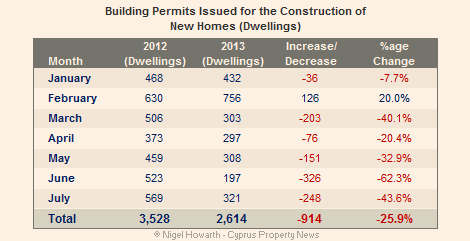
During the first seven months of 2013 a total of 3,220 building permits have been authorised; a drop of 25% compared with the 4,284 permits issued during the same period last year. Their total value has fallen by 20% and their total area by 28%.

New home construction

The 350 residential building permits approved in July provided for the construction of 321 new homes comprising 162 single houses and 159 multiple housing units (such as apartments and other residential complexes).

This is a fall of 39% compared with July 2012 when building permits were issued for the construction of 569 new homes.

During the first seven months of 2013, the number of new homes for which permits were authorised has fallen by 25% compared with the same period last year.

Cyprus-new-home-construction-July-2013

According to the Cyprus Statistical Service, building permits constitute a leading indicator of future activity in the construction sector.

Cyprus slips in Top of the Props chart

CYPRUS slipped two places to number fourteen in the September edition of the ‘Top of the Props’ published by the property portal TheMoveChannel.com, accounting for 1.44% of on-line searches on the property portal.

America retained its number one position for a second successive month accounting for more than a quarter of all overseas property enquiries, while Spain, Portugal and France kept their second, third and fourth positions.

Brazil moved up two places to the number five spot, followed by Italy (which dropped a place) and Canada (up 4). Thailand came in at number eight followed by Turkey and Hungary at numbers nine and ten respectively.

TheMoveChannel.com Director Dan Johnson comments: “US property has been the number one market for investors for most of 2013. The top six countries on TheMoveChannel.com in September 2013 were USA, Spain, Portugal, France, Brazil and Italy. With the exception of Spain’s slide into second, this top six is the same as it was one year ago, a sign that investors have lost no interest in the familiar European markets.

“America, though, is racing ahead of the pack. In the first nine months of 2012, Spain had been the most popular destination on TheMoveChannel.com for nine months. This year, the US has been the most popular destination for seven months; buyer tastes are the same, but the focus has shifted. With its share of activity surging 11.03 per cent across the third quarter of 2013, the American government may be shutting down, but international interest in US real estate is only just firing up.”

The full breakdown of the September 2013 edition of the Top of the Props chart is as follows:

Rank
Country
Share (%age)
Change
1 USA 25.66 No change
2 Spain 8.04 No change
3 Portugal 7.06 No change
4 France 4.37 No change
5 Brazil 4.12 Up 2
6 Italy 3 Down 1
7 Canada 2.95 Up 4
8 Thailand 2.69 Up 5
9 Turkey 1.72 Down 3
10 Hungary 1.72 Up 9
11 Greece 1.69 Down 3
12 Germany 1.62 Down 3
13 Cape Verde 1.5 Down 3
14 Cyprus 1.44 Down 2
15 Bulgaria 1.38 No change
16 Ecuador 1.34 Up 8
17 Malta 0.83 Down 1
18 Croatia 0.83 Down 1
19 Dominican Republic 0.74 Down 1
20 India 0.54 Down 6
21 Cayman Islands 0.54 Up 8
22 SENEGAL 0.5 No change
23 UAE 0.4 Down 2
24 Australia 0.4 Up 10
25 Poland 0.35 Up 6
26 St Lucia 0.32 Up 4
27 Switzerland 0.31 Up 6
28 Jamaica 0.29 Up 8
29 Belize 0.26 Up 6
30 Barbados 0.24 Down 7
31 St Kitts and Nevis 0.24 Down 11
32 Egypt 0.22 Down 7
33 Montenegro 0.21 Down 5
34 Slovenia 0.21 No change
35 South Africa 0.19 Up 3
36 Albania 0.18 Up 13
37 Austria 0.16 Down 10
38 Belgium 0.16 No change
39 Czech Republic 0.14 Up 4
40 Romania 0.1 Down 3

Founded in 1999, TheMoveChannel.com is the leading independent website for international property, with than 400,000 listings in over 100 countries around the world, marketed on behalf of agents, developers and private owners. Its ‘Top of the Props’ chart is based on the number of on-line enquiries for property in different countries around the world.