Sharp increase in non-performing loans

IMF-buildingAN EVALUATION report published by the International Monetary Fund (IMF) a few days ago showed that non-performing loans (NPL) in Cyprus accounted for almost 30 per cent of total loans at end-March 2013.

Moreover, the depreciation in their value is only 30% compared to the 50% of other European banks, suggesting that profitability will be significantly impaired going forward. Furthermore, the reclassification of NPLs to include all loans in arrears for more than 90 days, as agreed with the troika, will lead to even higher levels of NPLs.

The report highlights the fact that the current private sector debt-to-GDP ratio is close to 280 per cent, which is the highest in Europe and approximately double the EU average and that corporate credit has been concentrated in the real estate and construction sectors.

The report also highlights that unemployment climbed to 17.3 per cent in June compared with 11.7 per cent a year before; the highest year-on-year change in the Eurozone. Unemployment, which the IMF anticipated would rise to 17 and 19.5 per cent in 2013 and 2014 respectively, currently stands at 15.5 per cent.

Further reading

Cyprus – IMF Country Report No. 13/293 (September 2013)

Alpha Bank on the back foot

Cyprus home buyers sue Alpha BankA NUMBER of Christofi Law Clients have received letters from Alpha Bank, headed “without prejudice”, offering to restructure their loans.

The bank writes that it does so because of the “global crisis” and the proposal is intended to assist its customers either to continue to pay off their existing obligations or to allow them to “fully settle the loan” through what the bank describes as “a work out loan in Euro or Sterling”.

The letter goes on to outline that they are prepared to discount “a significant amount” for full and final settlement.

The letter requires a response by 18 October mentioning that new agreements will have to be entered into, which they describe as “formalities” (presumably a waiver of any existing claims). It is not clear what the significance of the deadline is, but the deadline is very close to the limitation period for issuing proceedings coming to an end for most mis-sold mortgages in Cyprus (December 2013 ). The reference so close to limitation raises the issue of whether the letters are intended to lull people into missing the issue deadlines.

Of course it is also possible that Alpha Bank are on the back foot and have realised that a substantial percentage of its loan portfolio may be declared unenforceable given the number of challenges that have been raised.

Christofi Law have encouraged one client to write back and see what the bank has on offer and will report in more detail in due course. If the bank proposal is genuine, those who have signed up with representatives who offer a proposal based on a percentage of loan saved might sensibly want to bypass their representative to go direct to the bank and see what the bank has to offer. In which case people are reminded to head up their letters with a protective “without prejudice”.

Text of letter sent to Christofi Law clients:

Dear Customer

Loan granted by Alpha Bank Cyprus Ltd (HE923) of Chilonos & Gladstonos Corner, Stylianos Lenas Square, 1101, Nicosia to XXX with loan account number commencing with the numbers XX and ending with the numbers XXX for the initial amount of CHF XXX-(the ‘Loan’).

The Bank, acknowledging the global economic crisis and its consequences on individual households, has decided as a gesture of good will and in order to facilitate you in meeting your repayment obligations to the Bank, to offer to you, for a limited period of time, a scheme that will assist you to either:

(a) continue repaying your obligations to the Bank, or

(b) allow you to fully settle the Loan.

The options available under the scheme are briefly outlined below:

1. Discounting of a significant amount on the current outstanding balance of the Loan and re-financing of the Loan through a new work-out loan in Euro or Pound Sterling to be granted to you by the Bank.

2. Discounting of a significant amount on the current outstanding balance of the Loan for full and final settlement of the Loan, through your own means.

We are available for further details regarding the above. We firmly believe that with the Bank’s support and your co-operation, your selection of either option, will, upon the completion of the formalities required by the Bank, assist you in either fully and finally settling your obligations to the Bank under the Loan or in rearranging your obligations to the Bank under the Loan, with the added benefit of a substantial discount to the sums due by you under the Loan.

To take advantage of this scheme and for further assistance in this matter please contact Mr Christos Koumas at Larnaca Foreign Citizens Housing Loans Department, contact number tel: 00357-24824419, e-mail address: [email protected], by 18th October 2013 at the latest.

This letter is sent to you without prejudice and in full reservation of the rights of the Bank. It is further clarified that any arrangement in the above context will be subject to the final approval of the Bank and to the execution of any new and/or additional and/or supplemental documents which the Bank considers necessary.

Capital controls to end in January 2014

PRESIDENT Nicos Anastasiades said in an interview with Bloomberg in Nicosia yesterday that Cyprus will lift restrictions on the movement of capital in January 2014.

In the interview the president stressed that his administration’s goal is to create the necessary conditions for growth to successfully deal with the problem of unemployment and to stabilize the financial monetary system.

“The goal right now is to create the conditions for growth and tackle the serious problem of unemployment, to stabilize the financial system,” Anastasiades said. “The controls are being lifted. They will end within a timeframe of January 2014.”

The lifting of capital controls will come as welcome news to those who have managed to sell their properties on the island but who have been unable to repatriate the total proceeds to their home countries.

Get a breakdown of your Immovable Property Tax bill

REGISTERED owners of multiple properties who have received Immovable Property Tax notices (?.??. 316) can now print an itemised breakdown of their properties showing the tax due on each.

The Inland Revenue Department issued the following announcement to assist taxpayers:

ITEMIZED BREAKDOWN OF REAL ESTATE – IMMOVABLE PROPERTY TAX

Please be informed that the Inland Revenue Department (IRD) through the website www.jccsmart.com, enables you to print an itemized breakdown of your real estate, which corresponds to the JCC reference number printed on the Tax Return sent. The itemized breakdown is linked to the information received from the Department of Lands and Surveys.

Note that, if the total value of the property as stated in the itemized breakdown, is greater than the corresponding amount mentioned in the Tax Return, this is probably due to the recent revaluation of any of your property by the Department of Lands and Surveys.

In case where the total value of the property as stated in the itemized breakdown, is less than the corresponding amount mentioned in Tax Return, this is probably due to information contained in the tax file maintained by the IRD.

Note that registered owners are those who have the Title Deeds to their property.

Further reading

Immovable Property Tax Notice – Form 316 (with English translation)

Inland Revenue announcement (English)

Inland Revenue announcement (Greek)

New home construction plummets

THE NUMBER of building permits issued in June 2013 stood at 416 compared with the 618 issued in June 2012; a fall of 33%, according to figures released by the Cyprus Statistical Service earlier today.

Compared with June 2012, the total area of these permits fell to 63,687 square metres from 134,085 (-53%), while their value decreased to €64.621 million from €126.585 million (-49%).

During May, building permits were issued for:

  • Residential buildings – 277 permits
  • Non-residential buildings – 72 permits
  • Civil engineering projects – 31 permits
  • Division of plots of land – 32 permits
  • Road construction – 4 permits

During the first half of 2013 a total of 2,701 building permits have been authorised; a drop of 26% compared with the 3,671 permits issued in the first half of 2012. Their total value fell by 17% and their total area fell by 25%.

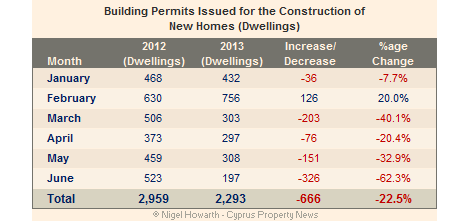
New home construction

The 277 residential building permits approved in June provided for the construction of 197 new homes comprising 121 single houses and 76 multiple housing units (such as apartments and other residential complexes).

This is a fall of 62% compared with June 2012 when building permits were issued for the construction of 523 new homes.

During the first half of 2013, the number of new homes for which permits were authorised has fallen by 23% compared with the first half 2012.

Cyprus new home construction June 2013

According to the Cyprus Statistical Service, building permits constitute a leading indicator of future activity in the construction sector.

Land Registry myth exploded

cyprus land registry mythALTHOUGH the Executive Board of the International Monetary Fund Cyprus recently praised Cyprus for the progress it has made in the rescue program agreed with the Troika,  (IMF, EC and ECB), a number of troika officials must be shaking their heads in disbelief on the issue of property taxation.

Yesterday, as parliament continued its discussions on numerous proposals to amend the Immovable Property Tax law, it was revealed that the Land Registry does not have precise ownership details for approximately 250,000 properties, making the collection of Immovable Property Tax on these properties this year impossible. According to the director of the Inland Revenue Department, George Poufos, this was due to old weaknesses in the system.

With a population of less than one million, it beggars belief that there could be a quarter of a million properties on the island for which the Land Registry does not know the true identity of their owners. Even if you allow for (say) 50,000 for properties purchased by non-residents who are lucky enough to have their Title Deeds, that still leaves the ownership of 200,000 properties to be correctly and fully identified – and their owners taxed (plus the many unregistered properties for which no building permits have been issued).