Real estate bank a possibility

THE authorities and the Bank of Cyprus are examining the possibility of establishing a real estate bank to improve its balance sheet and reduce the emergency liquidity in its books.

The various options for the Bank of Cyprus are being examined by the Central Bank and the Ministry of Finance in cooperation with consultants McKinsey and Alvarez & Marsal.

Another possibility is to set up an asset management company of the bank, which was included in the original conditions contained in the Memorandum of Understanding.

The difference between a real estate bank and an asset management company has to do mainly with the handling of the Emergency Liquidity Assistance (ELA).

The study is not expected to be completed before September, when the restructuring plan of the Group will be ready.

Help for cash-strapped homeowners

RATHER than face eviction, people unable to keep up with their mortgage payments will be able to continue dwelling in their home as tenants, under a scheme prepared by the government.

Essentially the state will buy from the banks houses that are up for seizure. Dubbed “Rent instead of Repossession,” the plan is targeted at low-income households.

The scheme will be implemented via the Cyprus Land Development Corporation (KOAG), a public-law corporation that is under the jurisdiction of the Interior Ministry.

Moreover, those eligible and who apply for the programme will also be given the opportunity to buy back their real estate property after five years.

KOAG will buy from the banks properties facing foreclosure at their current estimated market value. In the event this value exceeds what the property owner owes to the bank, the difference will be credited to the homeowner’s account.

Conversely, any outstanding debts after the transaction are still owed to the bank.

The scheme concerns homes of a current market value up to €200,000, and eligibility depends on a person’s or family’s gross annual income, as follows:

  • Single persons, with an income up to €13,000;
  • Single persons with health problems, income up to €21,500;
  • Single-parent families with one child, income up to €20,000, and an additional €2,000 for every additional child;
  • Married couples without children, income up to €22,000;
  • Families with one or more persons with a disability, income up to €33,000.

In addition, to be eligible a person cannot own more than one house, or any other property worth over €20,000, and he or she must have exhausted all other means to have their debt restructured.

The plan provides for low (subsidised) rents, and promises to keep confidential a person’s change of status from property owner to tenant.

According to the proposal drawn up by the Finance Ministry, the project is fundable and will be managed by redistributing funds credited to existing housing schemes of the Interior Ministry.

To implement the scheme, KOAG will be topped up with an additional €60 million for three fiscal years (2013, 2014 and 2015). The Finance Ministry claims the plan can be implemented with a “neutral fiscal effect.”

Help for cash-strapped home owners

Court rules eight banks overcharged on loans

A CROATIAN court ordered eight commercial banks to recalculate loans denominated in Swiss francs into the national currency at a fixed interest rate, saying they had overcharged borrowers.

Judge Radovan Dobroni? ruled that the banks acted contrary to the provisions of the Consumer Protection Law as they contracted loans denominated in Swiss Francs while failing to advise clients of the potential risks.

“This is contrary to the provisions of the Consumer Protection Law, a violation of the Law of Obligations, and the banks are required to reduce the principal to the amount of the domestic currency, Croatian kuna, issued at the beginning of the loan. The interest rate should be applied to the principal calculated in kuna.

“The applied interest rate should be the same as the one determined at the beginning of loan, and it has to be fixed interest rate for the whole repayment period.

“Burden of litigation costs borne by the bank,” said judge Dobroni?.

The plaintiffs’ counsel, Nicole Kwiatkowski, is satisfied with the first-instance judgment and pointed out that the judgment was positively though, is still only the first instance verdict. “We have done a lot, but it still does not mean that something will change for those citizens who have been harmed, because there is still appeal” – said Kwiatkowski.

Economist Branka Luka?evi?-Gregi? said “The judge has successfully applied the laws on the economic matters showing exceptional knowledge and understanding of the problem noting all the harmful effects in the synergy of contractual parameters.

“Finally, the judge pointed out well that the variable interest rate unilaterally applied to the variable amount of the principal (application indexed). The loan user, as a non-professional, had very little information and all the risk on their backs compared to banks, which are professionals and had all the information available and transferred almost all the risks to the consumers”.

This ruling will not compensate individual loan users, who will have to raise individual claims against the banks. To avoid high pressure on the bank and the judiciary, the judge urged the bank to reconsider the settlement.

Four of the banks said they would appeal against the verdict, which local media portrayed as a victory for consumers whose rights will be enhanced following the country’s recent accession to the European Union.

The other four banks, which are also expected to appeal, were not available for comment and the central bank, which regulates and monitors the banking system, declined to comment.

The lawsuit was filed by Potrosac, a consumer protection group, on behalf of 100,000 citizens who had taken loans pegged to the franc in the past decade, three-quarters of them housing loans.

Last month Poland’s financial watchdog, KNF, stepped in to curb local banks granting mortgages denominated in a foreign currency. Its recommendation, which will come into force at the end of this year, urges lenders to issue mortgages in the same currencies as clients get their income.

Property sales keep falling (updated)

ECONOMIC instability, lack of liquidity, high interest rates, record levels of unemployment and uncertainty over the future have brought Cyprus’ property market to a virtual standstill.

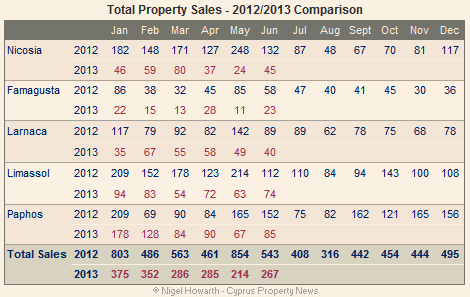
Latest figures from the Department of Lands and Surveys show that a total of 267 contracts of sale were deposited at Land Registry offices across Cyprus in June 2013 compared with the 543 deposited in June last year; an annual decline of 51%.

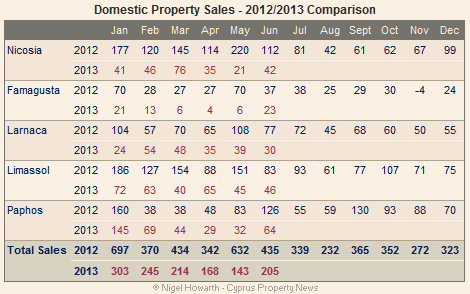
Of those 267 contracts, 77% (205) were deposited on behalf of domestic buyers, while 33% (33) were deposited in favour of overseas buyers.

Sales fell in all districts: Nicosia -66%, Famagusta -60%, Larnaca -55%, Paphos -44% and Limassol -34%.

During the first half of 2013 a total of 1,779 properties were sold, falling 52% compared with the 3,710 sold during the first half of 2012. This downward trend is expected to continue while the downturn in the island’s economy persists.

Total property sales - June 2013

Domestic sales

Domestic sales in June were down 53% compared with June last year, with sales falling in all districts.

Sales in Nicosia fell 63%, while those in Larnaca fell by 61%. Sales in Paphos, Limassol and Famagusta were down 49%, 45% and 38% respectively.

Speaking to Stockwatch, property valuator Polys Kourousides attributed the fall in sales to the lack of liquidity in the market.

Mr Kourousides noted “People expect the situation in the banking system to be stabilized in order to make movements” stressing that “the only solution for the industry’s recovery is to offer incentives to foreign investors.”

Cyprus domestic real estate sales - June 2013During the first half of 2013 a total of 1,278 properties were sold to domestic buyers compared with the 2,910 sold during the first half of 2012; a fall of 56%.
Overseas sales

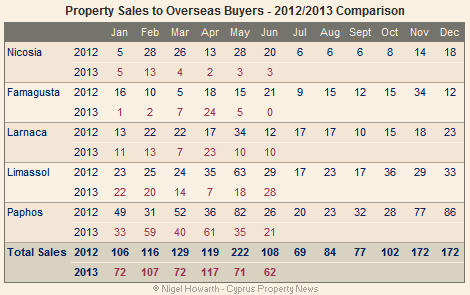
Overseas sales in June were down 43% compared with June last year. Famagusta recorded zero sales, and sales in all the other districts fell.

Sales in Nicosia fell 85%, while those in Paphos fell by 19%. Sales in Larnaca and Limassol were down 17% and 3% respectively.

Antonis Loizou FRICS said that although the Chinese market boomed between October 2012 and April 2013, it has slowed as a consequence of the Eurogroup decisions and the behaviour of a number of property developers who had sold homes at a value higher than their actual worth.

Mr Loizou warned “Developers should be very careful because the Chinese market is the only market left and we should not think that we can exploit them because there are other countries that offer similar incentives”.

Mr Kourousides said “We need entrepreneurs to behave with maturity and responsibility and to be aware that the competition is international and exacerbated,” adding that we should protect the interests of foreign investors and buyers.

Cyprus overseas property sales - June 2013

During the first half of 2013 a total of 501 properties were purchased by overseas buyers compared with the 800 they purchased during the first half of 2012; a fall of 43%.

China Glory flirts with new plots

CHINA Glory International Investment Group, which acquired Venus Gold Resort against €290 million, is considering purchasing new plots.

According to sources, the company is considering buying plots of land in Limassol, Larnaca and Paphos.

As for the implementation of the agreement for the acquisition of Venus Rock, it is progressing normally.

The company’s offices in Nicosia are delivered tomorrow and will be located at the Hilton hotel. It’s been two months now that the company went into hiring Manager to handle operations in Cyprus and will soon move into recruitment.

The sale of Venus Rock Estates was announced on May 20. Dolphin Capital Partners announced that the subsidiaries of Aristo Developers and Venus Rock Estates disposed their share in Venus Gold Resort against €290 million. Dolphin controlled 49.8% of the project and the remaining is controlled by companies belonging to Mr Theodoros Aristodimou.

The purchase price of €290 million represents discount 22% from the latest valuation of Venus on December 31, 2012 which reached €370 million.

The company’s Chairman, Charles Zhang met in May with the President of the Republic in the presence of Theodoros Aristodimou.

The project will include two golf courses, five-star hotel (Nikki Beach Hotel), two large sports centres, shopping centres as well as housing units.

China Glory flirts with new plots

Bill to extend Immovable Property Tax deadline

property-taxA DRAFT BILL to extend the payment period for Immovable Property Tax to November 15 will be put before the Cabinet in the next few weeks but the tax brackets will not change.

According to reports, the extension of the time period from September 30 to November 15 was necessary to enable the appropriate department to print, file and send property owners the owed tax amounts.

The time needed for printing the letters is estimated to be approximately two and a half months, not including placing them in envelopes and mailing.

Reports claim that the government is in no position to change the new tax brackets that were passed in the plenary a few months ago, as it was not possible to gather the necessary information from property owners whose property value exceeds the value listed on the land registry’s records.

Meanwhile, president Anastasiades has requested that the information be re-assessed as gaps had been found in the taxing of property which had been developed and gained greater value but was presented at the land registry office as simple plots.

Based on recent legislation, the government expects to receive €100 million of the estimated €130 million in taxation of property following deductions that will be made as part of its Troika commitments.

More specifically, property estimated between €0 and €40,000 based on prices in 1980 will be taxed at 0.6%. Property worth between €40,001 and €120,000 will be taxed at 0.8% and for property worth between €120,001 and €170,000 the tax will come to 0.9%

Property ranging from €170,001 to €300,000 will be taxed at 1.1%, property worth €300,001 to 500,000 at 1.3% and for property worth between €500,001 and €800,000 tax will come to 1.5%. Finally, any property that is worth between €800,001 and €3m will be taxed at 1.7% and for anything above €3m tax will come to 1.9%.

Bill to extend IPT deadline