Property price corrections are slow

PRICES of residential properties in Cyprus are almost double those of 2003, according to new statistics from the European Central Bank.

The statistics show a sharp rise in property prices in recent years, resulting in the exclusion of many first-time homebuyers from the market.

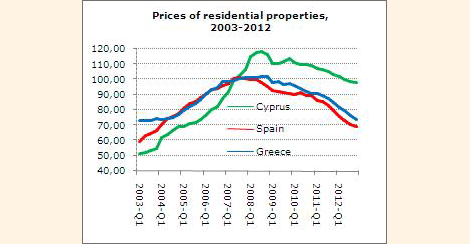
The residential property price index from the European Central Bank also shows that, despite the reduction in sales, the fall in property prices is relatively small compared to the large price corrections that have taken place in the other “memorandum” countries of Spain and Greece.
Residential Property Prices 2003-2012

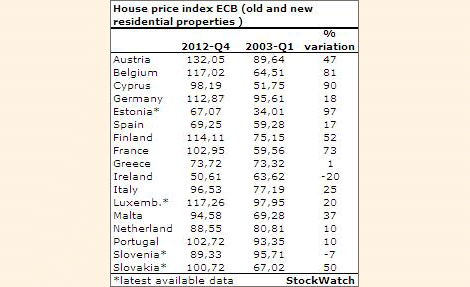
According to ECB data elaborated by StockWatch, property prices in Cyprus were 90% higher in 2012 compared to ten years ago.

The only country that shows a higher increase in property prices is Estonia, where prices have risen  by 97% since 2003.

In France, prices rose by 73%, in Belgium by 81% and in Germany by only 18%.

Things are different in the countries of memorandum. In Greece, prices have dropped to levels of 2003, having lost close to 30% of the levels they were in 2007.

In Spain, the decade increase is restricted to 17% and in Portugal to 10%.

On the other hand, residential property prices in Ireland have suffered significant and rapid correction having dropped to levels 20% below the 2003 prices.
European Central Bank - Hose Price INdex

Based on the European Central Bank statistics, prices of new and old residential properties in Cyprus recorded one of the biggest increases in the eurozone. From 2003 to 2008, prices jumped by 130%; in the past five years they have dropped by 17%.

The relatively mild correction emerged despite the large decline in sales from 12.6 thousand units in 2003 to about half that number in in 2012.

The rapid development of real estate led to an oversupply in the real estate market, which is currently not being absorbed due to the difficulties in the disposal of properties by the banks.

Banks have recorded hundreds of millions of losses from bad loans in the industry. According to Pimco, the Bank of Cyprus is estimated to have suffered losses of €0.8 billion from loans to developers.


Property price corrections are slow

Millions owed by big names

A COMMITTEE of inquiry investigating how the country’s banking system came to near collapse, yesterday asked the Bank of Cyprus (BoC) to confirm press reports on a number of problematic loans the bank had handed out between 2006 and 2011.

Eraclis Eracleous, with the BoC’s credit risk management department, was asked to list a series of problematic loans, most of which were unsecured. Some of the loans were readily handed to property developers without real caps up until 2008, when the sector overheated, he said.

Eracleous told the inquiry that although some loan applications would originally get rejected, they would eventually be given following pressure from high ranking bank members. He was not asked to clarify, although he said that loans pertaining to executives or interested parties needed to be approved by the board.

Aristo Developers which had a loan portfolio of €24.54 million in 2006 when its owner Theodore Aristodemou was a board member, ended up amassing €198.59 million by 2011, Eracleous said.

There was no estimate as to whether the debt was recoverable. Eracleous said. Aristodemou was elected BoC chairman in 2008, and had a stake in Dolphin Capital Atlantis Ltd which bough Aristo’s full stake at the time. He later bought back majority stake in Aristo, now a private company.

D. Michael Constructions ended up amassing some €10.5 million in debt with the BoC by 2011, from €1.47 million in 2006.

The Libra group, dealing with real estate and hotels and run by majority shareholder businessman Andreas Drakos, owed the BoC some €16.96 million in 2006 and increased its debt to €114 million in 2011, Eracleous said.

Louis Group owed the bank €31 million in 2006, but increased its debt portfolio to €114.41 million by 2011.

A company connected with former chairman of Omonia football club, Miltiades Neophytou increased its debt from €5 million in 2006 to €14.95 million. Neophytou used a substantial part of his debt to finance his football club, the inquiry heard.

Hassapis Land Developers raised their loan portfolio to €130.07 million by 2011, from some €5.6 million in 2006.

PrimeTel’s “high risk” debt stood at €35.74 million in 2011, Eracleous said.

S.Z. Eliades amassed €38.93 million in 2011 from €1.8 million in 2005, while SFS group held €80.68 in debt with the bank in 2011, from €48.87 in 2006.

Hadjiyiannis hotels in Famagusta has €31.18 million debt, which is potentially unrecoverable.

Quality Group amassed a €73.59 million debt in 2011, from €7.03 million.

Millions owed by big names in property development

Severe property slump grips the island

THE FIFTEENTH edition of the RICS Cyprus Property Price Index, which is produced in conjunction with the Association of Quantity Surveyors and Construction Economists, reveals that the fall in property prices across the island accelerated in the second quarter of 2013

Over the quarter, prices of residential apartments and houses fell by an average of 4.2% and 5.0% respectively.

Apartment prices in Paralimni/Famagusta fell 6.7% over the quarter, followed by Nicosia (-5.2%), Limassol (-3.9%), Paphos (-3.3%) and Larnaca (-2.4%).

House prices in the Larnaca fell 9.2% over the quarter, followed by Paralimni/Famagusta (-6.6%), Nicosia (-4.1%), Paphos (-3.0%) and Limassol (-2.6%).

RICS Cyprus commentary

During the second quarter of 2013 Cyprus bore the consequences of the decisions of the Eurogroup on 15 and 27 March to “bail-in” the depositors of two of Cyprus’ largest banks, to close down Laiki Bank, and to impose capital restrictions. The implications of these decisions were unfolding throughout the quarter, with no bank finance being available and deposits being blocked in bank accounts.

Given prevailing economic conditions and the turbulence in Cyprus’ banking system, there was a lack of transactions during the quarter. Local buyers in particular were the most discerning as the increase in unemployment and the worsening prospects of the local economy led to a sharp reduction in interest. Furthermore, those interested were unable to access bank-finance or their deposits.

Price changes over the past year

Compared to Q2 2012, the average price of a residential apartment has dropped by 12.6%, while the price of an average house has fallen 11.2%.

Prices for commercial property have also fallen, with the price of retail units falling by 23.3%, while the prices of offices and warehouses have fallen by 13.0% and 14.8% respectively.

Gross rental yields

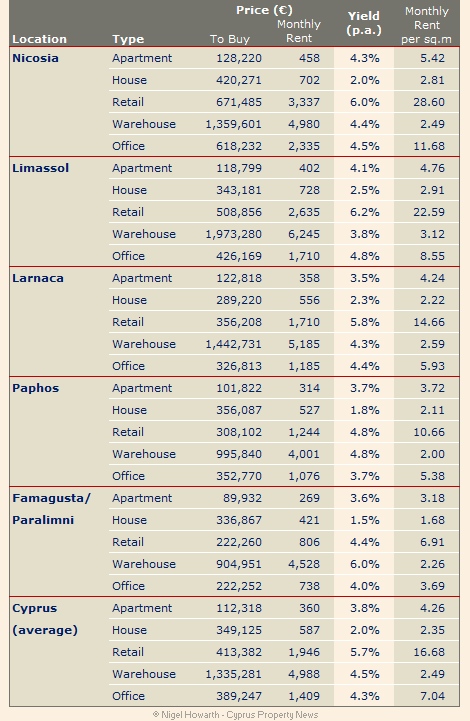
Yields are a useful tool showing the relationship between rent and property prices.  At the end of Q2 2013 average gross yields stood at 3.8% for apartments, 2.0% for houses, 5.6% for retail, 4.5% for warehouses, and 4.3% for offices.

Derived from the RICS Cyprus Property Price Index for Q2 2013

The parallel reduction in capital values and rents is keeping investment yields relatively stable and at very low levels (compared to yields overseas). This suggests that there is still room for re-pricing of capital values to take place.

Outline of properties used to calculate the index

Apartments: Residential, two bedroom, 85sqm, Medium quality.

Houses: Residential, three bedroom with garden, Semi-detached, 250sqm, Medium quality.

Retail: High-street retail, 100sqm ground floor area with 50sqm mezzanine.

Warehouse: Light industrial area, 2,000sqm, which includes 200sqm office space.

Office: Grade A, City centre location, 200sqm

(All property types used to calculate the index are: freehold, have all licences and permits in place, have their Title Deeds, are subject to VAT and are in a good state of repair).

Monitoring Process

The estimation of price levels is carried out by accredited RICS property professionals who are active in the relevant markets.

Methodology

The methodology underpinning the RICS Cyprus Property Price Index was developed by the University of Reading UK and may be viewed by clicking here.

Developers are the problem says bank chairman

SPEAKING on the state radio the temporary Chairman of the Bank of Cyprus, Sophocles Michaelides, said that the Bank is facing a huge number of non-performing loans, the majority of which stem from the land development sector which has received billions of Euros in loans which currently cannot be served.

“I have to tell you that these loans came from deposits and the bank although it pays interest on deposits it has not received interest from land developers. These are the major insecurities deriving from the property sector and not from households and small businesses, which are mostly very consistent”,  said Mr Michaelides.

He stressed that the bank does not have many options and should follow this practice.

Then, he criticized previous management and administration which, as claimed, did not follow best practices as they did not assess the risk of each loan, they did not analyse the concentration of loans in a sector or industry, leading to excessive concentration of loans in the field of land development.

He expressed the view that the persons of previous administrations that were responsible for the mismanagement should be apologizing before the courts or the legal service.

He noted that the idea of separation is based on modern practices in relation to banking issues.

“Already, much effort has been made internationally to separate commercial banks from the investment ones, as the general terminology is,” he added.

Bank of Cyprus is one of the largest creditors in land development, and according to Pimco, around €0.8 billion or 25% of the loans injected in this sector could become problematic.

Asked to comment on whether the idea of separation is of the transitional Board of Bank of Cyprus or the Central Bank, Mr Michaelides explained that “the transitional Board has as a general mandate to restructure the organization and the Restructuring Committee headed by interim CEO Christos Sorotos – and we concluded that an excellent way to move the bank to consolidation was this separation.”

He clarified that the separation of bank in commercial and real estate is still in its early stages and has many aspects, which should be studied in detail in relation to the provisions of the banking law, in accordance with the instructions of the European Central Bank, based on the rights of the new shareholders and the tax implications for investors.

“There is consensus between the government, the Central Bank and the Bank of Cyprus to move forward with the study and that’s what we will do.”

He said that two meetings were made with the troika about the issue last Saturday and expressed the view that this practice will be adopted as it is one-way.

He explained that, basically, loans of about 50 land developers, which are currently non-performing, will be transferred to the new bank.

Mr Michaelides, in an effort to dispel initial reactions and concerns by households, ensured that this class of people has nothing to fear as these, he said, belong to the core banking operations.

“On the other hand,” he added, “we care about the average customer. Already, whoever has a problem is coming to us to negotiate his loan so as to be relieved temporarily.”

On the question when the bank will leave the resolution regime, Mr Michaelides said on July 31.

The shares will be distributed to private shareholders and a general meeting of shareholders will be held to elect the new Board of Directors.

Developers are the problem says bank chairman

How we could deal with the transfer of BoC assets

Bank-of-Cyprus-HQTHE physical transfer of the banks’ assets (mainly owned and repossessed collaterised assets) to an Asset Management Company (AMC) has been the case of extensive debate and discussion in Cyprus (and the EU).
Taking into account the solutions provided in Germany, Ireland, Spain and Portugal, it seems that there are two key forms of structures that our banks could potentially adopt in Cyprus:

The German Structure

The first one relates to the asset division which takes place at the banking entity.

In this structure, the shareholders of the ‘good’ bank (with the ‘good’/performing loans) are also the owners of the ‘bad’ bank (non-performing/repossessed assets) and potentially assume unlimited future losses from these problematic loans (this solution was partly implemented in Germany).

The Irish/Spanish Structure

The second structure of a real estate-management (REM) bank or an AMC is similar to the Spanish-Irish solution.

The banks’ assets under are ‘sold’/transferred to a joint government company that then conducts the wind-down (disposal) comprehensively. In Ireland, after transferring the assets to this wind-down company (called ‘NAMA’), the ‘good’ part of the banks (and their shareholders) were entirely relieved from any future losses from problematic loans and the repossessed.

One could argue that the set-up of a REM bank or AMC in Cyprus will mainly depend on the scale and nature of the expected losses resulting from disposal and effective management of the repossessed assets or the assets under management.

Troika will require the strict application of the Memorandum of Understanding (MoU) measures. In the original settings of the Memorandum, the option of an Asset Management Company was indeed discussed where assets will be transferred at their long-term economic value.

To this end, it is noteworthy that the difference of ‘real estate-management bank’ and ‘asset management company’ has to do mainly with the handling of the emergency liquidity (ELA).

The real estate-management bank could take over part of the emergency liquidity that has accumulated in the books of Bank of Cyprus (BOC), potentially improving its balance sheet.

On the other hand, the asset management company will not be a bank and will not be able to absorb the emergency liquidity that has real estate as collateral.

Depending on the solution to be decided, all collateral for the problematic loans that have been granted in recent years will be transferred to the new entity, and the new entity – bank or company – will undertake the asset sale or rent in order to repay the loan.

The key aim of the of an AMC or a REM bank is to pro-actively manage and wind-down these problematic assets with a view to maximise recovery value (note that there are also social/economic implications that the policyholders need to address with mass liquidations and disposal of properties).

The asset transfer at long-term economic value would require a meticulous quality review. Pricing these assets most likely to lead to a significant discount compared to current book values (in Ireland assets have been discounted as much as 70% from their book value when transferred to NAMA).

The AMC authority (or shareholders) need to have tight control and ownership (working closely with external advisors), while Cypriot banks should only have negligible control (even if they are the ones who have the initial customer relationship).

The AMC will require the setup of asset managers with local knowledge of the property and banking sector, exclusively pro-actively managing these assets. The setup and execution of such a model requires thorough preparation, both from the Cypriot authorities but also from the participating banks to ensure that all economic, legal and accounting issues are addressed properly.

The new Bank of Cyprus needs to start fresh and isolate itself from the ‘bad’ or ELA assets. Cleaning their portfolios, it’s the only way the Cypriot banking system will revive and breathe again. But until then, we have a long way to go…

Dr George Mountis
Partner | Banking, Strategy & Financial Services advisory | Leaf Research
[email protected]
www.leafresearch.com

New home construction slips in April

THE NUMBER of building permits issued in April 2013 stood at 508 compared with the 500 issued in April 2012; an increase of 2%, according to figures released by the Cyprus Statistical Service earlier today.

However, compared with April 2012, the total area of these permits fell to 85,812 square metres from 106,044 (-19%), while their value decreased to €87.934 million from €106.275 million (-17%).

During April, building permits were issued for:

  • Residential buildings – 343 permits
  • Non-residential buildings – 84 permits
  • Civil engineering projects – 25 permits
  • Division of plots of land – 46 permits
  • Road construction – 10 permits

During the first four months of 2013 a total of 1,905 building permits have been authorised; a decrease of 24% compared with the 2,496 issued during the first four months of 2012. Their total value has decreased by 7% and their total area has fallen by 14%.

New home construction

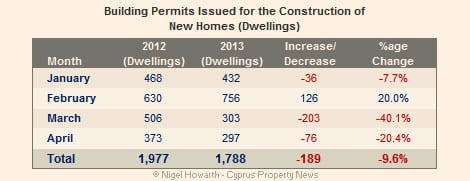
The 343 residential building permits approved in April provided for the construction of 297 new homes comprising 182 single houses and 115 multiple housing units (such as apartments and other residential complexes).

This is a fall of 20% compared with April 2012 when building permits were issued for the construction of 373 new homes.

During the first four months of 2013, the number of new homes for which permits were authorised has fallen by 10% compared with the same period in 2012.

Cyprus new home construction April 2013

According to the Cyprus Statistical Service, building permits constitute a leading indicator of future activity in the construction sector.