Action against Cyprus

DENIS O’HARE of the Cyprus Property Action Group (CPAG) has been advised by the Head of the Unit for Consumer and Marketing Law at the European Commission that infringement proceedings have been opened against Cyprus.

The move follows a campaign led by CPAG encouraging those who had been duped into buying property built on mortgaged land – and subjected to other nefarious property-related business practices – to seek redress through the Cyprus Competition Consumer Protection Service.

However, as the Competition Consumer Protection Service apparently rejected consumer complaints and failed to take action, CPAG took the complaints to the European Commission with the supports of many MEPs.

The letter of formal notice, dated 20 June 2013, is the first step in infringement proceedings under Article 258 TFUE (Treaty on the Functioning of the EU). The Cypriot authorities have been invited to comment within two months. Further proceedings will depend on their observations.

The letter to Mr O’Hare advises “Since infringement proceedings between the Commission and a Member State have no direct impact on the legal position of individual consumers, affected consumers have to take appropriate steps within the time-limits applying under national law to defend their rights.”

Further information on those ‘appropriate steps’ may be found on the CPAG website.

Further reading

Infringement Case 2013/2082 – Cyprus (previous references EU-pilot 2632/11/JUST, CHAP(2012) 3262, CHAP (2011) 3252)

Cypriot property Title Deeds (updated)

European Parliament in session
The European Parliament in Session

THE MEMORANDUM of Understanding (MoU) agreed between Cyprus and its international lenders requires Cyprus to “eliminate the title deed issuance backlog to less than 2,000 cases of immovable property sales contracts with title deed issuance pending for more than one year” by Q4-2014.

However, of utmost importance to those who have been duped into buying property built on land that their property developer has mortgaged to the bank is that its title, when issued, will be ‘clean’ – i.e. free of encumbrances and other impediments that prevent the transfer of ownership of the property to its purchaser.

And of course there’s little point in clearing the Title Deed issuance backlog if the ownership of the properties they relate to cannot be transferred to their buyers who have paid in full for those properties – it’s merely a paper exercise.

To obtain clarification on this issue Daniel Hannan, MEP for South East England, has raised the following question in the European Union Parliament.

Question for written answer
to the Commission
Rule 117
Daniel Hannan (ECR)

Subject: Cypriot Property Title Deeds

Following the lobbying by many UK MEPs in coordination with the Cyprus Property Action Group, it is gratifying that the Commission as part of the Troika has ensured that the title deed issue is addressed by Cyprus as part of the bailout conditions.

Nevertheless, in order to eradicate any doubt could the Commission please confirm that all buyers who have hitherto paid in full for properties will have access to their deeds, without exception, as a result of this exercise? Furthermore, could the Commission also confirm that none of these deeds will have any encumbrances placed upon them?

Answer given by Mr Rehn on behalf of the Commission (added)

The Commission attaches priority to resolving the title deeds issue in the interest of the Cypriot economy, the European taxpayer, and the many EU citizens affected by the problem. In Article 5.4 of the memorandum of understanding (MoU) concluded between the Commission, acting on behalf of the European Stability Mechanism (ESM), and the Republic of Cyprus, it is therefore stated that the Cypriot authorities will, by end 2014,

‘Eliminate the title deed issuance backlog to less than 2,000 cases of immovable property sales contracts with title deed issuance pending for more than one year. The Cypriot authorities will enhance cooperation with the financial sector to ensure the swift clearing of encumbrances on title deeds to be transferred to purchasers of immovable property, and implement guaranteed timeframes for the issuance of building certificates and title deeds’

(The text of the memorandum of understanding is also available at: http://ec.europa.eu/economy_finance/publications/occasional_paper/2013/pdf/ocp149_en.pdf)

The MoU therefore envisages a specific deadline for the elimination of the observed backlog. The swift clearing of encumbrances on title deed transfers constitutes an important element of this agreement.

Mr Hannan and the Cyprus Property Action Group must be thanked for their continuing efforts, but one issue still remains unsolved:

For the transfer of ownership of a property to be achieved, the vendor has to supply receipts from the Inland Revenue Department to the Land Registry showing that he has cleared his Immovable Property Tax and Capital Gains Tax liabilities – and receipts from the Sewerage Board and the Municipality/Community in which the property is located confirming that these charges have been paid.

It is clearly a fault in the ridiculous processes that someone who has paid for their property in full and which has a ‘clean’ title is prevented from owning that property because the vendor is either unable or unwilling to settle his tax and other liabilities.

Perhaps a further question in the European Parliament to clarify this matter is needed?

New Limassol marina is ‘a gem’

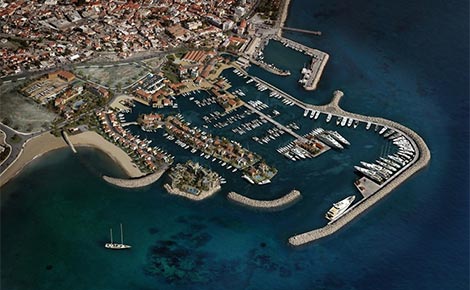
The new Limassol marina
Limassol Marina

THE NEW Limassol Marina is an impressive development, according to tourism minister George Lakkotrypis on his first official visit to the marina on Thursday.

After Lakkotrypis’ visit and tour of the development, he said: “It is really an impressive project, a real gem, both for Limassol and for Cyprus.”

He also mentioned that the project gave an excellent example of what could be successfully achieved with the collaboration of the public and private sectors.

Despite the economic crisis in Cyprus, property sales at the marina were satisfactory, according to the minister.

Lakkotrypis said Marina were an essential part of the government’s policy to enrich tourism.

Taking this as an example, Lakkotrypis said the project should be emulated in other regions of Cyprus “in order to bring about growth and tourism to our island.”

Referring to the development of other marinas, the minister said problems with funding were the reason why more were not being developed.

“This is something we are looking into. There is interest from foreign investors and we put them in contact with project contractors,” he said.

“We hope other marinas have the chance to reach the level of success established by the Limassol Marina.”

The project is still not finished. Its completion is expected by the end of the year, with the official opening taking place in spring of 2014. It will have 54 shops and 12 restaurants with parking space for up to 750 cars.

The first yachts were welcomed into the Limassol Marina on May 21, a few months after delivering 94 luxury apartments to their residence.

The new marina boasts a capacity of 650 berths, for yachts up to 115 metres in length and is the first full service super-yacht marina on the island.

New Limassol marina is 'a gem'

Law of supply and demand will take care of prices

EXTENSIVE coverage was given to the fall of rental and sale prices of property in the first two quarters of this year, reported by RICS (Royal Institution of Chartered Surveyors).

The property bubble financed by easy bank credit, which saw real estate prices soar to absurd levels has been deflating in the last couple of years, the only surprise being the slow rate at which this has been happening.

It appears the rate of decline of prices would be slower than was initially expected and the correction of the market would take longer to be completed. This is because the banking sector is still in disarray and there is uncertainty about its future, not to mention the capital restrictions. These factors are slowing down the correction, but once the banks start to sell off collateral used as security for loans that are not being repaid, property prices would go into free-fall, until they are at a level that is attractive to speculators with cash.

Press reports yesterday suggested that Central Bank restrictions on real estate purchases would be lifted next week.

The difference from the stock market bubble of 1999 is that real estate will always have some value, in contrast to shares, and would eventually appreciate. On the minus side the collapse in property prices would have much more far-reaching consequences than the stock market crash, as it would drastically restrict the ability of businesses to secure loans – if and when bank credit is available – and impose big losses on people who borrowed money to invest in property.

The news made a mockery of political party plans to impose a 20 per cent reduction on the rents of shops which fell by nine per cent in the first quarter of this year and by 12 per cent in the second quarter.

So the 20 per cent reduction of rents had already taken place; a reminder that the market takes care of prices much more effectively than meddling politicians pandering to potential voters. Rents, particularly for commercial properties, will keep falling as the economy contracts and more companies go out of business.

The law of demand and supply will take care of rental and sale prices of property much better than politicians would ever do. The market will adjust to the new economic conditions.

But in Cyprus it seems that everyone is a supporter of free market rules when prices and profits are going up, opposing all regulation (like tighter credit which would have limited the scale of the property bubble) but when the inevitable downturn arrives they want to impose controls the market.

Cyprus property prices

Playing the waiting game

IT ONLY TOOK EIGHT YEARS, so we count ourselves as the lucky ones. Many are still waiting – some after 30 years or more. Title Deed acquisition in Cyprus is certainly not for the faint-hearted.

Back in 2003, during the frenzied property boom on the island, you could turn in for the night and awake to face not only a new day, but also equally new batches of villa walls in the valley below; it was like a giant game of village Jenga.

When plumping for a new build, everything begins and ends with the developer. The fervent hope is that he’s the sole owner of the land he plans to build on, that he has sought planning permission to do so, and that the land is not mortgaged – he actually owns the plot he’s offering to you.

Apart from our villa, the developer we chose (because he had the land with the view we craved) had designs for eight others on the large plot. Individual Title Deeds are not issued until all the building is completed.

There is an awful lot of toing and froing between the developer, the planning department and the Land Registry, giving ample opportunity for delays and oversights.

Somehow, in our case, the owner of the local taverna was apparently entitled to a say in the matter, too. Last year, a top government official pitched in and, in an effort to get things moving, was recorded as having “started shouting at the mayor”.

After each visit to the lawyer, we would emerge into the hot sun carrying a batch of paperwork all in Greek and a tight knot of worry. We were assured, “Everything is good. This is Cyprus. No problem. You are here to relax! Siga-siga …”

We paused on our way out, to grill the secretary: “How long do you think? When will we get them?”

Her reply: “Maybe next month, maybe next week, or maybe tomorrow.”

It became the norm when bumping into old friends and/or meeting new people: “Hello! How are you? How’s the dodgy knee? Have you got your Title Deeds?”

Life went on – a volcano in Iceland erupted causing flight chaos; the Human Genome Project was completed; Facebook and Twitter were launched; President Barack Obama was sworn in; technology raced on – the iPhone, Kindle, Google Street View… Cyprus joined the EU. But we waited for our Title Deeds.

Several times a week our neighbour could be heard on the phone haranguing some poor chap, who would later reveal that he hadn’t the foggiest idea why we Brits were so hung up about this stuff. This, after all, was Cyprus.

Other neighbours packed a coolbox and staked out the offices of the Land Registry, refusing to budge until they were seen. Still nothing happened. To be fair, having had plenty of experience of the notoriously loose Mediterranean sense of time, we had to admit that, ultimately, most things do get done. Eventually.

Once, we ordered a replacement mirror for the guest bathroom; it was expected to take a week to arrive. Six months later, when I was out and my children were watching television in the lounge, three delivery men emerged via the patio and marched upstairs with a mirror tucked under their arms. They installed it perfectly, cleared up every scrap of mess and promptly left. If the children hadn’t mentioned it to me, I probably wouldn’t have noticed the new mirror for days. It got done.

Then, a phone call. Would we care to go along and pick up our Title Deeds? Racing home with the precious envelope (stop for champagne!) we pored over the documents spread out on the table. The drawing was very neat: a parcel of land we recognised as our own, but no building. No house evident on the Deeds. Apparently, we’d been living in a field for eight years.

A phone call established that these were our temporary Deeds (stage 1) and that the full version (stage 2) was to come. Soon. By this time, we had changed. We were in Cyprus. We liked – no, loved – our life here. We decided to call off the active and soul-destroying pursuit of the Deeds. We backed off.

One day, three chaps turned up at our house equipped with a GPS device on a long pole and with a mission to determine the position of our house on its plot. This was looking good. Halfway round the house, they downed tools. They’d run out of batteries. They assured us that they’d be back and beat a rapid retreat before we could imprison them in the boiler room. They’d heard horror stories about us enraged Brits. True to their word, they returned to finish the job. Three months later.

Then, the unthinkable happened. Our friend was apoplectic on the phone: “Have you heard what they’ve done? Have you heard?” All bank accounts were frozen in Cyprus, investors were to stump up for the island’s woes; the EU big boys were intent on making an example out of Cyprus. The Title Deeds issue plunged in priority.

In sharp contrast to the frenzied media portrayal of demonstrations, rampaging crowds and desperate queues building up before empty cash machines, the locals simply shrugged and headed to the beaches clutching armfuls of kites, to take part in the annual Green Monday kite-flying tradition. The expat community rallied, too. We drove away from the houses we did not own, past the banks we could not access, and hit the beaches; we may not be able to fly off the island (flights were heaving), but we could fly a kite.

A few weeks ago, we were eating lunch by the harbour when my husband’s mobile phone trilled. He answered, lowered the handset and picked up a stray chip. “We can go and pick up our full Title Deeds.” We shrugged and ordered another Keo beer. No rush.

Property in Cyprus: playing the waiting game

Prices falling for three and a half years

SINCE the introduction of the RICS Cyprus Property Price Index in the fourth quarter of 2009, there have been some dramatic falls in prices across the island.

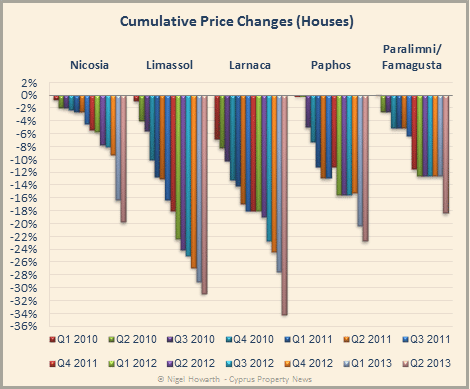
Nationwide, the average price of a 2-bedroom 85sqm residential apartment of medium quality has fallen by 33.6%, while the average price of a 3-bedroom 250sqm house with a garden has fallen by 25.1%.

As we reported on Wednesday, the fall in property prices across the island accelerated during the second quarter of 2013 as a consequence of the decisions taken by the Eurogroup.

However, price falls vary considerably in different parts of the island as can be seen in the charts and tables below.

Residential apartment prices

Cyprus apartment price changes

Town/District
Residential apartment prices at Q4 2009
Residential apartment prices at Q2 2013
Percentage Change
Nicosia €171,155 €128,220 -25.1%
Limassol €177,978 €118,799 -33.3%
Larnaca €187,590 €122,818 -34.5%
Paphos €154,917 €101,822 -34.3%
Paralimni/Famagusta €153,790 €89,942 -41.5%
Average price €169,086 €112,318 -33.6%

Residential house prices

Cyprus house price changes

Town/District
Residential house prices at Q4 2009
Residential house prices at Q2 2013
Percentage Change
Nicosia €523,438 €420,271 -19.7%
Limassol €496,250 €343,181 -30.8%
Larnaca €438,750 €289,220 -34.1%
Paphos €460,417 €356,087 -22.7%
Paralimni/Famagusta €412,500 €336,867 -18.3%
Average price €466,271 €349,125 -25.1%

Please note that the RICS index does not include the prices of holiday homes.