Britons cases scheduled for trial in Cypriot court

PROVISIONAL trial dates have been set for UK buyers of property in Cyprus who were missold Swiss Franc mortgages, were ‘misled’ by their solicitors and are now facing demands for huge mortgage payments, threats of UK litigation and the very real chance of losing their UK homes.

Judicare Group, which encompasses a Spanish law firm, is currently acting on behalf of over 200 buyers and pursuing litigation in Cyprus, where the purchase took place, and not in the UK where the need first to establish jurisdiction adds an unnecessary timely, risky and costly step in the process.

If litigation is successful in the UK Courts it will still require the Cyprus Courts to enforce the ruling. Judicare believes that its approach will void the loan agreements and free UK buyers from untenable agreements. Many have found their monthly mortgage repayments more than doubled after the banks in Cyprus advised that clients take out a loan in Swiss Francs as this currency was perceived as stable at the time and provided a low interest loan.

The barristers from the Cyprus law firm Triantafyllides & Christoforou (TCA Law), appointed by Judicare, claim that in many of the buyers’ cases the Power of Attorneys used to sign the loan agreements were not valid as they were not signed in strict accordance to the legal process. In most cases, paperwork was validated without a Certifying Officer present, making the loan agreement and any other documentation void through the use of this instrument. In addition, the provisions of the local lending laws were not met.

A recent escalation in the process has also seen judgements by the Cyprus courts against UK buyers being enforced in the UK, putting their assets at risk, and so it is crucial that any client receiving a Writ of Summons from a Cyprus Court does not ignore the service and seeks legal guidance immediately.

Judicare estimates that there are over 20,000 people in the UK in similar circumstances from purchasing a property in Cyprus from 2003 to 2008.

Neil Heaney, CEO of Judicare, says: “Our clients feel as though they have been let down by everyone – the banks and IFAs who misadvised them and the lawyers who failed to protect them. People were sold a dream home in a beautiful country with manageable monthly mortgage instalments. Many believed that rental income would help with the costs of the property but they didn’t take into consideration currency fluctuations or the tough economic climate. Pursuing the courts in the UK only adds other difficult factors to the equation – time and money. We’re advising people not to bury their heads in the sand and to seek advice as soon as possible.”

Judicare provides advice on what to look out for when buying a property overseas:

  • Find someone on your side. Appoint your own independent lawyer who is not connected to the developer or the agent and who acts in your best interest.
  • Currency fluctuations. Take out a mortgage in the currency that you are normally paid in so that you are not at the mercy of currency fluctuations.
  • Do your own due diligence. Go to the area where you are buying a property to ensure that you like what you are buying and its surrounding environment.
  • Finance. Don’t base your investments solely on other people’s recommendations. Do your own research and calculate your costs and do a budget before agreeing to buy.
  • Rental. If you are buying your property for investment, don’t imagine that you will have a full season booked out. Take into consideration that inevitably there will be dry periods during the year which you will need to build in to your costings.
  • Mortgage. If you are buying your property for investment, don’t imagine that you will have a full season booked out with rent to help pay of your mortgage. Take into consideration that inevitably there will be dry periods during the year which you will need to account for.

About Judicare

Judicare is an international legal firm providing a wide range of legal services such as conveyancing and commercial litigation on and specialising in property investment recovery. In this role it works solely on behalf of buyers (not developers or agents) helping them to seek compensation in the event of problems with the purchase of a property overseas.The company has a network of lawyers around the world and currently has client cases in twelve international jurisdictions – Bulgaria, Cape Verde, Cyprus, Dominican Republic, Dubai, Egypt, Greece, Morocco, Poland, Portugal, Spain and Turks & Caicos Islands.

It has a track record of recovering money for clients and focuses on the best course of action to deliver the optimum outcome for its clients and not ‘litigating for litigation’s sake’.

Why should any foreigner buy property?

THE ADVANTAGES which Cyprus has are evident to all – friendly and hospitable people, beautiful countryside and many others too numerous to mention.

The disadvantage which Cyprus has is the Internet – not the speed or reliability of the data transfer, but the fact that anyone who is contemplating buying a property in Cyprus will use the internet for their research. After only a few minutes searching, they will surely come across those websites aimed at expatriates which contain countless horror stories relating to Title Deeds and the sharing of communal expenses, and will rapidly come to the conclusion that their property purchase should be made in another country.

I would like to propose two measures which would help to overcome these problems which could help rejuvenate the Cypriot property industry and encourage more foreigners to buy property and spend money in Cyprus.

The first relates to Title Deeds. Any foreigner thinking of buying a property will not proceed if they think there will be any problem with obtaining their Title Deeds. In most major countries, every single property – whether pre owned or a new build – will have its own individual Title Deeds available before the property is put on the market. I believe that it will be in Cyprus’ best interests if it adopts the same procedure. I realise that this will be a major change in the way it has been done for years but sometimes one does have to change in order to progress.

Developers should be taken to court if they start a development without the appropriate planning permission. During the construction phase, there should be regular inspections of the development to ensure it is being built in accordance with the building permit. A final permit should be issued only on completion and a developer who permits buyers to occupy the property before being in receipt of the final permit should be fined. You could ask your representatives in major western countries to research the purchase procedures for a new build property in the countries in which they are serving and for Cyprus to adopt a “best practice” after reviewing the various alternatives.

The preceding will take time to implement. In the meantime, prospective buyers will be following the Title Deeds fiasco for those who have been waiting years for them. Although measures have recently been introduced to expedite the issuance, the problem is that many developers will not be able to finish complexes (“no money”) or obtain the final permit nor be able to pay off their outstanding tax liabilities. The result is that many innocent buyers will not (probably never) obtain their Title Deeds. This will become evident very quickly and will put off prospective buyers.

It is quite unreasonable that innocent buyers should be held hostage by the failure of developers to find the funds to pay off loans, tax obligations or even to finish the complexes. I believe that previous administrations must bear some responsibility for – can I be blunt, this mess – but you have an opportunity to revitalise the property industry by introducing both the measures I am suggesting.

In regards to Title Deeds, I would propose a proper Amnesty, not aimed at developers over minor issues, but aimed at the innocent buyers who have been caught up in a mess which is not of their making. I would propose that Title Deeds be issued to all those who are waiting for them and are in occupation of the property whether the complex has been fully finished or not and for these Title Deeds to be issued by the 31st of December 2014. It would then be the responsibility of the various government departments/banks to sue the developers for not having complied with their obligations – loans, tax, failure to comply with the building permit etc. etc. – and not hold the innocent buyers hostage to failings of other parties.

My second measure relates to the handling of those owners who refuse to contribute to the communal expenses in a complex. There are many threads on the internet where a prospective purchaser will quickly learn that it may be possible to take non payers to court but it will take many years with several lawyers advising that it will not be worth it until the arrears amount to several thousand Euros. Non-payment causes much anguish and stress and complexes which have non payers quickly become run down. Indeed, any visitor to Cyprus cannot fail to notice the many tatty blocks of flats which can only impart on the visitor a feeling that they have entered a third world country.

I would propose that non-payment of communal charges should become a police matter. A complaint from an authorised residents’ committee to the police should result in that complaint being investigated within a matter of days and, if the complaint is deemed to be justified, the non-payer should be given 28 days in which to start making payments acceptable to the residents’ committee or else the police should be able to impose an “on the spot” fine with further fines to be imposed every 28 days until the miscreant starts to make his payments.

In conclusion, the question on which your administration should focus is this:

Why on earth should any foreigner buy a property in Cyprus which will undoubtedly result in lots of stress with the likelihood of owning a property in a complex which will become more and more run down and with the prospect of not even holding the Title Deeds?

I believe that you now have an opportunity to transform the property industry in Cyprus which will result in satisfied buyers, more income for Cyprus and more Cypriots employed spending more money. The alternative is for the property market to remain moribund with fewer and fewer buyers and more and more empty and partly finished developments with even the occupied developments becoming more and more run down.

Yours sincerely,

A foreign Cyprus resident. Name and address supplied

Why on earth should any foreigner buy a property in Cyprus

Construction crisis deepens

THE NUMBER of building permits issued in May 2013 stood at 380 compared with the 618 issued in May 2012; a fall of 39%, according to figures released by the Cyprus Statistical Service earlier today.

Compared with May 2012, the total area of these permits fell to 74,157 square metres from 134,085 (-45%), while their value decreased to €107.762 million from €126.585 million (-15%).

During May, building permits were issued for:

  • Residential buildings – 272 permits
  • Non-residential buildings – 58 permits
  • Civil engineering projects – 19 permits
  • Division of plots of land – 29 permits
  • Road construction – 2 permits

During the first five months of 2013 a total of 2,285 building permits have been authorised; a drop of 27% compared with the 3,114 issued during the first five months of 2012. Their total value has fallen by 9% and their total area by 21%.

New home construction

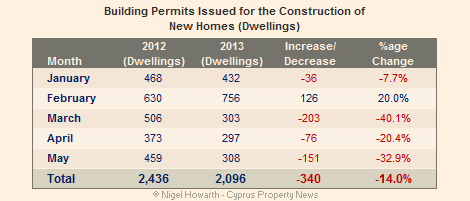
The 272 residential building permits approved in May provided for the construction of 308 new homes comprising 178 single houses and 130 multiple housing units (such as apartments and other residential complexes).

This is a fall of 33% compared with May 2012 when building permits were issued for the construction of 459 new homes.

During the first five months of 2013, the number of new homes for which permits were authorised has fallen by 14% compared with the same period in 2012.

Cyprus new home construction May 2013

According to the Cyprus Statistical Service, building permits constitute a leading indicator of future activity in the construction sector.

Playing games with property taxes

MIRACLES TO alleviate dire poverty promised by our president will begin on July the first 2014 and not before. On that date, the poor and struggling will receive help in paying their mortgages or rent, feeding themselves, their electricity and other outstanding ‘exceptional’ bills.

Pensioners living below the poverty line (which was around six hundred euros a month) will also be shown some consideration, probably towards heating their homes with coupons exchanged for olives, black bread and sun dried trachanas, staple fodder which fed our forefathers throughout those harsh winter months in the mountains or bitterly windswept plains of this formerly, and now again, impoverished island.

Evidently means tested, specifics remain thus far vague and unannounced, although the value of your home will be included in any welfare pay-out equation – our president’s word as good as his bond. The bad news is that those individuals receiving two or three different pay-outs in total exceeding 2,000 euros monthly will be reduced to one when all social benefit, unemployment and welfare departments come under one roof next year – this move aimed at reducing exploitation of the system and reducing government hand-outs.

We have yet to be told by our president how the impoverished are expected to survive from now until next July – hot air circulating in abundance from the day he took over as ‘chef of the kitchen’ from ‘cauliflower head’.

Householders (many double mortgaged at interest rates of 9 per cent or more) whose title deeds are in the hands of the banks, bankrupt property developers or lackadaisical land registries, will probably be evicted or pay rent to the mortgagee subsidised by taxpayers lest their homes be repossessed and join the long queue of already unsalable and empty properties.

And to cap it all, we are far from finished with surreptitious increases in taxation. My municipality increased the cost of emptying dustbins by 20 per cent this year, removing subsidies to single owner/occupiers and pensioners – we now all pay the same – a family of five and an elderly lady living alone. Are those presidential promises of help in the pipeline ‘pour les démunies’ purely pipedreams?

On what basis will the 2014 Immovable Property Tax (IPT) reassessments be made given the present catastrophic fall in house values?

Last week, a frustrated expat resident of Paphos collected a 2013 IPT assessment form from his local Inland Revenue tax payment office. He completed the form, returned it by hand to a clerk at the IR office, who checked the amounts with the help of a hand held calculator before Frustrated was permitted to pay the tax well ahead of the October 15 deadline. For his supreme effort he received a ten per cent discount.

He noticed that completed expat payment forms sat alongside those of Cypriots – the two piles equal in height when ex-pats number just 10 per cent of the Paphos District population. Could it be that most of my compatriots have yet to register their homes and pay transfer tax never mind IPT?

Frustrated complained about the unfairness of property taxes in general, saying that in all other EU member states it is based on the value of the property with no discounts/allowances for the number of owners whether more than one or as many as ten.

Take IPT here for example: if a property has a valuation of 60,000 euros at 1980 value, a single owner pays 40,000 at 0.6 per cent (240 euros) plus 20,000 at 0.8 per cent (160 euros) which gives a total of 400 euros IPT payable per annum.

Two owners on title deeds pay 30,000 at 0.6 per cent (180 euros each) making a total of 360 euros per annum, a saving of 40 euros.

For larger property values the difference is much greater, which seems unfair to those single person property owners on just one salary or small pension.

On the other hand, transfer taxes charged on the purchase of property highlight even greater disparities, which I will demonstrate in Cyprus pounds as the calculations are easier.

For a single name on title deeds of a property that cost 200,000 Cyprus pounds, transfer fees were charged at 3 per cent on the first 50,000, five per cent on the next 50,000 and 8 per cent on the final 100,000, giving a total transfer tax of CY £12,000.

For two owners on title deeds fees were charged on 100,000 each: first 50,000 at 3 per cent, next 50,000 at 5 per cent giving a total transfer tax of only CY £8,000.

If there were four owners of the property, the transfer tax would be CY £1,500 each – CY£6,000 in total, a saving of CY £6,000 on that paid by a sole owner.

It seems totally unfair that a single person should pay 50 per cent more than a couple or twice as much as four joint owners.

When the government introduces the new property tax laws in 2014 are they going to remove ridiculous anomalies?

Were those ‘thousands’ of Chinese property buyers, who purchased their minimum 300,000 euro two room flats, advised by developers to put at least four names on title deeds? If only one, it will have cost the purchaser more in transfer fees than their jerry built flats are worth at today’s fast declining values.

My local pharmacist in Nicosia tells me that we should receive IPT bills by early September. Penalty dates for non-payment of IPT have been changed from 15 October to 15 November, after which an extra ten per cent is added to your bill.

By 2014, all property and land will be taxed at new 2014 valuations, says the minister of the interior!

It is currently your responsibility to declare all Cyprus property in your name. Tax will be calculated on the collected sum of your property and not individual properties.

When the unbearable heat has subsided, pop along to your local tax payment office and collect an IPT assessment form.

Those of you awaiting title deeds should beware of criminal hiking of IPT bills by your developer, and frankly, nearly all of them are as seriously bankrupt as our banks!

Housing market in Cyprus

A PAPER recently published by the European Commission entitled “The Economic Adjustment Programme for Cyprus” provides an insight into the findings of the troika delegation out of which came the Memorandum of Understanding for the island’s bailout.

The paper contains several references to the property and construction sectors, the most significant of which is reproduced below:

Housing Sector

THE HOUSING market in Cyprus is of particular importance for both financial stability and fiscal sustainability, as it poses a serious risk to bank balance sheets.

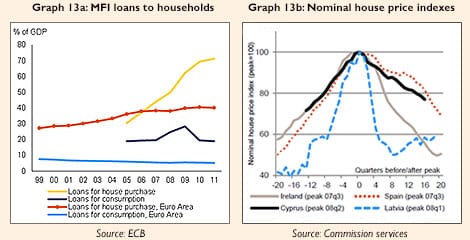
The housing boom was accompanied by a rapid increase in loans to households (Graph 13a) and non-financial corporations up to 2008, leaving the Cypriot private sector the most indebted (in relation to the country’s GDP) among the euro-area Member States (on a par with Ireland). Indeed, loans amounting to 150% of GDP in 2011 were directly related to the domestic housing sector, with even more consumer and business loans collateralized with real estate.

The due diligence of the Cypriot banks has established that, in many cases, banks put a greater weight on collateral than on cash flows of the borrowers. Loans to residential developers and the construction sector exceed 50% of GDP in 2011, with more than half of them already having been rescheduled (estimate). Thus, an important part of bank balance sheets hinged on assets related to local house prices, which were experiencing protracted adjustment after a long boom.

In real terms, real house prices saw a downward correction by ca. 28% (in Q1 2012) from their peak values in Q1 2008 (Graph 13b)1.

EC graphs Cyprus housing market

Regulatory factors influence the scale and pace of house price adjustments

Moreover, supply and demand factors indicate that prices are set to undergo a further substantial decline, in particular prices for holiday homes. The pace of the house price decline will crucially depend on the amount of loan rescheduling and the efficiency of collateral seizure.

Repossession procedures are in turn affected by both the backlog of the land registry system (title deeds) and considerable delays in asset liquidation administration and judicial procedures.

Furthermore, the housing market will be affected by fiscal consolidation efforts via the rationalization of the existent myriad of housing assistance schemes and the implementation of a recurrent property tax system based on updated valuations of the tax base.

Collateral seizure is in turn influenced by both the backlog of the land registry system (title deeds) and considerable delays in asset liquidation administration and judicial procedures. Improving these settings would result in a more rapid supply increase and a swifter decline in house prices, and accordingly in earlier price stabilization.

The potential advantages of a swift decline in house prices would be: front-loading of mortgage book valuation losses, earlier restoration of confidence in the housing market and thus a pick-up in (external) demand, with a positive feedback to GDP growth. The risks lie mainly in front-loading effects on the economy and the risk of undershooting house prices and thus collateral values.

Registration and transfer of immovable property

In 2011, up to 120,000 – 130,000 properties lacked title deeds, i.e. the land registry does not reflect their building and ownership situation. Scattered evidence on the progress since 2011 indicates that only a rather small portion of pending cases have been resolved so far.

This regulatory issue creates a bottleneck for the housing market in two respects:

First, it acts as an impediment to demand, particularly from foreigners, as they are not able to fully enjoy the benefits of ownership (for instance, deeds are generally required as proof of mortgage collateral).

Second, there is a risk element for the bank mortgage books, as it is not clear how many (developer) mortgages are secured with title deeds that are actually outdated and should be replaced with new title deeds to be transferred to dwelling purchasers. This is compounded by the fact that a sales contract on immovable property represents a senior claim on the property for the amount that has already been paid, thus giving the buyer a secured creditor position.

Against this backdrop, the Parliament approved substantial reforms in 2011 (N81(I)/2011). The new framework introduced vested contracts, enabling the sale of a property without a deed, and provided purchasers and authorities with the rights to request, and enforce, the issuance of title deeds.

The approval of planning and building permits as a necessary prerequisite for the issuance of title deeds was identified as a major driver of the title deeds backlog, and has been tackled by the introduction of simplified approval procedures and a town planning infringement amnesty in 2011.

However, the effectiveness of these reforms hinges on their implementation in expediting the issuance of the more than 100,000 still-outstanding title deeds. Preliminary figures suggest this measure resulted in a substantial, but by far non-exhaustive, decrease in the title deeds backlog. Note, however, that any new title deeds issued still have to be transferred to the purchasers, which poses further risks for sales contracts concluded before 2011.

Improving judicial incentives in order to ensure speedy title deed transfers is therefore a crucial aspect in resolving regulatory risks to house prices, banks, and the economy.

1 Note that this figure is based on the harmonized Eurostat house price index. Data from the Central Bank of Cyprus indicate that decline was less steep, and closer to 15% between Q3 2008 and Q2 2012.

Further reading

The Economic Adjustment Programme for Cyprus – May 2013

Investing in real estate debt

Investment in Cypriot real estateLIFE has a way of testing a person’s will; either by having nothing happen at all or by having everything happen at once.

Since the ‘bail-in’ for Bank of Cyprus’ deposit holders was agreed at 47.5%, the new ‘hot topic’ for discussion is real estate debt. Mortgage backed residential loans, commercial loans, non-performing loans, etc. are all expected to be up for grabs as investors begin to circle local financial institutions.

Investment in private real estate debt is the acquisition of performing or non-performing real estate loans from private lending institutions or from government sponsored ‘bad banks’. The investor acquires the rights to receive repayments of loans secured against real estate assets.

There are two main categories of loans; performing and non-performing.  Loans may be performing in that interest is being paid and the borrower is not in breach of minimum Loan-To-Value (LTV) ratios (i.e. the outstanding loan balance is below a certain ratio to the value of the property) or interest coverage covenants (i.e. the interest expense is below a certain ratio to the income produced by the property). The investor is typically buying the right to receive future interest payments and principal repayments. Loans may be non-performing in that the borrower is in breach of minimum LTV ratios or interest coverage covenants, although the borrower may still be paying some interest on the loan.

In the case of non-performing loans, the investor’s cash flow is more directly related to the profile of the asset. The income from the loan is essentially a function of the real estate asset’s rental income; whilst the repayment of the principal is essentially a function of the capital value of the real estate asset at the end of the loan. There are two main options open to the buyer of a non-performing loan:

The lender can exercise their rights to repossess the asset. If the asset is not sold immediately, this requires on-going management of the asset. This raises the issue of what obligations the lender has to the borrower once they have seized control of the asset.

The lender can co-operate with the borrower to ‘work out’ the loan in an orderly manner. In a portfolio context, this may involve disposal and active management of assets or development or re-commencing development of development assets.

For the lending institution the range of choices may make things slightly more complicated. The first part of the exercise is to identify and divide assets into core and non-core, and into performing and non-performing. The second step is to establish a restructuring unit, which will attempt to carry out a rundown of non-core portfolios without imposing excessive strain on capital. The third step is to decide on the general and on the specific strategy for each asset; to hold the loan to maturity, to make it available for sale, to carry out some form of yield optimisation exercise, or to ‘work out’ the loan as described above. For each of these steps the main decision is whether the institution wants (and is capable) to have an active or a passive portfolio management strategy.

To a considerable extent the range of options available to the lender will be determined by the profile of the loan and of the asset. Are the assets standing investments or development opportunities? Do the assets require specialist management? How is the borrower behaving? What is the institution’s time horizon and/or objectives?

Two examples highlight the value of taking an active interest in how the collateral or the repossessed loans are managed. The first is the strategy followed by the FDIC (Federal Deposit Insurance Corporation) in the USA, where in order to avoid ‘fire sales’ the real estate advisor is encouraged to source investors who will take an equity position in the asset, i.e. the FDIC acting on behalf of the lender becomes a JV partner in the development/investment of the asset capitalising on the investor’s expertise and lowering their entrance costs. Similarly, NAMA (the ‘bad bank’ set up in Ireland) has recently announced that it will jointly develop a residential tower in Dublin’s docklands and, separately, that it is providing the financing for some half-finished projects to be completed. In both cases the institutions have realised that by investing they are also creating assets ripe for disposal in the years to come.

The question is whether Cyprus is ready to move away from moaning about destitute, populist demagogues and preaching about the need for transparency, to taking active control of the situation. And as we all know, in Cyprus only a chat over a coffee can answer that….

Pavlos Loizou
Managing Partner | Real Estate Advisory
Leaf Research
[email protected]