Cabinet modifies Immovable Property Tax charges

THE CABINET yesterday decided to exempt immovable property worth up to €5,000 at 1980s values from the new taxation.

In one of several decisions taken during the meeting at the presidential retreat in the Troodos mountains, the cabinet also scrapped the minimum amount of €75 for immovable properties worth between €5,000 and €40,000, which will now be taxed at 0.6 per cent on the 1980’s value.

From next year, the immovable property tax (IPT) will be based on 2013 values.

The IPT is an obligation assumed by Cyprus as part of its €10 billion bailout agreement. The state expects to collect between €105 million and €110 million.

For 2013, the Inland Revenue Department (IRD) will tax owners with properties registered in their name based on the 1980 value.

Government spokesman Christos Stylianides said yesterday the cabinet’s decision aimed at addressing imbalances in the taxation which would have forced anyone owning any piece of land – no matter its value – to pay tax.

He said that the owner of a plot of land on the mountains would have been called to pay at minimum a flat fee of €75, just for having “(say) a field with three olive trees”.

“The state considers the administrative cost to be too large for such properties of insubstantial value,” Stylianides said. The changes “reduce injustices and the distortions of the current legislation,” he added.

Stylianides said that in the process of updating property values for taxation purposes, the land registry noted they would surpass the tax targets agreed with the troika of lenders by some €10 million.

“In this way, this amount is returned to the owners of low-value immovable property,” Stylianides said.

In effect, authorities have decided to forego some of the additional revenue that would have been raised, scrapping the flat minimum fee of €75 for properties worth up to €40,000 and leaving a tax free band for immovable property worth less €5,000 at 1980 values.

Opposition party AKEL hailed the cabinet decision, which it said was a response to a “popular reaction against that unfair and levelling taxation”.

Cyprus Immovable Property Tax

Editor’s notes

How do non-residents pay?

Earlier today I spoke with the Chief Revenue Officer at the Inland Revenue about the problems faced by non-residents in paying their Immovable Property Tax.

1. Non-residents owning property should send an email to [email protected] stating:

– Their names and contact details (permanent address and telephone number)

– Details of the property (Land registry reference on its Title Deed and address)

The Inland Revenue will send them the forms to complete and return. If these are in Greek, please visit Money off your Immovable Property Tax to get English-language translations.

2. Only the owners of property (i.e. those with Title Deeds) are required to pay IPT to the Inland Revenue.

Immovable Property Tax 2014

Sensational rumours abound that, because the basis on which Immovable Property Tax is calculated will be revised next year, property tax in future years will increase dramatically.

Such rumours are totally unfounded!

Immovable Property Tax demands by post

PROPERTY owners (i.e. those with the Title Deed to a property registered in their name) will receive a notice by 15 September to pay their Immovable Property Tax.

Imposed on all owners of property as part of the bailout package agreed with Cyprus’ international lenders, notices concerning large properties have already been sent by post.

Property owners may benefit from a 10 per cent discount if they pay before 16 October, while those who delay payment until after 15 November will pay a 10 per cent surcharge on their tax bill.

Taxpayers can pay either at the Inland Revenue offices or electronically (presumably using TAXISnet) by citing a reference number attached to the payment notice.

Properties belonging to the same owner will be considered as a whole and Immovable Property Tax will be imposed on their total value.

Tax estimates for this year are based on 1980 values of property, while as of next year a new valuation will be made based on the current value of properties.

At the present time it is unclear whether the tax demands will be printed in different languages to cater for non-Greek speaking property owners.

Further information

Immovable Property Tax bands for 2013, English translations of the required forms and guidance on payment may be found at Money off your Immovable Property Tax bill.

Update 20 August

Earlier today the cabinet met in Troodos where it was announced that those with properties whose 1980 value was €5,000 or less will be exempt from paying IPT. (This has to be approved by Parliament)

Family turns to eBay to sell Paphos property

LOOKING for a way to reach potential buyers directly, a family with a commercial property to sell in a prime location in Paphos, in a novel move, has turned to internet giant eBay.

The listing says that “all reasonable offers will be considered”.

“We wanted to reach a bigger audience online,” said the Manchester-based Nick Georgiou, 31, whose Cyprus-based grandfather asked him and his family to help him sell the property.

The detached property is listed as lying in the heart of Paphos just across the entrance to popular Tomb of the Kings archaeological site. It was completed in 2009 and according to the sellers its basement comes with a night club/recreational centre licence. The rest of the property offered as a potential restaurant and shop complex.

Georgiou’s 84-year-old grandfather George Nicolaou is based in the coastal city of Limassol. But he asked his family to help him sell the property, which was previously advertised via real estate agents.

“We struggled to sell the property for various reasons,” says Georgiou talking of a financial crisis in Europe and later in Cyprus. There was also the matter of timing. In 2009, after years of a property boom which saw soaring property prices with banks eager to lend and take on Title Deeds as collateral, the overheated market started slowing down. Paphos was among the first regions to be affected and prices have been dropping ever since.

Georgiou says the family had hoped the situation would get better. “But [it] kept getting worse.”

On eBay, people offer for auction anything from their unwanted collectibles and clothes to services. But selling a commercial property is different to selling a comic book collection. For one thing, the suggested buy-it-now price is 1.38 million pounds sterling, roughly €1.6 million. But, whether a seller is offering a Fantastic Four comic book or a commercial shop unit, the principle is the same: sellers negotiate directly with interested parties.

So why not try eBay? “There’s no harm in doing it (and) people haven’t tried it much,” said Georgiou.

The Title Deed is held as collateral by the owner’s lender, but Georgiou says it will be handed over following a contract agreement. “We are trying to be straightforward with people,” Georgiou says. Prospective buyers may conduct independent surveys at their own cost, and are encouraged to get their own lawyer.

Visit New-Build Restaurant/Commercial Shop Unit in Paphos, Cyprus to find out more. Georgiou’s contact details are available on the eBay listing.

Paphos property on eBay

Transfer fee penalty for delays

Property Transfer FeesACCORDING to the Memorandum of Agreement (MoU) between Cyprus and the troika, the Cypriot authorities are obliged to “provide for mandatory registration of sales contracts for immovable property by Q2-2013”.
In an effort to fulfil this obligation, the authorities intend to impose a fine on those buying property who fail to deposit their contract of sale at the Land Registry within six months from its date of signing.

This fine will amount to a 10% increase in the Property Transfer Fees payable at legal completion.

Notes

Property Transfer Fees are a government tax based on the market value of a property at its date of sale; they are the Cypriot equivalent of the UK’s Stamp Duty Land Tax (SDLT) which are payable on the purchase or transfer of property or land in the UK.

On paying the Property Transfer Fees, title (ownership) of the property is transferred from the transferor (vendor) to the transferee (purchaser).

Legal completion is the time at which the Title Deed becomes available for transfer and the purchaser pays the Property Transfer Fees to secure ownership of the property.

July sales boosted by overseas investors

FIGURES published by the Department of Lands and Surveys yesterday reveal that a total of 354 contracts of sale for the purchase of property were deposited at Land Registry offices across Cyprus last month; a fall of 13 per cent compared with the 408 deposited during July last year.

Of those 354 contracts, which include sales of residential, business and commercial property and land, 71% (251) were deposited on behalf of domestic buyers, while 29% (103) were deposited in favour of overseas buyers.

With the exception of the business centres of Nicosia and Limassol, where sales increased by 8%, sales in the coastal areas of Famagusta, Larnaca and Paphos fell by 70%, 38% and 4% respectively compared to July last year.

Total property sales in Cyprus - July 2013

During the seven months of 2013 a total of 2,133 properties were sold, down 48% compared with the 4,118 sold during the same period in 2012.

Domestic sales

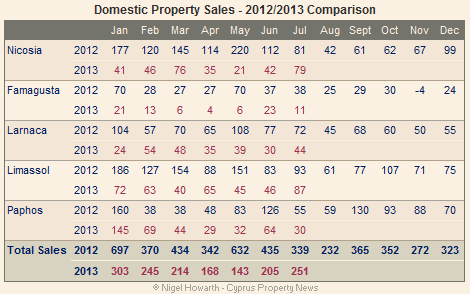
Domestic sales in July fell 26% compared with July 2012, with sales falling in all districts.

Sales in Famagusta fell 71%, while those in Paphos fell by 46%. Sales in Larnaca, Limassol and Nicosia were down 40%, 7% and 3% respectively compared to July last year.

Domestic sales - July 2013

During the first seven months of 2013 a total of 1,529 properties were sold to domestic market compared with the 3,249 during the same period last year; a fall of 53%.

This downward trend in local demand is expected to continue while the downturn in the island’s economy persists.

Overseas sales

Overseas sales received a welcome boost in July with overall sales increasing by 49% compared with July last year.

Although sales to overseas investors in Famagusta and Larnaca fell 67% and 35% respectively, other districts recorded an increase in sales.

Sales in the commercial centres of Nicosia and Limassol saw sales increase by 150% and 88% respectively, while Paphos, the favoured destination for Chinese investors, saw sales increased by 110%.

Encouraging though these numbers may be, they are still a small fraction of the numbers sold during the boom years before the property bubble burst in 2008.

Sales to overseas investors - July 2013

During the first seven months of 2013 a total of 604 properties were purchased by overseas investors compared with the 869 they bought over the same period last year; a fall of 31%.

The Civil Registry and Migration Department has reported that it has received 445 applications from Chinese nationals seeking permanent residency in Cyprus this year compared with the 29 it received during the whole of 2012.

Speaking to the Cyprus Mail Huali Che, the president of the Chinese friendship association in Cyprus, said that more than 1,000 Chinese nationals have bought properties on the island with some 80% of them setting up home in Paphos.

Meanwhile, the University of Cyprus has plans – tentatively pencilled in for the end of 2014 – to open a Confucius Institute, promoting Chinese language and culture.

Restrictive measures road map unveiled

A ROAD MAP to end capital controls for Cypriots was announced yesterday but no clear timeline was given as to when those restrictions would be completely lifted.

Under the terms outlined by the Finance Ministry it could take a year or two before the free movement of capital – outside and inside Cyprus – is allowed.

The eurozone’s first and only capital controls were introduced in March as the banking system threatened to collapse as the Troika imposed harsh bail-in terms to warrant a €10 billion Cyprus bailout.

“The restrictive measures were enforced to ensure the stability of the financial system and to safeguard public order,” said a Finance Ministry statement yesterday.

“Cypriot authorities are committed to removing the restrictive measures and ensuring free movement of capital, as soon as conditions allow,” it added.

It said the Troika had agreed on the key principles that restrictive measures shall remain in place only for as long as it is strictly necessary.

And restrictive measures will be “gradually removed” through careful and prudent steps, so as to safeguard financial stability.

Under the agreed road map the priority is to abolish restrictions on transactions within the Republic to be followed by allowing free cross border movement of capital.

But the relaxation of measures is linked to specific milestones such as recapitalising the banking sector and post-resolution Bank of Cyprus restructuring.

“These are instrumental in rebuilding depositors’ confidence in the Cypriot banking system and help economic recovery,” said the ministry.

“The restrictive measures linked to the particular relaxation stage will be removed in a step by step process,” it added.

For increased accessibility of funds and re-establishment of the free transferability of funds within the banking system, a co-op restructuring plan must be submitted to the European Commission and recapitalisation of Hellenic Bank completed.

Re-establishing free movement of capital within the Republic is conditional on completion of the co-op mergers – expected to begin in September and be completed in March 2014 – and tangible progress in the implementation of Bank of Cyprus’ restructuring plan.

And the abolition of all restrictive measures relating to the transfer of funds outside the Republic is linked to progress in the 2013-2016 adjustment programme combined with restitution of depositor confidence.

Capital controls on Cyprus