Title Deed issuance progress and mortgages

ONE of the bailout conditions Cyprus agreed with its international lenders (troika) was that it should “Publish quarterly progress reviews of the issuance of building and planning permits, certificates, and title deeds, as well as title deed transfers and related mortgage operations throughout the duration of the programme.”

The Department of Lands and Surveys has published a commentary in Greek and English together with mortgage and Title Deed issuance statistics:

?????? ???????? – ????????

?? ?????????? ??? ???????? ??? ??????????? ??????? ??? ??????, ?? ????? ????? ????????? ??? ?? 2010 ?? ????????? ?? ?? ???????? ??????????, ??? ?????? ??? ?????????????? ???????, ????? ???????? ??? ??????, ?????? ??? ?????, ??? ?????????????? ?????????? ??????????.

??????, ? ????????????? ?????? ??? ?????????? ?? ??????????? ????? ?????????, ??? ??????????, ???????????? ??? ?????? ??????? ???? ??????? ????????? ??? ???? ???? ?? ????????? ?? ?????? ?? ???? ????? ????? ??? ???????? ????????.  ? ???? ?????? ????? ??????? ???????? ???????? ???? ?? ???? ???????, ??? ????????? ???? 386, ????????? ??? ??? ??????? ??? ?????????? ??? ??? ??????? ???????? ??? ??????.

Mortgages

The Banking Sector’s problems since 2010, along with the lack of liquidity in the market and the rise of non-performing loans, have severely affected the financing of new housing developments.

The lack of financing towards any kind of investment i.e. commercial, touristic, has put a negative pressure on the amount of mortgages registered within DLS.  This limited amount of 386 mortgages registered during April, can be explained as an after-effect following the on-going resolution of the two large main banks.

?????? ??????????? ???????

? ?????????? ?????????? ??? ?????? ? ?????? ????????? ??? ???? ????????? ?? ???????.

??? ???????? ??? ???? ?????????, ?? ?????????? ???? ????? ????????????? ??? ?? ???? ??? ?? ????? ????? ??????? ?????? ????????? ????? ????????.

? ??????? ??? ????????????, ? ?????? ??????????????? ??? ???????????? ????? ???? ??? ?????? ??????? ?????????? ??????? ??????????.  ??? ???? ??? ? ??????? ??? ????????????? ????? ???? ???????.

???????????, ???? ????? ?????  ??? ??????? ??????? ??? ????????????? ????? ??? ? ???????? ???? ???????? ??? ?????????????? ??????????? ?? ?????? ??? ?????????.

Transfers of Sale

The construction sector and more generally the property sector are facing very low levels of demand.  Currently, there are no new developments in property projects, existing developments are being postponed and new projects with building permits issued are being halted.

The very low numbers in transfers of sale registered at DLS involves older contracts of sales.   In addition, the inability of buyers to pay the requested transfer fees has put a negative pressure on the amount of transfers of sale registered.

?????? ?????? ??????????? ?? ???? ?????????

? ?????? ???? ?????? ??????????? ?? ???? ????????? ????????? ?????? ???? ???? 1200 ?? 1300 ???????.  ???? ???? ????? ?? ??? ??????????? ???????? ??? ?? ??? ??? ???? ????????.

????, ????, ??? ????????? ??????????? ?????????? ???? ????? ??? ??????????? ??????????? ??? ??????? ??? ?? ?????????? ??? ?????, ??????????? ??? ?? ??????????? ?? ????????? ??? ??????? ??? ???????? ??? ?????? ???? ??????, ??? ?? ???? ??? ?????????? ?? ?????? ????????? ?????? ???????????.

? ????????? ???? ?? ?????? ??? ????????? ????????????? ??????? ??? ???????? ??? ??????? ??? ?????? ??? ??????? ??????????? ??? ???? ??? ????????? ??????? ?? ???????? ???? ?????? ??????? ??? ??????? ??? ??????.

Certificates of Registration (Title Deeds) for Development Projects

The issuance of certificates of registration for development projects amounts to an average of 1200-1300 per month; this amount relates to both existing, as well as new applications registered at DLS.

The negative situation in both the construction and property market sectors, along with the halt in new development projects may lead to a reduction in applications and the amount of new titles issued.

However, the strengthening of the productions teams at our local District Land Offices, dealing with specific problems resolution along with the issuance of new titles, is expected to have a positive effect on the whole process.

????????? ???????

? ????????? ?????? ???? ???????? ?????????? ????????, ? ????? ???????????? ????  ????  ?????  ???????,  ????  ???  ??????  ???  2013  ??  ?????  ??  ??  2012,  ????? ????????? ??? ?????????? ??? ?????? ??? ??????? ??????????? ??? ????????????? ???? ?????????? ??????????. ???? ??? ???? ??????????? ?????? ????? ? ???????? ?????????????/?????????????? ???? ??? ????? ??? ?????????????? ????????? ???, ???? ??? ????????? ???????? ??????????? (?????????, ?????????????, ????????? ???????????? ?.?.) ??? ??? ????????. ?? ????????? ???? ?????? ?? ???????????? ??? ?? 2010 ??? ????????? ??? ???????? ?????? ????? ??????.

Contracts of Sale

The decrease in the numbers of Contract of Sales registered within DLS during Q2-2013 in relation with the same quarter of the previous year, is an after-result of the situation in the economy itself and the problems in both the construction and property market sectors.

The lack of liquidity and financing by the banks both for developers and buyers is the main reason for this decrease; the problem has been evident since 2010 and continues with a negative trend up to today.

Statistics

Certificates of Registration (Title Deeds) issued for development projects ? 2013
Mortgage statistics ? 2013

On-going collapse in Cyprus property sales

LACK of liquidity and financing together with the on-going problems in the island’s economy and the construction and property sectors contributed to the continuing collapse of property sales in Cyprus.

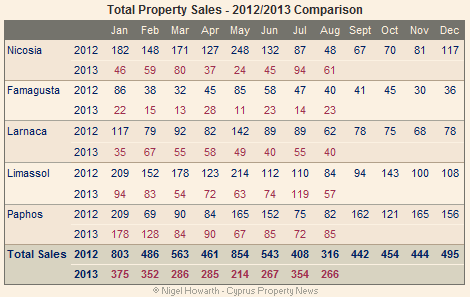
Latest figures from the Department of Lands and Surveys show that a total of 266 contracts of sale were deposited at Land Registry offices across Cyprus in August 2013 compared with the 316 deposited in August last year; an annual decline of 16%.

Of those 266 contracts, 79% (210) were deposited on behalf of domestic buyers, while 21% (56) were deposited in favour of overseas buyers.

With the exception of Nicosia and Paphos, where sales increased by 27% and 4% respectively, sales were down in all other districts.

Property sales in Famagusta fell to 23 from the 40 recorded in August 2012 (-43%), while sales in Larnaca fell to 40 from 62 (-36%) and those in Limassol fell to 57 from 84 last year (-32%).

total property sales aug 2013

During the first eight months of 2013, overall sales are down 46% compared to the same period last year having fallen from 4,434 to 2,399.

Some pundits expect that property prices will fall 30% in the coming years as a result of the lack of liquidity and the banks not granting loans, while the Economics Research Centre of the University of Cyprus says that: “Recession in the Cyprus economy is forecasted to deepen in the remaining of 2013 and in the first quarter of 2014. Subsequently real GDP growth is also projected to contract but at smaller rates” in its latest report.

Domestic sales

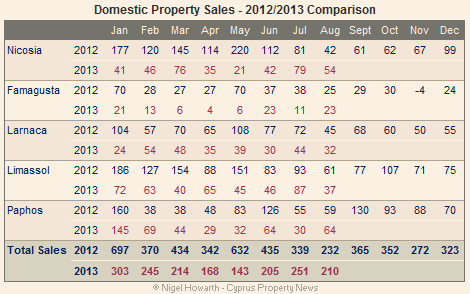
Domestic sales during August were down 10% compared with August last year.

Although sales in Nicosia and Paphos increased by 29% and 9% respectively, the number of properties sold in Limassol, Larnaca and Famagusta continued to fall.

Sales in Limassol fell to 37 from 61 recorded in August last year (-39%), while sales in Larnaca fell to 32 from 45 (-30%) and those in Famagusta fell to 23 from 25 last year (-8%).

domestic property sales aug 2013

During the first eight months of 2013, domestic sales have fallen 50% compared to the same period last year having dropped from 3,481 to 1,739.

Overseas sales

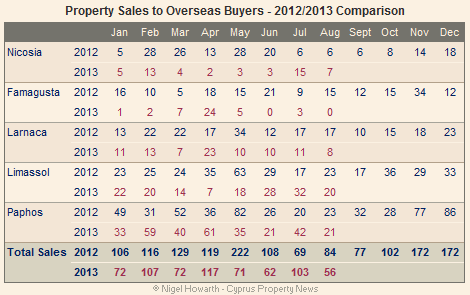
August was another disastrous month for overseas sales with the number of properties sold dropping to 56 compared with the 84 sold in August last year; a fall of 33%.

With the exception of Nicosia, where 7 properties were sold during August compared with 6 in August last year – an increase of 17%, sales continued to fall in all other districts.

Zero properties were sold in Famagusta compared with the 15 sold in August last year. Meanwhile sales in Larnaca fell to 8 from 17 last year (-53%), those in Limassol fell to 20 from 23 (-13%) and sales in Paphos fell to 21 from 23 (-9%) in August last year.

overseas property sales aug 2013

During the first eight months of 2013, property sales to the overseas market have fallen 31% compared to the same period last year having dropped from 953 to 660.

Our position on the issues of Jurisdiction & Time Bar

DURING the last few days/weeks the issue of jurisdiction, i.e. in which Court the purchasers of immovable property in Cyprus must pursue their rights, has again become a major topic. One wonders why.

Could it be that the motive behind this is the pursuit of clients? We sincerely hope not (for the benefit of the purchasers who have already suffered enough, both financially and emotionally). From our part we retain the view that everyone is acting and expressing his/their opinion in a bona fide manner and it is in this spirit and in this spirit alone that what follows herein below is stated.

The issue also surrounding clients potentially being “time-barred” from making a claim has also been raised; we address this latter issue at the end of this article.

So why should the purchasers pursue their rights in Cyprus Courts? The main reasons are the following:

  1. (i) The purchasers are not “attacking” their agreements with the Developers (or at least the vast majority of them are not). Our policy is to “go after” the Loan Agreements which the purchasers entered into in order to purchase the properties. Why is this? For the obvious reason, that the big threat to the purchasers comes from them. They are facing alleged claims from the Banks of hundreds of thousands of pounds in each case.If we are successful it means that this enormous financial burden is removed. At the same time an enormous threat (as explained below) is done away with.
     
    (ii) On the other hand going after the agreements with the Developers means that, if purchasers are successful, they will end up with a claim against the Developer of some thousands of pounds paid as down payment.
     
    Damages will not be able to be recovered since in the vast majority of cases the properties purchased have not been paid for (since there has been a default on the Loan Agreements) and so the properties will be claimed by the Banks.
     
    And a final word on this. Even if damages can be recovered, who will pay them? In most cases the Developers are bankrupt due to the dramatic fall of the property market. The same applies of course to the return of the down payment paid.
  2. In conjunction with what is stated above what are the realities faced by the Purchasers bearing in mind always that the Loan Agreements were entered into with Cyprus Banks?
     
    (i) The Banks are already proceeding in Cyprus Courts against their clients (the purchasers). What does this mean? The other party to the Loan Agreement has found himself before the Court in Cyprus even without his choice. Should he leave this Court Action undefended?
     
    In our view it would be disastrous for a purchaser to ignore the Court proceedings in Cyprus which are initiated by the Bank. If he does – and provided of course the Court documents are properly served on him or her- the Court will issue a judgment in default against the purchaser and will then have it registered in England and have it executed against his property in England.
     
    Naturally nobody wants this. So the Court Actions against the purchasers in Cyprus Courts have to be defended. This means retaining a Lawyer in Cyprus to represent the purchaser and trust the Court and the legal system in which the purchaser will argue his or her defence.
     
    Incidentally the Cyprus legal system is the same as the English legal system and most judges are English trained. The same applies for a large number of the Lawyers.
     
    (ii) This takes me to the next step. If you are going to raise – as a purchaser – various claims in Court in Cyprus as a defence in an Action against you why risk giving the impression that what you allege is an afterthought just because the Bank has sued you?
     
    Why not move first and take the Bank to Court and raise first the various issues that relate to the illegality of the Loan Agreement? This puts the Bank on the defensive and apart from “doing away” with the above mentioned risk, if there is the possibility, along the way, of reaching an out of Court settlement the purchaser will negotiate this from a position of strength and not as a defendant in the Action.
  3. I have studied the point raised relating to the jurisdiction of English Courts based on article 15 of EU Regulation 44/2001. I have serious doubts if this is so because it would involve interpreting it in a rather restricted way.
  4. What is then the end result of what I mention above?
     
    (i) Cyprus Courts definitely have jurisdiction. The Banks will not dispute it. On the other hand the jurisdiction of English Courts has to be proved through Court proceedings as the Banks will dispute it. This means additional legal costs.
     
    (ii) Even if English Courts have jurisdiction this is parallel to that of the Cyprus Courts. It’s not instead of the jurisdiction of Cyprus Courts. So purchasers will still find themselves as defendants in Actions brought against them by Banks in Cyprus Courts. This they cannot avoid. So in effect they will be “fighting a battle” on two fronts i.e. incurring double legal costs.
     
    (iii) And then if they obtain a judgment in an English Court against the Bank how can they enforce it? Only by going to the Cyprus Court in order to register the English judgment. So again the Cyprus Court, a Cyprus Lawyer and additional expense cannot be avoided.
  5. The above I think adequately answers the point made in relation to legal costs and that the possibility of bringing a group Court Action in England results in legal costs in England being less than if individual Court proceedings are initiated in Cyprus.
     
    I do not agree with this position. How can this stand to logic when a purchaser will have to pay a lawyer in England to represent him as a member of a group Court Action and at the same time will have to pay a Lawyer to defend him in the Court proceedings brought against him by the Bank in the Court in Cyprus. Remember. This he cannot avoid as it does not depend on the Purchaser but the Bank. And in addition to this how can it stand to logic if he has to pay a Lawyer to represent him in a Cyprus Court in order to register the judgment he has obtained in England as a member of a group court Action so as to enforce it against the Bank.

I could go on and enumerate additional reasons that lead to the inevitable conclusion that Cyprus Courts are the ones that have the jurisdiction purchasers must chose in order to fight to safeguard their legal rights. I will not do it because the objective is not to give the impression that a fight is going on who will attract more clients.

The pure fact of the matter is that Cyprus Courts definitely have jurisdiction. English Courts may or may not have jurisdiction. At the end of the day though the fact that Cyprus Courts definitely have jurisdiction will lead the cases before them (the Banks will follow this course). This means, for the reasons stated above, that it is much more reasonable in every respect for the purchaser to follow this course as well.

And remember. We are talking all along about fighting the Banks and disputing the validity of the Loan Agreements and not fighting the Developers. The big risks lie in the amounts involved in the Agreements with the Banks. This is the fight that must be fought and hopefully won.

This is the fight that Banks definitely will bring into the Courts in Cyprus and this is the purchasers must fight it. Whether they like it or not. Otherwise they will end up fighting in two fronts (if English Courts are found to have jurisdiction since Cyprus Courts definitely have one) with all the negatives that such an approach entails the most prominent of which being the one I mention above namely the enforcement against a purchaser of judgment of the Cyprus Court against him in the proceedings initiated by the Bank if these remain undefended and the consequential threat to his or her property in England.

Limitation

Before I “close” I will add a word in relation to the issue of the Court actions by the Purchasers being time barred on the basis of the relevant statutory provision.

Under Cyprus Law – and remember, this is the one the Banks will use in their Court Actions against the Purchasers in the Courts in Cyprus – this eventuality does not arise: Based on the relevant statutory provision the period of six years does not start to run until the Bank sends demand letter.

It could be said that this applies in the case of the Court Action by The Bank and not by the Purchasers. This is doubtful but even if it is so and taking into account all that is stated above this is one more reason why the Purchasers should chose to litigate in Cyprus Courts.

Court proceedings in England will still “leave them open” to Court proceedings against them in Cyprus by the Banks, with no six year time limit and all the negatives mentioned above.

All legal comment within is provided by;

Christos M. Triantafyllides
Barrister-at-Law
Advocate
Member of the Law Firm of Triantafyllides & Christoforou & Lead Counsel for Judicare in Cyprus

A simple warning on loan restructuring

corruptionONE of the largest loan takers in Bank of Cyprus – a land developer – today owes the bank 457 million euro. In an internal audit carried out at the beginning of the crisis, the bank noted that he had not serviced any of his loans – including interest – since 2009. Provisions? None.

There are several such cases in Bank of Cyprus and in the mess formerly known as Laiki Bank, which was absorbed by Bank of Cyprus (BoC) in March. Overall, according to the internal audit, the problematic loans, corporate NPLs with little hope of resurrection, were covered by provisions at 40%.

All hope rests on collateral prices, pumped up and overstated through the years of the bubble, and stubbornly propped up by a strange rule of the Land Registry Department which regularly records prices on real estate that are higher than those recorded in transactions: You sell a house for, say 250 thousand euro and the Land Registry Department records the “going price” at a higher level, say 300 thousand.

This, on top of the traditionally elevated prices recorded by real estate brokers who, not only had to protect their clients (the banks) by overstating the value of collateral so they could give higher loans and protect market shares, but also got paid on commission based on the value of the transactions.

This sort of cronyism is not a “Cypriot” phenomenon, of course. We’ve seen artificial prices, connected lending, overstated collateral and loan “restructuring” that makes no sense before, not the least in the Asian crisis.

But at this point, BoC is being resolved itself, and the main thinking behind the next moves, is to form a hybrid (some might say mutant) form of an Asset Management Company (AMC) to absorb bad loans, restructure them and sell off collateral over time. The merits of an AMC, avoiding fire sales and preserving value, are rather self-evident.

The real problem in BoC, however, remains the track record of the bank, and the attitude maintained (formally and behind-the-scenes) by decision makers controlling the bank. When you owe the bank 457 million (or 335 million, for that matter, or 198 million still), the issue is not only that the bank has a problem – the issue is that half of the political elite is also at your feet, as they were when you were financing campaigns.

While the details of the AMC are still foggy, and any serious commentary on this decision should rest on the details, where, after all, the devil lies, one thing is clear: Loan restructuring is meant to preserve value and rescue good loans that are under temporary stress. What is it not meant to be, is a trick to rescue bad businesses by evergreening their obligations, by lengthening their repayment period, providing payment holidays on the principal and lowering interest payments.

In other words, loan restructuring is supposed to preserve/rescue value, not cook the books.

The danger in BoC is the very pathology that brought the bank to the brink – bad loans that were covered by extending yet more bad loans; connected lending to companies “related” to the Board that were then repeatedly rolled over so that NPL rates would appear lower and, finally, crony lending that only an eight year old would extend to companies that, for years, appeared entirely beyond salvation.

At the same time, official land price levels remain unrealistically high, not the least because of a policy followed by the Land Registry Department that is on the verge of outright corruption.

After all, a “businessman” who owes almost half a billion euro for projects in developing land in the middle of nowhere (eg Paphos), and who couldn’t make his payments during the era of the “fatted cows”, can’t be expected to turn things around under current conditions.

And this is a dire warning for Cyprus today, as decision makers continue to deny that the largest loans extended were problematic at all, trying (apparently) to protect large campaign donors from destruction. One, in fact, wanders if Alvarez and Marsal will continue to accommodate this policy, given the absolute control that Central Bank senior staff say it exercises over the Governor who appears paralyzed like a deer in the headlights of the crisis…

BoC can still be saved – but more of the same virus will certainly spell much worse illness to come for Cyprus, unless Central Bank (and Alvarez) start doing their job better.

Editor’s comments

Readers may find the original article on the ‘forthisisland’ blog at A simple warning on loan restructuring.

State to offer property for long-term leasing

Old Larnaca airport buildingTHE CABINET decided last Tuesday to push development through long-term lease agreements to enable private investors to take on the management of government property.

Investors will be able to lease property for up to 99 years, and develop it as they see fit within the framework of town planning regulations, government spokesman Christos Stylianides said.

The communications ministry, which submitted a bill, wants to promote use of existing property including the old Larnaca airport and prime land across from Nicosia’s Hilton hotel, Stylianides said. There have previously been promises of strategic multi-million investments in relation to both of those properties, eventually coming to naught.

Stylianides said that in addition to the strict implementation of the government’s agreement with its international lenders, the state was trying to give incentives for development.

He said requests for tenders’ proposals will be announced for each case “under specific terms”.

Under the memorandum agreement with its lenders, authorities may not enter any new tendering processes and sign new public-private-partnerships (PPPs) before setting up “an adequate legal and institutional framework for PPPs designed according to best practices”.

State to offer property for long-term leasing

Immovable Property Tax debacle continues

FOLLOWING numerous comments and press articles this week on the ‘notorious’ Immovable Property Tax, I’m considering changing the title of this journal to ‘Immovable Property Tax News’.

What has happened?

On Tuesday at a meeting of the Council of Ministers in Troodos, the Cabinet agreed to scrap the €75 IPT minimum payment and that those owning property whose total 1980 values are no more than €5,000 will be exempt from paying IPT.

This move was designed to “reduce injustices and the distortions of the current legislation” according to government spokesman Christos Stylianides.

On Friday the main opposition party, AKEL, said that it would resubmit an amendment to the Immovable Property Tax that will exempt the first residence from IPT.

(Neither of these amendments have been discussed by Parliament and we will have to wait until any changes to the current law are published in the Cyprus Gazette before we can assess their impact).

Complaints

Meanwhile the Inland Revenue Department has been flooded with complaints from property owners concerning the calculation of their IPT.

It seems that the owners of multiple properties are not being issued with detailed statements of how their IPT has been calculated, but a lump-sum 1980 value of their properties and the tax due.

Inland Revenue Director, George Poufos has said that “We can’t print out detailed statements for some 450,000 registered owners and mail them, that’s neither practical nor feasible at this time.”

According to a report in the Greek language newspaper Phileleftheros, those who want a detailed statement of all their properties nationwide must pay €50 fee, while those who want a breakdown for a specific district are being asked to pay €20.

In addition, many people who have recently had the 1980 value of their properties reassessed are also complaining.

Doom and gloom

As if that wasn’t enough, the ‘doom and gloom merchants’ have been spreading rumours that IPT will increase dramatically next year as the tax will be based on 2013 property values rather than 1980 values as they have been in the past.

To scotch these rumours Interior Minister Socrates Hasikos has stepped in and given his assurance that there will be absolutely no tax increases.