Why have construction output prices not fallen?

OUTPUT in construction recorded its steepest drop in 2012 since the long recession in the sector that began in the second half of 2008, with the construction production index falling by 22% compared with the previous year.

Construction output also recorded its steepest decline on a quarterly basis, falling by 27% in the fourth quarter compared with the same period of 2011, to 57.8 (2005=100).

This is the lowest index on records that began in 2000. It means that construction output is only around quarter of the size it was 12 years ago: in the first quarter of 2000, the construction output index was 76.5 (2005=100).

The decline in 2012 was across both subsectors: building construction fell by 19.8%, while civil engineering tumbled by 27.3%.

The steeper decline for civil engineering is probably related to building projects in the run-up to Cyprus holding the EU presidency in the second half of 2012. Civil engineering projects recorded a small 1.2% increase in 2011.

As regards building construction, this has been hit by oversupply built up during the boom period and tighter credit conditions thereafter.

In an earlier Financial Mirror article, Sapienta Economics explained how by 2011 Cyprus had a total housing stock of 431,059 but only 309,300 households to fill them, meaning a housing oversupply of around 120,000, which was too large to be filled by holiday home-buyers.

Construction output prices down in Q4

Despite the decline in construction, output prices have taken a long time to respond. Output prices fell by only 0.4% overall in 2012 although they fell by a steeper 2% year on year in the fourth quarter. Does this mean that construction companies are still squeezing the end-buyer for profits?
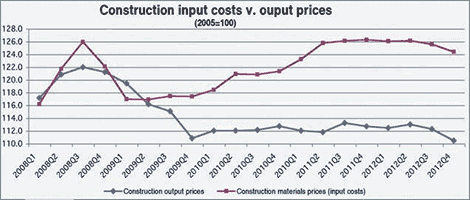
Cyprus output construction costsProbably not. The main reason for the slower decline in prices, despite tumbling demand that should depress prices, is related to the cost of materials inputs.

Input prices of materials, reported as the price index of construction materials, are heavily influenced by oil prices.

As can be seen from the chart, input prices dropped after the peak in mid-2008 but started to climb again from the beginning of 2009 and did not drop off until the last quarter of 2012.
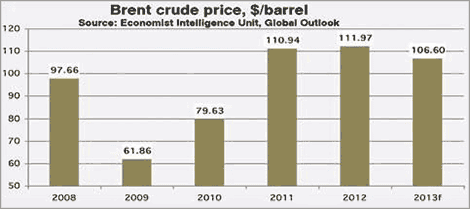
brent crude oil priceThis more or less matches the path of oil prices. According to the Economist Intelligence Unit’s monthly Global Outlook, Brent crude fell from $97.66/barrel in 2008 to $61.86/b in 2009, then climbed to $79.63 in 2010, $110.94 in 2011 and $111.97 in 2012. It is expected to drop to $106.60 in 2013.

As input prices fell, the chart shows that developers in Cyprus followed suit, cutting output prices. But they carried on cutting long after construction input prices had started to rise again.

Developers have seen a deep cut in profit margins

The result is a widening gap between the amount developers pay for inputs and the amount they can charge once the project is completed. In other words, a deep cut in profit margins.

One can reasonably infer from the rapid rise of unemployment among construction workers that the developers have responded to lower demand and tighter margins by laying off staff. We can also assume that in some cases the staff laid off have been replaced by cheaper and not necessarily officially registered workers in their place.

How to re-skill and retrain the 6,717 unemployed construction workers registered at the end of March so that they can be employable in other fields is a huge undertaking with no easy answers. At least in Cyprus we have a wealth of knowledge on what has and has not worked elsewhere via Professor Chris Pissarides, the chairman of the new economic advisory council, who won his Nobel Laureate through research into labour markets.

Fiona Mullen – Director, Sapienta Economics Ltd

Just more empty talk about title deeds

The Houses of Parliament (photo by Adrian Pingstone)

IN A RECENT speech in the British House of Commons, the Cypriot Foreign Minister included the following as part of his statement:

“At this point, I wish to express understanding for the difficulties that British residents in Cyprus face with regards to the timely issuance of real estate title deeds. Many Cypriots face the same problem too. To this end, we aim to introduce a speedy and fast track system to assist foreign nationals wishing to invest in real estate.”

It’s all in the words so let’s carefully examine those ‘words’. Firstly, the age old deflective technique of stating that Cypriots are also suffering holds no water. So what?

Secondly, the word ‘aim’ is no clear commitment to actually doing anything speedily about the problem and the timescale could extend to yet more years.

Finally, ‘wishing to invest’ only refers to those who are likely to alight on Cypriot shores in the future and hardly tackles the problems of those locked into the current corrupt system which, in so many cases, incorporates developer mortgages.

In short, this yet again is pure flimflam and will cut no ice whatsoever with those who’ve witnessed over many years the delaying tactics and machinations of government, developers, lawyers, bankers and all those connected to the Cypriot real estate fraternity.

Gavin Jones, Lemba.

Just more empty talk about title deeds


Revised property tax bill announced

THE COUNCIL of Ministers today approved changes to a bill imposing a tax on immovable property as part of the bailout agreement with Cyprus’ international lenders.

If passed by Parliament, the tax will generate up to €131 million/annum.

According to Stockwatch, the revised annual rates are as follows and are based on the assessed value of property at the 1st January 1980.

  • Up to €12,500 – €50/annum
  • From €12,500  to €40,000 – 0.4%
  • From €40,000 to €120,000 – 0.6%
  • From €120,000 to €170,000 – 0.8%
  • From €170,000 to €300,000 – 1%
  • From €300,000 to €500,000 – 1.2%
  • From €500,000 to €800,000 – 1.4%
  • From €800,000 to €3,000,000 – 1.6%
  • More than €3,000,000 – 1.8%

However, government spokesman Christos Stylianides has admitted that there are shortcomings in the data used to assess the new tax rates.

For example, there are areas in Limassol, Nicosia and Larnaca where houses have been built that are worth many millions of Euros but no building permits have been issued for their construction; they are currently registered as lands and fields. Municipalities and Communities need to gather data on these properties by June to arrive at a final fill that includes them.

Further reading

Calculation of Immovable Property Tax yield for the fiscal year 2013 based on the revised rates.

Criminal investigation into land registry officials

A NUMBER of “corrupt” public officials at the Land Registry Department have been dipping their hands into the honey jar, Interior Minister Socrates Hasikos said yesterday, adding that the ministry will not hesitate to pursue criminal investigations wherever necessary.

According to Hasikos, seven land registry officials are under criminal or disciplinary investigation in relation to allegations of corruption, bribery, embroilment, violation of personal data laws and depriving the state of revenue.

“It appears there is corruption, without wishing to taint all land registry employees. On the other hand, there are these exceptions where civil servants appear to have been frequently putting their hands in the honey jar,” he said.

“The ministry is in a position to identify these exceptions and we will not sit idle,” he added.

Hasikos told the Cyprus Mail two land registry officials have already been suspended and their files sent to the police to launch a criminal investigation into allegations of corruption and bribery.

The two are allegedly involved in helping Greek Cypriots – for a fee – sell their properties in the occupied areas by applying to the Immovable Property Commission (IPC) in the north.

“It appears a ring is operating… particularly in the Larnaca district, where this illegality appears to be blossoming,” said the minister.

He did not rule out others being involved.

In a separate case reported by Phileleftheros yesterday, Hasikos confirmed that a disciplinary investigation is underway against four employees accused of filing 25,000 applications for information on property owned by 16,300 citizens across Cyprus.

It appears the employees were filing fake applications for a data search at the land registry in order to retrieve information for hidden individuals in exchange for a fee.

Hasikos said he did not rule out also sending this case to the police to launch a criminal investigation.

The case involves potential violations of personal data laws, as well as actions which have deprived the state of revenue, since invoices were not issued and paid for the fake applications for data searches at the department.

According to Phileleftheros, Auditor-general Chrystalla Georghadji uncovered the scam which allegedly took place between 2008 and 2012.

Through a surprise visit to the land registry department by a member of her office, Georghadji found a number of officials had printed out thousands of data searches for immovable property without being authorised to do so. It was not clear whose hands the information ended up in.

In her report, Georghadji also had a dig at the land registry department for carrying out an “inadequate” investigation into the allegations.

A seventh employee is also being investigated in relation to a separate case of alleged bribery regarding the sale of land, said Hasikos.

Criminal investigation into Land Registry officials

EU set to finalise rules on mortgage lending

EUROPEAN Union negotiators are expected to finalize the bloc’s first common rules on mortgage lending on Monday, in an attempt to avoid a repeat of property bubbles that helped fuel the euro zone’s debt crisis.

The legislation will force lenders in Europe’s 6.5 trillion euro mortgage market to check the creditworthiness of potential customers and their ability to repay, effectively banning self-certified or “liar” loans.

The rules would also make it illegal for those carrying out credit checks within banks and other lenders to have their pay linked to the number of mortgages they approve – a practice blamed for encouraging irresponsible lending in the past.

“We are hoping to conclude talks with the European Parliament on Monday on these important new rules to protect consumers and mortgage holders,” said a spokeswoman for the Irish EU presidency, which will negotiate on behalf of EU governments.

If a deal is reached, the draft rules will need to be rubber-stamped by the full parliament and EU governments before entering force in mid-2015.

Irresponsible home lending in the United States created a domestic housing bubble that, when it burst, helped to spark the global financial crisis.

Similar property bubbles in Ireland and Spain left banks holding hundreds of billions of euros in bad debts, forcing governments to prop them up and then seek euro zone bailouts when the expense proved too much.

As well as seeking to avoid reckless lending, the rules also increase consumer protection by making it harder for lenders to seize homes from borrowers who fail to keep up with repayments.

Other elements in the regulations are designed to encourage cross-border competition between mortgage providers, for example by requiring them to provide certain information in a standardized way to consumers across the bloc.

Regulators believe greater competition between lenders in different countries will result in a better deal for consumers and contribute to the bloc’s economic recovery.

Reuters

Property tax for all

THE GOVERNMENT has almost finalised a new bill for the taxation of properties that will be put before a plenary session of the Cypriot parliament later this week.

According to Socrates Hassikos, the Cyprus Interior Minister, a fairer system of property taxation will be proposed for deputies to consider in which every registered owner will be required to pay.

Mr Hassikos suggested that the revised taxation will be based on the assessed 1980 value of properties, which will be achieved by amending the value bands.

Under the present legislation approximately 78,000 home owners are exempted from paying any property tax as the 1980 value of their properties falls below the €120,000 threshold at which this tax becomes payable.

The previous property tax proposal put forward by the AKEL adminstration, which aimed to raise €180 million and which reduced the tax free threshold to €40,000, was rejected when hoteliers, landowners and developers protested saying that the changes would drive the economy deeper into recession.

Under the bailout deal reached with the EU, Cyprus must ensure additional revenues from property taxation of at least €75 million – and the passing of a relevant bill is a prerequisite for receiving the first tranche of the bailout from the EU.
