Price falls continue as uncertainty grows

THE THIRTEENTH edition of the RICS Cyprus Property Price Index, which is produced in conjunction with the Association of Quantity Surveyors and Construction Economists, shows continued falls in property prices across the island.

Over the quarter, prices of residential apartments and houses fell by an average of 3.1% and 1.4% respectively.

Apartment prices in Paralimni/Famagusta fell 7.0% over the quarter, followed by Limassol (-5.0%), Nicosia (-2.5%), Paphos (-1.5%) and Larnaca (-0.3%).

House prices in the Paphos and Paralimni/Famagusta areas remained steady. But prices Larnaca fell 4.6%, followed by Nicosia (-1.3%) and Limassol (-1.1%).

RICS Cyprus commentary

During the fourth quarter of 2012 the Cyprus economy bore the consequences of the slowdown in the economy (year-on-year GDP contraction of 3.3%), the increase in unemployment (year-end at 14.7%), the on-going turbulence in the banking and financial sector, and the political uncertainty caused by the lack of a Memorandum to bailout the country.

The worsening state of the Cyprus economy and the growing political and economic uncertainty, led to a pronounced slowdown in mortgage and corporate lending and a further rise in the rate of unemployment.

There has been a dearth of investment transactions during the second half of 2012. Property, both commercial and residential, is viewed as a risky asset and one with negative prospects in the near to medium term. Local buyers in particular were the most discerning as the increase in unemployment and the worsening prospects of the local economy led to a sharp reduction in interest.

Price changes over the past year

Compared to Q4 2011, the average price of a residential apartment has fallen by 7.9%, while the price of an average house has fallen 5.7%.

Prices for commercial property have also fallen, with the price of retail units falling by 15.5%, while the prices of offices and warehouses have fallen by 10.0% and 9.3% respectively.

Gross rental yields

Yields are a useful tool showing the relationship between rent and property prices. At the end of Q4 2012 average gross yields stood at 3.8% for apartments, 2.0% for houses, 6.0% for retail, 4.7% for warehouses, and 4.6% for offices.
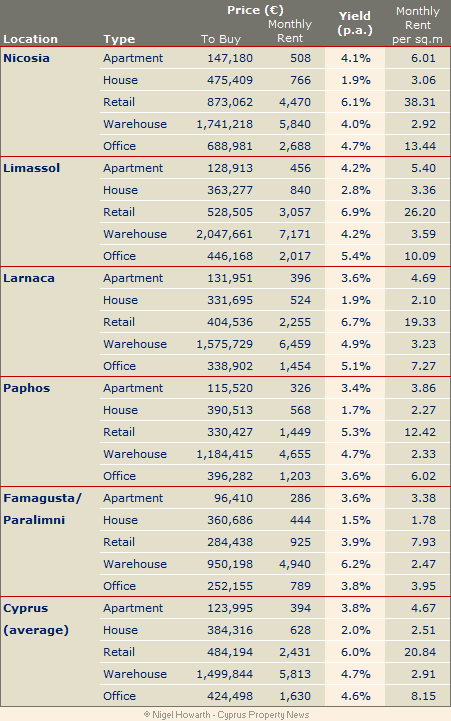
Derived from the RICS Cyprus Property Price Index for Q4 2012

The parallel reduction in capital values and rents is keeping investment yields relatively stable and at very low levels (compared to yields overseas). This suggests that there is still room for re-pricing of capital values to take place.

Some pundits predict that there will be double-digit price falls in property prices in some areas of the island in the wake of the 10-billion euro rescue deal reached between Cyprus and the European Union last Monday.

Outline of properties used to calculate the index

Apartments: Residential, two bedroom, 85sqm, Medium quality.
Houses: Residential, three bedroom with garden, Semi-detached, 250sqm, Medium quality.
Retail: High-street retail, 100sqm ground floor area with 50sqm mezzanine.
Warehouse: Light industrial area, 2,000sqm, which includes 200sqm office space.
Office: Grade A, City centre location, 200sqm

(All property types used to calculate the index are: freehold, have all licences and permits in place, have their Title Deeds, are subject to VAT and are in a good state of repair).

Methodology

The methodology underpinning the RICS Cyprus Property Price Index was developed by the University of Reading UK and may be viewed by clicking here.

Mortgages muggings and the gutter press

WHEN it came to choosing between Scylla (a disastrous exit from the Eurozone) and Charybdis (the German crewcut), Cyprus chose to stay in the Eurozone. Whether this painful and courageous decision to save the island’s banks and its economy from total collapse was correct we shall never know.

At the present time discussions are continuing on the way forward and the banks should reopen for business tomorrow (Thursday).

Unlike countries outside the Eurozone, Cyprus was unable to devalue its currency or embark on a process ‘quantitative easing’; effectively printing more banknotes to stimulate the economy.

Since the bailout was announced, I have received literally hundreds of questions from those planning to holiday here asking if it’s safe, are there riots, will I be robbed? While those with those with property on the island have been sending me questions about their mortgage repayments and other matters.

Is it safe to visit Cyprus?

In a word YES – do not believe the stories you read in the gutter press, like the one that was recently published by “The Sun”:

“FAMILIES heading to Cyprus for Easter are being told to take plenty of euros – and try not to get MUGGED.”

The extraordinary Foreign Office advice came as the island teetered on the brink of financial meltdown.”

This is a lie; the advice from the Foreign Office says nothing about being mugged. The Foreign Office advises that visitors to the island should take “appropriate security precautions against theft.” This is the same advice it offers to British nationals travelling to many parts of the world – it doesn’t mean you should wear a crash helmet and a suit of armour when you visit the island to avoid being mugged!

My wife and I have lived in Cyprus for eleven years without any problems – and I first want to assure all those planning to visit that the island is perfectly safe – don’t cancel your holiday.

Contrary to other reports in the foreign press my wife and I, who bank with the Laiki, have been withdrawing cash from their machines and paying in shops, supermarkets and petrol stations with our Laiki debit cards.

Property and mortgages

I have received questions from many people asking if they should continue making their regular mortgage repayments to their banks in Cyprus, even though some of them are in difficulty and may not be around for much longer.

In a word, the answer is YES. Failing to maintain your mortgage repayments could result in penalties imposed by the bank for non-payment and the potential loss of the property.

Finance minister Michalis Sarris announced on state TV that alternative arrangements will be made for those with mortgages with the Liaki (Cyprus Popular) Bank.

Non-performing loans

As you may have read, the Laiki bank is to become the island’s ‘Bad Bank’ and will take over all non-performing loans. As regular readers will know, Cyprus had a unique way of classifying loans as non-performing as it did not count fully secured loans as non-performing even though they have not been serviced in 90 days.

I know that that many thousands of people, both Cypriot and foreign, were deceived into buying property built on land that a developer had mortgaged; a material fact that was concealed from them by disreputable developers, lawyers and banks.

The questions I am being asked is what will happen if the developer’s mortgage is classified as non-performing and is transferred to the Laiki ‘Bad Bank’.

I’m afraid it’s too early to say. Until the Memorandum of Understanding has been ratified by the Eurogroup and is in the public domain, no-one can say.

However, I would hope at the very least that those who have bought property with a mortgage and who are maintaining their mortgage repayments will be protected.

Commercial property

As well as property prices taking a dramatic tumble, commercial rents are also facing a downturn.

Many local businesses will face closure as the recession deepens resulting in many commercial properties coming onto the market. This will put further downward pressure on rents as well as prices – and if offshore companies decide to move elsewhere, further downward pressure will be put on prices of residential and commercial property as well as rents.

Price falls loom in wake of bailout

PROPERTY valuers in Cyprus have suspended work as they come to terms with a financial bailout that is likely to deepen price falls of recent years, the chairman of the country’s Property Valuers Association told Reuters.

The association, which represents about 90 percent of valuers in the country, advised its members last week not to carry out valuations for banks or individuals until the terms of a financial bailout become clear, Charalambos Petrides said.

A 10-billion euro rescue deal was agreed between Cyprus and the European Union on Monday after the country’s outsized financial sector ran into trouble with soured investments in neighbouring Greece.

Valuers are likely to resume work once the banks re-open on Thursday after a closure of almost two weeks designed to prevent a run on deposits.

Prices have already fallen by half for residential property in some parts of Cyprus and 35 percent for some commercial real estate since the last peak at the start of 2009, Charalambos said.

Any further falls will magnify the pain felt by the Cypriot economy as a whole, which has relied heavily on the second-home market among British and Russian buyers.

“This is a very big shock for Cyprus that could lead to double-digit price drops in some areas,” said Eri Mitsostergiou, a director of European research at property consultant Savills who has advised on development deals in Cyprus.

Charalambos said it was too early to predict how large falls would be.

In addition to Russian and British buyers who have dominated the Cyprus residential market, the island has seen emerging interest from the Chinese in the western coastal town of Paphos.

Many Britons sold their holiday homes in the wake of the financial crisis in 2009 and 2010 and Russians may head for the door after suffering losses on their bank deposits and as scrutiny on Cyprus as an offshore base grows, Mitsostergiou said.

“This is the end of an era for Cyprus. It is another real estate-driven economy that faces falling demand,” she said.

While some Cypriots may now choose to invest in London or Athens real estate over banks, bargain hunters are lining up for Cyprus property.

“There will be some great deals,” said Kostas Kazolides, a London-based investor who has been buying property and advising on deals in Cyprus since the 1970s, before the bailout deal.

“People that are stuck may need to sell up their land very quickly.”

Reuters – reporting by Tom Bill; editing by Peter Graff

Bailout deal for Cyprus agreed in Brussels

CYPRUS clinched a last-ditch deal with international lenders on Monday for a 10 billion euro ($13 billion) bailout that will shut down its second largest bank and inflict heavy losses on uninsured depositors.

Following is the detail of the deal in a statement from euro zone finance ministers.

  • Laiki will be resolved immediately – with full contribution of equity shareholders, bond holders and uninsured depositors – based on a decision by the Central Bank of Cyprus, using the newly adopted Bank Resolution Framework.
  • Laiki will be split into a good bank and a bad bank. The bad bank will be run down over time.
  • The good bank will be folded into Bank of Cyprus (BoC), using the Bank Resolution Framework, after having heard the Boards of Directors of BoC and Laiki. It will take 9 billion Euros of ELA with it. Only uninsured deposits in BoC will remain frozen until recapitalization has been effected, and may subsequently be subject to appropriate conditions.
  • The Governing Council of the ECB will provide liquidity to the BoC in line with applicable rules.
  • BoC will be recapitalized through a deposit/equity conversion of uninsured deposits with full contribution of equity shareholders and bond holders.
  • The conversion will be such that a capital ratio of 9% is secured by the end of the program.
  • All insured depositors in all banks will be fully protected in accordance with the relevant EU legislation.
  • The program money (up to 10 billion Euros) will not be used to recapitalize Laiki and Bank of Cyprus.

(Reuters)

After the eurozone’s finance ministers’ approval, several national parliaments, such as Germany’s, must also approve the bailout deal, which might take another few weeks. EU officials said they expect the whole programme to be approved by mid-April.

Comments

“The debt clean-out will help growth as it always has. But cold comfort for the people sacrificed by a toxic blend of European idealism and grotesque local incompetence.”

“We’ve put an end to the uncertainty that has affected Cyprus and the euro area over the past week,” said Jeroen Dijsselbloem, who chairs the meetings of the 17-nation eurozone’s finance ministers.

“We believe that this will form a lasting, durable and fully financed solution,” said Christine Lagarde, chief of the IMF.

Cyprus’ finance minister Michalis Sarris said: “It’s not that we won a battle, but we really have avoided a disastrous exit from the eurozone. A long period of uncertainty and insecurity surrounding the Cyprus economy has ended.”

Pissarides Sees ‘Disastrous’ Implications in Cyprus

March 25 (Bloomberg) – Nobel Laureate, Christopher Pissarides, the head of Cyprus’ economic policy council, talks about the island nation’s bailout package and the outlook for its future membership of the euro zone. He speaks from Nicosia with Guy Johnson and Francine Lacqua on Bloomberg Television’s “The Pulse” (Source: Bloomberg)

[youtube=http://www.youtube.com/watch?v=a3qJjUxBDks&w=470&rel=0]


Press conference given by the Cyprus Finance Minister

Finance minister Michalis Sarris held a televised press briefing following the bailout deal reached in Brussels. The first 12 minutes of the briefing (below) are in English, the remainder in Greek.

[youtube=http://www.youtube.com/watch?v=ddSfzKAyAQM&w=470&rel=0]

Buyers’ grievences heard in EU Parliament

DISCUSSIONS took place in the European Parliament by the Internal Market and Consumer Protection Petitions Committee concerning problems with the purchase of property in Cyprus, in the presence of one of the petitioners who presented his case.

The petitioner described the many problems he faced and urged the Commission for their support. His complaints against his lawyer, developer and bank are typical of the many that I receive.

The committee session was broadcast live by EuroparlTV, the relevant segment of which can be viewed below.

[youtube=http://www.youtube.com/watch?v=BYviBIsI8Qw&w=470&rel=0]


As the chairperson says during her reply to the petitioner, the Commission has received many such petitions and concluded the session by assuring the petitioners of the Commission’s support and that the Commission will instigate infringement proceedings against Cyprus if the country is failing in its European obligations.

Please note  – those wishing to comment on this article are advised to refrain from making unproven allegations against their developer, lawyer and any other persons. Failing to do so may result in legal action being taken against them.

Petitioning the European Parliament

Any citizen of the European Union, or resident in a Member State, may, individually or in association with others, submit a petition to the European Parliament on a subject which comes within the European Union’s fields of activity and which affects them directly.

Any company, organisation or association with its headquarters in the European Union may also exercise this right of petition, which is guaranteed by the Treaty.

For more information on the procedures for submitting a petition to the European Parliament, please visit Petitions – one of the fundamental rights of European citizens.

Extra holiday to pass legislation on bank deposits

bank depositTHE rescue package for Cyprus hammered out over the past week includes a highly controversial and unpopular levy on bank deposits.

Those with bank deposits under €100,000 will lose 6.75%, while those with more than €100,000 will lose 9.9%.

The Cypriot parliament was due to vote on the measure on Sunday. But in a dramatic turn of events, the vote was put back to Monday, which has led to speculation that the government does not have enough support to get the bill through parliament. There is further speculation that the President may have to declare additional bank holidays on Tuesday & Wednesday to give the government more time to garner support.

Although ex-pats with savings in Cypriot banks will be hit, George Osborne has pledged that the UK government will compensate British troops and civil servants based in Cyprus.

Monday is a public holiday in Cyprus – Green Monday, which marks the start of lent in the Orthodox calendar. Celebrated with picnics and children flying kites, the atmosphere this year will be subdued.

Analysts have described the decision to raid all bank accounts in Cyprus as a threat to the entire economy of the island. Some are predicting a run on the banks as depositors rush to withdraw cash when they re-open after the holiday.

Long lasting damage

“The damage will be long-lasting,” said Fiona Mullen, a leading economic analyst and Director of Sapienta Economics.

“Business and financial services were the only sectors generating jobs and tax revenue and they have just had a double whammy with both the increase in corporate tax and the hit on deposits,” she added.

Marios Skandalis, vice president of the Cyprus Institute of Certified Public Accountants, said: “There is a very high risk that this could be the end of Cyprus as a strong and reliable financial centre.

“The whole banking system is based on trust. If the trust is lost, the whole system is going to collapse,” he said.

At the very least the move will further erode investor confidence and increase the downward pressure on property prices and sales.

President’s promise

In his speech to the nation, President Nicos Anastasiades said: “The state recognises its obligations, and will offer to those who will keep their deposits for two years, the worth of their loss in bonds tied to future state income from natural gas.”