UCPD review offers no solution for Title Deeds

Viviane Reding - Photo: ec.europa.eu
Viviane Reding – Photo: ec.europa.eu

WHILE the past week’s news from Cyprus has been dominated by the bailout negotiations taking place between the government and the Troika, the European Commission has announced plans to strengthen enforcement against unfair commercial practices.

In a press release issued last week, the Commission has identified that travel and transport, digital, financial services and property markets are the major sectors where consumers continue to lose out and where more efforts are required.

The EU Justice Commissioner, Vice-President Viviane Reding said: “We have good rules in place to protect consumers, but we need to make sure they are better enforced, especially in cross-border cases. I want to see zero tolerance for rogue traders so consumers know exactly what they are buying and are not getting ripped off. That also means a coherent approach to enforcing the same set of rules.”

The press release coincided with the publication of the Commission’s study on the application of the Unfair Commercial Practices Directive (2005/29/EC) in the fields of financial services and immovable property, in which Cyprus receives an honourable mention:

“The Commission has received a large number of complaints, citizens’ letters, parliamentary questions and petitions on problems relating to the purchase of property in Cyprus, Bulgaria and Spain.

“In Cyprus and Bulgaria property developers engage in misleading advertising by making various misrepresentations about the characteristics of a property and in particular omitting to disclose that properties sold would continue to be subject to prior mortgages for present and future bank loans contracted by the developers.

“The Commission is currently in contact with the Cypriot and Bulgarian authorities on these matters in order to find a solution to the issues raised.”

Black list request rejected

The Unfair Commercial Practices Directive contains a ‘black list’ of 31 practices that are deemed to be unfair in all circumstances.

The Cyprus Property Action Group was asked for its input as part of a review of the blacklisted practices being undertaken by the Justice Commission and urged that the withholding of legal title to property should be deemed unfair; a view that was supported by 42 MEPs in a letter addressed to Viviane Reding on the subject.

Regrettably, it would appear that the European Commission has rejected this request as the study reveals, on page 20, that:

“In the light of the enforcers’ experience and the feedback from the consultation, there is no need at this stage to amend the Black List.

“No new practices which are not covered by the Directive have been identified.

“It is, however, important to make sure that the criteria and concepts contained in Annex I are interpreted in a uniform manner, which can be done by enhancing the Guidance and the UCPD Database.”

Robbed by property fraud

EARLIER this month, Andrew Stunell MP raised a question in the House of Commons on behalf of one of his constituents:

“My constituent Mr Percival is one of many who have been robbed by property fraud in Cyprus following the default of the Alpha bank.

“Will a Minister meet me to discuss with the Greek and Cypriot authorities what might be done to rectify this disgrace?”

Replying to Mr Stunell, Minister for Europe David Lidington said:

“Ministers at the Foreign and Commonwealth Office and our high commissioner in Cyprus regularly raise property issues with the Cypriot authorities.

“I have made a commitment to meet members of the all-party group on the defence of the interests of British property owners in Cyprus to discuss the particular case to which my right hon. Friend has referred and the broader issues.

“I would be very happy to talk to him in that context.”

We await further developments.

Further reading

Source: House of Commons Hansard Debates

About Andrew Stunell MP

Andrew-Stunell-MPAwarded an OBE in 1993, Andrew Stunell was first elected as the Liberal Democrat Member of Parliament for the Hazel Grove constituency in Greater Manchester in 1997.

In 2010 he was appointed as Parliamentary Under-Secretary of State in the Department for Communities and Local Government.

Cyprus property mis-selling disputes

MANY British people have been contacting their MPs about property mis-selling disputes in Cyprus.

Buyers have for instance found themselves unable to meet drastically increased mortgage payments, and/or have discovered that their homes were to be sold in order to pay off their developer’s debts.

One particular issue is the Alpha Bank/Alpha Panareti dispute, which concerns British people who bought property in Cyprus using Swiss Franc mortgages and allege that they were not properly advised by the bank or by lawyers.

The British Government does in some circumstances raise property issues with the Cypriot government, and provides information and advice on its High Commission website, but it cannot give individuals legal advice.

Bill Cash MP is co-ordinating a new All-Party Parliamentary Group on British Property Owners in Cyprus, set up after a meeting between MPs and people facing legal action by banks in Cyprus. The European Parliament has also taken an interest in this issue.

Some people are pursuing cases against Cypriot developers and banks in UK and Cypriot courts.

Author: Arabella Lang

Download the full report (6 pages)

Cyprus property mis-selling disputes

(The report contains links to a number of related articles and documents concerning the mis-selling issue, questions that have been raised in the European Parliament  and the recently established All-Party Parliamentary Group on British Property Owners in Cyprus).

EU questions and answers (27 pages)

To complement this report, the editor has compiled a comprehensive list of questions and answers raised in the European Parliament on the subject.

Questions raised in the European Parliament relating to Cyprus property

Government scraps property tax bill

THE Cyprus government is to scrap the previous administration’s bill on Immovable Property Tax (IPT) and will prepare a new one, Interior Minister Socrates Hasikos said yesterday.

“The legislation is being shaped in collaboration with the Finance Ministry. It will definitely not be the previous bill,” Hasikos said.

Asked whether this meant the bill drafted by the Christofias administration was being withdrawn, the minister said: “Yes, for now.”

He did not indicate any timetable.

The previous government had intended to pass its bill through parliament before the recess for the presidential elections but the majority of MPs voted to postpone discussion on the grounds that more time was needed to study the provisions in depth.

That bill exempted property of up to €40,000 at 1980 values from paying the tax, but also abolished a tax-free threshold, meaning assets above that amount would be taxed on their full value.

It provided that properties worth more than €40,000 and up to €120,000 would be taxed at a rate of €4.00/thousand on the full amount, without subtracting the tax-free €40,000.

From then on: between €120,001 and € 170,000, the tax rate would be €8.00/thousand; for properties worth between €170,001 and €300,000, the tax rate would be €12.00/thousand.

For properties worth between €300,001 and €500,000, the tax rate would be €15.00/thousand.

Owners whose properties are valued between €500,001 and €1.0 million would pay €18.00/thousand and those who have properties worth more than €1.0 million would be taxed at the rate of €20.00/thousand.

The tax was to be applied on the total value of the property in someone’s name.

Government scraps property tax bill

Hope for property sales in Cyprus

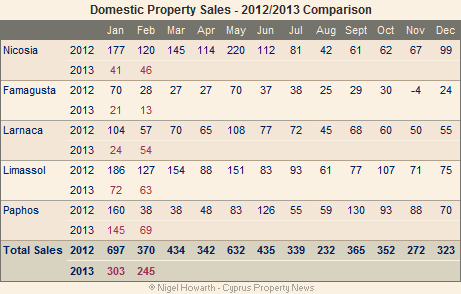
WHILE property sales in February continued to decline, it appears that the rate of decline may be slowing and improvements were seen in Paphos where sales to both domestic and overseas buyers increased compared to February last year.

Overall, property sales in Cyprus fell in February with a total of 352 contracts deposited at Land Registries across the island compared with the 486 deposited in February 2012; a fall of 28 per cent.

Of those 352 contracts, 69.6% per cent (245) were in favour of Cypriot buyers and 30.4 per cent (107) were in favour of overseas buyers.

With the exception of Paphos, where overall sales jumped from the 69 recorded in February 2011 to 128 (an increase of 85.5 per cent), sales fell in all other areas of the island compared to 2011.

Domestic sales

Last month Cyprus elected a new President, Nicos Anastasiades, and with him comes the hope of a swift conclusion of a bailout deal with the troika and end to the island’s economic uncertainty.

Overall 125 fewer properties were sold in February than in February last year; a fall of 34%.

Nicosia was hardest hit with 74 fewer properties being sold (-62%). Sales in Famagusta fell by 15 (-54%), in Limassol they were 64 fewer sales (-50%), while in Larnaca sales fell by 3 (-5%).

Sales in Paphos jumped from 38 in February 2011 to 69 last month; an increase of 82%.

Cyprus domestic property sales February 2013

In the first two months of 2013 sales to the domestic market stood at 548 compared with the 1,067 sold during the first two months of 2012; a drop of 519 (-34%).

Overseas sales

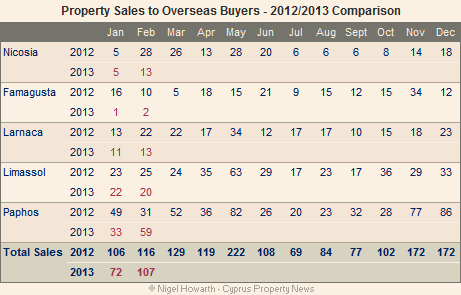
Cyprus-wide sales to the overseas property market fell by 9 (-8%) in February compared with February last year, but were buoyed up by sales in Paphos, where much effort has been put into enticing overseas investors from China.

Famagusta recorded the lowest fall in sales with just 2 properties being sold to overseas buyers in February down from the 10 sold in February last year (-80%).

Nicosia saw sales drop by 54%, with the number of properties sold falling from 28 in February 2012 to 13 last month.

Larnaca recorded a fall in sales from 22 in February 2012 to 13 (-41%), while in Limassol sales fell from 25 to 20 (-20%).

Sales in Paphos made significant headway with sales up 90%, increasing from 31 in February 2012 to 59. Although the Department of Lands and Surveys does not publish the nationalities of foreign buyers we suspect that the majority of these sales would have been made to buyers from China following exhibitions in the country promoting Cyprus as a destination for overseas investment.

Cyprus overseas property sales February 2013

During the first two months of 2013, sales of property to the overseas market stood at 179 compared with 222 sales during the first two months of last year; a fall of 43 (-19%).

Marshall Case creates Conflict of Law

Conflict of Law - Cyprus and UKWHILST there has been some pre- occupation with the case of Barclay-Watt and others v Alpha Panareti and others [HQ11X02379] another equally significant case, that of Marshall v Bank of Cyprus has gone largely unnoticed.

In the latter case, brought by Christofi Law in Cyprus on behalf of Mrs Marshall, substantially the same issues were raised on application in the Cypriot courts to determine whether they had jurisdiction to hear cases relating to Cyprus property buyers who are domiciled abroad, usually in the UK.

In the High Court case against Alpha Panareti, the case reached the courts on 20 July 2012 and judgment was handed down on 23rd November. The judgment, made by Master Whittaker contained a number of reservations and qualifications which narrow down the class of people able to bring actions via the UK, but for the Barclay-Wyatts and their co-claimants, whose action revolved around very specific facts relating to Alpha Panareti sales, the outcome was that they had the right to bring their action in the UK provided that it was brought within a six year limitation period.

The outcome of the Marshall Case throws cold water on that. The case – described by one of the participants as “trench warfare” – involved the Cypriot District Court receiving skeleton arguments from each side’s respective counsel exceeding 20 pages of references, and the judgment, eventually delivered on 31 January 2013 by Judge David consisted of 20 pages. Judge David ruled that the correct jurisdiction was… The Republic of Cyprus.

The outcome means that there is a conflict of laws between the British and the Cypriot courts. Five of the Barclay Wyatt Claimants actions were commenced in Cyprus. Moreover there are issues over the seniority of the judgments – the Judge in the Cypriot Court is likely to have greater seniority than the Senior Master in the High Court – so observers can expect legal “hand bags” when the two clash.

Mrs Marshall’s case is directly against the Bank and involves the misselling of Swiss Franc Foreign Currency loans unlike the Barclay-Watt case, where no claim was brought by the lawyers against the bank.

Mrs Marshall has appealed the order and has vowed, if necessary, with the support of Christofi Law, to take the matter to the European Courts. The likelihood is that her case will reach Europe before any further substantive issues are dealt with in the Alpha Panareti case.

Editor’s note

Conflict of laws is a set of procedural rules that determines which legal system and which jurisdiction apply to a given dispute. The rules typically apply when a legal dispute has a “foreign” element such as a contract agreed to by parties located in different countries.