Moody’s downgrade piles on the junk

MOODY’S Investors Service has downgraded the senior unsecured debt and deposit ratings of three Cypriot banks to Caa2 and lowered the standalone credit assessments of two of those banks, Hellenic Bank Public Company Ltd to caa3 from caa2 and Cyprus Popular Bank Public Co Ltd to ca from caa3.

In its statement, Moody’s said that it rating actions are triggered by the downgrade of Cyprus’ government bond rating to Caa3 and they reflect:

  • uncertainty regarding the timing and conditions of a finalised Memorandum of Understanding (MoU) between the Cypriot government and the International Monetary Fund, the European Union and the European Central Bank to finance bank recapitalisations;
  • heightened risk of sovereign default, which could jeopardise the effectiveness of bank recapitalisations once the external support programme is in place; and
  • the associated impact of increased sovereign credit risk on banks’ standalone credit profiles, given the banks’ sizable portfolios of government securities.

The three affected banks are:

  • Cyprus Popular Bank Public Co Ltd: Senior unsecured debt and deposit ratings downgraded to Caa2 from Caa1; standalone credit assessment lowered to ca from caa3, within the E standalone bank financial strength rating (BFSR) category.
  • Hellenic Bank Public Company Ltd: Deposit ratings downgraded to Caa2 from B3; standalone credit assessment lowered to caa3 from caa2, within the E standalone BFSR category.
  • Bank of Cyprus Public Company Limited: Senior unsecured debt and deposit ratings downgraded to Caa2 from Caa1; standalone credit assessment of caa3 remains unchanged within the E BFSR category.

The outlook on the banks’ senior debt and deposit ratings is negative.

Construction industry loans under microscope

Pimco invetigates construction industry loansPIMCO, the US-based investment company best known as the world’s biggest bond trader, will be meeting the leaders of the Cyprus Popular Bank and the Bank of Cyprus in Nicosia today.

According to Cyprus News Agency (CNA) sources, the meeting will discuss issues relating to loans that both banks gave to the construction industry.

Representatives from Pimco are currently on the island to hold meetings with the Steering Committee to discuss issues relating to the company’s estimations of the capital needs of the Cypriot banks.

The Steering Committee is charged with overseeing the due diligence review of the Cypriot financial system that was carried out by Pimco. It includes representatives from the European Commission, the European Central Bank, the European Stability Mechanism, the International Monetary Fund, the European Bank Authority, Cyprus Finance Ministry, the Central Bank and the Cyprus Authority for the Supervision and Development of Cooperative Societies.

According to CNA sources representatives of troika in the Steering Committee requested details of loans provided to the construction industry by the Cypriot banks on Tuesday.

Pay developers’ debts or lose your home

Edward_McMillan-Scott_MEPMcMILLAN-SCOTT MEP’s question concerns British property owners who face losing their homes in the UK (and other EU member states) if they fail to repay the debts of their now defunct property developer SNK Venus Homes Exclusive Ltd.

Question for written answer E-011456/2012
to the Commission

Rule 117
Edward McMillan-Scott (ALDE)

Subject: Payment of developers’ debts in Cypriot property cases

Purchasers of property in the Elena Gardens development in Xylofagou, Cyprus, have recently been told by the Cypriot Government that they will, in effect, have to pay off the debts of developers who have gone into liquidation without completing building work.

SNK Venus Homes Exclusive Ltd went into liquidation after taking GBP 840,000 from a purchaser without completing the construction of his villa, and leaving some four or five other buildings incomplete as well.

The property purchasers had been assured, by both lawyers and the Cypriot Government, that they were covered by something called ‘specific performance’, which protects the purchaser in all circumstances and ensures that they are registered as the legal owner of the property to which their contract refers.

The Cypriot Government has allowed banks to lend large amounts of money to developers using, as security, properties already sold to unsuspecting purchasers and registered with the land registry. The developers have since defaulted on these loans and, in the case of SNK Venus Homes Exclusive Ltd, gone into liquidation as a result.

Property owners who refuse to pay back the developers’ debt to the banks risk having any properties they may own in other EU countries repossessed to cover monies the banks recklessly lent developers against properties they did not own in the first place.

Whilst national property rights are indeed a matter of subsidiarity, could the Commission:

1. explain what can be done at EU level in such cases to protect innocent property buyers from across the EU?

2. state whether Cyprus, in this particular case, has contravened the Unfair Commercial Practices Directive (2005/29/EC), specifically Article 7 on ‘misleading omissions’, which states that a commercial practice shall be regarded as misleading if ‘in its factual context, taking account of all its features and circumstances and the limitations of the communication medium, it omits material information that the average consumer needs, according to the context, to take an informed transactional decision and thereby causes or is likely to cause the average consumer to take a transactional decision that he would not have taken otherwise’?

Further reading: Payment of developers’ debts in Cypriot property cases

About Edward McMillan-Scott

First elected in 2004, Edward McMillan-Scott is a Liberal Democrat MEP for Yorkshire & Humber and Vice-President of the European Parliament for Democracy and Human Rights. He has been elected four times as European Parliament Vice-President.

On 25 September he won the top award, for ‘Outstanding Contribution’ in the 2012 MEP Awards presented by the Parliament magazine, Brussels sister publication of Westminster’s House magazine.

Homeowners call for simple and fair tax system

Cyprus-taxation-propertyTHE Cyprus Land and Property Owners Organisation (KSIA) said yesterday that any changes to Immovable Property Tax system should be simple and fair.

MPs are set to vote on amendments to the law at the plenary session of the House on 17th January, but the government has yet to submit a revised set of proposals for their consideration.

KSIA also questioned why a decision on the new system had to be taken so urgently as any new tax regime would not be implemented until September and that “the immediate signing” of the EU bailout agreement was “doubtful”.

The island’s Interior Minister, Eleni Mavrou, repeated that that the government is making every effort to avoid taxing the average home owner, such as those with a house on half a building plot or a large apartment.

“If the €40,000 threshold based on the values of 1980 is finally adopted we more or less maintain the groups included in the existing law and increase the number of contributors,” she said.

(Immovable Property Tax, which is based on the Land Registry’s assessment of the 1980 value of a property, is a confusing concept to most foreigners as it has no parallel in other EU countries. At the present time, the majority of registered property owners are exempt as the 1980 value of their property falls below the €120,000 threshold at which this annual tax becomes payable.)

Moody’s cuts Cyprus rating on default risk

MOODY’S Investors Service slashed the Cyprus government bond rating late on Thursday to Caa3, citing the anticipated increase in the government’s debt burden.
In addition to Thursday’s three notch downgrade, Moody’s added that it saw a 50 per cent probability the Mediterranean island would “default outright or press for a distressed exchange” on its debt.

Moody’s has downgraded Cyprus’ rating nine notches over the past 10 months and the country’s rating now stands just three notches above default.

The outlook is negative reflecting Moody’s view that the situation could deteriorate over the next 12 to 18 months due to:

  • Liquidity concerns. Although Moody’s base assumption continues to be that access to short-term funding will remain sufficient for the Cypriot government to meet its funding needs, the rating agency notes that, in the absence of a disbursement from the Troika, the government may face a severe crisis.
  • Bank recapitalisation needs. The government has employed a US asset manager, Pimco, to estimate the banks’ recapitalisation needs. Until its report is finalised later in January, there will be lingering uncertainty about the amount of support that the government will need to provide to Cyprus’s banking sector in 2013.
  • Progress of negotiations with the Troika. While Moody’s believes that the current agreement in principle between Cyprus and the Troika on an MoU represents significant progress, the rating agency notes that the finalisation of an agreement and disbursement of funds have been delayed and that an assessment of debt sustainability has also not been completed. Moody’s base assumption continues to be that the Cypriot government will be able to reach an agreement with the Troika that will result in the provision of official assistance to the Cypriot government until at least 2016 – however, questions about debt sustainability remain central to Moody’s views on the probability of a default event for Cyprus.

Sales in 2012 plummet to record low

DESPITE tax incentives introduced by the Cyprus government in efforts to boost the island’s property sector, the number of properties bought during 2012 hit a record low.

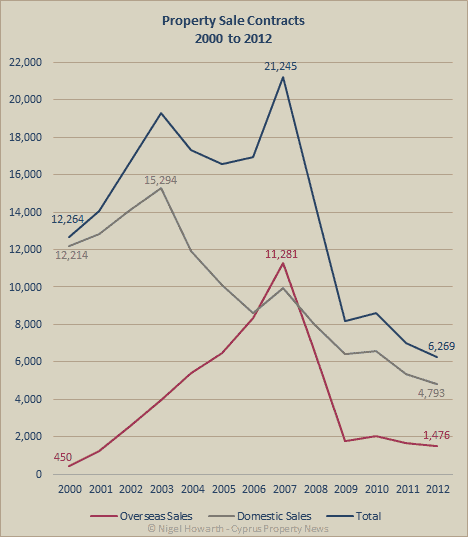
The latest figures from the Department of Lands and Surveys reveal that property sales across Cyprus in 2012 fell to a mere 6,269 from 7,018 in 2011. As can be seen from the chart below, this is the lowest number of sales on record and less than half the number sold more than a decade ago in 2000.

Cyprus Property Sales 2000-2012
Source: Department of Lands and Surveys

The rise and fall of the property market

The collapse of the domestic market, which started in 2004, resulted from rocketing land prices. Although salaries kept pace with construction costs, land prices shot up more than five times between 1998 and 2008 pricing many local buyers out of the market.

The overseas market, which started to take off when plans for Cyprus to join the European Union were announced, reached its peak in 2007. Its collapse in 2008 was precipitated by the financial turmoil that engulfed the world and the nefarious activities of rogue property developers, lawyers and estate agents that received much publicity in the foreign media with questions being raised in the UK and EU parliaments.

Cyprus property sales chart 2000-2012
Source: Department of Lands and Surveys

Outlook for 2013

It will come as no surprise that the outlook for the property sector in 2013 remains bleak and that it will be significantly worse than 2012.

Speaking to StockWatch, property valuer Polys Kourousides said “The New Year will continue to be problematic and there will be no recovery because there are four factors that have negative impacts”.

According to Mr. Kourousides, the negative impacts are the lack of liquidity in the market, high interest rates that prohibit any investment, lack of confidence and the high levels of bad debts that will lead to a fall in property prices under the new methodology.

According to the Cyprus Central Bank property price index, house prices continued their downward spiral of recent years, with an annual decline of 5.8% in the third quarter of 2012. This is roughly in line with the RICS Cyprus index with an annual decline of 6.0% in residential property prices.

Lakis Tofarides, chairman of the Cyprus Land and Building Developers Association said that “things are so cold in the market that anything could be positive. The February elections will contribute to boost the negative sentiment”.

Solomon Kourouklides, vice president of the Cyprus Real Estate Agents’ Association said “With the completion of the election, uncertainty about the economy will be raised, provided that the new government will act more decisively and will fulfil all procedures on the memorandum. This will be the beginning of the beginning since liquidity will be injected in the state and banking funds”.

This will create a positive prospect provided that funds will be injected to SMEs in Cyprus while the people’s psychology will begin to stabilize and then to be reversed”.

“There is a small ray of hope that properties with the drop in prices will become more attractive for the foreigners, who seem to be the only ones who can buy without a loan”, he added, stressing, however, that recovery is not expected before 2014.

The Financial Mirror concludes that 2013 will be another “Annus Horribilis” for Cyprus based on a consensus of the views expressed by a distinguished panel of seven economists.