FIGURES released by the Department of Lands and Surveys on Wednesday show that the downward trend in property sales to the domestic market gathered momentum in December with numbers falling 40 per cent compared to December 2011.
According to the figures, the number of contracts of sale deposited in favour of domestic buyers at Land Registry offices throughout Cyprus stood at 323 compared with the 535 deposited in December 2011.
Sales were down in all areas. Limassol was hardest hit where 66 fewer properties were sold (-47%) followed by Paphos, where sales fell by 63 (-47%). Sales in Famagusta fell by 17 (-42%), while in Nicosia and Larnaca they fell by 45 (-31%) and 21 (-28%) respectively.
Source: Department of Lands and Surveys
Annual performance
Looking at the number of sales to the domestic market over the year, there was an overall fall of 11 per cent compared with 2011. With the exception of Larnaca and Paphos, where sales increased by 135 (+19%) and 130 (+15%) respectively, sales fell in all districts.
The total number of sales to the domestic market in 2012 stood at 4,793. This is the lowest number of sales this century and down by more than 60 per cent on the 12,214 properties sold in the year 2000.
THE NUMBER of building permits issued in October 2012 stood at 782 compared with the 594 issued in October last year; an increase of 31.6%, according to the latest figures released by the Cyprus Statistical Service.
Compared with October 2011, the total area of these permits fell to 126,546 square metres from 180,757 square metres (-30%) but their value increased marginally to €172.6 million from €170.5 million (+1.2%).
During October, building permits were issued for:
Residential buildings – 390 permits
Non-residential buildings – 84 permits
Civil engineering projects – 264 permits
Division of plots of land – 40 permits
Road construction – 4 permits
During the period January – October 2012, 6,147 building permits were issued; a decrease of 3.1% compared to the number issued in the same period last year. Their total value fell 21.5% and their total area fell by 32.9%.
New home construction
The 390 residential building permits approved in October provided for the construction of 469 new homes comprising 235 single houses and 234 multiple housing units (such as apartments and other residential complexes).
This is a fall of 24% compared with October 2011 when building permits were issued for the construction of 617 new homes.
During the first nine months of 2012, the number of new homes for which permits have been issued has dropped 37.2% compared with the same period last year.
According to the Cyprus Statistical Service, building permits constitute a leading indicator of future activity in the construction sector.
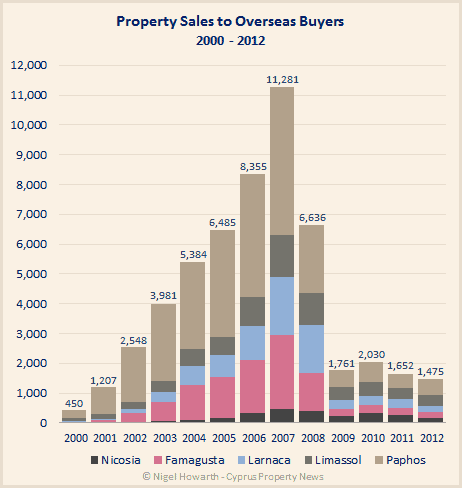
DURING the height of Cyprus real estate boom in 2007 overseas buyers purchased more than 11,000 properties on the island, accounting for more than half of all the properties sold that year.
But the collapse of the market in 2008 left the once popular tourist hot spots littered with thousands of unsold and unfinished holiday homes, many of which were targeted at British investors and which are unsuitable for permanent living.
Some of these will not be sold for many years as they suffer from poor build quality and will deteriorate rapidly or they have legal and other problems preventing their sale, such as the lack of a ‘promised’ golf course and other facilities promoted in their sales brochures.
The reasons for the collapse are well known. The financial turmoil that engulfed the world coupled with the nefarious practices of property developers, lawyers and bankers, the lack of Title Deeds, inadequate laws that left buyers with little or no protection and an ineffective system of justice all combined to stop the market dead in its tracks.
A number of UK-based companies jumped on the property gravy train acting as estate agents, investment specialists and exacerbated the many problems. Others wanting a slice of the action set themselves up as property developers, often leaving disasters in their wake after fleeing the island.
It didn’t take long for Cyprus good name to be dragged through the mud. Disaster stories started to appear in the UK media and investigative TV and newspaper journalists visited the island to find out for themselves the level of deceit and corruption in the property industry. As a consequence of the bad publicity these reports generated, Brits with money started looking at safer places to invest, turning their backs on Cyprus.
The Cyprus Property Action Group (CPAG) have been very effective in raising awareness of the problems with the British public and the European Union. Some changes to the law were implemented in 2011 to help improve consumer protection. But further changes are necessary to restore investor confidence.
Property developers are now tapping into new markets as witnessed by the increased number of sales in November and December. However the total number of properties sold to overseas buyers throughout the whole of last year (1,475) was the lowest for more than a decade.
Source: Department of Lands and Surveys
Buyers from as far away as China are now being ‘encouraged’ to buy property on the island. But it will not be very long before they too turn their backs on Cyprus.
We have already heard from two independent sources that a number of Chinese buyers have complained of being cheated by at least two developers operating in the Paphos area. Will they never learn?
FIGURES released by the Department of Lands and Surveys earlier today show that 172 property purchase contracts in favour of overseas buyers were deposited at Land Registry offices throughout Cyprus in December; a 48% increase compared with December 2011.
This is the second month in succession that property sales to overseas buyers have improved and a sign that they may be returning to the island.
Exactly a half of those 172 contracts were for properties in Paphos, where sales more than doubled compared with December 2011. Sales also increased in Famagusta, Limassol and Larnaca. Nicosia fared less well; sales were down 22%.
So a positive end to 2012 and an expectation that sales to overseas buyers will continue to improve in the year ahead.
Property developers have put much effort into opening up new markets. At the recent International Property Expo held at the China World Trade Centre in Beijing, Cyprus was the largest international exhibition group with more than 30 booths. Many of the billboards along the Cyprus highways advertising properties for sale are now written in Chinese.
A director at the Expo said moving abroad, securing a sound education and diversifying asset portfolios are the top three reasons why Chinese are purchasing international properties.
Chinese families, ranging from the highly affluent to the middle class’ upper crust, are showing a keener interest in purchasing overseas housing. They are primarily driven abroad not only because of China’s soaring housing prices but because of the government’s curbs on property ownership in the past two years in an attempt to cool prices.
We understand that a number of property developers and representatives from the Ministry of Commerce will be attending the 28th international real estate exhibition DOMEXPO being held in Moscow from the 11th to 14th April.
CYPRUS has been reaching out to third countries (those from outside the European Union) with some notable success and the government has amended the law to further encourage investment in property.
The amendments, announced by the Interior Ministry last month, enable an individual or a couple from a third country to purchase up to two units in the same development.
The two units must be adjoining and, if they are houses or apartments, they may be consolidated into a single unit. (This could include a pair of adjoining town houses or a pair of apartments sharing a party wall or having a common ceiling/floor).
The units may be two residential units units (apartments or houses) or a residential unit and a store with an area of 100 square meters, or a home office with an area of 250 square meters.
Cyprus has had some success in attracting more visitors from China. Property developers from the island took more than 30 booths at the International Property Expo held at the China World Trade Centre in Beijing last September.
According to a report in the China Daily, the Cypriot embassy in Beijing had received more than 1,500 visa applications by November last year, while only 350 visas were issued during the whole of 2011.
Wei Kefei, a director at the Beijing International Property Expo, said moving abroad, securing a sound education and diversifying asset portfolios are the top three reasons why Chinese are purchasing international properties.
LATE last month, the government had second thoughts about a bill that would have seen Immovable Property Tax in Cyprus rocket.
The proposed tax hike, which was far more than that suggested by the troika, was greeted with protests from landowners, property developers and hoteliers who said the changes would put many of them out of business and drive the economy deeper into recession.
The bill was the only one of a number of bills related to the bailout package not to be voted on by parliament last month.
The Interior Minister, Eleni Mavrou, said that the whole matter was being reviewed and that the government would use the existing formula to calculate IPT using the January 1, 1980 value of a property.
Parliament will continue discussion on amendments to the bill on 17th January.
Yesterday the Employers & Industrialists Federation (OEB) and Chamber of Commerce and Industry (KEVE) suggested a one-off property tax of €4.60/thousand as a stop-gap measure until a new bill has been formulated, agreed and implemented.
Their proposal is that the tax should be paid on each Title Deed and will not be cumulative (i.e. not based on the sum of the 1980 values of properties registered to an owner).
If calculated in the same way as last year, Immovable Property Tax would bring in €28 million this year – and their proposed one-off tax would bring in an additional €69 million.
They also suggested implementing a simplified uniform property tax policy with each owner submitting details of their property. The present system of property taxes, which include VAT, Property Transfer Fees, Stamp Duty, Capital Gains Tax, Sewerage Fees, etc., involves a huge administrative cost with property owners having to deal with different departments with different timescales for payment.