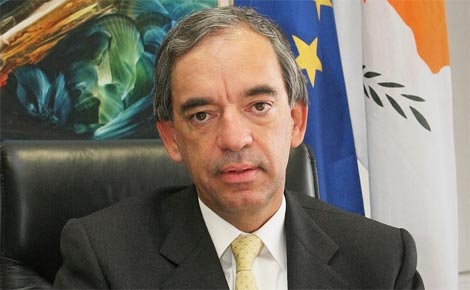
Bank of Cyprus takes a €1 billion hit on Greek debt

BANK of Cyprus (BoC), the island’s biggest lender, has posted a €1.01 billion net loss for 2011 after taking provisions for a Greek sovereign debt swap.

BoC said the total impact of its participation in a voluntary swap of Greek government bonds with a 60% impairment, amounted to €1.3 billion for 2011.

The nominal value of the Greek government bonds held by the group, after the write-down, totalled €975 million at the end of December 2011.

The total nominal value of bonds affected by the write-down was €2.08 billion.

Excluding the impairment, the group’s net profit for the period reached €312 million, an annual increase of 2.0%.

Profit before provisions and tax reached €802 million – up 11%.

“Due to the uncertainty concerning the Greek bond swap program, the group has cut the nominal value of the bonds it holds by 60 percent, a fact that affects net profits,” a joint statement by BoC chairman Theodoros Aristodimou and CEO Andreas Eliades said.

However, the bank also said its final audited results for last year could “potentially be materially different” from the preliminary results due to the final terms of the private sector involvement for the restructuring of Greek public debt.

Eurozone finance ministers yesterday agreed on a €130 billion rescue for Greece to avert an imminent chaotic default after forcing Athens to commit to unpopular cuts and private bondholders to take bigger losses.

The accord will enable Athens to launch a bond swap with private investors to help put it on a more stable financial footing and keep it inside the euro zone.

Private sector holders of Greek debt will take losses of 53.5% on the nominal value of their bonds, which equates to a loss of around 73 to 74 percent on the net present value of the bonds.

BoC said it is pushing ahead with its plan to boost capital, expected to be complete next March.

It will do so through a rights issue of up to €396.3 million and a voluntary exchange of convertible securities of up to €600 million, the lender has said.

“With the completion of the program and the very satisfactory liquidity it possesses, the group will actively continue to support its customers and the economy,” the joint statement said.

The bank said that excluding the write-down, it has achieved its profitability goals for the year and “remains in position to tackle the challenges of the uncertain economic environment.”

The bank closed the year with a total of €28.9 billion on its loan books, a 4.0% rise from 2010.

Some €10 billion in loans were given in Greece.

Deposits were down 7.0% at the end of 2011 – €29.7 billion.

The percentage of non-performing loans reached 10.2 in 2011, compared with 7.3% in 2010, the bank said.

Non-performing loans in Cyprus were 9.5% while the respective figure for Greece was 11.6%.

Cyprus economy has yet to hit bottom say economists

THE RECESSION in Cyprus’ economy in 2012 will be deeper than expected, according to economists from the Economic Research Centre of the University of Cyprus.

The economists believe that following a slight increase of 0.5% in 2011, the Cyprus economy will shrink by 1.5% – 2% in 2012.

They noted that challenges are big and uncertainty is significant.

The council of experts is composed of M. Clerides, P. Pasiardis, Chr. Pissarides, M. Sarris and L. Christofides.

The forecast does not include the VAT increase from 15% to 17%, which may add at least half percentage point to inflation in 2012.

According to the survey, the current condition of the global economy and the uncertain future of the euro area have increased dramatically the risks for the Cyprus economy.

The necessary fiscal adjustment and measures decided by government and Parliament, admittedly belatedly, have changed the data for 2012. On the one hand, they have improved the fiscal condition of the economy, but on the other hand, they deteriorate the economic condition of households in the short term, pushing their available income down.

As for the external environment, it has worsened and will possibly affect growth prospects in 2012.

The economists believe that the negative risks are greater than the positive and that the economy will be largely affected in 2012.

Specifically, the risks in 2012 are:

  • The critical condition in Greece and the uncertainty in psychology and the attraction of investments. This affects negatively the ratings of the Republic and the banks and puts more pressures on the economy. A possible deterioration could largely affect the economy of Cyprus. The negative climate affects international business activities, a significant sector of the island’s economy.
  • The slowdown and/or decline in exports as a result of the deterioration in the external environment, especially in the EU and the eurozone.
  • The high borrowing level of households and businesses along with the anticipated restriction of credit growth may affect negatively private consumption and investments.
  • The reduction in disposable income due to various measures that have been implemented may affect negatively private consumption in the short term, which can be moderated with the improvement of the climate and the increase in employment, given that the government remains committed to the structural reforms announced, including those aiming at the increase in productivity and the permanent reduction of state expenditure.

Although the exact quarter-turning point of the economy cannot be assessed easily due to huge uncertainty in relation to the implementation of the measures in Cyprus and the developments abroad, according to the econometric analysis, GDP is expected to drop in the first and second quarter of 2012.

Specifically, the GDP is expected to decline 2½% – 3% in the first and second quarter of 2012 and 1% – 1½% in next quarters.

The incorporation of the aforementioned risks in the analysis with the use of variables containing information about expectations of consumers, businesses and investors, means that the chances of error are expected mostly positive, i.e. above the central scenario, although chances of error down are still significant.

Policy to be followed is crucial

As for the policy that must be followed, it is noted that the economy faces significant challenges in both the internal and external environment. They expect a slowdown in growth and a possible increase in unemployment, which could be moderated if the government remains committed to promises for structural reforms for an increase I productivity and permanent reduction of the state expenditure.

The permanent improvement of the climate, which can be achieved by demonstrating commitment and determination to the need to promote financial objectives, will affect positively the confidence of international investors. Macroeconomic stability will give a clear message that Cyprus remains a major financial centre, with competitive advantages, including low taxation. This means a decline in spreads, widening the possibility of promoting growth measures.

The anticipated GDP decline may have significant impacts on the state’s fiscal condition. The possibility of a higher deficit must be taken seriously into account in order to cover the subsequent funding deficits that the state will face.

The structural reforms in the public sector and the labour market that must be promoted immediately are critical to the success of the fiscal consolidation effort and the recovery of the economy.

Reforms must re-examine the state’s role, increase productivity and promote private initiative.

Institutional changes should be promoted to enhance financial stability, which is the backbone of the economy, but also to strengthen the institutions in general (supervising and administrative). Those reforms can not only mitigate the adverse effects of fiscal austerity but also to enable the economy to withstand the short-term pressures and to improve the long-term economic outlook. The reforms should be promoted on a constant basis and not only in view of deadlines imposed by the EU.

Corruption in Cyprus at all levels says former minister

Former Finance Minister, Mr Charilaos Stavrakis

THERE is a lot of corruption at various levels of public life, former finance minister Charilaos Stavrakis said, and the bad thing is, it is almost acceptable in Cypriot society.

“In dealing with public life for the first time, I clearly realised there is a lot of corruption at various levels,” Stavrakis said in his book Economy in Politics and Politics in the Economy, presented to the media last Friday.

The former minister said certain government departments wield great power and their “sometimes arbitrary “decisions concerning town-planning, health, taxation and other matters, “can create huge benefits or burdens to entrepreneurs and companies.”

“Many times I felt that these people’s main concern was to help certain businessmen instead of trying to defend the state’s interest,” the former minister said.

Stavrakis said he did not believe there was an issue of outright bribery but to maintain good relations with the crème de la crème of Cypriot entrepreneurs “was perhaps more important for some state officials.”

Some aimed at securing important positions in banks or other organisations after retirement from the public service, Stavrakis said.

“It would be interesting for one to count how many former ministry permanent secretaries or ministers or other officials, ended up – after retirement – serving on the boards of companies or in organisations they previously had a close relation with.”

The former minister said Cyprus is a small country and one can see that some entered politics poor and at some stage became very rich.

“What is bad is that this is almost acceptable to Cypriot society and reaction is very limited.”

Stavrakis did not offer any names “because I think many of these people are known.”

Concerning himself, Stavrakis said only once did someone try to approach him.

He was a Greek businessman who owned a very large company operating in the wider financial sector.

“The finance minister’s signature would have fetched him huge revenues and he called me repeatedly asking to meet alone,” at a secret location.

Stavrakis refused, and offered to see the businessman at the ministry in the presence of his associates.

“It is then that he used the characteristic phrase: ‘are you pulling my leg minister?” Stavrakis said.

The former minister acknowledged that his personal wealth was, strictly speaking, an important element.

“I cannot know how big the temptation would be for someone who might be in need of extra income,” he said.

Transfer of development rights to be aided by new bill

LAWMAKERS have tabled an addition to the bill for transferring development rights from one property to another, calling for the measure to apply to properties owned in the occupied areas as well.

The proposal, submitted by all parties except ruling AKEL, has been added to the bill which hopes to regulate problems that arise for owners whose properties are affected, either by public works or the area being deemed environmentally protected. The plan is for building rights to be transferred to Cyprus government-owned land elsewhere, in areas that will be specified by the Interior Ministry.

Fifteen MPs submitted the proposal to the House Interior Committee yesterday, calling for 12 per cent of the value of people’s occupied properties to be transferred to land in the Republic of Cyprus.

Presenting the proposal, DIKO deputy Sophocles Fyttis said the government’s bill was ideal for having this addition – which, for the record, was part of former President, the late Tassos Papadopoulos’, pre-election commitments.

“There will be a limit of 12 per cent on the current value of the land, with the highest payable amount being €600,000,” said Fyttis. “It will be transformed into a building factor for development or sale, through an organisation that will be created through the bill submitted by the government.”

The proposal, he added, will lead to a fairer share of the 1974 Turkish invasion’s burdens and increase property owners’ solvency in the north.

Furthermore, Fyttis said it would rejuvenate the construction industry and prevent people from applying to the Turkish Cypriot properties’ commission to receive compensation for their land.

“We are calling on the government and AKEL to not react but examine and view positively the added provisions to this legislation that is under discussion,” said Fyttis.

Explaining AKEL’s stance, the Committee Chairman, AKEL’s Yiannos Lamaris, said such a prospect would be “wrong and inappropriate”, adding that such a massive problem should not be resolved with fragmented moves.

He added, “In most areas of the occupied areas, there aren’t zones, therefore most refugees won’t be able to transfer anything to the free areas anyway”.

Lamaris concluded that if the proposal was passed, it would create a huge distortion in the Cyprus property market.

Cyprus construction output falls 17 percent

ACCORDING to a Eurostat news release published earlier today construction output in Cyprus during the third quarter fell 16.8% compared with the same period in 2010, following a fall of 3.1% during the second quarter.

This is the third highest fall amongst the 27 EU member states after Slovenia and Ireland, where construction output declines 25.5% and 18.6% respectively. Construction output also fell in Greece during the third quarter, by 8.3%.

Further reading

Eurostat Construction output news release

Free tickets to ‘A Place in the Sun Live’ at Earls Court

Amanda Lamb, Jonnie Irwin and Jasmine Harman (photo: A Place in the Sun)

THE NEXT ‘A Place in the Sun Live’ overseas property exhibition is to be held at London’s Earls Court between Friday 30th March and Sunday 1st April.

Once again, the organisers are offering complementary tickets – and you can get yours by clicking on your complimentary ticket to A Place in the Sun Live and following the instructions.

Every spring and autumn, A Place in the Sun Live features thousands of overseas properties for sale, by hundreds of exhibitors from more than 40 countries worldwide. And with homes from less than £20,000 to over £1 million, there really is something to suit almost every taste – and budget.

The centrepiece of the show is The Main Stage sponsored by MBI Consulting where Channel 4 TV presenters Amanda Lamb, Jasmine Harman and Jonnie Irwin will be appearing over the weekend to give their top tips on buying property overseas.

Then there’s the Buying Advice Seminar Theatre sponsored by HomeAway.co.uk which will play host to sessions on buying property in Spain, Cyprus, Turkey, plus many other destinations.

Get Your complimentary ticket to A Place in the Sun Live