Casino revenues could help fill government coffers

IN RECENT times there has been much talk of licensing a number of casinos in Cyprus; Larnaca’s old airport terminal was one possibility and the mayor of Paphos is keen to have one in the town.

The four largest municipalities in the Famagusta district presented their joint plan for a modern multi-purpose complex that would include a luxury casino at a news conference last Friday.

In 2009 President Christofias declared that: “There will be no casinos in Cyprus as long as I am President,” adding that “Casinos are expression of corruption and can create a crisis to the system”. But in a remarkable U-turn last October, the government announced that it was considering the possibility of allowing the operation of casinos on the Island.

Now it seems that the Finance Ministry has put together a set of proposals for up to five ‘high-quality’ casinos, preferably in the tourist areas.

According to documents presented by the Greek-language newspaper Politis, each licence would cost €100 million and the target would be to secure €500 million by the end of the year to help fill the government’s coffers.

We understand that the Finance Ministry’s proposal calls for an independent casino supervisory authority to be established and a strict legislative framework.

Whether any projects will get the go-ahead in the foreseeable future is unclear as the subject has yet to be discussed in parliament and legislation will have to be drafted and agreed.

We await further developments.

Striking construction workers threaten further action

TROUBLE IS brewing in the construction industry, after striking builders warned yesterday they would actively ensure all building sites were free of subcontractors today.

The construction industry yesterday came to a halt, after thousands of workers island-wide launched a 24-hour strike to protest employers’ decision to freeze pay rises and the Cost of Living Allowance (CoLA).

They say that despite a recent agreement reached between employers and unions – after an intervention by the Labour Ministry – for CoLA to be left untouched, employers cut it unilaterally.

Yesterday’s work stoppage started at 7am, with strikers guarding building sites until 10am to ensure no work was carried out. They then went to their unions’ district offices, where speeches were made and two resolutions were approved.

The resolutions were handed over to the Federation of Associations of Building Contractors Cyprus (OSEOK) and the Labour Minister at noon.

One resolution stated that workers intended to visit all construction sites today to ensure there were no subcontractors in action.

Their main gripe is that permanent staff are being fired and being replaced with subcontractors and EU workers to save money.

“As of (today), wherever there are subcontractors carrying out work – such as building bricks, placing floors, plastering walls – they will be distanced immediately from their workplace,” the builders said in their resolution. Asked later how they planned to carry this out, they said they would “take the actions that are necessary”.

The builders also called on contractors to withdraw a letter sent to the ministry last December, voicing their intention to freeze CoLA rises for 2012. This, they said, was in violation of the agreement reached between Employers and Industrialists federation (OEV) and trade unions SEK and PEO at the start of the month.

The ministry was urged to put an end to the “constant wave of redundancies” imposed on workers in the industry, by contractors offering humiliating wages and work conditions.

“The workers in the construction industry are certain that with their actions they will demonstrate the massive problem of unfair competition, which has turned into a scourge for the workers,” said the resolution.

Builders also called on the ministry to alter its tenders’ procedures for public works in a way that takes other factors apart from the lowest price into account.

The strikers said they had been authorised by the unions “to expand measures whenever they deemed it necessary, and at the same time they said they would respond to any invitation from the Labour Ministry’s mediation services to renew the collective agreements and resolve the problems in the construction industry”.

Around 2,000 builders gathered outside the PEO office in Nicosia after the resolutions were prepared and marched to the nearby offices of OSEOK – and then the Labour Ministry – to hand them over.

Receiving the resolutions, the head of OSEOK, Nicos Kelepeshis, said that if builders went ahead with their threat to remove subcontractors from the sites today, this would mean “the destruction of the construction industry”.

He rejected workers’ accusations, saying it was in fact the unions that were violating the collective agreement by striking.

Earlier in the day, Kelepeshis deemed the strike “unacceptable”, saying everyone should understand there is an economic crisis, which was bringing construction to its knees.

His comments followed those of Yiannakis Ioannou, the head of SEK’s builders’ union, who said contractors were taking advantage of the crisis to fire workers.

“We have some serious claims about redundancies,” said Ioannou. “Discrimination is taking place, which is sending workers to the unemployment offices, while they are being replaced by illegal workers.”

OEV deputy head Michalis Antoniou said this was a very sad day for constructions. He said the situation would only harm the already-hurting industry further, adding that the damage would be massive, not just for contractors but for builders too.

Antoniou said he hoped yesterday’s events weren’t repeated and admitted that both sides were responsible for how things turned out.

“We have allowed things to lead to a conflict, from which only wounds will be caused, in an industry that is already one of the most affected,” he said. “We all have responsibilities, OEV and everyone, but also the unions, which eventually have to understand that we can only find a solution through dialogue.”

Slowdown in the Cyprus construction sector continues

ACCORDING to figures released by CySTAT, the number of building permits issued last December fell to 560 compared with the 733 issued in December 2010; a fall of 24%.

In December, building permits were issued for:

  • Residential buildings – 398 permits
  • Non-residential buildings – 99 permits
  • Civil engineering projects – 23 permits
  • Division of plots of land – 30 permits
  • Road construction – 10 permits

The total value of these permits reached €189.3 million and their total area 213.9 thousand square metres.

During 2011, 7,506 building permits were issued; a decrease of 14.5% compared with 2010 and their total value slumped 21.8% to €2,065.1 million from €2,639.5 million in 2010.

Residential buildings

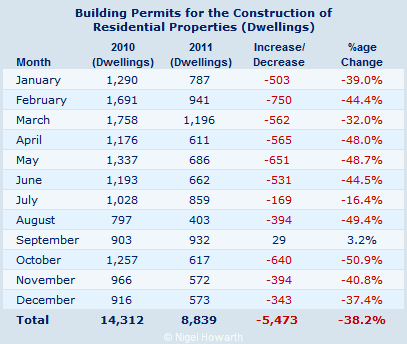
Last December, 398 permits were approved for the construction of 573 residential properties comprising 224 single houses and 349 multiple housing units (such as apartments and other residential complexes).

This is a fall of 37.4% compared with December 2010 when building permits were issued for the construction of 916 dwellings.

Source: Cyprus Statistical Service

During 2011, building permits were issued for the construction of 8,839 residential properties compared with 14,312 during 2010; a drop of 5,473 (-38.2%)

According to the Cyprus Statistical Service, building permits constitute a leading indicator of future activity in the construction sector.

The last ten years

The number of residential properties being built has now reached its lowest level since 2002. The latest figures from CySTAT show that they have fallen by 57% since the height of the property boom in 2007.

Source: Cyprus Statistical Service

There was some good news for the Cyprus property market last month. The number of properties sold increased for the first time in 18 months following the introduction of tax incentives by the government designed to stimulate the Island’s moribund property market.

Whether these increased sales will help revive the construction sector should become evident as we move forward in the year.

Residents in hot water over swimming pool regulations

PROPERTY owners at the complex in question have been trying to cut through legal red tape for more than 18 months over the operation of a small pool. They hope to clear up the issue before the summer.

According to a spokesman for the residents, swimming pool-rules on Cyprus are still handled according to the laws of 1992 and 1996 classing the facility as ‘public’.

“These stipulate that, in order to obtain an operation licence, residents of a ‘public’ communal pool must install a chlorinator, electrical improvements and drawings of the electrical panel of the pool, drawings of the swimming pool pump room, two changing rooms, two chemical toilets, one oxygen bottle and a foot-bath. Additionally, under the laws they must employ a lifeguard at the cost of approximately €2,000 per month,” he told The Cyprus Weekly.

“Our pool is virtually a splash pool. The maximum depth is 1.4 metres. Most of the owners have a swimming certificate, but this is not acceptable for the authorities. They insist that we do a professional course which is unacceptable for us as most of the owners are over 70 years old.”

Most of the owners at the complex live abroad and visit Cyprus at most twice a year and say they are aggravated by “impossible rules of the municipality.”

Municipalities are responsible for enforcing laws on public swimming pools. For years the authorities turned a blind eye to the laws on public pools over concerns that a necessary increase in communal charges would put off potential buyers of properties in complexes.

But the Interior Ministry has demanded municipalities provide documents for operating licences.

Pools attached to a private home are not affected by the laws. Paphos Municipality confirmed to The Cyprus Weekly that it is in charge of public swimming pools but the specific staff member was not available to clarify what constitutes a public pool or whether the laws are being updated to the EU framework.

Property owners at the complex in question had their passports taken away by the court and were required to return several times before retrieving them after the judge said their failure to comply with pool regulations was a criminal offence.

“These were honest people in their seventies. The legal and court fees were €1,350. What a shame for Cyprus,” the spokesman said.

“Cyprus signed and adopted the EU-standards over communal pools. These European standards have been given the status of a national standard and conflicting national standards should have been with drawn at the latest by March 2009. Apparently these standards were published in the Cyprus Official Gazette on October 24, 2008. In other words, Cyprus is bound to implement these European standards.”

Introduced in 2008 and known as EN 15288-1 and EN 15288-2, the European Union standards have been prepared by a special Technical Committee.

The EU-standard means that the pool in question must be classed under Type 3 as a private pool rather than a public pool and therefore be free from the requirements stipulated under the 1992 and 1996 laws.

But after the court-case the residents were under pressure from Paphos Municipality to install the facility improvements as required by the Cyprus Law in order to get the licence. The total cost of this was €6,900.

“Today we still do not have the licence for the pool as we do not have a lifeguard. We did not have another alternative other than to close the pool and so we did as of November 2010 until further notice. The time has come to change the Cyprus Law into the EU standards so that the authorities in most cases can give a licence to the complexes and stop with impossible money-eating regulations.”

Meanwhile, Peyia councillor, Linda Leblanc is trying to get some answers on how the legislation affects residents there.

“I’ve been trying to get things moving through Peyia Municipality but we are still stuck with no action and no further news on the legislative side yet.”

Editor’s comments

According to the Cyprus swimming pool regulations:

  • Cyprus Law N.55(I)/92 paragraph 2 states that the term ‘public swimming pool’ also includes the swimming pools of buildings which are used by the owners of the units or their tenants.
  • Regulation Number 368/96 paragraph 47 (1) states that all the employees relating to the swimming pool have to obtain a health certificate, to be clean and to behave properly.
  • Regulation Number 368/96 paragraph 47(2) states that all the trained supervisors will be on duty during the operation and the use of the swimming pool. Their number is determined in accordance with the size of the swimming pool and the number of the persons usually using the swimming pool.
  • Regulation Number 368/96 paragraph 47 (2)(a)(i) states that for small swimming pools at least one trained supervisor is necessary to be appointed.
  • Regulation Number 368/96 Part VII paragraph 53 states that a license is needed for the operation of a swimming pool by applying to the relevant authority. The last decision is made by the Minister.

However, according to the European Union standard EN 15288-2, Type 3 pools are “private use – use of an installation designated solely for the owner’s/proprietor’s/operator’s family and guests including the use connected with renting houses for family use”.

European Commission replies to property complaints

NUMEROUS letters have been sent the European Commission Vice-president and commissioner responsible for justice, fundamental rights and citizenship, Viviane Reding, complaining about the unfair practices of the property industry in Cyprus.

Recently, many of those complained have received a reply from the Civil Justice Directorate of the EC:

Dear

Thank you for your letter informing Vice-President Reding about the prejudice suffered by you and many other immovable property buyers because of the practices of Cypriot developers, lawyers and banks, and apologies for our belated reply.

Let me first assure you that the European Commission takes the Cypriot situation very seriously.

Although matters of real estate property ownership are primarily within the remit of the Member States and are regulated by their national contract laws, there may be Union legislation applicable to the practices described.

On the one hand, Directive 2005/29/EC on unfair commercial practices985 (the “UCPD”) prevents traders from engaging in misleading and aggressive commercial practices. Its provisions require that traders operate in accordance with professional diligence and that they do not distort the economic behaviour of consumers by inducing them to enter transactions they would not have entered otherwise. Whilst the failure to transfer legal ownership cannot, in itself, be regarded as unfair in all circumstances, such as the practices clearly spelled out under the Annex I of the UCPD (the so called “black” list), whether it nonetheless amounts to an unfair practice in the specific cases at stake is an assessment which should be primarily carried out by competent national authorities and courts, taking into account the applicable national laws regulating real estate property matters.

This being said, the European Commission considers that the lack of pre-contractual information to property buyers about the existence of developers’ mortgages on the Cypriot properties offered for sale is an aspect which can be assessed in the light of Article 7 of the UCPD concerning misleading omissions.

It should however be noted that the UCPD came into application on 12 December 2007, therefore its provisions are not applicable to transactions made before this date.

On the other hand, Directive 84/450/EEC concerning misleading advertising986 was applicable to business-to-consumer relations until the entry into application of the UCPD. This Directive protects consumers against misleading advertising, defined as “any advertising which, in any way, including its presentation, deceives or is likely to deceive the persons to whom it is addressed or whom it reaches and which, by reason of its deceptive nature, is likely to affect their economic behaviour”.

I would also like to draw you attention to Directive 93/13/EEC on unfair terms in consumer contracts987, which provides that contract terms should be written in a plain and intelligible language and that a contract term causing a significant imbalance between the parties to the detriment of the consumer shall be regarded as unfair and as such shall not be binding.

Both Directives are applicable to transactions made after May 2004, i.e. after Cyprus joined the European Union.

Cross-border misleading practices and unfair terms fall under the competence of the EU-wide enforcement network established by the Regulation on Consumer Protection Cooperation988. This Regulation establishes a network of enforcement authorities and empowers them to detect, investigate and stop such infringements. In this regard, the national enforcement authority of your country of residence may be able to request further investigation from their Cypriot counterparts.

Should you live in the United Kingdom, I would therefore recommend that you report your case to the British competent authority, whose contact details are the following:

Office of Fair Trading
Fleetbank House
2-6 Salisbury Square
London EC4Y 8JX
E-mail: [email protected]
Website: http://www.oft.gov.uk

If your place of residence is located in another Member State, you will be able to find the contact details of your national competent authority using the following link and after clicking on the relevant country:

http://ec.europa.eu/consumers/empowerment/cons_ networks_ en.htm

Following previous exchanges of correspondence, the European Commission has sent a request for information to the Cypriot authorities, enquiring as to the actions carried out at national level to address the reported practices and to ensure an appropriate protection of EU consumers.

The reply of the Cypriot authorities, received mid January, is now being thoroughly analysed. Should the information communicated be unsatisfactory, the European Commission will act to ensure its compliance and the protection of EU citizens and consumers, as appropriate.

However, I would like to emphasise that the enforcement of Directive 2005/29/EC, Directive 84/450/EEC and Directive 93/13/EEC is primarily the responsibility of the competent national courts and/or public enforcement authorities. In addition, aspects related to the consequences of illegal practices, such as, for instance, compensation for breaches of national contract law concerning real estate matter and/or abuse of public powers in relation to building permits remain mainly regulated by national law and should hence be brought to the attention of the national competent courts.

Yours sincerely,


Veronica Manfredi
Head of Unit


985 OJ L 149, 11.6.2005, p. 22
986 OJ L 250, 19.9.1984, p. 17
987 OJ L 095, 21.4.1993, p. 29
988 OJ L 364 of9.12.2004, p. 1

Commission europeenne, B-1 049 Bruxelles / Europese Commissie, B-1 049 Brussel -Belgium. Telephone: (32-2) 299 11 11.
Office M059 04/42. Telephone: direct line (32-2) 2993772. Fax: (32-2) 2967669.
E-mail: [email protected]

When will the government protect property buyers?

I AM WRITING in reference to the letter by Chris Solomon, published in the Sunday Mail of January 29, 2012: “Paying for my developer’s illegalities“.

Does this not simply highlight the hypocrisy of the Government’s so-called efforts to assist buyers in obtaining their title deeds?

In truth, isn’t this so-called amnesty simply the latest piece of useless legislation designed to protect the guilty – government, developers, lawyers and bankers – in this long running farce?

The government does not use existing legislation to protect buyers, the developers simply ignore planning and building regulations, the lawyers seldom seem to protect their clients during the buying process and the bankers are quite happy to give out a mortgage on a property that has already been mortgaged by your developer.

With some people going to all this effort and expense to obtain their title deeds through this process, many are yet to find out that the title deeds they have every right to own will, in fact, be tainted, because the building irregularities that affect their homes cannot be resolved, thus potentially leaving their homes either unsaleable or with a substantially-reduced value.

In actual fact, we should not have been in the position of requiring a planning amnesty had the government simply enforced existing legislation.

Article 10 of The Streets and Buildings Regulations Law, Chap 96 states the following: ‘No person shall occupy, use or permit any other person to occupy or use any building until a certificate of approval has been issued in respect thereof by the appropriate authority.’

Taking this into consideration then, tens of thousands of us hapless buyers should therefore not even be in occupation of homes that do not comply with planning and building regulations.

When will this government stop tinkering around the edges and simply enforce existing legislation, so as to protect buyers and pursue the guilty?

Andrew McClay,
United Kingdom