THE INTERIOR ministry has presented new automation systems that will be installed at the Town Planning and Land Registry departments to upgrade the services they offer the public.
Presenting the systems on Friday, Interior Minister Neoclis Sylikiotis expressed his conviction that they will “usher in a new era in the services provided by the state to the public.”
The first concerns a comprehensive information system worth over €12 million for the Town Planning Department that will cover all its activities and services as well as those of district administrations regarding construction permits.
The system will be rolled out gradually within 36 months from the day of introduction, the minister said.
For the public it would mean less bureaucracy and shorter waits for construction permits, Sylikiotis said.
It will also allow people to access useful information through the Internet.
“For the state, among others, it means cuts in cost, increase of productivity, (and) a more rational organisation of development,” Sylikiotis said.
As regards the Land Registry, in the next two months the department will introduce an Internet application that will provide the public with information on plots of land.
At the same time the Land Registry will be linking its systems with municipalities that will be able to input information about property within their boundaries, the minister said.
This will in turn enable the Land Registry to swiftly provide the public and other departments with information. Tenders for this system will open early March.
Sylikiotis also said that efforts were underway to introduce in the next four months, an online system linked to the civil registry and migration department where users will be able to change personal data and submit applications.
YESTERDAY Standard & Poor’s announced that it had downgraded the creditworthiness of nine Eurozone nations, including a two-notch cut in the ratings of Cyprus, Italy, Portugal, and Spain.
The downgrade resulted in Cyprus’ long-term sovereign credit ratings being cut from ‘BBB’ to ‘BB+’ (junk), and a cut in its short-term rating from ‘A-3’ to ‘B’.
In its press release, Standard & Poor’s said “The downgrade reflects our opinion of the effect on Cyprus of deepening political, financial, and monetary problems within the European Economic and Monetary Union (eurozone), with which Cyprus is closely integrated.”
“The downgrade also reflects our view of Cypriot financial institutions’ significant exposure to Greece, which we believe further exacerbates Cyprus’ existing external vulnerabilities.”
“The outlook on the long-term rating is negative.”
The downgrade will result in a tightening of the money supply and increased borrowing costs.
Cyprus blasts downgrade
CYPRUS accused Standard & Poor’s of bias and improper behaviour in downgrading the Island’s economy to junk status.
Finance Minister Kikis Kazamias said that the decision on Cyprus was arbitrary and unsubstantiated and that Standard & Poor’s had acted in a high-handed manner. He said that the ratings agency had ignored the Island’s moves to reduce its deficit and improve its finances.
Mr Kazamias said that Standard & Poor’s had turned down his application for a reconsideration and questioned whether the agency served other expediencies. He also said that the agency had ignored the fact that the European Commission had only recently praised Cyprus for tackling its deficit levels and that it has fully covered its financing requirements for 2012.
President Christofias also said that Standard & Poor’s decision was unjust, unacceptable and laden with expediencies. Christofias said that the international agency had downgraded Cyprus on the pretext of external factors at a time when its economy has given signs of recovery and significant reserves of natural gas had been discovered.
However, the President conceded that it will take some time before gas exploitation could start and advised a reserved stance on the issue.
FURTHER analysis of the figures released last week by the Department of Lands and Surveys for the number of property sale contracts deposited at Land Registries across the island show a 22% increase in sales by Cypriot buyers in December 2011 compared with the same month last year.
Domestic sales in Paphos in December shot up by an astonishing 343% compared with December 2010, followed by a 52% increase in Famagusta. Sales also went up in Nicosia by 1%, but they fell in Larnaca and Limassol by 22% and 1% respectively
This surge in the number of contracts at the end of last year may be attributable to the recent legislation passed by the government; a permanent reduction in VAT on property purchases for first-time buyers who are permanent residents in Cyprus and the temporary abolishment/reduction in Property Transfer Fees on the first sale of a residential dwelling.
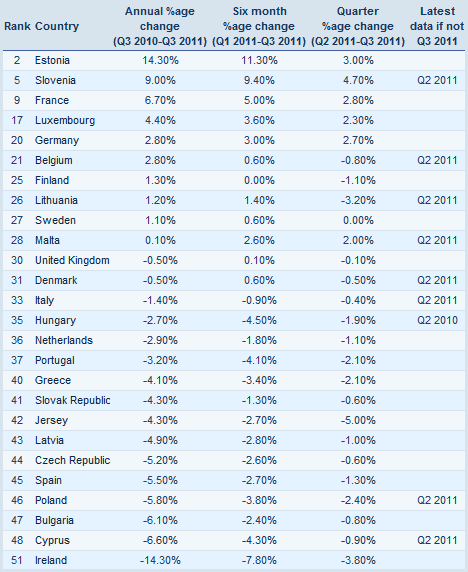
ESTABLISHED IN 2006, the Knight Frank Global House Price Index tracks the performance of fifty-one of the world’s mainstream housing markets. The index is compiled on a quarterly basis using official government statistics or central bank data where available.
The latest issue, for the third quarter of 2011, showed zero growth over the three months to September. This was the index’s weakest performance since the second quarter of 2009 and raises fears that it could enter negative territory by the end of the year.
According to Knight Frank the boom conditions experienced between 2004 and 2007, when global housing markets recorded double-digit annual price growth for 16 consecutive quarters, are a distant memory.
Perhaps not surprisingly, Ireland experienced the largest annual fall in property prices with a drop of 14.3%. Amongst other EU countries, prices in Cyprus have fallen by 6.6% and those in Bulgaria by 6.1%.
Source: Extract from Frank Knight Global House Price Index
Looking forward, Knight Frank believes that house prices are likely to show little improvement in the final quarter of 2011 given that much of the unravelling of the eurozone sovereign debt crisis took place post-September and has yet to be reflected in the index results.
Another factor that has yet to be reflected in prices in Cyprus is the impact of the explosion at the Evangelos Florakis Naval Base at Mari, which killed 13 people and devastated the Vasilikos Power Station.
ALTHOUGH the property market is certainly not at its best, I am disappointed by the analysis of the data and specifically by the explanations given as to the low percentage reduction of transactions in Limassol (-4%) compared with other cities. Limassol ‘is holding on because of the Russians’ was said.
I would ask all to spend a few minutes analyzing the Land Registry’s data.
Cyprus’ property market is significantly dependent on foreign buyers. Specifically, foreign buyers accounted for 22% of transactions in 2009 and 24% in 2010 and 2011 (note that in 2007 they represented about 50% of transaction volume). But if we study the data further, we see that each district has, as we would expect, different percentages of foreign buyers.
For 2011 foreigners accounted for 14% of buyers in Nicosia, 18% in Limassol, 31% in Larnaca, 33% in Famagusta and 36% in Paphos. We can see that Limassol has nothing special when compared to other towns in terms of the influence of foreign buyers and that one could even go as far to say that it may be better off because of the low percentage of foreign buyers in relation to that in other coastal cities.
Why do we have large percentage fluctuations in the number of transactions in other cities and not in Limassol? The answer lies in two different places.
The first is that due to the overall low transaction volume, small numbers create what is termed the “percentages fallacy”. If you have €1.00 and you lose €0.05, you lost 5%. If you have €0.20 and you lose €0.05, then you lost 25%.
Because Limassol and Nicosia represent 56% of transaction volume and because of the reduction in the number of transactions in other cities in previous years, the percentage changes in Larnaca, Famagusta and Paphos appear to be apparently huge even though in absolute numbers they are not.
For example, in absolute terms, in 2011 Famagusta had a drop in transactions of 134 (from 848 transactions in 2010 to 714 in 2011) and Limassol a drop in transactions of 84 (from 2,202 in 2010 to 2,118 in 2011). Although the difference between them is only 50 transactions, in percentage terms the annual reduction is 16% in Famagusta vs 4% in Limassol.
The second part of the explanation lies in where the reduction came from. The decrease in transactions by locals accounted for 76% of the total reduction (1,202 fewer properties were purchased by locals and 378 fewer properties by foreigners).
Registered sale & purchase agreements 2010 and 2011
Of this reduction, the biggest drop in local buyers was in Nicosia (-29% compared with 2010) whilst the biggest reduction in foreign buyers was for properties in Paphos (-28% compared with 2010). Limassol had the third largest percentage decrease in overseas buyers by 20% compared with 2010. In contrast, the lowest fall in local buyers was in Limassol (0.4% compared with 2010) whilst Larnaca had an increase in foreign buyers (up 4% compared with 2010).
It seems that the main reason that Limassol is ‘holding on’ is not because of foreign buyers, but that the locals (who form 82% of its market) continue to buy. In contrast, the decrease in transaction volume in Nicosia is almost exclusively because of locals, whilst other cities have significant percentage fluctuations (but not so significant in absolute terms) due to the small number of transactions taking place.
Foreign buyers play an important role in Limassol’s real estate market, which can seem larger than it really is because of their high concentration in specific areas (especially to the east of the city). A simple analysis of the data however, clarifies that it is the locals who continue to trade and “motor” the market.
As aptly put by my childhood hero, Sherlock Holmes “The temptation to form premature theories on insufficient data is the bane of our profession.”
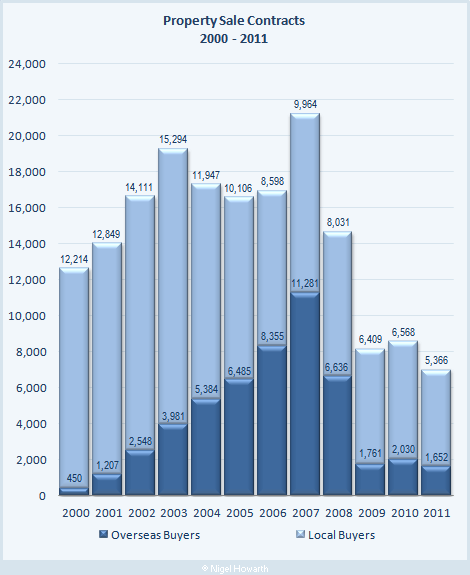
FIGURES released by the Department of Land and Surveys earlier today reveal that the number of property sale contracts deposited at Land Registries last year fell to their lowest since the Department started publishing figures in 2000.
Domestic demand is being depressed by uncertainty in the market, record levels of unemployment and a lack of liquidity.
Speaking to Stockwatch, property valuer Polys Kourousides said that it is difficult to predict recovery. “The lack of liquidity and the fear for investments cannot change things”, he said.
“We do not expect recovery in 2012 although there are good opportunities in the market”, he stressed.
According to the figures the number of sale contracts deposited in 2011 fell to 7,018; a drop of 18% on the 8,598 deposited during 2010. Sales to overseas buyers accounted for just under a quarter of all properties sold.
Source: Department of Lands and Surveys
Speaking to OPP last week after the publication of the overseas sales figures, Yiannis Misirlis of Limassol-based Imperio Properties, said “2011 has been a bad year for the property market in Cyprus. Despite the upward trends in the first half of the year, the year ended with a big decline of the overall sales. The East (Ayia Napa, Larnaca) and the West (Paphos) of the island seem to be the areas most affected, although the same signs start to appear in Limassol and Nicosia (traditionally the best performing areas) too.
The foreign investments seem to be more ‘reserved’ too. A large part of our buyer community continues to come from Russia, and a smaller part from Asia and the Arab world. The Arab Spring seems to be helping a bit. And people seem to be more selective in terms of quality and prime location. The latter (prime location) seems to be able to attract a premium again. I see the same trend for 2012 … quality will trump price.”
Source: Department of Lands and Surveys
Ioannis Verdelis, a consultant with Best International, believes that perception and confidence lie at the heart of the difficulties in Cyprus.
“Few markets have done more to hurt investor confidence than Cyprus has,” he told OPP last week. “The ongoing North Cyprus political situation has always been in buyers thinking, but for years buyers in the South at least knew they enjoyed the protection of a developed European country.”
“However, story after story has broken to the press with developments stalling, title deeds not existing, and of course recently banks foreclosing properties in situations where a developer defaulted and had not registered titles for existing buyers.”
Verdelis would like to see a more pro-active fight-back from the authorities to address these perception problems.
“The Cyprus market has a lot going for it,” he told OPP, “but it takes time to educate people. To bring investor confidence back would require bold steps from the local authorities to resolve the ongoing title problems. A lot of steps have been taken to this direction already, but I think it will take bold moves to get the attention of the media and buyers again.”