YESTERDAY Finance Minister Kikis Kazamias revealed that a foreign investor is seriously interested in investing in a large project that would boost the beleaguered construction industry and the Cyprus tourism sector.
The minister accompanied the investor during a meeting with President Demetris Christofias yesterday at the presidential palace.
Speaking to the media after the meeting the minister declined to elaborate further saying that details will be given by the investor himself. But according to reports in the Greek media the minister did reveal that the investor was an American with dual citizenship.
It has also been reported that the investment will create a large hotel complex and casinos.
The minister noted that the government was considering a number of proposals from other potential foreign investors.
AS WE approach the end of the year it is apparent that the Island’s property market is in a deep recession with little hope of a recovery in the near future.
Domestic sales have been hit by the uncertainty in the property market, the lack of liquidity plus the high cost of loans, record levels of unemployment and the problems with the Island’s economy.
British buyers have virtually deserted the market as a result of the revelations about Title Deeds and the misdemeanours of property developers, real estate agents and banks featuring in the UK media.
Property sales to overseas buyers in Paphos, once a favourite of the British, are down by nearly 90% on the numbers sold in 2007 and are at half the number sold ten years ago at the start of the property boom.
Like many other countries in the European Union, the UK has problems with its economy. Rising levels of unemployment, the fall in the value of Sterling against the Euro and the general economic situation has reduced the number of Brits buying overseas property.
But there are still many Brits investing. In Spain for example, sales to overseas buyers increased by nearly 25% during the third quarter of 2011 compared to last year, while sales to overseas buyers in Cyprus over the same period fell by 30%.
Prices
SINCE RICS Cyprus started publishing its Property Price Index in the last quarter of 2009, apartment and house prices have been falling steadily.
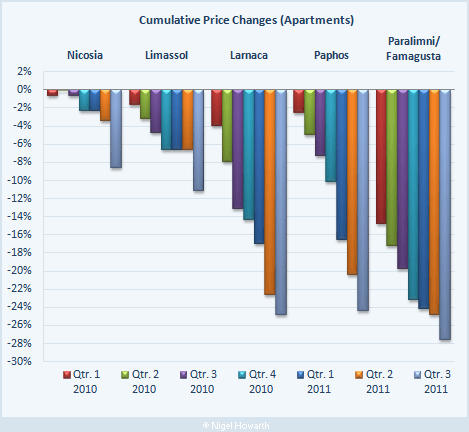
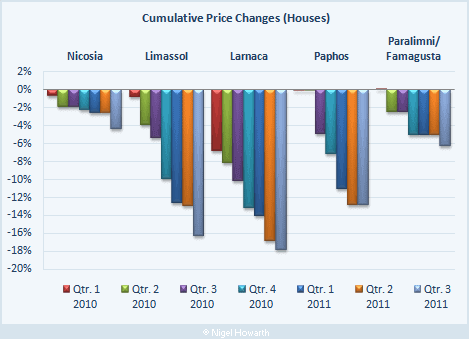
Apartment prices have fallen by an average of 19% and those of houses by 12%. But these falls have not been consistent across the Island. Prices of apartments in the Paralimni/Famagusta area have fallen by 28% and house prices in Larnaca are down 18%.
The commercial centres of Nicosia and Limassol seemed to be weathering the storm quite well. But the latest report from RICS shows that both seem to have succumbed to the problems of falling prices experienced in the other urban areas of the Island.
Derived from the RICS Cyprus Property Price Index Q4 2009 - Q3 2011Derived from the RICS Cyprus Property Price Index Q4 2009 - Q3 2011
Government action and incentives
DURING the year, the Government introduced new legislation in its endeavours to instil confidence in the market and increase the flow of revenue into state coffers.
The ‘Town Planning Amnesty’ laws were approved in March. These were designed to enable the legalisation of various building irregularities that were preventing the issue of some of the 130,000 Title Deeds that were pending. Initially set to last for six months, the Amnesty was subsequently extended for a further six months. But it had an unpleasant sting in the tail which meant that properties suffering from severe planning infringements could not be sold or mortgaged.
The Sale of ‘Immovable Property (Specific Performance) Law’ came into force earlier this year replacing the old ‘Sale of Land (Specific Performance) Law’. This new law provided additional protection for those buying property, but caused outrage amongst existing purchasers when they learnt that its provisions were not retrospective.
The government also reduced the VAT on property for first-time buyers and abolished/suspended Property Transfer Fees for a period of six months in efforts to kick the Island’s beleaguered property market back into life. Depending on circumstances, these incentives could reduce the cost of owning a €250,000 house or apartment by around €38,000.
What next?
PROPERTY valuer Polys Kourousides believes that property prices will be reduced further and his views are echoed by Pavlos Loizou in the latest RICS Cyprus Property Price Index where he says “that there is still room for re-pricing of capital values to take place”.
It is unlikely that the government can afford to give the property industry any further incentives, but it can still do much to improve the protection afforded to those buying property. It needs to undertake a wholesale review and reform of the laws relating to the purchase of property – and then provide the authorities with the necessary powers to implement those reforms and to ensure their proper enforcement.
Top of the government’s list of priorities: full legal protection for purchasers and Title Deeds on delivery of a property.
BRITISH home buyer Conor O’Dwyer has been granted legal aid to continue his long-running civil case against the Paralimni-based property developer Christoforos Karayiannas & Son Ltd over a disputed property.
In a short hearing yesterday morning, Judge Tefkros Economou at Famagusta District Court said the aid was necessary, pointing to EU directive 2002/8/EC which deals with cross border disputes within the EU.
The EU directive was passed into Cyprus law in 2005 and has only ever been used in human rights and criminal cases, making O’Dwyer’s claim in a civil action a legal first.
O’Dwyer has been embroiled in an expensive and lengthy legal action with Paralimni based Karayiannas Developers, with several concurrent cases running in court.
The aid will help with his fees in case in which O’Dwyer claims unlawful termination of his contract of sale by Karayiannas (Case 365/2006). The aid will also pay for a court interpreter, accommodation costs and travel expenses between his home in Britain and court dates in Cyprus.
“Conor has been drained financially due to all the cases pending in the courts in Cyprus for all these years,” lawyer Yiannos Georgiaides, acting for O’Dwyer, told the Cyprus Mail yesterday.
“It came to the, point where he could not afford his legal fees; therefore he would not have had proper access to justice. He would have been in a very difficult position.”
Wrangling
O’Dwyer’s lawyers applied for aid after years of legal wrangling over a disputed villa in Frenaros, which began when O’Dwyer claimed he purchased a house that was then resold by Karayiannas Developers without his knowledge.
The dispute has taken a series of twists and turns, including O’Dwyer staging demonstrations outside the Cyprus High Commission in London, sleeping at the gates of the Presidential Palace in Nicosia and publishing his entire story online and on the video site YouTube.
He claims the spat resulted in him losing the house and £100,000 he had paid for the property.
The developers dismissed the accusations and accused O’Dwyer of attempting to extort a more expensive house from them – a charge that O’Dwyer flatly denies.
The case has been closely followed by expatriate communities on the island, where as many as 30,000 Britons are now thought to own property.
“If Conor was not granted this legal aid, this would be equal to the refusal of his right to justice,” Georgiaides added.
Last year the developer, his son and an associate were convicted of assault and actual body harm of O’Dwyer after he was beaten up outside the disputed house in early 2007.
O’Dwyer spent a week in Larnaca General Hospital after the attack and said the incident blighted his family life.
THE eighth publication of the quarterly RICS Cyprus Property Price Index reports that the decline in real estate prices and rents continued to fall during the third quarter of the year across all of the Island’s major urban areas.
In his commentary on the Index, Pavlos Loizou MRICS, Board member of RICS Cyprus writes: “During the third quarter of 2011 Cyprus’ economy bore the consequences of the decoupling of the Greek economy and the explosion at Evangelos Florakis Naval Base which severely damaged the country’s main electricity power station. The combination of the turmoil in Greece with this unfortunate event caused severe disruptions in daily lives and a loss of people’s confidence in the abilities of the state. In turn, the explosion led to numerous accusation and discussions by parliamentarians and government officials which escalated causing political instability.
Whilst the first and second quarters saw some signs of muted economic growth, the third quarter saw investors postpone their decision making and banks retrenching by limiting the amount of credit available. In turn this led to a low transaction turnover and to reduced interest, especially by local buyers, as they were affected by the increased tension between government and parliament.”
Prices
Residential prices for both houses and flats fell by 1.7% and 4.4% respectively during the third quarter of the year.
Nicosia suffered the biggest drop in apartment prices, where they fell by 5.3%, while the biggest drop in house prices was in Limassol, where they fell by 3.8%.
The values of retail properties fell by an average of 2.4% across the Island, whilst those of offices and warehouses fell by 4.1% and 1.4% respectively.
Compared to the third quarter of 2010, apartment and house prices have fallen by 10.7% and 6.7% respectively. Prices for retail units have fallen 9.4%, while those for offices are down 6.8% and those for warehouses are down 7.9%.
Rents
Over the quarter, average rental values for apartments and houses fell by 2.0% and 0.5% respectively. However, rental values for houses in Nicosia were up 5.9%.
Rental values for retail units fell 3.6%, while those for warehouses and offices fell by 2.2% and 1.3% respectively.
Compared to the third quarter of 2010, rents for apartments have dropped 11.4% and those for houses have fallen 6.6%. Retail unit rents have fallen 11.7%, office rents are down 7.5% and warehouse rents are down 11.4%.
The data shows that all asset classes and geographies are now affected, with landlords lowering their rents in order to attract tenants.
Investment yields
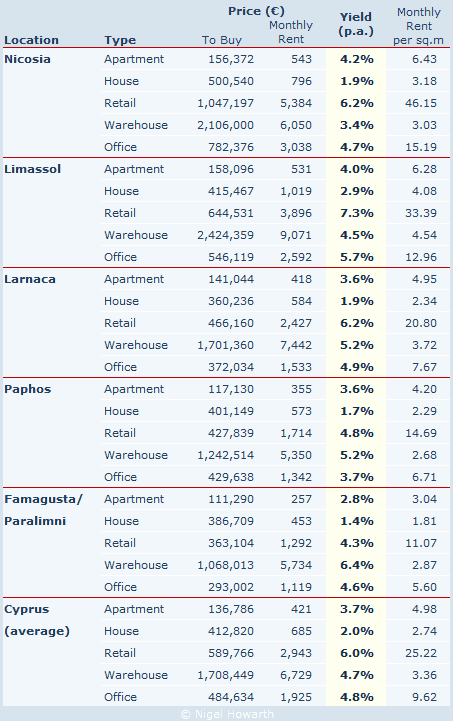
Yields are a useful tool showing the relationship between rent and property prices. At the end of the third quarter average gross yields stood at 3.7% for apartments, 2.0% for houses, 6.0% for retail, 4.7% for warehouses, and 4.8% for offices.
The parallel reduction in capital values and rents is keeping investment yields relatively stable and at very low levels (compared to yields overseas). This suggests that there is still room for re-pricing of capital values to take place.
Derived from the RICS Cyprus Property Price Index for Q3 2011
Outline of properties used to calculate the index
Apartments: Residential, two bedroom, 85sqm, Medium quality. Houses: Residential, three bedroom with garden, Semi-detached, 250sqm, Medium quality. Retail: High-street retail, 100sqm ground floor area with 50sqm mezzanine. Warehouse: Light industrial area, 2,000sqm, which includes 200sqm office space. Office: Grade A, City centre location, 200sqm
Methodology
The methodology underpinning the RICS Cyprus Property Price Index was developed by the University of Reading UK and may be viewed by clicking here.
A MULTI-MILLION Euro luxury development project between Cyprus and Qatar will be getting underway in the coming days.
The Island’s Finance Minister visited the military camp earmarked for the development in the heart of Nicosia to inspect the site and gave the go-ahead for the bulldozers to move in and tear the camp down; the camp ceased operating three weeks ago.
The joint project will include a luxury hotel, apartments, shops and offices located opposite the Nicosia Hilton hotel on the centre of town.
The project is a joint venture between the Republic of Cyprus and the Qatari Diar Real Estate Investment Company.
The agreements and memoranda were signed at the Presidential Palace in Nicosia in 2010 during official talks between delegations of Cyprus and Qatar, headed by President Demetris Christofias and the Emir of Qatar Sheikh Hamad Bin Khalifa Al Thani.
THE PERFORMANCE of Cypriot housing market suffered the third highest decline in the Euro area with prices falling by 4.9% during the first half of 2011 behind Ireland, where prices fell by 11.8%, and Spain, where they fell by 5.5%.
The European Central Bank (ECB) sources its information from the Central Bank of Cyprus and it is mainly based on valuations collected from commercial banks and on information received from the Department of Lands and Surveys and private real estate agencies.
According to the ECB’s figures, the rate of the decline in house prices has accelerated and is more than twice the decline in 2010 and higher than the drop in 2009, when prices came under pressure from the recession.
Stockwatch reported that market factors believe that the price correction is normal and that it will be maintained as a result of the liquidity conditions and the general climate in the Euro area and Cyprus.
According to property valuer Polys Kourousides prices had increased sharply in previous years compared to the rest of the EU member states and must now be corrected.
Between 2002 and the third quarter of 2008, property prices in Cyprus saw a huge increase averaging 14.8%/annum. Since then prices have steadily declined.
The Central Bank says that the boom in property prices was due to the increasing number of immigrants and high demand from overseas buyers. According to its latest bulletin, the boom was also fuelled by low interest rates being offered before the crisis. However, conditions have now changed and downward pressures on the property market will continue.
“Both the construction activity and the property sector will continue to be in recession and prices will continue to drop”, it added.