Transfer fee abolition/reduction law published at last!

AFTER a long delay, changes to the law designed to help stimulate sales of new property by abolishing and reducing Property Transfer Fees for a period of six months have finally been agreed and published.

The changes came into effect on Friday 2nd December and will remain in force for a period of six months. They apply only to the first sale of a property, where the contract is dated and deposited within the six month window. Specifically:

  • For those who pay VAT on their house purchase, no transfer fees are payable.
  • For those who do not pay VAT on their purchase, property transfer fees are reduced by 50%.

There are provisions in the law that prevent its abuse, for example, by buyers withdrawing  contracts of sale deposited at the Land Registry for Specific Performance, changing their dates and then re-depositing them.

No exemption or discount is available for sale agreements dated prior to 2 December 2011.

Further reading

Property Transfer Fees law changes (Greek)

Alpha Bank moves to repossess homes built by Liasides

From a Dream to a Nightmare
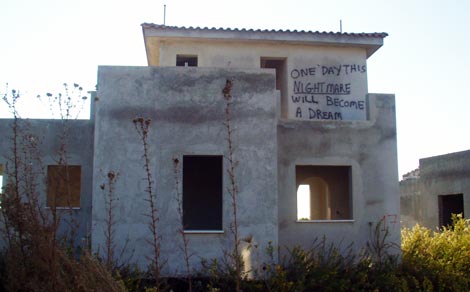
THE long-dreaded day when banks move to repossess homes sold by bankrupt developers with outstanding mortgages could be looming, after one bank has applied to auction up to 70 peoples’ homes.

According to the Cyprus Property Action Group (CPAG) Alpha Bank filed applications to the Land Registry to auction eight plots that were mortgaged to bankrupt property developer Yiannis Liasides.

Liasides’ story will be familiar to followers of Cyprus’ treacherous property market. He ceased trading in 2007 without paying off Alpha Bank, leaving around 250 people in 14 plots who bought properties from him without title deeds.

Now the bank has moved in on eight of the 14 after the official receiver faced opposition from residents and former Liasides directors.

In one of the eight, Anarita, Liasides reportedly made no mortgage payments since 2002, and since then the amount owed to the bank has likely exceeded the value of both land and properties that he built and sold to residents. Unfortunately, as acting interior ministry permanent secretary Andreas Assiotis said, land and buildings are considered as one asset to offset against the liabilities, meaning banks may claim to houses on mortgaged land. “The Ministry of interior tried to make it possible for these to be dealt with separately, but the new legislation does not affect existing contracts.” Assiotis said, adding that buyers should take care to study their contracts before paying any money.

For CPAG leader and tireless property campaigner Denis O’Hare, this position reflects something of a U-turn by the government, which has previously assured buyers’ rights to property, even if they don’t have their title deeds.

“All along the Ministry of Interior has been saying that once a certificate of sale is lodged with the land registry, the buyer is protected. We can now see this myth of protection has been scotched by this action of Alpha Bank,” he added: “All reassurances to Europe about buyer protection have been shown to be hollow.”

For Anarita resident Diane Lloyd-Roberts, 68, who now faces repossession of the house she bought with her then husband in April 2002 despite a personal written reassurance from Interior Minister Neoclis Sylikiotis that her property is secure, the ordeal has proven a harrowing experience.

“The thing is: the (bank’s) loan is only for the land, not the house I paid for. How can they take my house?” said Lloyd-Roberts, who despite the stress of the situation is remaining defiant.

“I’m on the list with the others… I’m scared and I feel like I’m in a nightmare I can’t wake up from. But over my dead body will you get me out of here. I won’t go without a fight.”

The mortgage was taken out on her property just before she bought it, and had she been informed of this at the time by her lawyer, she said, she would have cancelled the sale. “We visited the lender bank who informed us that our developer had not paid anything back from loans he took out on our property in 2002.” She was later advised to borrow to pay off the developer’s mortgage, and the Ministry’s current advice is to get a good lawyer.

Instead Lloyd-Roberts took it up with the Cypriot authorities, complaining to the Competition and Consumer Protection Service in May 2011, and last month, with CPAG’s help, to the European Court of Human Rights to investigate the Cyprus government’s breach of the EU Unfair Commercial Practices Directive (UCPD).

So, what’s next? Well, this depends, in part, on the Land Registry, which can either approve or decline Alpha’s application, and whichever they choose could prove to be a pivotal moment in the Cyprus property market.

With an estimated €6 billion in mortgages in Cyprus a landmark auction could see other cash-strapped banks following suit, leading to potentially thousands of the 100,000 or so property owners – 30,000 or so foreign buyers – without title deeds facing repossession. According to Minister Sylikiotis, the Land Registry can block a bank’s application and should this happen, the rightful owners will remain in situ and the already ailing banks will have lost their money to the unscrupulous developers. Whether the banks or the buyers win, it seems the Cyprus property market is sure to lose with either dwindling investor confidence or reluctance from the bank to lend to developers.

The Ministry is assuring house buyers like Lloyd-Roberts that their rights are protected, while advising buyers to beware and victims to seek out a trustworthy lawyer and upholding a banks’ legal right to the assets on mortgaged properties.

In the meantime, Alpha Bank’s appointed (and independent) liquidator for Liasides developers, Ninos Hadjirousos, will continue his unenviable task of gathering everyone with a claim on the land and finding an alternative solution to auction and repossession.

Hadjirousos said the banks don’t want to see residents’ houses repossessed – a claim borne out by one case last year when a bank allowed a couple to stay in their home until death, after no one showed at the repossession auction.

However, Hadjirousos has struggled to get on board with Liasides property residents, who are wary of beginning the process without an assurance from the banks that they can stay.

“At the moment the residents have their property and no one would give assurances without knowing how deep the waters are,” he said.

The already treacherous waters have also been muddied by a group of ‘professionals’ who are taking payment – up to €5,000 per purchaser- in return for assurance that they will get their deeds, and who are discouraging residents from sending their details to Hadjirousos.

With the ministry on the fence, a pending EU investigation into unfair practices surrounding property sales and a financial crisis putting a strain on all actors, a negotiated compromise through the receiver could be if not the quickest, then the only solution.

Cyprus: A country in denial and a scandalous political leadership

One would think that Cyprus had everything going for itself: A smaller, manageable country, classified among the high income countries and with a standard of living that is higher than most other EU member states… an economy that was characterized (only a couple of years ago) by robustness and macroeconomic stability with full employment conditions and internal stability… a strategically located thriving business and financial hub with the lowest corporate tax in the EU and about 50 double tax treaties… an established gateway to the world of international trade with tested legislation and more than adequate infrastructure of all sorts… a tourist destination that used to be ranked amongst the top 5 in Europe with annual tourist arrivals counting more than double of its population… a country that claims the largest natural gas reserves ever discovered in the European continent with a potential to becoming a guaranteed primary natural gas source and transit route to the EU… an envied economy that only a few years back was a textbook case of success of a water-locked country…
But now, despite, three-year-long market warnings, repetitive specific warnings by, the credit rating agencies, the European Central Bank and the Central Bank of Cyprus, international cash centres and international financial institutions, the Country and its political leadership remains in denial.

Cyprus reached to such a low point, that it can no longer access the international capital markets, and is confronted by the challenge of accessing financing to meet its fiscal needs in 2012 not to mention beyond! Ignorant voices suggested that the State could provide sovereign guarantees to the banks to keep things going… It is to wonder how this could be possible when the State has no credibility whatsoever, actually a worse in the international capital markets credibility than the banks themselves! It is now almost impossible for Cyprus not to be obliged to join the European Financial Stabilisation Mechanism (EFSM)!

How is it possible for Cyprus to have come to this point? Is Cyprus, “deaf”, “blind” or both?

Are the Cypriots so polarized that they can only play the role of an ignorant bystander in an act that jeopardizes not only their own lives but also that of their children? Because if they are, they deserve the misery that they are about to experience!

Are, the Government, the political parties and the trade unions so unpatriotic that they put their own interests before the wellbeing of all their citizens? Because if they are, their actions are equal to the most despicable crime!

Are, the Government, the political parties and the trade unions so ignorant and incapable of handling a crisis? Because if they are, they are not suitable to neither run the island nor hold catalytic to the prosperity of the Country positions!

Indecisive, Gutless, Bigoted, Populist and Ignorant: Five adjectives that describe perfectly the behaviour of the Government on the handling of the Crisis. Highlighting, the behaviour of most of the political parties cannot be characterized much differently.

Even after half a dozen notches of downgrading, rapidly increasing unemployment and total economic slowdown, the Government and the politicians are exhibiting with every opportunity the extent of their vanity. The Government, as if living in another planet, still preaches that everything is under control. The representatives of the ruling communist party blame capitalism; the representatives of the main opposition conservative party comment sarcastically whenever the word communism is uttered; some blame the credit rating agencies and others quote words out of context of Mrs. Merkel, Mr. Sarkozy or Mr. Rhen, trying to convince the public and probably themselves, that all is cool or that their point of view is the only point of view. There are even some who dare to claim that Cyprus is doing better than most: their “scientific deduction” is based on the comparison that Cyprus is doing better than the worst of the Eurozone countries!?!?! All without any exemption do not miss the opportunity to blame the other side, the way only immature teenagers do: “I told you so!”; “We said it first!”; “It was our idea!”… But no one, no member of the Government or no politician to date had the guts to take any responsibility for the miserable condition of the economy! If this is not scandalous, what is?

Anachronistic and Ignorant are two adjectives enough to describe the behaviour of the Trade Unions on the Crisis. How else can they be characterized when they should be aware that if the C.O.L.A. is not abolished, if the pension plan is not reformed, and if the public finances are not streamlined and sorted out, the Cypriots of today and the generations to follow will not just lose a salary increment or two but their livelihoods?! How is it possible that the Trade Unions cannot realize that Cyprus cannot be productive or competitive when the COLA defeats each and every purpose for competing?! How is it possible that the Trade Unions do not realize that Cyprus cannot seek for excellence when entrepreneurship and innovation is “massacred” by a system that is not based on merit and performance but instead promotes mediocrity and injustice?! How can some of the Trade Unions possibly claim that the EU and credit rating agencies’ warnings are unfounded?! How can they dare to play with peoples’ lives in such manner?!

Cypriots, two days ago, were pleasantly surprised to see the leader of the main opposition political party meeting with the President of the Republic, in an effort to find a solution to the Cyprus Financial Crisis. Although it is progress, the outcome of the discussion was as half-baked as all the decisions that have been taken so far in regard to the crisis. The announced measures, when they will be enforced (the 15 December deadline will come and the politicians will be still discussing the obvious), will buy Cyprus a few months, maybe a year, if of course no other external or internal factors by then, negatively impact the economy further.

What needs to be done!

  • The Government has to come out of its permanently-worn-election-campaign-shell, face its people, acknowledge that it underestimated the resilience of the Cyprus economy and with clarity admit that the Cyprus economy is in a mess. Moreover, the Government has to tangibly explain to its people that unless real sacrifices are made, the price that the Cypriots will pay tomorrow will be incomparably higher than what they are called to pay today.
  • The Government has to acknowledge that fundamental changes must be undertaken (and it has to evidently chart the way) in order for the Country to enjoy long-term financial stability, such are, the abolishment of the C.O.L.A., the reform of the pension plan and the streamlining of the public finances – providing measures that only scratch the surface will only prolong the problem and the credibility of the Country will be further tarnished… If Cyprus is to prosper, it has to strive for excellence, it has to become competitive, and it has to accumulate capital. The C.O.L.A., the growing cash deficits of the pension plan and the insurmountable public finances will never allow the Country to follow the path of prosperity.
  • The Government has to ensure that the measures to be taken will not promote further stagnation but instead encourage local and foreign direct investments. For instance, tax evasion (which must be dealt with systematically and promptly) should not become a “psychosis” by establishing complex legislation and inspection – if procedures do not remain as simple as possible they will scare off investment and eliminate the entrepreneurial spirit that resurrected this country after the Turkish invasion of 1974.
  • All political parties have to support and promote the Government’s efforts. A strong message has to be sent to the international capital markets that Cypriots united are behind the efforts of their leadership and that Cyprus as an international financial centre is the natural choice for the serious investor – the much needed spirit of collectiveness can be cultivated only if the leadership of the country embraces is first and sets the example.
  • The trade unions must realize that unless they support the fiscal consolidation process unreservedly, in a very short period of time their role will be diminished to obscurity. When their members (if drastic measures are not undertaken) in the very near future are laid off, one after the other, they, their members, will realize only too late that the Trade Unions were at the least ignorant…

Moreover, epigrammatically, the banking, tourism and real estate industries have to be reinforced in each and every possible way. Incentives, especially for foreign investors but also for private local ones have to multiply. Procedures and other administrative inefficiencies within the governmental machine at every level have to be rationalized and become more responsive. Technological innovation and sophistication, research and development have to be reinforced. Double tax treaties with more countries are a priority and should be dealt as such. Building coefficients in selected areas have to increase. Hospitality and tourism have to be upgraded. International hotel chains should be targeted and “invited”. Architectural monstrosity should be eliminated. Architectural uniformity in all areas has to become a way of life. Tradition and heritage have to be protected and better projected. Critical thinking, creativity and ingenious vision have to be cultivated…

In a nutshell, the main policy priorities should be to stabilize public debt at a more prudent level and boost competitiveness, while safeguarding the stability of the financial sector. Over and above the bold reforms and the sacrifices, a spirit of collectiveness, pride and transparency must be encouraged and adopted. Cyprus is given at this final hour the opportunity and probably a last chance to eliminate “cancerous” practices that have accumulated over the years…

Does Cyprus possess the common sense and resilience to map its own destiny?

Copyright © 2011 Pytheas Limited

Further reading

Cyprus – A country in denial and a scandalous political leadership

About the author

Harris Samaras is an Economist and presently the Chairman & CEO of Pytheas, an international investment management organization, Harris has also worked with the Bank of America Group, Thomson Financial BankWatch, and Moody’s Investors Service. His expertise lies primarily in the areas of investment and corporate banking, private equity and finance, risk management and business development. His research and extensive publications in these areas range across practice rather than theory, economic and business thought, entrepreneurship and geopolitics.

He has been an adviser to various governments, central banks, financial institutions, and other corporates and has been a member of the board of directors of multinational organizations.

Title deeds are key to restoring market confidence

A RECENT mini-poll conducted by the Cyprus Property News showed that 52 percent of the 1,040 readers who expressed an opinion believed that the availability of Title Deeds was the most important factor in getting the Island’s beleaguered property market back on its feet.

Property prices should represent value for money came in second with 18% of the votes, followed by an improvement in the economic situation (14%), other reasons (6%), a reduction in interest rates (4%), golf courses and marinas (3%) and finally improved build quality (3%).

Poll results – The Cyprus real estate market will recover when…

Among the ‘other reasons’ given were a need for improved legal safeguards for those buying property, more effective enforcement of the law, reduction of alleged incompetence and corruption by those in the legal profession (and others) and a greater determination by politicians to resolve the many problems affecting the market.

It is comes as no surprise that Title Deeds tops the poll as in some cases it can take 20 years or even longer for deeds to be issued. ‘Title Deed problems’ have been the subject of much media attention in the foreign press and questions have been raised in the European Parliament.

Many other countries in Europe and elsewhere operate a similar Land Registry system in which Title Deeds are issued on delivery of a property, or a few days later.

It is difficult to understand why Cyprus cannot investigate and adopt ‘best practice’ used by Land Registries and Planning Authorities in other countries as it appears that its current system is no longer fit for purpose.

Although the Cyprus government recently strengthened some property-related laws it seems that this has done little to inspire a recovery in investor confidence.

The adoption of a new ‘Specific Performance Law’ and changes to some other laws earlier this year attempted to patch some of the issues that resulted from delays in issuing Title Deeds. But they do not address the fundamental causes of the problem – mind-numbing bureaucracy within central and local government, developers who ignore the law and who profit as a result and the banks whose apparent reckless lending has resulted in even more problems for buyers now that the market has virtually collapsed.

MEP calls on EU to protect those buying homes abroad

DIANA Wallace, a Member of the European Parliament (MEP) for Yorkshire and the Humber, is an active campaigner on behalf of thousands of Britons who have bought overseas property and who have run into problems.

Earlier today she published a booklet “European Property Rights and Wrongs“. Although she points out that many EU citizens do successfully purchase property in other member states and enjoy their property without any problems, she makes a particular mention of the problems faced by those buying property in Cyprus and Spain.

Speaking to the Daily Telegraph Ms Wallace said: “Property rights issues in countries such as Spain and Cyprus are by far the most pressing in the Petitions Committee, and while tens of thousands face demolition, eviction or bankruptcy, the EU has been unable, or refused, to act.

“The EU offers consumer protection for someone purchasing books, a piece of furniture or a hairdryer, and yet it has been reluctant to act to protect consumers when they make the most important purchase of their life.

“I decided to launch this publication as a response to the stalemate we have found ourselves in, when defending those affected here in the European Parliament.”

Ms Wallace plans to present her booklet to the General Assembly of the European Land Registry Association that is meeting in the Estonian city of Tallinn tomorrow. Her booklet will also be presented to Commissioner Viviane Reding, members of the Petitions Committee and the various citizens’ action groups.

Referring to Cyprus in her booklet, Ms Wallace writes “The particular circumstances of the Cypriot title deeds issue have allowed unscrupulous developers to re-mortgage a property once it has been sold, to increase an existing mortgage or build without relevant permits in place, all without the knowledge of the purchaser”.

Get your copy of Ms Wallace’s publication “European Property Rights and Wrongs

Construction investment decline continues

FIGURES from the Cyprus Statistical Service (CYSTAT) released earlier today show that investments in the Island’s once thriving construction sector are continuing to fall.

CYSTAT’s figures reveal that a total of 648 building permits were authorised by the Municipal Authorities and District Administration Offices in September 2011. Compared with the 717 permits authorised in September 2010, this represents a fall of 9.6%.

In September, building permits were issued for:

  • Residential buildings – 465 permits
  • Non-residential buildings – 99 permits
  • Civil engineering projects – 26 permits
  • Division of plots of land – 50 permits
  • Road construction – 8 permits

The total value of these permits was €187.8 million and their total area 219.5 thousand square metres.

During the period January to September 2011, 5,751 building permits have been issued; a decrease of 13.3% compared to the corresponding period of last year. Their total value decreased by 21.9% and their total area by 24.2%.

Residential buildings

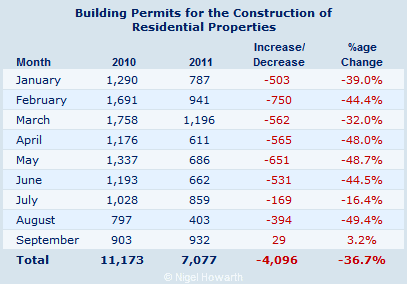
In September, 465 permits were approved for the construction of 932 dwelling units comprising 329 single houses and 603 multiple housing units (such as apartments and other residential complexes).

This is a marginal improvement of 3.2% compared with September 2010 when building permits were issued for the construction of 903 residential units.

Source: Cyprus Statistical Service

So far this year, building permits have been issued for the construction of 7,077 dwelling units against 11,173 during the same period last year; a drop of 4,096 (-36.7%).

According to the Cyprus Statistical Service, building permits constitute a leading indicator of future activity in the construction sector.