Another Eurozone country bites the dust

REAL estate in the Republic of Cyprus has been popular with foreigners who own about 100,000 homes – in a country with 803,000 people. The British alone, whose colony this was until 1960, own more than 60,000 homes. Turns out, real estate is Cyprus’ national sport sponsored by dumb money.

But now it has become a nightmare that is unravelling the finances not only of expat home owners, but also of developers, banks, and the government. Yet it’s hushed up. By comparison, the banks’ impending losses on Greek sovereign debt, significant as they are, seem outright manageable.

“The most common mistake people make when buying property in Cyprus is to use a lawyer who has been introduced or recommended to them by a property developer,” says Nigel Howarth who has helped foreign property buyers in Cyprus for more than 10 years. Foreign buyers are sitting ducks. They’re unaware of the local business culture and don’t suspect that their lawyers are in cahoots with developers–aided and abetted by the banks.

The country acceded to the Eurozone in 2008, but it’s already in a heap of trouble. A recent loan agreement with Russia of €2.5 billion will keep it afloat for a few months into 2012. Then it’s bailout and haircut time. On October 27, Standard & Poor’s cut Cyprus to BBB. The big problem: exposure of its banks to Greek sovereign, corporate, and bank debt. But not a word about the title-deed scandal and the billions that evaporated with it.

As in the U.S., after years of speculative overbuilding, the real estate market is collapsing. Building permits are down 40.2% for the first eight months of the year and 49.4% for August. Home prices have dropped for six consecutive quarters, according to the Central Bank. The steepest declines were in the coastal regions favoured by foreigners. Of the 45,000 unsold properties, many are unfinished, and some are essentially abandoned. The Cyprus Property News points out that they “were built for buy-to-flip investors and are unsuitable for permanent living.”

Prices would have dropped even more steeply if the banks had dealt with their non-performing loans. But instead of pressuring developers to sell properties to service their loans, they’re pressuring appraisers not to reduce values so that loans appear to be adequately secured.

These kinds of issues have cropped up in the U.S. as well. What’s unique in the collapsing housing bubble in Cyprus is a title-deed scandal of unimaginable proportions. And it has embroiled waves of foreign buyers.

“The bulk of the problems stem from the archaic Ottoman land law still in existence in Cyprus which allows these dubious practices,” writes the Cyprus Property Action Group. Insufficient industry regulation and lacking enforcement of consumer protection laws also play a role.

The scheme works this way: A developer takes out a mortgage on the land but hides it from foreign buyers. The bank retains the title deed as collateral. When the developer sells the property, the buyers’ lawyer, who is in cahoots with the developer, doesn’t perform a title search and doesn’t “discover” the original mortgage. Buyers, assuming that their part of the property is free and clear, either pay cash or take out a mortgage. The developer pockets the money instead of paying off the original mortgage. The bank goes along because it can collect interest on one or two mortgages. But it retains the title deed as collateral for the original mortgage, and the buyer never sees it.

Throughout, buyers are told by everyone, including the government, that a buyer of immovable property is absolutely protected once the sales contract is lodged with the Cyprus Land Registry, and that they don’t need the title deed.

Meanwhile, as the property is still under construction and buyers are overseas, the developer strikes again. Alan Waring, an international risk management consultant, explains:

“Some cases have also involved alleged ‘double selling’ fraud whereby the developer sells a property to Party A, fails to lodge the contract with the Land Registry, and then sells it again to Party B (possibly for a higher price) but fails to reimburse Party A.”

Proving fraud in court seems to be impossible. In a recent double-selling case, the judge ruled against the plaintiff: lodging of a sales contract at the Land Registry does not mean that buyers “automatically and in perpetuity have become the ‘owners’ (as they mean it) of the residence,” she wrote. Hence, only possession of a title deed confers protection against double selling.

But the bank still holds the title deed as collateral for the original developer mortgage, and it has the right to foreclose on the property. Under normal circumstances, it takes a bank between 9 to 12 years to obtain control over the property. So banks extend and pretend until the developer goes broke. Then they move to recuperate a property that one or two other “owners” have paid for…. A nightmare. And no legal resolutions are in sight.

The numbers are stunning. In this tiny speck of a country with 803,000 people, about 130,000 properties are still awaiting their title deeds. If the average value of these homes is €150,000, then nearly €20 billion worth of properties might be in dispute, many of them with more than one mortgage and more than one owner.

The banks aren’t talking. And they aren’t writing down their assets to reflect the layers of mortgages that are worthless. Developers are going bust. The money they pocketed has disappeared. Expat homeowners who don’t hold title deeds are terrified of losing their homes, even if they paid cash. There are no legal processes in place to resolve this. Estimates of the missing money range from €3 to €6 billion—enough to take down all Cypriot banks. By comparison, the banks’ exposure to Greek sovereign debt is estimated to be €4.2 billion, of which only half will have to be written off.

In response to the impending haircuts on Greek debt—and not to the title-deed scandal, which continues to get hushed up in the hope that it will somehow go away—the Cabinet approved draft bills to recapitalize its banks and create a fund to stabilize the banking system. But there is no money to put into the fund (see EFSF, so leverage it?). A package of austerity measures has been approved. It includes such stalwarts as cutting 1,100 already vacant positions in the civil service and reducing entry-level salaries for civil servants by 10%. However, the government did blink in the title-deed scandal and revised some of the Ottoman property laws—a great example of too little too late.

“It wouldn’t surprise me that all those who bought properties in Cyprus might in the end be forced to pay additional money if they want to keep what they already paid for,” said my source in Cyprus.

And in Greece? “Tax fraud is a national plague,” said Greece’s finance minister after he found that Greeks owed $50 billion in back taxes. But it’s complicated…. Greece’s Extortion Game.

By Wolf Richter at The Testosteronepit – where the truth comes home to roost.

Standard & Poor’s downgrades Cyprus’ credit rating

STANDARD & Poor’s cut Cyprus’ long-term sovereign credit rating by a notch to ‘BBB’ from ‘BBB+’ yesterday, referring to the banking system’s exposure to the Greek sovereign debt.

In its press release, Standard & Poor’s said “In our opinion, the contingent liabilities posed to the Cypriot government by the Cypriot banking system’s exposure to Greece continue to weigh heavily on the ratings on Cyprus.”

“We believe that a Greek default scenario with private sector involvement (PSI) or “haircuts” higher than previously agreed by commercial creditors would necessitate the recapitalization of some domestic banking institutions.”

“We also believe the effect of a Greek government default could reverberate through Cyprus’ economy in the form of private-sector funding costs increasing beyond our previous expectations, thereby reducing investment and overall domestic demand.”

“Furthermore, weaker economic growth could worsen the Cypriot government’s debt dynamics and reduce the willingness of its political leaders to press forward with fiscal and labour market reforms.”

“We estimate the exposure of Cypriot banks to Greek debt (sovereign, corporate, and bank combined) at about 165% of Cyprus’ GDP.”

Commenting on the €2.5 billion bilateral loan agreement with the Russian government, S&P said that “this could help alleviate funding pressures well into 2012”.

However, it cautioned that temporary measures “would not structurally improve Cyprus’ public finances” and that “one-off agreements could reduce the willingness of social partners to agree to the planned fiscal consolidation measures”.

The move came only hours after EU leaders reached an agreement in which banks holding Greek debt would accept a 50 per cent “haircut” write-off.

Government response

Reacting to the S&P decision, in a statement, the government of the Republic of Cyprus “acknowledges the challenges which the Cypriot economy is facing due to the negative developments from Europe’s debt crisis”.

For this reason, it adds, “the Government intends to act promptly and decisively to take all necessary measures to achieve fiscal consolidation and to handle the challenges of the banking system in cooperation with the Central Bank”.

It urges the political parties to vote in favour of the 2012 Budget as well as all measures for fiscal consolidation “to give the message to markets that the Republic of Cyprus is determined to handle the challenges in an effective and decisive manner”.

On August 26th the House of Representatives approved the first of two packages of austerity measures aiming at fiscal consolidation. Presenting the 2012 state budget, Finance Minister Kazamias said it contains structural measures aiming to avert negative developments to the Cypriot economy.

It provides for total revenues of 6.22 billion euro, compared with 5.64 billion of 2011 and total expenditures, excluding loan payments, of 7.54 billion euro compared with 8.01 billion of the 2011 state budget.

The budget also includes provisions for a 10% reduction in entry-level salaries for civil servants, abolition of 1,100 vacant positions in the civil service, continuation of the freezing of procedures to fill up vacancies and for reducing by 200 million euro social benefits both by lowering the level of benefits and by introducing income criteria for certain benefits.

Many properties will remain unsold

ANALYSING the present situation in the property market to ratings agencies Moody’s and Fitch the lead consultant of Leaf Research, Pavlos Loizou, explained the explosive situation that has been created after years of speculative overbuilding.

Large numbers of properties remain unsold and the market is oversupplied. Many properties were holiday homes built for “buy-to-flip” investors and are unsuitable for permanent living. Now that the period of frenzied investment speculation has come to an end, these properties are unlikely to be sold in the near future.

Very little construction activity is taking place as the banks have tightened their borrowing criteria and are withholding finance for almost all projects. However, there is a demand for city centre apartments, some holiday homes, student housing and projects related to renewable energy.

This situation adds to the reputation created by Cyprus abroad as an unsafe place to buy a holiday home or even permanent home, unless its Title Deed has been issued and is readily available.

Mr Loizou referred to the bank’s exposure due to the fact that property is used as the main collateral to raise finance. He noted that takes a bank 9 to 12 years get control over a mortgaged property – and even then, it is unlikely that it can be sold if it is the defaulter’s main residence.

Summing up the situation on the state of the market and where it is heading, Mr Loizou said that:

  • Local buyers are taking advantage some “special cases” to acquire properties in central/prime areas, but there is little demand for long term investment and almost no demand for land in the countryside.
  • As long as overseas buyers continue to face problems in their own markets, the local economy and property market will continue to suffer. Even when things stabilise, the market will never return to the same level of transaction volume.
  • Banks are pressurising valuers not to reduce prices in order that their loans appear to be adequately secured.
  • Prices in secondary areas and the price of land are likely to reduce further and will take a considerable time to recover.
  • Financial institutions will find themselves under additional pressure due to non-performing loans and they will need to come up with more “imaginative ways” to recover their money,
  • There is further pressure on the economy and the structure of society due to the changes in the public sector and the banks.
  • The property market’s parameters have changed but most refuse to acknowledge it!


Government to support banks in financial crisis

YESTERDAY, the Cyprus Cabinet approved three draft bills concerning financial stability and the management of the financial crisis, in the light of developments in the Eurozone.

After the Cabinet meeting, government spokesman Stephanos Stephanou said that based on recent developments and in case of a financial crisis there should be immediate action to ensure financial stability.

He added that the three bills approved by the Council of Ministers offer the necessary institutional and legal framework enabling Cyprus to intervene and back the financial system, should the necessity arise.

The first bill will allow the government to step in and bolster a bank’s liquidity if required.

The second bill would create a fund to help stabilise the banking system.

The banks’ heavy exposure to Greek sovereign debt, estimated at some €4.2 billions and with a high risk of default, has been cited as a concern by credit ratings agencies which have downgraded the Island’s sovereign ratings in the past few months.

The third bill extends the existing special tax for credit institutions.

The three draft bills will require parliamentary approval.

Residential property construction in meltdown

DURING August, building permits were authorised for the construction of 403 residential properties in Cyprus compared with the 797 in August 2010; a drop of 49.4%.
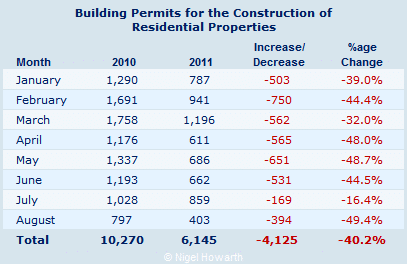
Of those 403 residential properties, 217 were single houses and 186 were multiple housing units such as apartments and other residential complexes.

So far this year, building permits have been issued for the construction of 6,145 residential properties against 10,270 during the same period last year; a drop of 4,125.

Cyprus residential property statistics August 2011
Source: Cyprus Statistical Service

According to the Cyprus Statistical Service, building permits constitute a leading indicator of future activity in the Island’s construction sector.

Banks not pressuring developers to service their loans

ON THURSDAY we reported that residential property prices had fallen for six consecutive quarters according to the Central Bank of Cyprus’ latest Residential Property Price Indices.

However, speaking to the Sunday Mail, economist and ex-banker Symeon Matsis said that the fall in property prices would have been worse if the banks pressed developers to service their loans by reducing property prices still further to encourage sales.

According to Mr Matsis developers’ arrears are on the increase and the banks are bracing themselves for a further haircut on their Greek bond holdings.

(Eurozone finance ministers agreed that banks should accept bigger losses on their Greek bonds but have not said how large these losses should be. In July, banks tentatively agreed to take a haircut of around 21%. But analysts are now saying that they may have to accept losses of between 50% and 60%).

In his interview with the Sunday Mail, Mr Matsis said that “The banks are not putting pressure on construction companies as they fear this would have further side effects. If the companies were pressed into selling their assets, this would cause a drop in the value of collaterals”.

Mr Matsis statement confirms widely held suspicions that property developers are receiving insufficient income from property sales to service their loans – and that the banks are not pursuing them for payment.

Clearly this situation cannot go on indefinitely and some property developers must be close to bankruptcy. The banking sector too must be very worried about the situation; but what can it do?