Transfer tax cut no use while house prices stay inflated

IN AN EFFORT to boost the sluggish property market, the legislature has approved a bill suspending the payment of transfer fees on new properties and reducing by 50 per cent the transfer fees on other property transactions.

Parties had been toying with this idea for some time, even though the government was opposed, because it would further reduce state revenue.

As a compromise, the law would have temporary effect, in the hope that it would kick-start a property market that has ground to a halt. The idea is that a revival of the property market, even with reduced or no transfer fees, might still generate more state revenue as well as helping the construction industry, which has been among the hardest hit by the recession, and creating jobs.

The law may seem like a good idea, but we very much doubt it will have the desired effect for one very simple reason – property prices, despite the recession, remain grossly inflated and without a significant reduction it is highly unlikely there would be much market activity. High bank interest rates, which are more likely to rise than fall, do not help things either.

It is true that flat and house prices in the coastal resorts, where there was glut, have tumbled but the pool of potential buyers has drastically contracted. In Nicosia, however, there have been small price decreases for apartments and small houses in the suburbs, while in the centre prices remain almost at pre-recession levels.

Developers admit that nothing is being sold, but at the same time refuse to offer the kind of discounts that would attract buyers.

There is another matter that the new law will not address. Potential buyers know that the economy is in a dismal state and, understandably, expect property prices, like rents, to come down. This is what happens in all economies during an extended recession. But here we are defying the laws of the market, owners maintaining inflated prices at which there is zero demand. And a rational buyer will not part with his money, simply because there would be a lower transfer tax, when his perception is that property prices were inflated.

Banks, which contributed to the problem by over-valuing properties, could now put pressure on developers to bring down prices in order to start selling and generating cash. This is a possible scenario now that banks are going on a re-capitalisation path, and would want to limit non-performing loans. Whether the banks could persuade developers and property sellers to obey the laws of the markets remains to be seen.

One thing is certain though. Unless property prices fall to reasonable levels the property market will not move.

Cyprus property sales down 21 percent in October

LIQUIDITY problems, record levels of unemployment and the huge uncertainty in the market continue to send the Cyprus property market into a tail-spin; there are still no signs of a recovery.

Sales fell for the 16th consecutive month in October, according to Department of Land and Survey figures published yesterday.

The figures reveal that the number of contracts for the sale of property deposited at Land Registry offices throughout Cyprus fell to 565 compared with 714 in October 2010; a drop of 21%.

Source: Department of Lands and Surveys

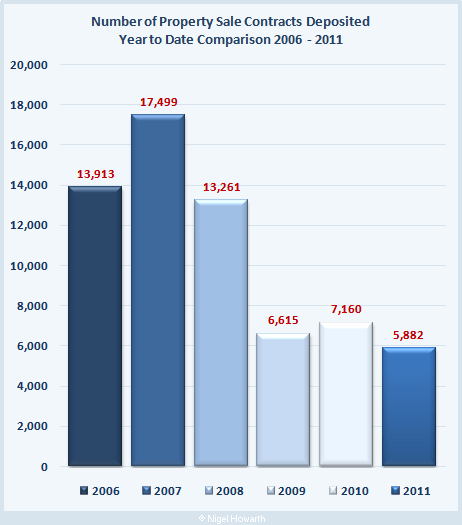
During the first ten months of this year, sales have fallen by nearly 18% – and they are now down by more than 11% on the numbers sold in 2009; the year the market crashed.

The area hit hardest by the decline is Larnaca, where sales during January to October this year have slumped 27%. In Nicosia, sales have fallen 26%, in Paphos they are down 22% and in Famagusta they have fallen 15%. Limassol seems to be weathering the crisis well with sales falling by just 0.2% over the year which has been attributed to an influx of Russian buyers.

Overseas sales

Overseas sales fell by 36% last month with the number of contracts deposited reaching 123 compared with 191 deposited in October 2010.

Although sales during October went up in Limassol by 3%, they fell in all other districts. Sales in Famagusta fell 74%, while those in Nicosia fell 63% followed by Larnaca, where sales fell 47% and finally Paphos, where sales were down 36%.

Source: Department of Lands and Surveys

Total overseas sales during the first ten months of the year totalled 1,433; a fall of 10% on the 1,593 sold over the same period last year.

Comment/opinion

Commenting on the falling sales numbers to Stockwatch, property valuer Polys Kourousides said that the fall was anticipated due to the lack of liquidity and the uncertainty in the economy.

According to Mr. Kourousides, parliament’s approval of the draft law on the suspension/reduction in Property Transfer Fees will make a positive contribution to the market and it was actually one of the proposals made by the Valuers’ Association three years ago.

The Vice Chairman and spokesman for the Real Estate Agents’ Association, Solomon Kourouklides, said that reduction in VAT to 5% and the reduction in transfer fees were two small steps in the right direction and his Association welcomed them, but added that they should have been taken three months ago.

Mr Kourouklides believes that the biggest problem is the lack of liquidity and that the measures cannot change the market by themselves; further incentives are needed.

He also expressed his concerns over yesterday’s decision by the government to suspend/reduce Property Transfer Fees as the law only applies to building plots and buildings – and it also excludes resale houses and apartments.

Source: Department of Lands and Surveys

Moody’s downgrades Cyprus’ bond ratings

MOODY’S Investors Service has downgraded Cyprus’s government bond ratings to Baa3 from Baa1 and placed the ratings on review for further possible downgrade.

This is the Island’s third rating downgrade by Moody’s this year after a two-notch cut in February and a second in July. It comes after losses on Greek bonds have been raised since last month’s revised deal on greater public sector involvement in Greece.

In yesterday’s statement, Moody’s said that the key drivers for its two-notch downgrade were:

  1. The high likelihood that the Cypriot banking system will require state support in 2012 as a result of the large expected write-downs on its exposures to Greek government bonds. (The Island’s largest banks, the Bank of Cyprus and the Marfin Popular Bank are estimated to have an exposure of €5 billion to Greek government bonds – and both have substantial retail operations in Greece)
  2. The Cypriot government’s loss of international market access and the resulting likelihood that the government will need to seek emergency funding from official sources.
  3. Cyprus’ weaker-than-expected institutional capacity to approve and implement the budgetary and structural changes that are needed to correct the government’s rising debt trajectory and improve the longer-term sustainability of its public finances.

Moody’s believes that the combined impact, and the links between, these three factors on the government’s balance sheet is, at best, consistent with the lower end of the Baa rating range. The structural rigidities in the government budget are not being decisively addressed, increasing risks to the fiscal consolidation plans.

These vulnerabilities have also substantially reduced the government’s ability to absorb an increase in debt stemming from the crystallisation of contingent banking liabilities. The potential size of these liabilities, along with the rapid deterioration of conditions in Greece, and the government’s weak response to these adverse developments have resulted in a loss of international market access.

The decision to maintain the ratings on review for further downgrade reflects the need to assess the substantial downside risks to the government’s fiscal performance, the Cypriot banking sector, and the state’s future funding plans. A rising probability that these risks will crystallise would likely cause the government to lose its investment grade debt rating.

The rating agency has also downgraded Cyprus’s short-term rating to Prime-3 from Prime-2 and placed it on review for further possible downgrade.

Last month, Standard & Poor’s cut Cyprus one notch to BBB, due to concerns over the Island’s banks and delays in bolstering its public finances. Fitch recently downgraded Cyprus to BBB.

(Yesterday the Marfin Popular Bank Executive Chairman, Andreas Vgenopoulos, announced his resignation from the Board of the bank).

Nine hundred and forty six new property owners

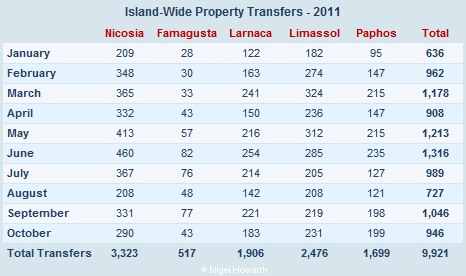
FIGURES released by the Department of Lands and Surveys earlier today show that 946 transfers of property took place at District Lands Offices throughout Cyprus during October.

So far this year 9,921 transfers have taken place compared with the 5,882 contracts for the purchase of property deposited at the District Lands Offices over the same period.

Source: Department of Lands and Surveys

The Land Registry’s assessment of the market value of the properties transferred so far this year totalled € 1,622,910,450.07. This is an uplift of 7.8% on the price € 1,505,916,646.46 declared by vendors and purchasers.

It has been reported elsewhere that the number of transfers only accounts for one fifth of the total number of deeds issued by the Land Registry.

As well as residential property, such as houses and apartments, the transfers include land and commercial property.

(I received my Title Deed earlier this month, which had been updated by the Land Registry to include my house, almost eleven months after I filed the application).

Cyprus government abolishes property transfer fees

EARLIER today the House of Representatives voted unanimously to abolish or reduce Property Transfer Fees for a period of six months, according to a report in Stockwatch.

  • For those who pay VAT on their house purchase, no transfer fees will be payable.
  • For those who do not pay VAT on their purchase, property transfer fees are to be reduced by 50%.

The House also approved an amendment to the bill enabling those who submit applications under the provisions of the Town Planning Amnesty to enjoy the same benefit.

The draft law will be effective for six months, until the Island’s Government submits a full proposal to the House.

Property Transfer Fees are based on the Land Registry’s assessment of the market value of a property at its date of purchase. However, using its discretion to reassess the amount of Transfer Fees payable, the Land Registry relies on its own historical data in a way that cancels out any transfer tax benefit of a “bargain-buy”, which can result in double the expected amount being levied.

There have been many reports of the Land Registry bumping up the perceived value of properties in order to extract higher Transfer Fees to help boost state coffers. This practice, which has been labelled “State Sponsored Fleecing” in the media, has done nothing to enhance the reputation of the Island.

The bill applies to cases where a contract of sale has been lodged at the Land Registry but for whatever reason a Title Deed is not issued within six months. It will come into effect when the changes are published and is not retrospective.

Update – 13 November 2011

Although the temporary abolition/suspension of Property Transfer Fees were agreed by MPs ten days ago, nothing has been heard since.

I spoke with a lawyer in the week who is of the opinion that that the amended laws will only apply to the first sale of a property – where the first deposit of a contract of sale occurs within 6 months of the enactment of the amended laws. (If this proves to be correct, it will not benefit those whose contracts have already been deposited at the Land Registry or those buying a resale home).

However, no-one can say with any certainty if and when the changes will be implemented or to which type of sales they will apply until the legal amendments have been published in the Cyprus Government Gazette.

Stay tuned for further information.

The Greek haircut and the Cyprus real estate market

BANKS lend approximately €0.90 of every €1.00 they take in deposits. The remaining €0.10 they hold as ‘liquidity’. Liquidity is a financial term that means the amount of capital that is available as cash at the request of the financial institution. Today, most of this capital is tied up in investments such as equities and bonds, which (theoretically) can be sold and converted into cash at the discretion of the bank.

For Cypriot banks, a part of this €0.10 is held in Greek government bonds which are effectively bank loans to Greece. How much of this €0.10 is in Greek government bonds varies from bank to bank, but the significance of the recently agreed 50% ‘haircut’ in Greek bonds is virtually identical for them all.

The ‘haircut’ reduces the amount that banks will receive from Greece when they redeem these bonds and the interest they receive from them in the meantime. If Greece has borrowed €0.04, the 50% haircut means that it will only have to pay the banks €0.02 – and the banks will lose the other €0.02.

Banks have a number of options open to them to increase/restore their liquidity from €0.08 to €0.10.

Their first is to issue their own bonds, i.e. borrow money from someone else. But this option is inappropriate because, as a result of the market’s low assessment of the Island’s economy and rising bad debts on existing loans, the banks will have to offer bonds at high interest rates.

Their second option is to attract new deposits through higher interest rates; this is already happening. However the increase in deposit rates will also increase the cost of borrowing and will lead to further damage.

The third option available to the banks is to increase their share capital by issuing more shares. For existing shareholders, in order for their investment not to be ‘diluted’, it means that they will have to give more money to a bank to receive the same level of dividend they are receiving on their current shares. But what shareholder, be they new or existing, would want to invest in a bank in Cyprus in the current environment? Cypriot banks are not profitable and are unable to pay dividends – so what is the point of investing in them?

As a consequence of the Greek bond ‘haircut’:

  • Firstly, the cost of borrowing on new and existing loans will increase as the banks try to recover losses from their investment in Greek bonds.
  • Secondly, there will be a further reduction in lending by banks and stricter criteria for those wishing to borrow money.
  • Thirdly, the reduction in loans is likely to reduce growth in the economy and lead to a significant increase in financial pressure on households.
  • Finally, the knock-on effect will be an increase in non-performing loans which will increase further the pressure on financial institutions and the Island’s economy.

And what about real estate?

In this article we have not discussed the real estate market, even though the sector has caused a significant part of the problem in which we find ourselves and holds part of the solution. However, as a society, we have yet to recognise that ‘the problem’ will not go away any-time soon. Slowly slowly – and when it’s probably too late – we will then move on and try to solve it.

About the author

Pavlos Loizou MRICS is the lead consultant at Leaf Research

Leaf Research carries out real estate market research and financial modelling for development projects and for properties that are used as part of a business. The company specialises in development, tourism & leisure, health & wellness, the education industry, and ‘green energy’.

(Originally published in Greek, this article first appeared in the Simerini Business Weekly supplement published on 28th October, 2011)