Moody’s downgrades Marfin Bank covered bonds

YESTERDAY Moody’s Investors Service downgraded Marfin Popular Bank covered bonds and put the Bank of Cyprus covered bonds on review for downgrade.

According to the statement released by the ratings agency yesterday:

  • Covered bonds issued by Marfin Popular Bank (Marfin), backed by Cypriot residential mortgage loans (Marfin Cypriot Pool CB): downgraded to Ba3 on review for further downgrade; previously downgraded to Baa3 on 4 August 2011;
  • Covered bonds issued by Marfin, backed by Greek residential mortgage loans (Marfin Greek Pool CB): downgraded to Ba3 on review for further downgrade; previously downgraded to Baa3 on 4 August 2011;
  • Covered bonds issued by Bank of Cyprus Public Company Limited (BoC), backed by Greek residential mortgage loans (BoC Greek Pool CB): Baa3 placed on review for downgrade; previously downgraded to Baa3 on 4 August 2011.

In its statement, Moody’s said that: “Today’s rating action on the covered bonds is prompted by Moody’s downgrade of Cyprus’ sovereign debt and associated rating actions on Cypriot issuers of covered bonds”.

On 4 November, Moody’s downgraded Cyprus’s sovereign debt ratings by two notches to Baa3 on review for further downgrade.

On 8 November, Moody’s downgraded Marfin’s senior unsecured rating by three notches to B2 on review for further downgrade and BoC’s by one notch to Ba2 on review for further downgrade.

Further reading

Moody’s takes rating actions on covered bonds of Cypriot issuers (subscription)

Beating termites & other wood-eating beasties

THINK OF termites and you might well think of American cartoon houses being consumed by swarms of roving dots, and you might be forgiven for thinking it is a uniquely American problem.

In fact, termites (and other wood eating pests) are a growing problem in Cyprus, with hundreds of home-owners in both rural and urban areas reporting infestations by native tiny wood eating insects each year.

According to pest control firms, the tiny, maggot-like beasties (they lose their wings after finding a place to nest) are routinely entering houses to feed on window frames, door frames and cupboards, before returning to a nearby subterranean colony, or simply taking up residence in the wood itself.

In one Nicosia resident’s case, an untreated infestation led to all the door frames and even chunks of wooden floorboard being eaten away, costing over €1,000 in treatments and taking three months to fix.

“We had to remove all of the wooden door and window frames,” Vassiliki Anamigo told the Sunday Mail this week. “The builders had to take them out and burn them.”

And while it is a costly nuisance for many modern home-owners, for those whose houses have wooden supports, an infestation could eventually bring down the building. Those with older houses fare even worse, as termites have shown themselves able to reach the second or third storeys of buildings.

Tackling the problem is expensive. With no DIY termite treatments on the market in Cyprus, home owners have to call in the professionals, who can charge anything from €500 to €2,200 to kill off the colony.

They do this by injecting a toxic chemical into several wooden areas or into the ground around the home. This does not automatically kill the termites – instead they collect traces of the chemical that are taken back to the colony. Over the course of a few days, this chemical will kill the colony.

N&G Pest Control’s Nicos Erakleous, which offers this service throughout the island from around €500 for an average home, said: “In general there is a problem with termites. We encounter them everywhere, especially areas with lots of dry trees, and normally they damage door frames, windows and cupboards.”

Another leading pest control firm, Atom Exterminators, has also reported an increasing problem with termites and other wood eating pests, like woodworm and dry rot treatment.

Asked about these, Atom’s boss – and Cyprus pest control association president – Michael Michael, said these are making their way onto the island in increasing numbers, stowed away in imported, middle eastern furniture.

“In Cyprus we have a very big problem with termites, dry rot and woodworm – and an EU committee on pests has put Cyprus in the red zone for termites.”

In the meantime, the growth in termite infestations has been fuelled by the property boom in the last decades, which has seen more houses encroach on termites’ natural environment habitat.

According to Michael, the most vulnerable houses are new builds in semi rural areas, where dead wood has been removed to make way.

“There are two types of termites in Cyprus, subterranean and drywood. For the subterranean colonies we put special chemicals in the ground, and for drywood termites it depends on the age of the house.”

In addition to the chemical treatment, Atom use a “Thermokill” method, which uses heat for an instant kill and in the case of widespread infestation, fumigation.

“If the termites have infested the bedroom wardrobes, kitchen cabinets and even the roof, the house must be insulated and fumigated,” he said. “For up to five days after the start of fumigation, depending on the degree of infestation, all residents and pets should keep out of the house.”

Atom is also well equipped to tackle other pests: “For woodworm we also have a mobile unit-we are the only company in Cyprus to have this, although the (agriculture ministry’s) forestry service has one.”

Asked about how the new houses become infested, Michael says that the long construction period of such houses – typically lasting between 18 months and two years leaves the homes open to the elements and invasions by all sorts of creepy crawlies, and aside from termites, he has known cockroaches, rats and fleas to take shelter in developments.

Such infestations, he says are easily prevented by preparing the land and treating the building at key points in the construction phase with chemicals.

“Once the plot is cleared, all areas are sprayed thoroughly (including the future garden area). This way we eliminate any already existing termite nests and we create a barrier zone for future invasion attempts.”

After this, says Michael, the exterminators respray the plot, bricks and garden area before the final stage: “After the building is completed, we fumigate and liquid spray the sewage system and the external and internal areas of the building and all other areas… This not only eliminates termites and other wood-infesting insects, but all other kinds of insects and rodents as well.”

This preventative treatment costs €3,500, but it if it avoids later infestations, could be money well spent. Indeed, Michael believes planning authorities should introduce legislation to enforce such measures prior to the sale of any new-build.

Unfortunately, the government is lagging behind the rest of Europe in terms of pest legislation.

A July 29 EU Directive on pesticide regulation is unlikely to be enforced until early 2013, and there is no legislation requiring house-sellers to ensure homes are not termite infested – as exists in Italy.

As a consequence, many developers are cutting costs and leaving it to new home-owners to foot the bill when the bugs invade.

“The government has not done anything yet” says Michael. An Agriculture Ministry source confirmed there were currently no plans in the pipeline to enforce termite infestation assessments, yet acknowledged it was a good idea.

For more information about termites in Cyprus – and the treatments on offer, visit Cyprus Termites.

Developers continue Immovable Property Tax scams

OVER the past few days we have received several emails complaining that property developers are trying to overcharge buyers for Immovable Property Tax (IPT) that has allegedly been paid to the Inland Revenue Department on their behalf.

Rather than developers basing their calculations on the assessed 1980 value of the property, as prescribed by the law, some developers are charging whatever they think people are prepared to pay.

Furthermore, these developers are refusing to allow the transfer of ownership of the property until this money has been paid; effectively extorting money by threatening to withhold Title Deeds to elicit payment.

It is relatively easy to check how much you should be paying the developer. Ask him to provide you with a copy of the Title Deed for the property.

About a third of the way down the Title Deed you will find the 1980 value of the property, which is shown on the box in red on the attached Title Deed that I have provided as an example (€60,000.00).

The annual amount of IPT payable is calculated at €4.00 for every €1,000. So in the example, the annual IPT that the developer has paid on your behalf would be €240.

I should point out that there have been cases where the Inland Revenue Department has calculated a developer’s IPT liability incorrectly and the developer has paid more tax than he should (which should be based on the 1980 value of the property as shown on its Title Deed when it is subsequently issued by the Land Registry).

Unfortunately, in these situations, the Inland Revenue Department will only reimburse buyers an amount calculated by using the 1980 value of the property as shown on its Title Deed and no more. As a consequence, these buyers are unable to claim the full amount of any overpayment; this practice by the Inland Revenue Department leaves a lot to be desired!

To calculate how much the developer should be charging you, simply multiply the annual figure by the number of years since you took delivery of the property to get the total figure.

In this example, if you took delivery of the property in 2008, the IPT charged by your developer should be no more than €720 (3 years at €240/year) – and this is the amount you could reclaim from the Inland Revenue once title to the property has been registered in your name.

You are cautioned not to pay a developer any IPT unless he:

  • Supplies you with a certificate from the Inland Revenue Department confirming how much he has actually paid.
  • Supplies you with a written invoice on the company’s letterhead for the agreed amount to be paid.
  • Provides a written company receipt for the amount paid.

Note that if you bought an apartment or a property on a larger development, the Inland Revenue Department will be unable to issue a certificate confirming the amount of IPT that the developer has paid for each individual unit comprising the development. What is more likely is that it will issue a certificate confirming how much IPT the developer has paid for each plot of land on which the development was built, which can then be used to calculate the IPT that the developer should be charging you more accurately.

Please refer to this letter from the Interior Ministry and print a copy and give it to your developer if he attempts to overcharge. If he refuses to cooperate, set your lawyer onto him.

We have published numerous articles in the past, including legal opinion on the matter obtained by the Cyprus Property Action Group.

Cyprus property support group marks its first year

A LOCAL SUPPORT group that offers free help and advice to home-owners in the Larnaca and Famagusta districts has just marked its first anniversary.
The Property in Cyprus Action Support group (PICAS) was created by members of an internet forum to share personal experiences and to offer advice in avoiding pitfalls or mistakes to those already on, or looking to join the property ladder.

While there are similar groups already in existence in Cyprus, this group is the first of its kind aimed at helping people in Larnaca, Ayia Napa, Paralimni and Protaras.

PICAS spokesman Steve Durkin said that members believed that those in distress needed personal support and the freedom to share their problems with others in a safe, secure and confidential setting.

“It was clear that there were numerous people were struggling in silence with a raft of property issues. The feeling of isolation, despair and bewilderment was clearly felt by purchasers on the eastern side of Cyprus. Whilst the forum was a valuable resource for information and assistance it was limited by the fact that it was internet based,” he said.

As well as members sharing their experiences, the monthly meetings are also attended by members of an advisory panel, which includes lawyer Stelios Stylianou and property advisor Nigel Howarth.

“We try to be an inclusive group welcoming all who find themselves with property issues regardless of nationality or location”, Durkin told the Cyprus Mail. “It was felt that a support network was needed where people could meet face to face in a safe and secure environment. In addition to confidential support, clear concise, reliable and qualified advice was needed.”

Recent guest speakers have included the British Vice-Consul in Cyprus and meetings have also dealt with non-property issues such as pensions and new rules for British passport applications.

“People can get in touch with us through our dedicated website: http://www.picas-cyprus.com which has full contact details and information about future meetings. In addition it is developing into an invaluable resource that should be helpful to many,” Durkin added.

Listen to Steve Durkin being interviewed by Nathan Morley on “Round and About”; CyBC Radio 2’s most popular daily show.

Cyprus’ top three banks downgraded by Moody’s

INTERNATIONAL ratings agency Moody’s has downgraded the Marfin Popular by three notches to B2 from Ba2 and has cut both the Bank of Cyprus and Hellenic Bank by a single notch to Ba2 from Ba1.

Moody’s added that the three banks, which are the island’s largest lenders, could be downgraded again.

Moody’s actions today come in the wake of its downgrade of the Cypriot government bond rating by two notches to Baa3 four days ago, over what it said was the increased possibility that the Island’s banks may need support from the government next year.

A further cut and Cyprus’ sovereign rating will be considered junk, raising fears that the Island may well need a financial bailout from its eurozone partners.

According to Moody’s, today’s downgrades result from the reduced ability of the country to support its large banking system.

The rating’s agency said that the Marfin Popular bank’s has a higher exposure to Greek government bonds compared with the other two banks and that this makes it more likely that it will require a large capital injection from the government. It said that following last month’s European debt deal for Greece, which includes a 50% ‘haircut’ on Greek bonds, that Marfin’s losses would more than double.

Referring to the other two banks, Moody’s said the Bank of Cyprus and the Hellenic Bank, which are both less exposed to Greek bonds than Marfin, could cover their losses from the proposed write-off without needing external help. However, it warned that any further ‘haircuts’ on Greek bond holdings cannot be ruled out in the future – and this would exert additional pressure on the banks.

Comment

Director General of the Association of Cyprus Banks, Dr Michalis Kammas, said that the Island’s banks remain stable and are ready to deal with the challenges that may arise.

Commenting on the Moody’s downgrade of Cypriot banks, he said that this latest move is simply a follow-up to Moody’s latest downgrade of the Cypriot economy last week. He also stressed that during this difficult time, it is essential to restore public finances. He added that achieving a budget surplus would send a message to the markets and restore confidence in the Cypriot economy.

Finance Minister Kikis Kazamias said that the government is expected to submit a new package of financial measures. Kazamias, who was in Brussels for today’s EU finance ministers’ meeting, noted that the instability in Greece has immediate effects on the Cypriot economy.

The Finance Minister also noted his concern over Moody’s double downgrade of the economy saying that it was excessive. On his return to the Island he said that the government must look into additional measures to improve the state of public finances.

Kazamias said that the constant criticism by the opposition of government policies had prompted the credit rating agencies to cut the Island’s ratings.

DISY’s Averof Neofytou called on the government to take measures to support the Island’s economy before it’s too late. DIKO said that the latest downgrade was expected, accusing the government of choosing to become a spectator as the spiral of downgrades continues.

AKEL spokeman hit back at DIKO and DISY parties for constantly slating the government’s attempts to handle problems, which he said that others had created. And EDEK said that the government’s inaction had lead to soaring Cyprus bond yields.

Meanwhile, President Christofias said that the global economic crisis has created very difficult conditions with direct negative consequences to the Island’s economy, adding that that everyone must contribute to help overcome the difficult situation. Speaking at the Annual General Meeting of Cyprus Municipalities, the President said that despite the current economic difficulties, the government will continue to support the local authorities as it has done for the past three years.

Further reading

Moody’s downgrades three Cypriot banks following Cyprus sovereign downgrade; banks on review for further downgrade (subscription)

Real estate prices & rents across Cyprus continue to fall

THE seventh issue of the Property Price Index, published by RICS Cyprus, reports that prices and rents across Cyprus’ major urban areas continued to fall during the second quarter of 2011.

In his commentary on the Index, Pavlos Loizou MRICS, Board member of RICS Cyprus writes: “During the second quarter of 2011 Cyprus economy and banks, in particular, bore the consequences of the decoupling of the Greek economy. This led to a loss of optimism as discussions by parliamentarians and government officials escalated as to the measures that the government should take in order to reduce its expenditure.”

“Whilst the first quarter saw some signs of price stabilisation and muted economic growth, the second quarter saw foreign investors postpone their decision making as companies, funds, and individuals took a “wait and see” approach. In turn this led to a low transaction turnover and to reduced interest by local buyers as they were affected by the increased tension between government and parliament.”

Prices

During the second quarter of the year (before the devastating blast at Mari naval base), average residential prices for houses and apartments fell by 1.0% and 2.7% respectively. The biggest drop for both took place in Larnaca, where house prices fell by 3.2% and apartment prices by 7.2%.

Average values of retail properties fell by 4.4%, whilst those of offices and warehouses fell by 2.2% and 1.7% respectively.

Compared to the fourth quarter of 2009, prices for apartments have fallen by 15.1% and those for houses by 9.9%. Retail prices have fallen 12.2%, offices are down 9.0%, and warehouse prices have fallen 6.4%.

Rents

Over the quarter, average rental values for apartments fell by 3.1%, retail units by 4.1%, warehouses by 5.4%, and offices by 2.0%. In contrast, rents for houses rose by 1.3%.

The quarterly change in capital and rental values shows that all aspects and geographies of the property market are now affected, and that landlords are lowering their rents to attract tenants.

Investment Yields

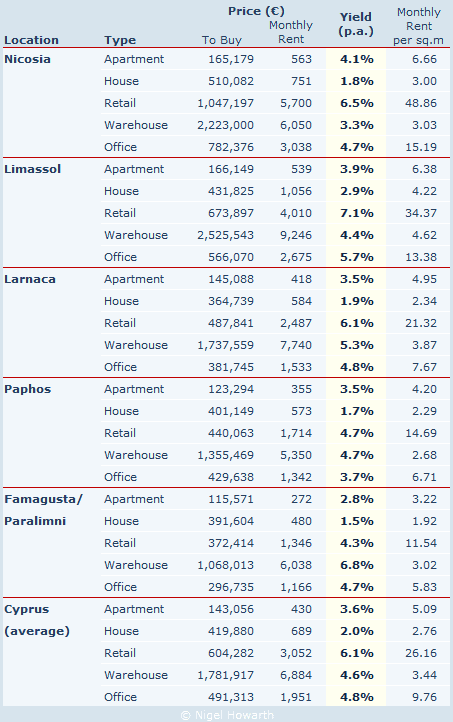
Yields are a useful tool showing the relationship between rent and property prices. At the end of the second quarter of 2011, average yields stood at 3.6% for apartments, 2.0% for houses, 6.1% for retail, 4.6% for warehouses, and 4.8% for offices.

The parallel reduction in capital values and rents is keeping investment yields relatively stable and at very low levels (compared to yields overseas). These suggest that there is still room for rebalancing to take place.

Initial (or gross) yields, as shown in the chart below, is the total yearly gross rent divided by the price, expressed as a percentage.

Derived from the RICS Cyprus Property Price Index for Q2 2011

Outline of properties used to calculate the index

Apartments: Residential, two bedroom, 85sqm, Medium quality.
Houses: Residential, three bedroom with garden, Semi-detached, 250sqm, Medium quality.
Retail: High-street retail, 100sqm ground floor area with 50sqm mezzanine.
Warehouse: Light industrial area, 2,000sqm, which includes 200sqm office space.
Office: Grade A, City centre location, 200sqm

Methodology

The methodology underpinning the RICS Cyprus Property Price Index was developed by the University of Reading UK and may be viewed by clicking here.