Monagroulli angel comes down to earth

The Interior Minister, Neoclis Sylikiotis, is adamant that if the height of the proposed “Kind Angel of the World” statue at Monagroulli is not lowered to be consistent with the broader character of Cyprus, permission for the development will not be granted.

The plans were presented to Mr Neoclis before any formal proposal had been submitted and this was apparently seen as an attempt to pressurise the ministry into giving the project a green light to proceed.

The International Club of Philanthropists and Patrons of Europe plans to build a gigantic metal statue of an angel holding a dove in Monagroulli (???????????) at an estimated cost of €100 million. The development will also include a conference centre, banqueting hall, theatre, restaurants, cafes and offices. The chairman of the Russian Club’s Supreme Council, professor Nikolai Drozdov, believes that the project will significantly enhance the number of tourists visiting the island and create new jobs.

If the project gets the go ahead it will be designed and developed by International Theme Park Services, Inc, an American company which operates in 50 countries. According to the company’s president, Dennis Spiegel, a study on the viability of the project next will be made in September.

In 2010 the International Association of Amusement Parks and Attractions presented Mr Spiegel with a Lifetime Service Award in recognition of his services to the industry.

(The Cyprus Architects’ Association has also expressed its opposition to the project, calling the development a deplorable piece of architecture.)

Property transfers continue to improve

FIGURES recently released by the Department of Lands and Surveys show that 1,316 property transfers took place at District Lands Offices throughout Cyprus during June; an increase of more than 100 on the number that took place in May.

Speaking with INBNews last week Interior Minister Neoclis Sylikiotis noted that there is now the possibility of issuing Title Deeds at the rate of 1,200 a month and 25,000 annually by reducing cumbersome procedures and making the system faster.

Source: Department of Lands and Surveys

So far this year, 6,213 transfers of property have taken place. These properties had a declared sale price of €953,715,113.69, which the District Lands Offices uplifted to an accepted price of €1,027,779,359.71; an increase of 7.8%.

Note however that there are still some 130,000 properties that have yet to be issued with Title Deeds and even at the rate of 25,000 a year, it’s going to take the Land Registry more than 5 years to clear the backlog – let alone deal with new applications.

New specific performance law increases safeguards

THE Sale of Land (Specific Performance) Law has helped to protect the rights of property purchasers for some years as the act of depositing a contract of sale at the Land Registry effectively prevented the vendor from selling the property in question to someone else or changing his mind about the sale.

However, it has long been recognised that the Island’s current Specific Performance law has a number of problems that enable unscrupulous vendors to exploit their position. For example, there is no obligation on a vendor to repay any existing mortgage that he may have on a property or from rescheduling or extending those mortgages. This problem has resulted in many thousands of people buying property on land that a developer has mortgaged and who face the very real threat of losing their homes as a result of a developer becoming bankrupt or a mortgagee foreclosing.

To alleviate the problems with the current law, a new law entitled ‘The Sale of Immovable Property (Specific Performance)’,  N81(I)/2011, has been approved by parliament and will shortly come into force. The new law, which contains significant changes designed to help protect those buying property and assist them to secure their Title Deeds, comes into effect on 29th July.

New legal provisions/safeguards

Some of the key points of the new law are noted below:

  1. A contract of sale for a property can be deposited at the Land Registry within 6 months from its date of signing to ensure the buyer’s right to become its registered & legal owner. (Before this had to be done within 3 months).
  2. Any term in a contract of sale that prevents it from being deposited at the Land Registry is void ab intio (from the beginning). So if a buyer is required to hand over a deposit or any sum of money for the purchase of a property and there is a term in the contract that prevents it from being deposited at the Land Registry until that money is paid, this is illegal and the buyer can file his contract immediately without constraint. (It is quite common for vendors to demand 20% or 30% of the purchase price on signing a contract to secure the agent’s fees).
  3. A vendor of a property is required to deposit a buyer’s contract of sale at the Land Registry before he encumbers that property with (for example) a mortgage.  This is an important change to the law which will now recognises that a buyer has a better right over the property if he has signed a contract of sale as it requires the vendor to deposit that contract before mortgaging the land.
  4. Should a vendor fail to comply with the above he will have committed a criminal offence and will be liable to a prison sentence of up to two years and/or a fine not exceeding €5,000.
  5. In circumstances where a property is sold that is already mortgaged, the buyer may pay a proportion of that mortgage to the mortgagee (usually a bank). The mortgagee is required to accept this – and the buyer’s contract of sale, having been duly lodged at the Land Registry, will take precedence over that mortgage regardless of whether the whole amount of the mortgage has been repaid. Furthermore, the vendor cannot intervene in this arrangement.So if a person purchases a property for (say) €200,000 and it is discovered subsequently that the land is mortgaged for €8,000,000, that person may pay the mortgagee €200,000 (or any smaller sum that is proportionate to the value of the property purchased). So in future, buyers will not be called on to pay the purchase price of the property and the debts of the vendor.However, for contracts that have already been lodged at the Land Registry when this law comes into force, the above arrangement can be made providing that both the vendor and mortgagee give their written approval.
  6. The encumbrance that is created by depositing a contract of sale at the Land Registry for Specific Performance secures each sum that the buyer pays towards its purchase price. So if the buyer has paid €200,000 to the mortgagee or the developer (see point 5 above) then that sum is secured against the property he has bought – or to the whole of the land if a separate Title Deed to that property has not been issued. In essence, the contract lodged at the Land Registry is regarded as a mortgage in favour of the buyer giving him the extra security of a secured creditor.
  7. In any legal action for Specific Performance brought against the vendor by the buyer, the Court may decide to award damages for breach of contract rather than a Specific Performance order. In such cases the contract of sale that has been lodged at the Land Registry acts as a mortgage in favour of the buyer to the value of the awarded damages.If a buyer is awarded damages under the current legislation, it is lodged as a ‘memo’  at the Land Registry and goes to the back of the queue behind other possible claimants such as suppliers, contractors, subcontractors, agents and any other unsecured creditors.But now that the buyer’s contract of sale is viewed as a mortgage and seemingly holding all the rights of a secured creditor, much like a bank, the buyer’s power to liquidate the immovable asset and seek its liquidation through the Court will be easier under the new law.
  8. Under the present law, a buyer can only sue for Specific Performance once a Title Deed for the property he has purchased has been issued. However under the new law, a buyer can file a single action for Specific Performance – and in that action he may also request the issue of orders enabling him to undertake all the measures necessary to secure the required permits, licences, approvals, so that a separate Title Deed may be issued in his favour plus an order for any costs he has incurred.
  9. The Court may issue a Specific Performance order in favour of a buyer even through there is a pre-existing mortgage on the development. However, the Court will only issue such an order if the buyer has paid a proportion of the debt to the mortgagee (see paragraph 5 above). Under the present law, a court cannot issue such an order unless the whole of the mortgage has been repaid and the mortgagee gives his consent.
  10. Any contracts of sale that were signed and that have not been lodged at the Land Registry may be filed within six months from the 29th July.

So if a buyer signed a contract of sale in 2005 but failed to file it at the Land Registry, he now has a 6 month window of opportunity to do so.

Property prices and rents continue to fall

PROPERTY prices and rental values across the Island continued to fall during the first quarter of 2011 according to the sixth issue of the RICS Cyprus Property Price Index, which tracks property prices and rents across 46 locations.

Residential prices for houses and apartments fell by 1.6% and 0.9% respectively over the quarter. The biggest drop in house prices took place in Limassol, where they fell 2.9%, whilst the biggest drop in apartment prices was in Paphos, where they fell 4.1%. Values of retail properties fell by an average of 0.8%, whilst those of offices and warehouses rose by 0.1% and remained stable respectively.

Compared to the first quarter of 2010, prices have fallen across the board; apartments (- 8.3%), houses (-7.0%), retail (-6.5%), offices (-7.4%) and warehouses (-2.0%)

Across Cyprus, rental values for apartments fell by 0.9%, houses fell 1.3%, retail units fell 1.0%, warehouses fell 0.7%, and offices fell 1.3%. Compared to the first quarter of 2010, rents have dropped 6.1% for apartments, 10.7% for houses, 7.1% for retail, 6.3% for offices and 5.8% for warehouses.

The quarterly change in capital and rental values shows that all aspects and geographies of the property market are now affected, and that landlords are lowering their rents in order to attract tenants. In parallel, many tenants are renegotiating their leases or moving to smaller or lower cost accommodation.

Investment Yields

Yields are a useful tool showing the relationship between rent and property prices. At the end of Q1 2011 yields stood at 3.6% for apartments, 1.9% for houses, 6.0% for retail, 4.8% for warehouses, and 4.8% for offices.

The parallel reduction in capital values and in rents is keeping investment yields relatively stable and at very low levels (compared to yields overseas). These suggest that there is still room for rebalancing to take place.

Initial (or gross) yields, as shown in the chart below, is the total yearly gross rent divided by the price, expressed as a percentage.

Derived from the RICS Cyprus Property Price Index for Q1 2011

According to Pavlos Loizou MRICS, Board member of RICS Cyprus “During the first quarter of 2011 Cyprus bore the brunt of the consequences of the increased uncertainty regarding the Greek economy and the, partly consequential, series of downgrades by rating agencies of Cyprus and of Cypriot banks.

Whilst the first quarter saw some signs of price stabilisation and muted economic growth, the lack of credit and the on-going events in Greece affected sentiment. In turn this led to a low transaction turnover and to reduced interest by local buyers (transaction volume, as recorded by the Land Registry, is circa 40% down from the ten year average).

The renewed investor interest experienced at the latter part of 2010 almost vanished, as companies, funds, and individuals took a “wait and see” approach. There seemed to be some limited investor interest for city centre, prime, properties, although evidence of this is anecdotal.”

Outline of properties used to calculate the index

Apartments: Residential, two bedroom, 85sqm, Medium quality.
Houses: Residential, three bedroom with garden, Semi-detached, 250sqm, Medium quality.
Retail: High-street retail, 100sqm ground floor area with 50sqm mezzanine.
Warehouse: Light industrial area, 2,000sqm, which includes 200sqm office space.
Office: Grade A, City centre location, 200sqm

Methodology

The methodology underpinning the RICS Cyprus Property Price Index was developed by the University of Reading UK and may be viewed by clicking here.

Foreign currency mortgages turn sour

TENS of thousands of Britons who bought into the dream of owning a property in the sun face repossession and ruin after their "low cost" mortgages turned sour.

They were sold a vision of sun-kissed beaches, world-class golf courses and the "best place to invest in property in the world". But the Greek debt crisis has sent their mortgage payments soaring and many fear that they will be forced to hand back their keys or lose their UK home if they are pursued for money that they owe.

The borrowers' mistake was to follow advice to buy in Cyprus with a mortgage denominated in Swiss francs. Their plight is a harsh reminder of the dangers of opting for a property loan in a foreign currency. Mortgage repayments and the loan value in sterling fluctuate with currency movements. If exchange rates move the wrong way, the costs can balloon with frightening speed.

Swiss franc loans were sold to tens of thousands of Britons and locals by Cypriot banks and their agents in 2007 and early 2008, at the peak of the island's housing boom.

Sarah Hordle, a Cyprus mortgage expert at Essential Consulting, says: "It was very easy to open an account with a bank and Swiss franc mortgages were offered as standard. Many people who bought at the time never even came to Cyprus as bankers and lawyers were flown over to the UK by agents."

The loans were an easy sell as the interest rate was much lower than that available in the Cyprus pound (which became the euro in January 2008) or sterling. Borrowers were asked to pay about 8 per cent on mortgages in Cyprus pounds or Euros while Swiss franc loans offered rates of about half that.

But in the past three years the Swiss franc has nearly doubled in value. Cypriot property prices have also tumbled, trapping those whose only hope is to sell. For borrowers like Ian Boorer, from Plymouth, Devon, the jump in payments has been crippling. He and his wife bought an apartment off-plan in spring 2008 in a golf-course development close to Larnaca.

They were advised by Ellesmere Property Group to take out a Swiss franc mortgage with Alpha Bank Cyprus. Like many loans at the time, this included an initial period, in their case three years, during which they did not have to make any mortgage payments. They were told that when payments did commence, these would be about £680 a month. However, the exchange rate moved against them, so their first payment, three months ago, was £1,100.

Mr Boorer, a 45-year old seismic survey engineer, says: "Our mortgage payments are much higher than we ever planned for and there doesn't seem to be any way out. We have talked about switching to a euro mortgage but that is going to be difficult because we are in negative equity as property prices have been falling and there are big charges for switching."

With hindsight, borrowers piled into Swiss franc mortgages at exactly the wrong time. Cyprus' housing boom occurred just before the credit crisis struck, which caused the Swiss franc to appreciate against currencies worldwide as investors sought to benefit from its reputation as a safe haven in times of crisis. It continued to strengthen as the eurozone problems intensified, which resulted in riots in Greece this week. In July 2007 the pound was worth SwFr2.49. Now it is valued at SwFr1.35, and currency experts say that the trend shows no sign of reversing soon.

Michael Derks, the chief strategist at currency trading broker FxPro, says: "It is said that quality rises to the top, and in the foreign exchange market it is the Swiss franc that is top quality these days. Notwithstanding its meteoric rise, it is difficult to see what might prick the Swissie's bubble in the near term."

As the Swiss franc has appreciated, the repayments on mortgages have risen in sterling terms. You would need £400 to cover a monthly repayment of SwFr1,000 at an exchange rate of SwFr2.50 to the pound. At SwFr1.35 to the pound, your sterling repayment would be closer to £740 a month.

The franc's appreciation has also increased the sterling cost of debt. A SwFr100,000 mortgage would be worth about £40,000 at SwFr2.50 to the pound. With the franc at SwFr1.35 to the pound, its value will have increased to about £74,100.

Paul and Penny Newman, from March, Cambridgeshire, used a Swiss franc mortgage from Marfin Laiki bank to buy a two-bedroom villa in the village of Lania in January 2008. They started by owing SwFr160,000, which was the equivalent of £75,000. They have since paid off SwFrF7,000 but their loan in sterling has mushroomed to £115,000.

Paul, 56, a security supervisor, says: "If it was down to my wife, we would just leave it and walk away but there would still be the worry that the bank would pursue us, which, of course, they would be entitled to do."

Their fate is a warning to anyone using a mortgage to buy a property overseas. Charles Purdy, of Smart Currency Exchange, the foreign exchange specialist, says: "In most cases we would suggest arranging your mortgage in the currency that you are buying the property in. That avoids the problem of your mortgage liability increasing relative to the cost of your property. At no time should you take out a mortgage in another unrelated currency."

The plight of the borrowers has been heightened by the collapse of the Cyprus property market. According to the Royal Institution of Chartered Surveyors, apartment prices fell by an average of 11.2 per cent in 2010, while house prices fell by an average 7.4 per cent. In popular resorts the slump has been even more severe. The worst-hit areas were Paralimni and Famagusta, where apartment prices slumped 23.2 per cent, and Larnaca, where house prices fell by 13.2 per cent.

Nigel Howarth, of Cyprus Property News, says: "Many developments were targeted at the British market and demand has virtually collapsed so there is great difficulty in selling."

The banks have made matters worse by increasing margins and forcing up the costs. Many mortgages are linked to Libor, the interest rate at which banks lend to each other. In 2007 and 2008, when the bulk of the Swiss franc mortgages were sold, most rates were pegged at 1.5 points above Libor, but some are now charging nearly 5 per cent over the inter-bank rate.

Some borrowers can't take any more. Ms Hordle says: "People are handing back keys every day and the first repossession cases are going through the courts."

But that may not be the end of the borrowers' problems. Banks can pursue money through the courts in Cyprus and the UK, putting the debtors' assets, including their homes in Britain, at risk.

Some homeowners are considering legal action against the banks and their agents because they believe that they were mis-sold. Ben Cook, 34, from Malvern, Worcestershire, says: "It is obvious in hindsight that taking out a loan in Swiss francs to be repaid in euros or sterling amounted to financial suicide. We were badly advised and mis-sold in our dealings with the agent in the UK, Alpha Bank in Cyprus and our solicitors in Cyprus, although we don't hold out much hope of getting redress."

Many companies involved have disappeared or gone bankrupt, making claiming compensation very difficult. Mr Cook was advised to take out a mortgage in Swiss francs by a company that became Optimum Overseas Investments Ltd. The Times tried to contact the company but its phone line and e-mail address are dead and it is not registered with Companies House. The banks also argue that the risks were pointed out. Alpha Bank says: "In the cases that the clients decided to apply for a mortgage loan in Swiss francs, they were asked to sign all the relevant legal documents, including declaration letters acknowledging that they fully understand the risks involved in borrowing in Swiss francs."

Bank of Cyprus says: "Bank of Cyprus would have made the customer aware of the possible risks of borrowing in a foreign currency."

But Chris Christofi, of Healys, a company of solicitors in London, believes that there may be grounds for action. He says: "It seems that a fair proportion of mortgage applications were submitted by intermediaries, usually the developers or their agent in Cyprus, and many of these included false information as to the amount of deposit paid, earning ability and so on. We are looking at using this as a basis for having some loans declared void.

"The biggest problem is convincing the banks in Cyprus who have given mortgages in Swiss francs that they should perhaps revert to sterling/euro-style mortgages backdated to the commencement of the loan because I think many people would be happy with that."

Anyone who buys a property overseas should remember some basic rules. Always seek specialist advice from independent solicitors and surveyors before buying. Some developers will wheel out lawyers who they claim are independent, but you should find your own. If you don't speak the language, make sure all the paperwork is translated into English by a reputable translator, preferably one who can compensate you for any material inaccuracies. To find a lawyer proficient in the law of your chosen country you could contact The Law Society (lawsociety.org.uk).

Case Study: 'I owe more now than I started with'

Peter Thompson, a boat pilot on the Thames, regrets the day that he decided to buy a two-bedroom holiday home in the Cyprus resort of Pernera with a Swiss franc mortgage. He says: "The mortgage was recommended to me by the personal banker at the Paralimni branch of the Bank of Cyprus because the interest rate was so low compared with a euro mortgage. They said that the repayments could fluctuate with exchange rates but they didn't really emphasise the potential risks. In my wildest dreams I never imagined what would happen."

The 53-year old, from Beckton in London, bought the property in June 2007 with a loan of SwFr 238,000. At the time you got 2.5 Swiss francs to the pound. Four years on, the Swiss currency is 1.35 to the pound, which has had terrible consequences for Mr Thompson. He says: "I've made nearly £50,000 worth of payments but, when you convert what I owe in Swiss francs back into sterling, I owe nearly £15,000 more than at the start."

Mr Thompson has talked to the Bank of Cyprus about switching to a euro mortgage but has been told that he will have to pay hefty exit penalties. "It has become a millstone round my neck," he says.

Crisis deepens as Cyprus property sales continue to tumble

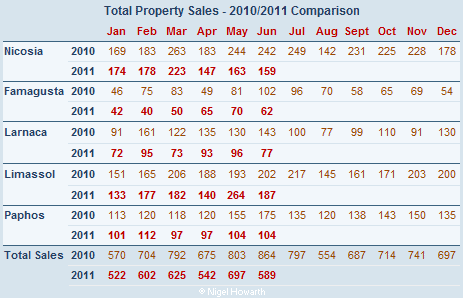
ACCORDING to Land Registry figures published today, the number of property contracts deposited at Land Registries throughout Cyprus in June was 589 compared with the 864 deposited in the same period last year; a fall of almost 19% and the biggest monthly drop for more than two years.

During the first half of 2011, property sales have fallen 20% to 3,577 from the 4,408 sold during the first half of 2010.

But even more worrying for the real estate industry is the fact that property sales in 2011 are worse than those of 2008; the year the market crashed, when just 3,848 properties were sold in the first half of the year.

During June, sales fell in all areas. Worst hit was Larnaca, where sales tumbled 46% compared with June last year. Larnaca was followed by Paphos (-41%), Famagusta (-39%), Nicosia (-34%) and Limassol (-7%).

Property valuer Polys Kourousides said that "prices must be cut to increase sales" and last week the Cyprus Land & Building Developers' Association proposed a series of measures that the government should take to help stimulate the property industry.

The banks have tightened their lending criteria making home loans (mortgages) more difficult to obtain and high interest rates must also be a contributory factor in the drop in sales along with the general unease about the state of the Island's economy.

Source: Department of Lands and Surveys

Overseas sales

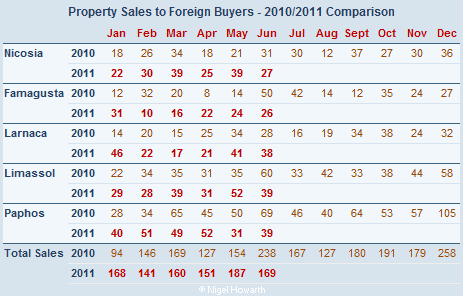
Property sales to foreign buyers also fell in June with a total of 169 contacts in favour of foreigners being deposited compared with 238 in June 2010; a fall of 29%.

Although property sales in Larnaca were up 36%, they fell in all other areas. In Famagusta, sales plunged 48% compared with June last year. Famagusta was followed by Paphos (-44%), Limassol (-35%) and Nicosia (-13%).

Source: Department of Lands and Surveys

Although tourist arrivals are up by 11% this year and revenue attributed to tourism is up by more than 19%, it seems that few tourists are showing an interest in buying property.