Building permits fell in April as construction slowed

FIGURES released today by the Cyprus Statistical Service show that 560 building permits were authorised by the Municipal Authorities and the District Administration Offices in April 2011.

Compared with the 668 building permits authorised in April 2010, this reflects a fall of 16.2% over last year.

In April 2011, building permits were issued for:

  • Residential buildings – 391 permits
  • Non-residential buildings – 92 permits
  • Civil engineering projects – 20 permits
  • Division of plots of land – 51 permits
  • Road construction – 6 permits

The total value of these permits reached €157.0 million and the total area 174.7 thousand square metres.

During the period January to April 2011, 2,637 building permits were issued; a fall of 14.0% compared to the same period last year. The total value of these permits fell by 24.0% and their total area fell by 27.8%.

Residential buildings

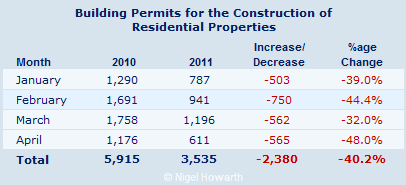
Focusing on the 391 permits issued for the construction of residential buildings, these were approved for 611 dwelling units – 311 single houses and 300 multiple housing units such as apartments and other residential complexes.

Compared to the April 2010 total of 1,176 dwelling units, this represents a fall of 48% and an overall year-to-date fall of 40.2%.

Source: Cyprus Statistical Service

According to the Cyprus Statistical Service, building permits constitute a leading indicator of future activity in the construction sector.

Developers association calls for tax review

IN A MEMORANDUM to President Demetris Christofias the Cyprus Land and Building Developers Association has put forward a number of suggestions to revive the Island’s property industry.

The memorandum calls on the President not to impose new taxes on businesses as these will result in a further deterioration in the business climate by depriving businesses of working capital and increasing unemployment.

The Association suggests that the government should provide incentives and measures to help revive and revitalize the property market and in particular, a review of the Property Transfer Fee bands, VAT and Capital Gains Tax.

Ten years ago, the average apartment cost the equivalent of €51,000 and attracted Property Transfer Fees of €1,500. Today, that same apartment would cost €200,000, and would attract Property Transfer Fees amounting to €9,000 plus €30,000 VAT; that’s a 2,600% increase in tax!

Capital Gains Tax thresholds, which have remained unchanged for 20 years, should also be reviewed. The Association argues that the current rate of 20% and the present thresholds deter sales and result in under-declaring a property’s purchase price in efforts to reduce a vendor’s Capital Gains Tax liability.

It also argues that revising Capital Gains Tax will eliminate the problem of creating what it calls a ‘shadow economy’ and the distortions that occur from the failure to declare the actual sales value in contracts.

Tax reviews

Other countries have recently reviewed their taxation systems to help revive their property markets.

In Ireland, for example, the government has reduced the stamp duty for deeds to 1% on the first €1,000,000 and 2% on the remainder.

The government of Holland has just announced plans to cut its overdrachtsbelasting (conveyancing tax) from 6% to 2% for a year in an effort to boost its housing market.

Comparison

The RICS Cyprus Property Price Index for the fourth quarter of 2010 gave the price for an average 3-bedroom semi-detached house at €431,705.

The Property Transfer Fees (or equivalent) payable by the purchaser would cost:

In Cyprus – €27,701.99

In Ireland – €4,317.05

In Holland – € 8,634.10

Perhaps the suggestions put forward by the Cyprus Land and Building Developers Association warrant further investigation.

Cyprus Title Deed campaign gathers pace

THE CYPRUS Property Action Group (CPAG), which represents some 50,000 property buyers with outstanding deeds, is leading the campaign with the backing of 60 MEPs and the European Commission’s Justice Minister Viviane Reding.

At CPAG’s behest, 42 of these MEPs sent a joint letter to UK Prime Minister David Cameron and Reading on June 17, which said: “The practice of withholding Title Deeds or legal ownership of properties which have been paid for in full by the purchasers is an infringement of EU directive 2005/29/EC and Cypriot Laws 103 (I)/2007 which transposes it.”

Asked about the letter, CPAG’s Denis O’Hare said: “We have tried to enlist the MEPs because we got nowhere with the government of Cyprus, despite their amnesty on Title Deeds legislation… The problem of Title Deeds is still there.”

A confirmation by the Justice Minister that property developers are currently infringing this unfair practices directive would be a significant development for home buyers, because it would allow them to bypass Cypriot courts and go straight to the European Court of Human Rights (ECHR).

This direct route to the ECHR is possible because the government, perhaps unwisely, stated its view that the directive does not apply to contracts of sale that predate the law, thereby exhausting buyers’ local options.

Following several complaints to the Cyprus Consumer Protection Service (CCPS) by home buyers who are waiting for deeds – once again with CPAG’s encouragement – nearly all were rejected for this reason.

O’Hare and the MEPs believe the government’s interpretation of the directive is wrong, however, and that the buyers have a strong legal case, since the directive talks about unfair practices ‘before, during and after a contractual relationship’ and as long a developer withholds the deed, the contractual relationship is continuing.

O’Hare said yesterday: “We believe the CCPS’ standard response is akin to saying that the government is going to implement a speeding law but it only applies to cars purchased after this law became effective”.

In addition to the MEPs, CPAG also has UK Minister for Europe David Lidington, who, no doubt to the dismay of local politicians, compared the purchase of usurped Greek Cypriot properties in the north to Title Deed problems in the south during a visit to the island earlier this week.

Lidington said: “I have letters from (British) MPs about the property issue in the south of Cyprus too… I am concerned to make sure as a British minister that the concerns of British citizens expressed to me by their members of parliament are understood by my colleagues here in Cyprus.”

O’Hare said CPAG is in direct communication with the European Union’s Justice Commission, which said that it was taking the matter seriously.

If the commission also finds in favour of the buyers, and the developers are shown to be infringing on the directive, then it could be up to the government to foot the bill since they are responsible for the non enforcement of a law.

EU funded scheme to make property purchasing safer

ESTABLISHED by the European Land Registry Association and funded by the European Union, the Cross Border Electronic Conveyancing (CROBECO) scheme allows for the procedure for buying property to be settled in the purchaser’s home country and protected by the laws of that country.

CROBECO, which is currently being piloted in Holland & Spain, means that a Dutch buyer of Spanish Property can apply Dutch law to the contract and ask a Dutch Court for compensation from the vendor if they later find there are unknown public limitations, such as retrospective planning laws, affecting the property.

Further pilots are expected to take place in other countries later this year.

In a statement to the Daily Telegraph Liberal Democrat MEP Diana Wallace, a keen supporter of the development and expansion of the scheme, said: “The EU has a role to play in helping to facilitate property deals across borders and at the very least provide a framework of legal certainty.

“In practice, this means we must ensure that there is full access to information on the state of a property, the conditions attached to it and any other legal obligations or obstacles.

“This must go hand in hand with a transparent administration of the property deal and a quick and clear judicial process in case something goes wrong.”

It will take a long time and a lot of legal framework building to reach this point; but the fact that a pilot scheme exists, has EU backing and funding and appears to work means that buying property in Europe could become safer and more transparent sooner rather than later.

Details of the CROBECO project were unveiled on June 14 at the EU parliament at a seminar hosted by Diana Wallis in a bid to find a way forward in overcoming legal uncertainties when buying property abroad.

A spokesman for European Land Registry Association said: “The fact that the deed is processed in the buyer’s own language by a conveyancer from their own country, [means] they get the feeling that they are better legally protected and will be less reluctant to buy real estate in foreign countries where the real estate market has collapsed.”

The scheme is likely to be welcomed by countries such as Cyprus and Spain that have thousands of unsold holiday homes littering their landscapes, faltering economies, and tarnished reputations – and who are desperate to attract overseas buyers back to their property market.

Comments on property issues provoke sharp reaction

THE FIRST ministerial visit from the current UK government ended on a sticky note on Tuesday after Europe Minister David Lidington made an “unfortunate” comment comparing property problems which exist north and south of the island, prompting a public rebuke from the Cyprus foreign ministry.

After meeting President Demetris Christofias on Monday, Lidington met Foreign Minister Marcos Kyprianou, DISY opposition leader Nicos Anastassiades and Turkish Cypriot leader Dervis Eroglu on tuesday.

The early morning joint press conference between Kyprianou and Lidington offered no surprises, keeping relations between Britain and its former colony on a firm footing.

However, during a separate press conference later in the day, Lidington was asked to comment on the fact that many British citizens buy Greek Cypriot properties in the occupied north and are then issued with illegal Title Deeds.

The Europe Minister responded: “The problem about title to a property is by no means one confined to the north of the island. There are issues to do with title and possession that apply to some British expatriates living south of the island as well.”

When quizzed further on the issue, he said: “This is not something that is a problem for the north of the island only. I have letters from (British) MPs about the property issue in the south of Cyprus too.”

He added: “I am concerned to make sure as a British minister that the concerns of British citizens expressed to me by their members of parliament are understood by my colleagues here in Cyprus.”

The reference to the thousands of legal property owners in Cyprus still without Title Deeds, the majority of whom are Cypriot, may have won the government of British Prime Minister David Cameron some friends among British expats on the island but did not score any points with the foreign ministry.

The ministry found the apparent link made between a political problem and a largely administrative issue a tad unfortunate.

In a statement released on Tuesday evening, the ministry said it was “at the very least unfortunate comparing and associating the usurpation of stolen Greek Cypriot properties in the occupied areas – the owners of which were expelled by force of arms as a result of the Turkish invasion and continuing occupation – with any legal or other problems that may arise from the purchase of immoveable property in the free areas by Britons.”

Regarding Lidington’s claim that he raised the issue of pending Title Deeds in the government-controlled areas with his Cypriot colleagues, the ministry maintained no such issue was raised. “Despite the fact that these issues did not come up in meetings with Mr Lidington, the Cyprus government is making every possible effort to address and resolve the issue of granting Title Deeds to legitimate property owners.”

Lidington’s comments were also described by DISY deputy Zacharias Zachariou as “totally unacceptable”. He accused Lidington of ignoring the British Court of Appeal’s ruling in favour of Greek Cypriot property owner Meletios Apostolides over the British Orams couple who were illegally resident on his land in the north.

DIKO MP Angelos Votsis said the minister’s statements “sent another message that this is the Britain we know so don’t get fooled into thinking it wants to help find a solution to the Cyprus problem.”

Asked to comment, spokesman for the British High Commission Paul Lakin said last night: “The minister was not making a comparison between the two issues but simply observing, as a UK minister, what his constituents and fellow MPs raise with him.”

Meanwhile, on the British government’s approach on the Cyprus problem, Lidington said: “We believe there is a moment of opportunity now available following the parliamentary elections both here in Cyprus and in Turkey.”

He hoped the July 7 Geneva meeting between the two leaders and the UN chief will “galvanise” the leaderships of both communities “to look anew on how to find a way forward to tackle the outstanding difficulties that stand in the way of a settlement, and not just be restricted to taking stock of what’s happened so far”.

Regarding the UN’s continued interest in the problem, Lidington highlighted that one “cannot take it for granted that their priority will continue to be with Cyprus if there is little sign of progress being made”.

Former Teesside rave club owner to face the music

Gary Robb
Gary Robb at AGA’s notorious Amaranta Valley project in northern Cyprus

A BRITISH criminal currently serving a prison sentence for drug dealing in the UK will soon be extradited to Cyprus to face accusations of developing and trading in Greek Cypriot properties in the north, the British Crown Prosecution Service (CPS) confirmed yesterday.

It will be the first time the Cyprus government has brought a case in Cyprus against an individual for the illegal development of Greek Cypriot property in the north.

Forty-eight-year-old Gary Robb, who escaped to northern Cyprus after being released on bail for drug dealing in the UK in 1996, will be re-arrested and deported to Cyprus on July 13 – immediately after he is released from jail in Britain, the CPS told the Cyprus Mail. After 13 years of hiding out in the north, Robb was sentenced to five years when recaptured in January 2009, but will be released on parole next month.

Before his recapture by British police in 2009, Robb established AGA Developments, a property development company that allegedly lured hundreds of unsuspecting Britons into investing in villas and apartments built on Greek Cypriot-owned land in the north. British police believe around 400 Britons collectively lost in the region of 35 million UK pounds in deals with Robb’s AGA Developments. AGA’s notorious Amaranta Valley project located close to the north coastal village of Klepini still consists of 500 rapidly decaying half-built properties.

According to information provided by the CPS yesterday, the European Arrest Warrant (EAW) charges Robb with nine offences and states that “between 2004 and 2005, the defendant conspired with others (named as Tuncel Tahir Soycan and Akan Kursat Talat) to develop land which did not belong to them, and to sell villas built without permission upon that land by means of false representations to the prospective purchasers”.

All cases against Robb refer to properties he sought to develop in the Kyrenia district and “concern the fraudulent sale or offering for sale of villas on the illegally-developed plots of land”.

Two other charges cited in the EAW accuse Robb and his compatriots of conspiracy to commit a felony and conspiracy to commit a misdemeanour. All the alleged offences are believed to have occurred between April 2004 and April 2005.

If Robb does appear in a Cyprus court, Greek Cypriot judges will not however be focusing on the losses of unsuspecting Britons, but on the losses of the Greek Cypriot landowners whose properties he dealt in.

As Greek Cypriot lawyer Constantis Candouna told the Cyprus Mail yesterday, “It is the Greek Cypriot refugees who are the victims. For the Brits, it was as if they were buying stuff off the back of a lorry”. He advised Britons who had been cheated by Robb to apply to courts in the UK or the north.

European arrest warrants for Robb and his two AGA associates Tahir Soycan and Akan Kursat were first issued in 2005 by a Nicosia court amid allegations the three were trading in illegally acquired Greek Cypriot properties in the north. Turkish Cypriot police however did not act on the warrants because the territory remains outside EU jurisdiction, and because its authority did not view Robb’s selling of Greek Cypriot property a crime. Britain, it seems, has waited for Robb to serve his sentence for drug dealing before deciding to enact the EAW.

rave club owner to face the music