Building permit numbers fell in November

THE Cyprus Statistical Service (CYSTAT) has announced that the number of building permits authorized by the Municipal Authorities and the District Administration Offices during November 2010 was 773, comprising:

  • Residential buildings – 512 permits
  • Non-residential buildings – 103 permits
  • Civil engineering projects – 46 permits
  • Road construction – 4 permits
  • Division of plots of land – 68 permits

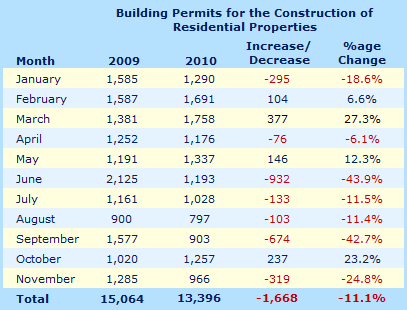
Focusing on the 512 permits issued for the construction of residential buildings, these were approved for 996 dwelling units – 352 single houses and 614 multiple housing units such as apartments and other residential complexes.

Compared to the November 2009 total of 1,285 dwelling units, this represents an increase of 24.8%.

Between January and November 2010 building permits were issued for the construction of 13,396 residential properties. Compared to the same period last year, when permits were issued for the construction of 15,064 residential units; a fall of 11.1%.

Building permits for residential properties in Cyprus - November 2010
Source: Cyprus Statistical Service

Looking at the broader picture, during the first 11 months 2010 of a total of 8,044 building permits were issued. This represents a fall of 1.4% compared to the first 11 months of last year. The total value of these permits fell by 5.4% and their total area fell by 6.0%.

According to the Statistical Service, building permits constitute a leading indicator of future activity in the construction sector.

Cement sales hit rock bottom

Confirming the continuing shrinkage in the construction sector, domestic sales of cement hit a 7-year low in 2010. The figures highlight the decline in the holiday home market and there are raising fears that there will be a further wave of redundancies in the sector.

According to CySTAT cement sales fell 7.9% to 1.3 million tons in 2010 compared with the 1.4 million tons sold in 2009 and by more than 30% compared with the 1.9 million tons sold in 2008.

Speaking to Stockwatch, the chairman of the Pancyprian Ready-Made Concrete Association Neoclis Kyriakou said “Our forecasts are that in 2011 things will continue to follow a downward trend and, unfortunately, this entails new dismissals.”

Cyprus property news welcomes one million visitors

Word MapLAST Friday the Cyprus Property News magazine welcomed its one millionth visitor. With more than 900 articles and news items on a range of property-related topics, it receives around 13,500 visitors a week.

Nigel Howarth, the magazine’s owner and publisher said:

“The magazine is going from strength to strength. Not only does this highlight the quality of the news and information we provide, but it also shows the interest being shown in the Island’s property market.

Although our readership is predominantly based in the UK and Ireland, the number of Russian visitors has been steadily increasing along with those from South Africa, the United Arab Emirates and Australia.”

Cyprus Property News

Launched in May 2008, Cyprus Property News is read in 176 countries and territories around the globe. It provides the news and events that are shaping the Island’s property industry without the usual sales and marketing hyperbole. It is currently ranked number one by Internet search engines Google, Yahoo and Bing.

2011 property market predictions

2009 was a disastrous year for the Island’s property market and 2010 was not much better. After a promising start to last year with sales improving on 2009 figures, sales declined for six consecutive months between July and December.

The market in 2011 has not got off to an auspicious start with property issues once again making headlines in the English language press. This bad publicity will do nothing to encourage overseas buyers, and in particular British buyers, to return to the market.

Title Deed legislation?

Readers may recall that in June 2008, Interior Minister Neoclis Sylikiotis assured property buyers that legislation to resolve problems in the sector could be implemented by the end of the year.

Last week, more than two years after the deadline Mr Sylikiotis set himself, Chairman of the House Legal Affairs Committee proudly announced that the Island’s Deputies (MPs) had agreed a solution to one of the many problems that Mr Sylikiotis was looking to resolve – developers’ mortgages.

This solution graciously allows those buying property to repay part of the developer’s mortgage to get the Title Deeds to their home.

Of course, this solution is merely a way of ensuring the present system continues virtually unhindered and does nothing to protect buyers from the crooks and conmen that plague the Island’s property industry.

Details of the other legislative changes being proposed have yet to emerge. But if they are as ridiculous as last week’s ‘solution’, no-one will be delighted; apart from perhaps the Banks and property developers.

Institutionalised Extortion?

Also last week we received news that District Lands Offices (DLO) are continuing to overvalue property when assessing the Property Transfer Fees. These fees are effectively a sales tax payable at the legal completion of a sale and are equivalent to the Stamp Duty Land Tax or SDLT, charged on property transactions in the UK.

In some reported cases DLO valuations are more than double the property’s purchase price.

Let us take an example of a recent case of overvaluing by the Paphos DLO of a property bought in joint names (husband & wife) to see the impact of this practice:

Property Transfer Fees based on the €130,000 paid to the developer – €3,900

Property Transfer Fees based on the Land Registry’s market valuation of €280,000 – €10,582.80

This overvaluation by the Land Registry cost the buyer an additional €6,682.80 in Property Transfer Fees.

If the property had been purchased in a single name, the additional Property Transfer Fees would have amounted to a cool €10,774.19.

Although the buyer has the right to challenge the Land Registry valuation, it would be Land Registry staff who would undertake the on-site revaluation of the property. How objective and impartial would their valuation be?

Impartial legal system?

The impartiality of the Cypriot legal system was brought into question last week following the unexpected verdict in the celebrated Conor O’Dwyer saga that has been dragging on for the last five years.

Mr O’Dwyer lost his private criminal prosecution against property developer Christoforos Karayiannas & Son Ltd concerning the sale of his house for a second time. The prosecution case against the woman who bought the house, Michelle McDonald, also failed.

Despite damning evidence to the contrary, the judge ruled that Christoforos Karayiannas had not committed fraud by selling Mr O’Dwyer’s home for a second time to someone else, and to add insult to injury, she ordered O’Dwyer to pay the defendants costs.

Speaking to the Cyprus Mail after the judgement Mr O’Dwyer said “My worst fears have come true. What this means is that a developer can keep your money and never deliver your house, then if they want they can re-sell it. Our contract is in the Land Registry and someone else is in our house, it’s that simple.”

There has been much discussion on Internet forums about the judge’s decision. Some believe she was bribed, some say she was leaned on by the local mafia, others say that she deliberately interpreted the law incorrectly to favour the Cypriot defendants.

Mr O’Dwyer’s lawyer, Yiannos Georgiades will file an appeal with the Supreme Court in the next few days, provided that the Attorney General gives his consent. “It’s a mistake on the judge’s part”, he said.

Conclusion

It is difficult to see how the Island’s property market will not be damaged further by these events. It is also difficult to see how Cyprus can recover from the damage without its government taking immediate and effective action to resolve the many problems and restore overseas investor confidence.

Good news at last for Conor O’Dwyer

FATHER and son Christoforos and Marios Karayiannas were found guilty today in a civil action which was filed in the District Court of Famagusta by Conor O’Dwyer with regard to his first assault case which took place back in 2006.

The judge accepted as true all of the evidence given before the court by Mr O’Dwyer and the other witnesses.

District Court Judge, G. Philippou concluded that both of the defendants assaulted Conor and are liable for the injuries that they caused to him and the damage to his video camera.

They used violence against him without any reason. The judge did not accept that the defendants tried to use reasonable force in order to prevent the Plaintiff from entering their property. The judge stated that he accepted the evidence given by the Plaintiff that he had been in a public place, not trespassing, after having been invited there by his friends who live in that residential block of houses.

The defendant tried to prevent the Plaintiff, by using force, from leaving the place despite the fact that the Plaintiff was trying to leave peacefully.

The judge said that the defendants forcefully grabbed the Plaintiff’s mobile, preventing him from calling his lawyer and then grabbed his video camera while at the same time, they were preventing him from going away. They pushed him around while he was trying to get into his car, injuring him and they broke his camera.

Both defendants were acting together and encouraging each other to assault Conor. The judge found that the defendants were lying in court and gave conflicting evidence. In many parts of his evidence, Marios Karayiannas gave different evidence than that which he had given in a previous affidavit.

The Court ordered the Defendant to pay the Plaintiff total damages of 1,739.20 Euros plus interest and legal fees.

This is the first time that Conor was assaulted by the developers from whom he had bought his house. The injuries sustained during this assault were not very serious but Conor was assaulted again in 2008 by Karayiannas and ended up in hospital for 6 days with serious injuries. The civil case for this assault is still pending.

Both father and son were found guilty of this assault by the Criminal Court of Famagusta last year and although the judge imposed a 10-month prison sentence, the sentence was suspended.

The Attorney General is appealing against the suspension of the sentence and the decision issued by the judge, i.e. to the effect that they were found guilty of actual bodily harm, not grievous bodily harm.

The Defendants tried to claim, via their lawyer, that the incidents had been triggered by the behaviour of the accused, who was ruining their reputation through the Internet because he had a dispute with them over the selling a house to him. Conor gave them 66,000 Cyprus pounds for a house that they never gave him and they also kept his money.

The judge stated without any disrespect to the defendants’ lawyer that the peaceful protest by the Plaintiff and the publication of his story on the Internet were irrelevant to the matter of the assault – “…any disputes among people who are entering into commercial transactions are not solved by the use of force or by causing fear or through verbal abuse.”

The judge also pointed out that despite the intensive and not so nice way that he was cross-examined by the lawyer for the defence, Conor remained calm throughout the whole procedure and he was answering in a simple way.

This whole dispute arose five years ago when Conor O’Dwyer and his family decided to live the dream and move to a house that they bought in Frenaros, Cyprus. The dream turned into a complete nightmare for the couple and their family when they paid a large deposit of 66,000 Cyprus pounds to the developer, only to be told subsequently that their dream home has been resold to another couple despite the fact that they were registered as the beneficial owners of the property at the Land Registry.

(The Attorney General will appeal a court decision and the sentence handed down in the second assault case against Christoforos and Marios Karayiannas that took place in 2008.)

More than ninety percent say no

A RECENT mini-poll conducted by the on-line Cyprus Property News magazine revealed that 93 percent of the 1,317 readers who voted said that they would not buy a property in Cyprus that did not have its Title Deed.

Poll results – Buying a property that does not have its Title Deed

This result is hardly surprising given the number of problems and the amount of bad publicity resulting from the Island’s Title Deed fiasco.

In the statement he issued in 2009, Interior Minister Neoclis Sylikiotis said that the government’s policy was to introduce “effective and comprehensive practices for solving this problem” and that its goal was to issue “some 20,000 Title Deeds by mid 2010″.

Two and a half years later, nothing has changed – and by mid-2010 a mere 10,701 Title Deeds had been transferred, slightly more than half the government’s stated target.

UK MPs and MEPs have been deluged with letters from disgruntled buyers and the EU has been asking some serious questions of Cyprus, which incidentally will take over the rotating Presidency of the Council of the European Union in the second half of next year.

Many of the problems have been reported by the Island’s English-language press and the UK media. A team from ITV, the UK’s largest independent terrestrial TV broadcaster, spent a week on the island recently recording material for their upcoming ‘Homes from Hell’ series; they are planning a second visit in February to record more material for a second one-hour episode.

But despite the bad publicity, the government appears impotent being either unable or unwilling to resolve the Title Deed issues and restore the Island’s tarnished reputation and overseas investor confidence.

Conor O’Dwyer’s lawyer speaks out

EARLIER this evening Conor O’Dwyer’s lawyer, Yiannos Georgiades, spoke with Rosie Charalambous on the CyBC Radio 2 programme ‘Round and About’ about the criminal case against property developer Karayiannas and the woman now living in Conor’s home, Michelle McDonald.

Here are Mr Georgiades opening remarks and background to the case:

“First of all I would like to clarify that it was a private prosecution, it was a criminal case. It wasn’t the Civil Case that is still pending through which Conor is pursuing his rights and is asking for remedies. This is just a private prosecution under Section 303A of the Penal Code.

And according to this section of the Penal Code the developer or anybody really, cannot sell or rent or in any other way give possession of a house to a third person which he knows belongs to another person.

So in this case Conor bought this house and he was according to the Supreme Court Judgement in Cyprus he was the owner, the beneficial owner, from the moment he filed the contract of sale with the Land Registry.

That was done in 2006. In 2006 Conor bought his house with his wife and they filed their contract with the Land Registry. They paid CYP66,000 and later on because of disputes he had with the developer, the developer decided unilaterally to terminate this contract and sell it to another person although he knew that it belongs to Conor and although he knew that he should go to court – the civil court – in order to decide whether he could lawfully terminate this contract and sell it to another person.

Well, the thing is that the second buyer – it seems like she knew about Conor’s purchase of this house and still she carried on buying the house and that is why in this criminal prosecution we filed the case also against the second buyer. Because according to the law, section 303A, anybody who is entering into transactions of selling or renting or getting a house belonging to another is liable for criminal offence.”

Click here to listen to the 16 minute interview between Rosie Charalambous and lawyer Yiannos Georgiades.