FITCH is the third ratings agency to place Cyprus on review. Last week Moody’s warned the Island’s Aa3 rating could be adjusted downward, while Standard & Poors cut Cyprus’ sovereign rating last November by one notch.
In its statement, Fitch said that it did not expect Cyprus’ AA minus rating to be downgraded by more than one notch. The rating review is expected to be completed during April and will focus on the fiscal risks facing Cyprus, including state pension schemes and the “economic, financial and banking relationships” between Cyprus and Greece.
Finance Minister Charilaos Stavrakis said the 2011 budget would cap the public debt at its present level of 61 percent of GDP.
But critics say the austerity package does not go far enough to deal effectively with a root cause of the fiscal problem – the bloated public sector.
With approximately 52,500 government employees in a country of 800,000, the state wage bill represents some 30 percent of all government spending.
Stavrakis has vowed to cut about 1,000 government jobs over three years and to open talks with the powerful government employees’ trade union on restructuring the government workers’ pension fund.
CONOR O’Dwyer has failed in his attempt to get justice through the Cyprus judicial system following a court ruling earlier today in his private criminal case against property developer Christoforos Karayiannas & Son Ltd and Michelle McDonald, the person now living in his home.
In 2008 the Attorney General wrote a three-line letter to O’Dwyer telling him that his developers had not committed any crime by effectively re-selling a house legally registered in his name. However, when O’Dwyer brought a private criminal prosecution against the accused, the judge agreed that Karayiannas and McDonald had a case to answer.
The judge accepted evidence from an official from the Department of Lands and Surveys who confirmed that O’Dwyer’s contract had been duly signed and lodged with the Land Registry for ‘Specific Performance’.
The court heard evidence that O’Dwyer made the stage payments as required by his contract until Karayiannas refused to accept a payment. It also heard how O’Dwyer made numerous attempts contact the Karayiannas to discover what was happening and how all of these were ignored.
The judge also accepted that the developer had resold the property to someone else without seeking Mr O’Dwyer’s consent to cancel the contract or applying for a court order to withdraw the contract from the Land Registry.
But despite the evidence submitted the judge did not consider it sufficient to prove that a fraud had been committed ‘beyond reasonable doubt’ and ordered Mr. O’Dwyer to pay the defendants’ costs.
According to the Island’s ‘Specific Performance Law’, the deposit of a contact of sale at a Land Registry prevents a property from being sold for a second time. It can only be withdrawn from the Land Registry with the agreement of the vendor and the purchaser – or by a court order.
Mr O’Dwyer’s lawyer, Yiannos G. Georgiades, said that: “We will appeal the decision; we believe it goes against the laws of Cyprus. The decision could give the wrong messages to overseas investors that their rights are not protected when they buy property in Cyprus even if they have filed their contracts with the Land Registry.”
“Investors must be assured that the laws of Cyprus safeguard their rights if they file the contract with the Land Registry and that the developer cannot resell their property without their consent.”
Referring to case law Andricos Nicou and others v George Georgiou 1 CLR(1999) p 940, Mr Georgiades added “The judgements of the Supreme Court are binding on the lower courts since in Cyprus we follow the English common law system.”
THE report we published earlier today, ‘Title Deed bill agreed by deputies‘, leads us to believe that the government has lost the plot in its efforts to resolve the Island’s long standing Title Deed fiasco and restore overseas investor confidence in the Cyprus property market.
Clearly, House Committee Chairman Ionas Nicolaou has failed to achieve the stated aim of: “striking a balance between the rights of the buyer and the seller.”
According to Mr Nicolaou the bill “gives the buyer the right to have the property transferred to his or her name regardless whether a pre-existing mortgage on that property has been paid in full.”
As to how this would work in practice, Mr Nicolaou explained:
“Having calculated their participation in the share of the loan for which there is a mortgage preceding the sales contract, buyers will be able to propose settling that amount to the lender on behalf of the seller.”
“Once such payment is made, for the purposes of a specific performance [court order] it shall be deemed to have priority over any mortgage.”
“A court will be able to order that the real estate be placed in the name of the buyer irrespective of whether the mortgage has been paid in full.”
In other words, if a buyer has been conned into buying a mortgaged property he can get its Title Deeds by repaying a proportion of the mortgage to the mortgagee; i.e. the financial institution that loaned the developer the mortgage.
Does this strike a balance between the rights of the buyer and the seller as Mr Nicolaou claims? I’m sure the banks will be happy to get the money and the developers will breathe a sigh of relief knowing that part of their debt has been cleared.
But what about the buyer who has been conned; not only does he have to pay for his house but he also has to repay part of his developer’s mortgage to receive his Title Deed!
There is another point that the Deputies have not taken into consideration:
If the vendor, or anyone else involved in the sale of a property, withholds the fact that a property is mortgaged they would be violating Directive 2005/29/EC ‘Unfair Commercial Practices Directive’.
The Directive states that it is a violation for a business to omit or hide material facts from buyers, which if had been made known, would have influenced the buyer’s purchasing decision. As the poll we conducted last year indicated, 98% of the 1,036 respondents said they would not have bought a property in Cyprus had they known the land on which it was built was mortgaged.
This EC Directive was transposed into Cyprus laws 103(I)2007 and 107(I)2007 and came into force on 12th December 2007; the competent authority in Cyprus being the Commerce Ministry’s Competition and Consumer Protection Service.
This raises the question of why the Government has proposed this half-baked bill rather than using existing laws to pursue nefarious developers, and others, who have broken the law?
Conclusion
Rather than taking action against the law breakers, this bill supports their nefarious practices while graciously allowing deceived property buyers to pick up the bill.
DEPUTIES mulling legal changes to solve the Title Deeds shambles yesterday agreed on a key provision that would give buyers the right to Title Deeds regardless of pre-existing mortgages on the property.
The House Legal Affairs Committee indicated after a meeting yesterday that important progress had been made on the issue. “We aim to strike a balance between the rights of the buyer and the seller, but also guarantee the rights of mortgagees,” committee chairman Ionas Nicolaou told reporters following a session involving land developers, property owners’ associations, bankers, and officials from the departments of Land Registry and Town Planning.
The House Legal Affairs Committee is currently working on two of five government-sponsored items of legislation geared at overhauling the system. Nicolaou said, however, that each bill was distinct and would be forwarded to the plenum irrespective of progress on the others.
A key provision of the bill, on which there was broad agreement yesterday, gives the buyer the right to have the property transferred to his or her name regardless of whether a pre-existing mortgage on that property has been paid in full.
Nicolaou explained: “Having calculated their participation in the share of the loan for which there is a mortgage preceding the sales contract, buyers will be able to propose settling that amount to the lender on behalf of the seller.”
“Once such payment is made, for the purposes of a specific performance [court order] it shall be deemed to have priority over any mortgage. A court will be able to order that the real estate be placed in the name of the buyer irrespective of whether the mortgage has been paid in full.”
Nicolaou said “everyone is in agreement that the sales contract shall have priority over the mortgage, for the purpose of protecting the buyer…from abusive practices.”
An estimated 100,000 properties in Cyprus are without Title Deeds and Land Registry officials have confirmed that 30,000 of these properties have been bought by foreigners, the vast majority being British.
Many of these buyers have been conned into buying property mortgaged by the developers and are left in the lurch when the developers default on their bank loans.
The spirit of the proposed bill is to spell out where the involved parties – the buyer, the seller and the lender -stand in relation to one another, the DISY MP noted. “It explicitly states who has priority and when, and defines an encumbrance [claim on real estate] that is created once a sales contract has been submitted to the Land Registry,” said Nicolaou.
It will be obligatory to present the property’s sales contract to the Land Registry Department before any such transaction can take place.
Regarding current sales contracts that have been signed but not yet filed with Land Registry, Nicolaou said a window of six months would be given for filing contracts after the law is passed. In this respect, the new law would not have retroactive effect.
In addition, on presenting the sales contract to the Land Registry, the buyer will be secure in the amount they have paid to the seller until that date, in the event the seller (developer) is unable to complete the project or to transfer individual units to separate buyers of a housing project.
“On submitting the contract, an encumbrance shall be created with regard to the amount paid up until that moment…and that encumbrance shall give the buyer priority over any other obligations of the seller.” Under the legislative proposal, Nicolaou said, “a buyer will have the right to take legal recourse and request a court injunction ordering the seller to transfer the immovable property to their name.”
“This is a straightforward procedure,” he added.
A poll conducted by the Cyprus Property News Magazine last year found that close to 100 per cent of foreign buyers would not have bought in Cyprus if they had been informed of the practice of withheld Title Deeds and developer mortgages.
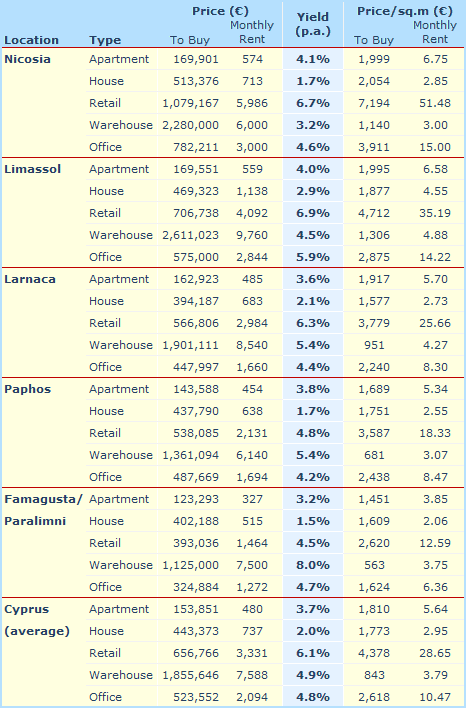
RESIDENTIAL property prices continued to fall across the Island during the third quarter of 2010. Houses fell by an average of 0.9% and apartments fell by 2.1% according to the recently published fourth issue of the RICS Cyprus Property Price Index. Overall, the Index tracks property prices and rents across 46 locations.
Larnaca suffered the largest falls with house values down 2.1% and apartment values down 5.1% compared with the previous quarter.
With the exception of warehouses, which remained stable, the value of commercial properties fell by an average of 2.9% for retail and 2.3% for offices compared to the previous quarter.
Across Cyprus, rental values for apartments fell marginally by 0.1%, while rents for houses, shops and offices fell by 1.8%, 1.7%, 0.6% and 0.4% respectively.
The change in capital and rental values shows an interesting dichotomy between Nicosia, which continues to be relatively stable and driven by the local market, and the coastal cities which are disproportionally dominated by overseas buyers/occupiers.
The decrease in capital and rental values of retail properties, is probably an indication of the reduction in spending by households and the expected decrease in spending power due to the upcoming increases in taxation.
Investment Yields
Yields are a useful tool showing the relationship between rent and property prices. Initial yields for commercial property increased, and now stand at 6.1% for retail, 4.8% for offices, and 4.9% for warehouses.
Yields for residential property are 3.7% for apartments and 2.0% for houses, with prices relative to rents remaining at high multiples, indicating that there is still room for rebalancing to take place.
Initial (or gross) yields, as shown in the grey/blue column in the chart below, is the total yearly gross rent divided by the price, expressed as a percentage.
Derived from the RICS Cyprus Property Price Index for Q3 2010
According to Pavlos Loizou MRICS, Board member of RICS Cyprus “In the first half of 2010, Cyprus took the brunt of the global financial crisis, with the economy slowing and government revenues falling. The third quarter of 2010 found the Cypriot economy showing some signs of stabilization and slow growth.”
“Similarly, towards the end of the second quarter and throughout the third, there were some early signs of stabilization of real estate prices, with local buyers taking advantage of low prices for holiday homes and having renewed interest in city centre prime buildings.”
“These early positive signs however should be considered within the broader framework of the continuous reduction in property loans from banks and other financial institutions, the reduction of income due to inflation and wage cuts, and the changing people’s expectations about future changes in capital values.”
Outline of properties used to calculate the index
Apartments: Residential, two bedroom, 85sqm, Medium quality. Houses: Residential, three bedroom with garden, Semi-detached, 250sqm, Medium quality. Retail: High-street retail, 100sqm ground floor area with 50sqm mezzanine. Warehouse: Light industrial area, 2,000sqm, which includes 200sqm office space. Office: Grade A, City centre location, 200sqm
Methodology
The methodology underpinning the RICS Cyprus Property Price Index was developed by the University of Reading UK and may be viewed by clicking here.
INTERNATIONAL ratings agency Moody’s has placed Cyprus’ Aa3 local and foreign currency government bond ratings on review for possible downgrade.
In its statement, Moody’s said that the decision to initiate this review was prompted by:
concerns that the recent deterioration in the Cypriot government’s fiscal metrics is largely structural;
competitiveness issues; and
the banking sector’s exposures to macroeconomic stress in Greece.
Moody’s said that the rating could be adjusted downwards by more than one notch, although the rating is likely to remain in the investment-grade A category.
Moody’s senior analyst Sarah Carlson said that: “The severe impact of the financial crisis on Cyprus caused a deterioration in government finances that may prove very difficult to reverse.” Adding that “While the Cypriot government has put forward a 2011 budget that appears to comply with its commitments under the EU’s Excessive Deficit Procedure, its plans do not address the structural issues that may undermine the government’s financial strength over the medium to long term.”



 THE report we published earlier today, ‘
 DEPUTIES mulling legal changes to solve the Title Deeds shambles yesterday agreed on a key provision that would give buyers the right to Title Deeds regardless of pre-existing mortgages on the property.