Title Deed bills run into problems

title deed problem
The complexities of Cyprus Title Deed problem

THE House Legal Affairs Committee’s effort to conclude two of five bills that hope to put an end to the title deeds nightmare in the property market has been delayed by a number of questions raised during recent discussions.

One such point of dispute is how to make it a criminal offence for a property seller to mortgage a property he or she has already sold as it will be obligatory to present the property’s sales contract to the Land Registry Department before any such transaction can take place.

A new meeting has been scheduled for next week, said Committee Chairman, DISY’s Ionas Nicolaou, after Monday’s session.

Nicolaou said the effort was to find a balance between the rights of the seller and the buyer, as determined in the sales contract that was signed.

This, he said, would resolve all the problems that have led to the crisis in Cyprus’ property market over the past few years.

“One matter that arises is the ability, within a period of six months from when this legislation comes into effect, to submit all sales contracts to the Land Registry, which haven’t yet been submitted,” Nicolaou explained. He added that this was independent of when the contract was signed.

But most importantly, he added, this would lead to “the creation of criminal responsibility in the event that a property seller takes out a mortgage on the property, without first confirming if the sales contract he signed was submitted to the Land Registry before applying for the mortgage”.

This measure, said Nicolaou, would protect buyers from property sellers who may sign a sales contract one day, then go and mortgage the property the following day, resulting in the mortgage having superiority over the sales contract.

Next week’s meeting is expected to shed some light on a number of issues.

The current system has left hundreds of overseas property investors at the mercy of developers who went out of business due to the current worldwide property and economic slump.

Britons face big losses as prices tumble

THE INVESTORS Chronicle reports Dubai and Bulgaria as being the hardest hit markets with price falls on investment property reaching 75%. Prices in the tourist hot spots of Cyprus have fallen with some developers offering 30% price reductions since the market peaked back in 2007.

Once the preserve of the well-off, overseas home ownership has rocketed in recent times. Encouraged by TV shows and cheaper mortgages over the last 10 years, an estimated 500,000 Brits now own a place in the sun and it has been estimated that the value of their purchases increased from £10 billion in 2000 to a peak of £58 billion last year.

This buying fever sent prices rocketing in Cyprus and many other overseas property markets and led many people to believe that buying a property abroad was a sound financial investment. But this buying fever came to an abrupt halt in when the credit crunch hit in 2007.

According to property consultancy Savills, at the height of the market 80% of overseas property purchases were financed by a mortgage; this compared with a mere 20% just seven years previously. The price collapse in many of the once popular foreign property hot spots means that the majority of the estimated 35,000 Britons who bought property in 2007 and 2008 will be in negative equity.

Some foreign banks, including those based in Cyprus and Greece, are seeking to chase mortgage defaulters in the UK. Since last Christmas, EU creditors can pursue a European order for payment which makes the process of debt recovery easier and cheaper.

Paul Connearn, a spokesperson for the UK National Debt Helpline, said that “There hasn’t been a sudden rise since the legislation was introduced, but we are getting a steady trickle of cases where people are in situations abroad that haven’t worked out,” adding that “Creditors could try and enforce the debt through a charging order on UK assets, typically the family home. This secures the debt on that property, but doesn’t necessarily force the sale.”

Contact points

National Debtline (England, Wales & Scotland) – Tel: 0808 808 4000 – Monday to Friday 9am-9pm – Saturday 9.30am-1pm

Debtline (Northern Ireland) Consumer Credit Counselling Service (CCCS) – Tel: 0800 027 4990

Further reading

Britons face big losses on holiday homes

HELP – I can’t pay the mortgage!

Sales up in 2010 but outlook bleak

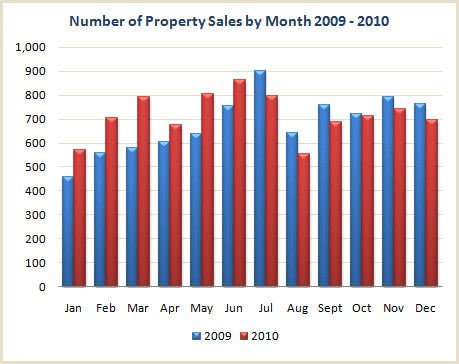
FIGURES released this morning by the Department of Lands and Surveys show that a total of 8,170 contracts of sale were deposited at Land Registry offices throughout the Island during 2010 compared with the 8,598 contracts deposited during 2009.

June was the best month for sales when 864 contacts being deposited; the worst was August with a mere 554.

The largest increase was in Nicosia, where sales increased by 13.5% over the year. Nicosia was followed by Limassol where sales increased by 9.7% and Paphos, where sales were up 2.8% compared with 2009.

However, sales in Larnaca fell by 5.4% and those in Famagusta fell by 3.7%.

Cyprus property sale numbers - 2010 vs 2009
Source: Department of Lands and Surveys

After a promising start to the year with sales improving on last years figures, property sales declined for six consecutive months between July and December.

Cyprus property sales monthly chart - 2009 vs 2010
Source: Department of Lands and Surveys

Many believe that this downward trend will continue and that the outlook is bleak for property developers and other companies involved in real estate who will continue to struggle in the year ahead.

Lakis Tofarides, the president of the Cyprus Land & Building Developers’ Association was reported as saying “The real estate sector saw a small light at the end of the tunnel in Nicosia and Limassol,” and that “The problem will continue unless the government adopts the necessary measures to help the industry recover.”

Overseas property market recovering despite problems

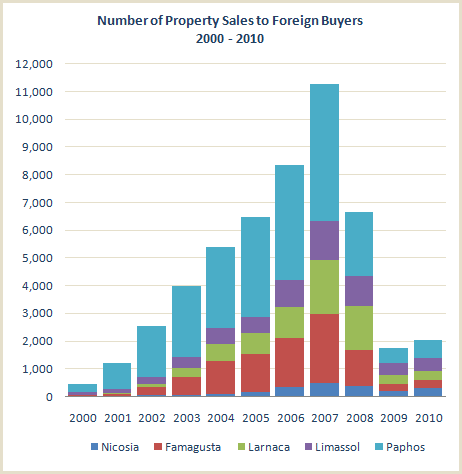
FIGURES released this morning by the Department of Lands and Surveys reveal that a total of 2,030 contracts of sale were deposited in favour of overseas (non-Cypriot) buyers at Land Registry offices throughout the Island during 2010 compared with the 1,761 contracts deposited during 2009.

With the exception of Larnaca, where sales fell 4.8% compared to last year, sales were up in all Districts. Nicosia performed particularly well with sales up by more than 46%. Nicosia was followed by Famagusta, where sales were up 16.5%; Paphos, up 16.3%; and finally Limassol, where sales were up 12%.

Property sales to non-Cypriots 2009-10
Source: Department of Lands and Surveys

Although the numbers are encouraging, the 2,030 properties sold to non-Cypriots last year is only a fraction of the 11,281 sold in 2007 and less than the number sold 8 years ago, before the property boom started.

Property sales to non-Cypriots 2000-2010
Sales of property to non-Cypriots 2000 to 2010 (Source: Department of Lands and Surveys)

During the year, many reports of problems have been appeared in the English language press. For example:

  • In April, the Supreme Court ordered Nicos Papacleovoulou, a Paphos-based lawyer, to pay around €120,000 to his former clients in money lost over a property contract prepared over a decade ago.
  • In May, around 100 members of the Leptos Buyers’ Action Group and their supporters staged a peaceful protest by marching along the Paphos seafront to the port demanding their Title Deeds.
  • In June, Armonia Estates Ltd and Pantelis Leptos backed down in a libel action against property rights campaigner Denis O’Hare.
  • In August, Larnaca-based K & M Famagusta Developers were reported to be under investigation by the police for alleged property fraud.
  • In October, a judge at the Famagusta Court found property developers Christoforos & Marios Karayiannas and an employee of their company guilty of causing British home buyer Conor O’Dwyer actual bodily harm as a result of their assault on him in January 2008.
  • In November, ITV sent a crew to Cyprus to report on the Conor O’Dwyer case and several other cases involving British buyers in Larnaca, Famagusta and Paphos. It was reported that shots were fired while the crew were filming at Frenaros.
  • In November Adrian Mills, a British property developer, was tracked down by the BBC to a village in Gloucestershire having fled Cyprus after taking an alleged €2.5 million from his customers.
  • In November, MEP for Scotland Alyn Smith sent a personal letter to President Christofias asking for his help in cases involving the exploitation, extortion and fraud of his constituents.
  • Two property developers were reported to be bankrupt leaving buyers at the mercy of the banks.
  • MEPs asked a number of searching questions of Cyprus in the European Parliament.

Sadly, few of these problems have been reported in the Greek language media and the Greek speaking population is generally unaware of the appalling situation.

Quite naturally, many Brits are now looking elsewhere for their place in the sun and so property developers have been extending their sales networks into mainly non-English speaking markets, including  Russia and the Middle East.

This year yet again, the Cyprus government has announced its intention to introduce legislation designed to better protect buyers from the ‘crooks’ and cowboys that plague the Island’s property industry.

Whether that legislation will be passed by Parliament and whether it will prove successful remains to be seen; we will report on any developments as soon as the news breaks.

Property prices may stabilise in 2011

SPEAKING to Bloomberg recently, the vice president of the Cyprus Association of Valuers and Property Consultants Kyriakos Talatinis said that “In the first half of 2011, home prices overall will remain unchanged compared with 2010” and that “Domestic demand will depend on whether banks keep their rating standards the same or tighten them”.

Mr Talatinis also believes that external demand will remain weak and prices will fall in most coastal areas.

According to a statement on the Central Bank’s website, mortgages rose at an annual rate of 15% reaching €14 billion in November. Capital Gains Tax receipts rose 19% during the first eleven months of 2010 following a fall of 75% in 2009 which resulted from the 80% crash in property sales during the year.

A new dawn for the Cyprus property market?

A new dawnSOME legal and political events are expected to influence the developments in the beleaguered Cyprus property market in the coming year.

Planning amnesty

It is anticipated that the four proposed amending Laws on «planning Amnesty» which are before the House of Representatives will soon be passed into Law. They propose to amend the Town and Country Planning Law, 90/1972, the Streets and Buildings Regulation Law, Cap. 96, the Immovable Property (Tenure, Registration and Valuation) Law, Cap 224 and the Sale of Land (Specific Performance) Law, Cap. 232.

The Amending Laws are intended to cure the Title Deed problem for existing projects and those under construction – and are designed to ensure that such problems will not arise in the future.

Some of the proposed amendments are:

  1. the trade-off and legalization of existing illegalities or irregularities by the payment of an administrative penalty or by other means;
  2. the speeding up of the whole procedure by the concurrent issue of both the Building Permit and the Division Permit;
  3. the assigning to the engineer responsible for the building works of more responsibilities, such as issuing Certificates describing the level and the stage of the work being performed. This will ease the work of the relevant Authority whose role will be limited to sample inspections;
  4. the facilitating of the issue of a Certificate of Approval by the appropriate Authority either voluntarily or after a request by the buyer;
  5. the possibility of issuing Title Deeds for units with irregularities on condition that such violations are shown on the Title Deed;
  6. the enabling of the issuing of Title Deeds for only part of a project, and;
  7. providing that any sale agreements for immovable property:
  1. must be in writing and be deposited in the Lands and Surveys Department;
  2. must specify in full detail the unit being sold;
  3. will not be acceptable for deposit unless the property is free from any encumbrances, (e.g. a Mortgage).

It remains to be seen if the new Laws will manage to cure, or at least alleviate the Title Deed Problem.

Urban consolidation

Another important proposed Law is the one on Urban Consolidation. The idea for this Law emanated from the resounding success of rural consolidation in Cyprus, during the last forty years.

By the proposed Law, which is pending before the House of Representatives for its passing into Law, a Council of Consolidation, Management and Reallocation of Immovable Properties will be established aiming, inter alia, to:

  1. the availability of developmental land and the securing of the necessary infrastructure;
  2. the readjustment of ownerships within development zones and;
  3. the rational location of large scale uses within the scheme area.

The new law is expected to have a considerable effect on the property market, as a large number of plots in rural areas which are now impossible to develop because of lack of access and/or the necessary infrastructure will be unlocked.

Intercommunal talks

Last, but not least, political events, most importantly the possible positive outcome of the intercommunal talks, will have overwhelming effects on all sectors of the economy, including the property market.

The so called «affected properties» i.e. GC properties in the north and TC properties in the south will gradually be returned to the market one way or another. These properties amount to almost 40% of the total private ownership of Cyprus. Increased supply will affect property values.

On the other hand, demand is expected to rise as well, as a result of the normalization of the political environment, the withdrawal of foreign troops and the application of the European acquis in the whole island.

The property market in the Turkish Cypriot Constituent state will probably benefit more from the reunification of the island, as the present situation of illegal transactions in the «TRNC» will cease and land prices in the two parts of the island will tend to converge.

There is no doubt that, for a number of years, the property market will be unstable and fluctuating, but in the long run it will stabilize and we will evidence a new run of property market flourishing.