Laws to iron out problems with Title Deeds

UNTIL NOW, buying a house or apartment and even paying for it – or taking out a mortgage – did not necessarily mean that the buyer had his or her full rights, often having no Title Deed. If the developer went bankrupt, the rights to the property were immediately handed over to the bank, which effectively owned the property’s Title Deeds.

The current system has not only landed a lot of people into trouble, it has also exposed Cyprus and its property market abroad, as many foreigners – especially Brits – have fallen victim to the system.

But not any more.

The House Legal Affairs Committee in cooperation with the government, Legal Services, banks and Developers’ Association are attempting to bring some significant changes to current legislation, with two bills that are currently under examination.

In an extraordinary meeting yesterday, the Committee said it was attempting to regulate property sales and purchases, loans taken out by buyers and mortgages.

“With the changes attempted in the legislation, we are making it easier for buyers to seek the registration of their property in their name,” Committee Chairman, DISY’s Ionas Nicolaou, explained after the meeting.

”On one hand, by altering the deadlines for submitting a lawsuit and on the other, by reducing the restrictions that exist in today’s law,” he added.

AKEL’s Aristophanis Georgiou said the current law had caused a series of problems, not just for sellers but also buyers.

“With the regulations in the new law, buyers are finally given their rights and these rights are secured and updated up until the point that the contract is used as a mortgage for the property,” Georgiou explained. “At the same time, the rights of the sellers and banks, which will loan those who will buy, are not at all negatively affected.”

The aim, he added, is to wrap discussions on these two laws by January 13.

The main changes the Committee is hoping to achieve are for the purchase contract to have superiority over the mortgage – that the developer has taken out on the property – and to secure the buyers’ rights while taking the banks and sellers’ best interests into account.


Laws to iron out problems with Title Deeds

Government needs to take urgent action

6

SPEAKING to the Overseas Property Professional (OPP), Harris Samaras, the chairman and chief executive of local research company Pytheas, said “a major factor in turning the amazing potential that the island has into achievement in the overseas property market is the ability of the Cyprus Government to develop, introduce and enforce effective legislation to deal with the many problems in the country’s real estate, banking and legal sectors.

Samaras called on the island’s politicians to be much more pro-active and for “Cyprus to act forcefully, with a greater sense of urgency to reverse its high fiscal deficits, to safeguard public financing and to increase the scope for private sector growth.

He argues that even though the Cypriot banking sector is basically sound, “the real estate market is a significant component of the banks’ loan books and represents the majority of loan collaterals (more than 40%).” The situation worries him and “the low overall profitability contribution to Cypriot banks from Greece and the elevated loan provisions that subsequently need to be undertaken will affect the funding ability of banks to real estate related clients for at least the next 12 months.

The lending community on the island needs to be much more competitive says Samaras. “Where some other countries have lowered their mortgage interest rates and property taxes to encourage overseas investors, mortgage interest rates in Cyprus are amongst the highest in Europe and the government is talking about increasing property taxes it charges large land owners; a charge that will no doubt be passed on to those buying property. This approach is a recipe for disaster, especially when competition (governments in other countries) has taken steps to reduce the costs associated with property ownership to encourage investment.

Samaras is worried about longer term trends too. “Cyprus enjoyed a more than ten-year housing boom until 2008” he says, “and then the market began to fall in certain areas, mainly because of:

  • the fall in the value of Sterling against the Euro over the past two years means that British buyers, who accounted for more than 50% of foreign buyers, have less equity at their disposal. At the beginning of 2007 a pound Sterling would buy €1.47; today it will buy around €1.20, making investments in the Eurozone that much more expensive;
  • the worldwide economic turmoil that has changed the characteristics of the ‘typical’ overseas property buyer. Investors are now being much more cautious about their investment decisions;
  • the property-related laws in Cyprus that need to become more transparent, although the government seems to be making concrete attempts to rectify the situation;
  • the mortgage interest rates in Cyprus which are amongst the highest in Europe.

Government needs to take urgent action

Developers meet with Central Bank Governor

YESTERDAY a delegation from the Board of the Cyprus Land and Building Developers Association (LBDA) and the Director General of the Cyprus Employers & Industrialists’ Federation (OEB) met with the Governor of the Central Bank of Cyprus, Athanasios Orphanides.

They discussed various issues that fall within the remit of the Central Bank. The main issue concerned extending the boundaries, restructuring the loans and interest of land and property developers. LBDA President, Lakis Tofarides, said that the issue resulted from a severe reduction of liquidity within the industry due to the economic crisis and the fall in property sales; a situation that is likely to continue into next year.

Mr. Orphanides stressed that the Central Bank has no problem with restructuring loans providing that the businesses concerned remained solvent.

Among the recommendations made to bring an end to the crisis was to reduce purchasing costs by abolishing/reducing transfer fees and VAT; measures that have been taken in other European countries to help stimulate their property markets.

They also discussed concerns relating to the package of bills before the Parliamentary Committee to reform the laws relating to the thorny issue of Title Deeds. The Governor shared the view that the three types of Title Deeds would cause many problems in the market and would also deprive owners of their right to sell or mortgage those properties given an ‘incomplete title’ as a result of serious planning violations.

Building permit numbers improve in October

THE Cyprus Statistical Service (CYSTAT) has announced that the number of building permits authorized by the Municipal Authorities and the District Administration Offices during October 2010 was 676, comprising:

  • Residential buildings – 497 permits
  • Non-residential buildings – 90 permits
  • Civil engineering projects – 30 permits
  • Road construction – 4 permits
  • Division of plots of land – 55 permits

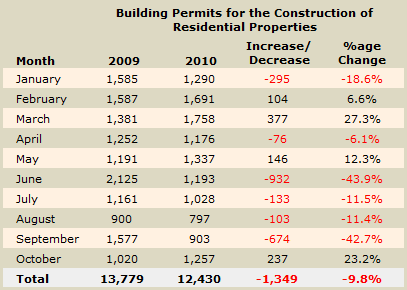
Focusing on the 497 permits issued for the construction of residential buildings, these were approved for 1,257 dwelling units – 376 single houses and 881 multiple housing units such as apartments and other residential complexes.

Compared to the October 2009 total of 1,020 dwelling units, this represents an increase of 23.2%.

Between January and October 2010 building permits were issued for the construction of 12,430 residential properties. Compared to the same period last year, when permits were issued for the construction of 13,779 residential units; a fall of 9.8%.

Building permits for residential properties in Cyprus - October 2010
Source: Cyprus Statistical Service

Looking at the broader picture, during the first 10 months 2010 of a total of 7,311 building permits were issued. This represents a fall of 1.0% compared to the first 10 months of last year. The total value of these permits fell by 6.6% and their total area fell by 4.8%.

According to the Statistical Service, building permits constitute a leading indicator of future activity in the construction sector.

Top 10 stories from Cyprus in 2010

SINCE the beginning of the year, Cyprus Property News has attracted more than 490,000 readers and as we approach Christmas we are publishing a list of the Top 10 stories that have attracted the most interest from our readers over the past 12 months.

Surprisingly, the most popular story was a ‘spoof’ video about a massive new development in Paphos which criticised the nefarious activities of those in the construction industry.

Cyprus Property News ‘Top 10 of the Props’ 2010

1. Massive development planned for Cyprus

Published 29th June 2010 – read by 10,014

IN THE NUMBER 1 SPOT this year is a story about the largest development ever to be undertaken in Cyprus codenamed ‘Papholand’. Heading up the consortium of property developers is none other than Adolf Hitler and the spoof video highlights the practices of the Island’s nefarious property developers. Watch it again below.

[youtube=http://www.youtube.com/watch?v=Yw4c0UeEIac&w=470&rel=0]

2. Time to buy? House prices fall 20-30 percent

Published 15th August 2010 – read by 4,063

ANTONIS Loizou warned that although prices of property in some part of Cyprus have fallen by as much as 30 percent, the risk in the market has increased and called for extreme caution by prospective buyers.

3. Dark clouds loom over Cyprus property market

Published 22nd April 2010 – read by 5,420

SAVVAS Savouri, partner and chief economist at Toscafund Asset Management LLP highlighted a number of significant problems in the Cyprus property market and warned that prices have still to fall from their already depressed levels before they bottom out.

4. Massive implications for property sector & economy

Published 1st November 2010 – read by 5,128

FOLLOWING on from the revelations in the Cyprus Mail that developers, estate agents, lawyers and banks in Cyprus are continually, systematically and habitually infringing EU Directives and breaking the law we reported on the possible implications for the Cyprus property sector and banking system.

5. RICS Cyprus property price index published

Published 29th January 2010 – read by 4,489

A NEW ERA dawned with the launch of the RICS Cyprus Property Price Index which aims to contribute to the transparency of the property market in Cyprus. The index uses a methodology developed by Professor Dr Pat McAllister MRICS and Dr Franz Fuerst from the Reading University Department of Real Estate & Planning at Henley.

6. Cyprus overseas property market collapse

Published 7th January 2010 – read by 4,149

FIGURES published by the Cyprus Department of Lands and Surveys revealed that the Island’s overseas property market collapsed in 2009 with a mere 1,761 properties being sold to non-Cypriot buyers compared to the 6,636 sold in 2008 and the 11,281 sold in 2007.

7. Cyprus Property Action Group silenced by libel threat

Published 25th April 2010 – read by 3,907

FOLLOWING a court order issued at the request of Leptos estates, the Cyprus Property Action Group (CPAG) closed down its website. The writ was moved on March 31 against Denis O’Hare, the CPAG representative who owned the website, by Armonia Estates Ltd and Pantelis Leptos.

8. Home buyers may lose their properties

Published 24th October 2010 – read by 3,800

A BANK moved an application to appoint receivers and liquidators to recover the debts of a property developer in Paphos who owes his creditors approximately €3 million. Criminal proceedings were instigated against the developer for non-payment of VAT and some forty homeowners face the prospect of losing their homes.

9. Leptos Estates backs down in libel action

Published 11th June 2010 – read by 4,774

LEPTOS Estates, the Cyprus property development company, backed down and withdrawn its libel action against property rights campaigner Denis O’Hare of the Cyprus Property Action Group. The packed public gallery of a Paphos courtroom broke into applause when the lawyer acting on behalf of Mr O’Hare announced that the libel case against his client, brought by Armonia Estates Ltd and Pantelis Leptos, had been dismissed.

10. Recovery plan for struggling Britons in Cyprus

Published 21st March 2010 – read by 3,682

THE DREAM of owning a place in the sun has turned into a nightmare for Brits struggling to meet mortgage payments on a property that has sunk in value. But a new UK-based scheme claims it has a solution which could allow owners to bail out without incurring the penalties of repossession and negative equity.

Call to reform the property tax system

THERE is still a long way to go before the property market recovers, with any movement in the sector seen as only a flash in the pan, the president of the Cyprus Property Owners’ Association George Strovolides warned this week.

Speaking at the association’s annual general meeting, Strovolides said the dramatic drop in the sector was ongoing, especially in tourist areas where prices remain 30% down compared to the previous two years.

He was clear that any activity in the property sector is only temporary and the market here depends on the economic recovery of international markets mainly Britain and Russia – the island’s main markets.

There continues to be a slump in the market and purchases by Cypriots in the tourist areas of Paphos and Protaras are only a drop in the ocean,” he said sounding the alarm that it was premature to make statements about a recovery.

Even transactions through the Land Registry may concern older sales where transfers are made at a later stage,” he added.

The Association favours the proposal to review property prices for tax purposes from 1980, provided a tax reform is in place so that the system becomes fair.

The untaxed sum of properties should be corrected since values will multiply,” Strovolides said.

He criticised the ongoing delay in issuing title deeds with 130,000 still pending and the state losing hundreds of millions in transfer fees.

The association insists on the simplification of the property tax system so that state coffers would benefit.

Strovolides argued property taxes are currently multiple and complex while a simplification of the system would boost state revenues and spark mobility in the moribund sector.

The Association is proposing a reduction in capital gains tax from 20% to 10% and higher untaxed sum, saying lower taxes would help combat tax evasion.

It also suggests the reduction of transfer fees to 3% without scales, the abolition of property tax and abolishing double taxation of rents – as income or corporation tax, and a special defence contribution.

Tax payments should also be simplified, so that property owners pay a single authority.

Call to reform the Cyprus property tax system