Will UK govt help Brits caught in Cyprus scams?

The Houses of Parliament (photo by Adrian Pingstone)

AN ARTICLE in yesterday’s Daily Telegraph reported on the initiative taken by the UK government in Spain where the government has recently appointed a special overseas property advisor to help deal with the Spanish property scams.

A similar approach was suggested by the Cyprus Property Action Group (CPAG) in its report ‘Cyprus Property Pitfalls: a time for action’ submitted to the Cyprus Government at the start of 2008. And last month in his letter to Cyprus President Dimitris Christofias, MEP for Scotland Alyn Smith suggested that he “may wish to consider establishing a foreign investor advice service or an impartial ombudsman for such cases”.

As you will see from the Daily Telegraph article below, there are many similarities between the scams in both the Spanish and Cyprus property markets.

British government intervenes to help expats caught in Spanish property scams

The UK government is currently dealing with more than a dozen different action groups made up of thousands of disenchanted expats who have lost hundreds of millions in property scams throughout Spain.

The situation is so severe that the government recently appointed a special overseas property advisor to help deal with it and to better understand the problems of those involved.

As a result, contentious issues such as illegal properties which do not have correct permits, cases where off-plan developments have not been built as specified and the length of time and cost involved in resolving property disputes were recently raised by the British ambassador to Spain with the Andalucian regional government and the Minister for Public Works and Housing.

A spokesman for the British Embassy in Spain said: “The UK government has no authority to interfere in any matters relating to Spanish domestic legislation, whether national, regional or local.

However, we continue to express concern at the impact these problems are having on the lives of some of our citizens and Spain’s reputation abroad, and we have raised property issues with ministers in Spain and regional governments on numerous occasions.

We understand the regional government is currently working with town halls in affected municipalities to draw up inventories of illegal properties and to seek solutions.

We believe that the regularisation of these properties will come through updates and modifications to local town development plans.

One of the cases being studied by the special overseas advisor is that put forward by the Abusos Urbanisticos Lliber – NO! (AULN) action group, made up of expats who bought 298 family homes in the upmarket, inland village of Lliber on the Costa Blanca more than ten years ago.

The area has been blighted as a consequence of the arrangements made between former town hall officials and builders to build with building licences granted by the town hall but without authority from regional government.

Wholesale construction continued from 1999-2004, by which time an estimated £60 million was handed over to developers by unsuspecting expat families and retired couples.

One of the victims, who wishes to remain anonymous, said: “In 2004 the local environment agency, the college of architects and the guardia civil decided the homes were illegally built so building stopped.

“I took early retirement and with my wife, through an agency in Cheltenham, bought a three bedroom, three bathroom villa with swimming pool and views over the hills but we have no mains water, no electricity and we can’t sell because it is illegally built. We are in limbo. The embassy has been great with advice but their hands are tied. The Spanish just don’t want to know. It is a dirty, dirty business.

Thanks to the action group and its members’ persistence, 2.4 million euros were recovered last year when police arrested the town hall architect and found the money in a private Andorran bank account.

A further 18 people are currently awaiting trial for corruption and fraud relating to the illegal building of homes in Lliber including the ex-mayor José Mas Avellá, British builder Trevor Bourne and agent Miguel Muntaner who had accumulated 100,000 sq of land in the Marina Alta as well as 16 houses and seven cars.

Only this week the Telegraph reported on the 300 Britons who lost an estimated £34 million after paying deposits on off-the-plan apartments in a proposed development called Estepona Beach and Country Club, 20 miles from Marbella.

In some cases, the prospective owners – many of whom were from Northern Ireland – put down an £85,000 deposit. However, the land still belonged to its original owner and the complex was never built.

As the overseas advisor continues to do her best to advise distraught expats and direct them to competent authorities and organisations which may be of assistance, the question has to be asked: why have scams been so prevalent in Spain?

Charles Svoboda, vice president of the Valencian action group Abusos Urbanisticos – No (AUN), who has been advising distraught British expats year after year, told Telegraph Expat that it is simply because: “The laws are too lax and full of loopholes that tend to favour the scammers.

There have been too many unscrupulous promoters, developers, estate agents, lawyers, notaries, town halls, etc involved in the process, whose main aim has been to make as much money as fast as possible.

Their attitude has no concern about the lack of morality, let alone legality or corruption in all this. The sentiment that buyers are suckers who don’t understand anything here and can’t see past the beaches and bars when they buy is widespread.

Some expats are naive enough to believe that things should work here as they do in the UK or northern Europe, when that is a pipe dream.

And finally, the courts are slow and there are very few other recourses or ways to put things right here.

By Sean O’Hare

Are we being deceived by EC reply to Cyprus question?

IN OCTOBER, MEP Daniel Hannan raised a written question in the EU Parliament concerning developer mortgages in Cyprus and evidence that developers, estate agents, lawyers and banks are habitually breaking the law.

He asked the Commission what action it would take against Cyprus to protect EU nationals’ rights who have been misled into buying property that the developer had previously mortgaged. He said:

it is clearly a material fact that the property being purchased has a developer’s mortgage on it, and that in the event of the developer being forced into liquidation, buyers could potentially lose their homes. This fact is systematically hidden from potential buyers by developers”  – and continued  – “Cypriot banks even grant mortgages to buyers without informing them that the developer may also have a prior mortgage of his own on the property.

European Commission reply

IN HER WRITTEN reply on behalf of the Commission published yesterday, Vice-President Mrs Viviane Reding noted:

The Commission is aware that the purchase of immovable property in Cyprus has generated some degree of concern amongst a number of consumers”.

In relation to the alleged infringements of Union legislation by real estate market operators in Cyprus, please note that these problems may be addressed by the Unfair Commercial Practices Directive 2005/29/EC2 which was transposed in Cyprus in July 20073, and has been in force in that State since December 2007.

Its provisions require that traders, including property developers, operate according to the requirements of professional diligence and that they display in a clear, intelligible and timely manner material information that consumers need to make informed choices.

However, only national authorities and courts are competent to assess, on a case by case basis, whether not informing consumers that there are title deeds on the property which is being offered constitutes a misleading omission in the sense of the Directive.

(Click on the highlighted text to read MEP Hannan’s question on the subject of developer mortgages in Cyprus and the reply on behalf of the European Commission by Vice-President Mrs Viviane Reding).

Editor’s comments

Are we being deceived?

CLEARLY, the European Commission has failed to answer or even address MEP Daniel Hannan’s question.

His question had nothing whatsoever to do about “not informing consumers that there are title deeds on the property”.

It concerned the fact that “there is evidence of continuing, systematic and habitual infringement of EC law by developers, estate agents, lawyers and banks” … “it is clearly a material fact that the property being purchased has a developer’s mortgage on it, and that in the event of the developer being forced into liquidation, buyers could potentially lose their homes. This fact is systematically hidden from potential buyers by developers.

I would not be surprised if this misleading and rather foolish answer was designed to deceive the European Union. But I am confident that Mr Hannan and his MEP colleagues will be asking some serious questions of the European Commission and of Cyprus in the days ahead.

Central Bank real estate price index

ACCORDING to the Central Bank’s December Economic Bulletin, property prices fell by 1.8% during the first three quarters of 2010 compared to the 4.1% price fall they suffered in 2009.

This is the first time that the results of the Real Estate Index prepared by the Central Bank, in collaboration with domestic monetary and financial institutions, have been published.

The Index correlates with other trends in the housing market including the rate of change in the construction production index, the construction material price index and domestic sales of cement.

The Real Estate Price Index will be published on a quarterly basis by District and/or type of property.

The Central Bank of Cyprus is expected to provide a more detailed description of the methodology in further releases or announcements.

The Economic Bulletin also reported that loans to the real estate sector at the end of September accounted for 20.6 percent of total domestic loans while home loans increased 15.4 percent in September this year compared to September 2009.

Editor’s note

View the Central Bank’s December Economic Bulletin (Greek). Information on the Real Estate Price Index can be found on page 64.

Cyprus tax loses rose to 626 million Euros in 2009

ACCORDING to the Auditor-general’s report, the Island’s Inland Revenue Department collected €1.31 billion in taxes last year compared to the €1.35 billion it collected in 2008.

However, the government lost millions of Euros in tax revenues because it failed to introduce proposals made by the Auditor-general last year on tax evasion, the revaluation of immovable property and capital gains tax.

By the end of 2009, the amount of revenue lost amounted to €626 million compared to the €580 million lost in 2008; an 8% increase.

One problem area highlighted in Chrystalla Georghadji’s report was the loss in revenue from property sales. It noted that in many sales the registered sale price was lower than the sale price achieved and that this reduced the amount of capital gains tax collected by the state.

The Cyprus Church came under fire. According to Georghadji, it could owe as much as €175 million in unpaid taxes because it failed to comply with an obligation to declare its real estate holdings. But this amount could be as much as €74.3 million lower according to an estimate based on nominal values by the Audit Office (a re-evaluation has been requested).

In May this year, Archbishop Chrysostomos was reported as saying that he would not pay a “single Euro” in unpaid taxes “as long as he is the head of the Church”.

Furious Paralimni residents still await electric supply

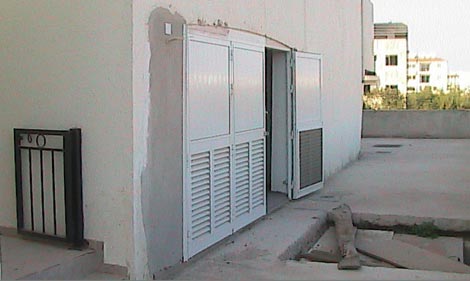
Illegal electricity substation
Illegal electricity substation built in a garage of a block of flats in Paralimni

LONG SUFFERING residents of a block of flats in Paralimni who were left without electricity for 13 days in October are furious after developers built an illegal high voltage substation on their property – to supply another building.

The bizarre twist comes as the complex still remains without a legal supply, five years after developers promised to fix the problem.

Since 2005, a single electric cable, illegally plugged to a nearby house has supplied 24 apartments, resulting in the occupants suffering a constant stream of cuts and blackouts.

In early October developers told the Cyprus Mail that a legal supply would be switched on within 10 days, but since then the situation has gone from bad to worse, with an illegal and potentially dangerous substation being constructed on their doorstep – for the exclusive use of an adjacent complex. (see Paralimni residents left in the dark)

The substation, which has been built in a garage below one of the apartments, extends on to the patios of two other properties and has left residents bewildered and angry.

Residents claim they were not warned about the substation and have voiced fears that it poses a possible risk to their health. They also point to official guidance that states that such units should be sited at a maximum distance from dwellings, schools and businesses.

Substations generate strong electromagnetic fields and according to the Electric Authority’s own published guidelines, the station is illegal: “Such substations are located on the borders of building plots (preferably in areas surrounded by greenery so as to maximize the distance from residential developments), in commercial and industrial developments, in apartment bocks and/or other developments requiring a significant electrical load”.

Ian Hudghton MEP
Ian Hudghton MEP

The EAC has confirmed it is conducting an investigation into the matter, and Ian Hudghton MEP has requested that developers halt any further work to enable an urgent site inspection.

Despite MEP Hudghton’s pleas, the electric station has been activated and is now transmitting 24-hours a day. Pantelakis Kyriakides, a spokesman for the developers would not be drawn on the matter, only commenting that: “We are working on it.

One apartment owner, who wished not to be named, said the situation was astonishing with the residents left to suffer the consequences.

It’s absolutely ridiculous. They (the developers) built an illegal electric substation in a residential building that has no electric of its own,” he said.

Furious Paralimni residents still await electric supply

MEP Alyn Smith asks Cyprus president to help

Alyn Smith, MEP for Scotland

CONSTITUENTS of Alyn Smith, MEP for Scotland, have approached him for help in their cases involving the exploitation, extortion and fraud they have suffered in Cyprus as a result of buying property on the Island.

Earlier this year, Alyn raised a question in the European Parliament on the subject of Cypriot legal and property rights.

In the latest development Alyn has written to the President of Cyprus, Demetris Christofias, asking for his assistance in this matter and suggests that the President may wish to consider establishing a foreign investor advice service, or an impartial ombudsman to assist in such cases.

30th November 2010

Our Ref: AES/Cypriot Property
When replying please reply to: Brussels

President Dimitris Christofias
Presidential Palace,
Presidential Palace Avenue,
1400 Nicosia,
Cyprus

Dear President Christofias,

Cypriot property rights & legal concerns

I am writing to you, as a friend of your beautiful country, regarding concerns of my Scottish constituents surrounding the purchase and build of properties in Cyprus.

I have received many letters which all express similar, if not the same, concerns regarding the difficulties they have encountered when buying or building properties in Cyprus. Despite attempting to seek a solution to their problems through Cypriot channels, they have received no assistance and so have instead approached me as one of their representatives in the European Parliament for guidance.

Over the last few months I have heard complaints of substantial build delays, illegally-obtained Power of Attorney documents, unauthorised draw-downs of money, failure to obtain rental licences, unfinished and poorly maintained properties, remortgages on land, and extortionate mortgage and maintenance fees. In one case, a constituent found that the entire amount of her mortgage was taken and used to fund an entirely different project, leaving her with a £150,000 mortgage in Cyprus and only a concrete shell to show for it. As a result of practices like this, hundreds of UK investors have defaulted, and will default, on their mortgages and file for insolvency, losing their deposits and their homes, suffering the risk of Cypriot banks pursuing their UK assets to recuperate their losses.

I am afraid that I have been informed that many of those who have attempted to take legal action in Cyprus against such unscrupulous practices have found no solace in the legal system. Firstly, those lawyers who have been engaged to deal with property transactions have deliberately or neglectfully failed to perform the relevant checks. Further, lawyers have refused to represent members of the public who wish to take civil action against other lawyers. I am told that complaints directed to the Cyprus Bar Association are consistently ignored also.

Clearly, with such a volume of investments some are bound to go wrong, and there are property disputes in every country.  However, I am afraid that the volume of complaints I am receiving is growing, and I think it right to make you personally aware that the combined actions of this sector are reflecting poorly upon your country, which I personally know well.  Reports such as the ones that have reached me do nothing to encourage faith in the legal processes of your country and therefore are very unlikely to encourage further or prolonged investment by Scottish citizens.

Perhaps you may wish to consider establishing a foreign investor advice service, or an impartial ombudsman for such cases as it would appear to me that, at the very least, the existing domestic channels are not functioning as well as they might be expected to.

Thank you, and I look forward to receiving your reply at your earliest convenience.

Yours aye,

Alyn Smith MEP

About Alyn Smith

BORN in Glasgow in 1973, Alyn grew up in Scotland and Saudi Arabia, returning to Scotland in 1986. He studied Law and European Law at Leeds University and spent an Erasmus year studying at Heidelberg in Germany.

He graduated from Nottingham Law School in 1996. Alyn also gained a Masters degree in European Studies from the College of Europe in Warsaw. After a year teaching English in India and working with Scotland Europa in Brussels, Alyn moved to London where he qualified as a lawyer with commercial law firm Clifford Chance.

In 2000 Alyn moved back to Scotland working first for a legal firm in Edinburgh and from 2002 for Richard Lochhead MSP then the SNP Group at Holyrood as an adviser on European, Justice and Business policies.

Elected to the European Parliament for the first time in 2004 and re-elected in the SNP victory in the 2009 election, Alyn is Scotland’s youngest MEP and is Honorary President of both the youth wings of the SNP, the Young Scots for Independence and the Federation of Student Nationalists, as well as a member of the SNP’s National Executive Committee. In Parliament, he is a full member of the Agriculture Committee and won the coveted Scottish Farmer Magazine award for “Outstanding Contribution to Scottish Agriculture” at the Highland Show in 2009. He is an alternate member of the Education and Culture Committee in addition to the Constitutional Affairs Committee. He is a full member of the Delegation for relations with the Arabian Peninsula, and also sits as alternate member on the Parliament’s Delegation for Relations with Switzerland, Iceland and Norway.

Alyn and his partner Rob live in Edinburgh.