Total sales continue to fall during November

FIGURES released by the Land Registry on Thursday show that property sales fell for the fifth consecutive month in November compared to last year, signalling that the property market will continue to face difficult times in the coming year.

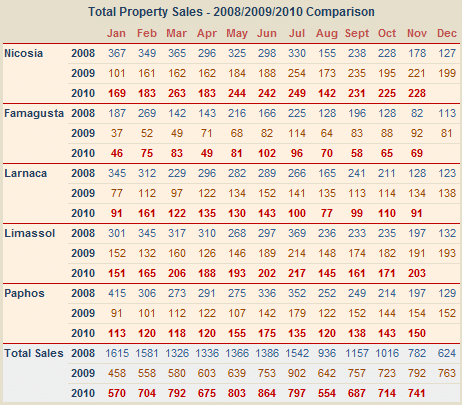
According to the Land Registry, the number of contracts of sale deposited at Land Registries throughout Cyprus during November was 741 compared to 714 during the previous month and 792 in November 2009. The annual decline in November reached 6% compared to the 1% decline experienced during October.

The hardest hit areas were Larnaca, where sales in November were down 32% compared to last year, and Famagusta where sales fell by 25%. Sales in Paphos fell by 3%.

The areas of the island least affected by the downturn in the market are Limassol and Nicosia as their market is not dependent on holiday home sales. Nicosia sales went up by 3%, while Limassol’s were up 6% compared to November last year.

Nationally, sales so far this year have reached 7,901; an increase of nearly 7% on last year’s total of 7,407.
Cyprus property sales November 2010
Property Sales (Source: Department of Lands and Surveys)

The general picture for the first eleven months of this year is similar to that of November, with sales in Nicosia and Limassol increasing quite strongly, while other areas are in recession experiencing lower or negative growth. In the first eleven months of 2010, property sales in Nicosia and Limassol have increased by 16% and 10% respectively, while those in Paphos have risen by 4%.

However, sales in Larnaca have fallen by 5% and in Famagusta they have dropped 1%.

Downward trend to continue into 2011

According to property valuer, Polys Kourousides, stagnation will continue and the year will close with a slight increase mostly due to last year’s low basis.

Things in 2011 will be the same as those in 2010. Nicosia and Limassol, which were kept high in 2010, might be affected more”, he concluded.


Plans for new shopping malls in Cyprus

CONSTRUCTION work on two new shopping malls is expected to begin early next year. The first of these will be constructed in a suburb of the capital Nicosia; the second will be built in Paphos.

Nicosia mall

The new ‘Nicosia Mall’ will be built in the Lakatamia-Anthoupolis area of Nicosia. It will include several department stores, supermarket(s), various shops of different sizes, a playground and 1,700 car parking spaces. The total indoor area of the new mall will be approximately 82,000m2.

Cyprus Nicosia Mall
The new Nicosia mall - Artwork: InBusinessNews.com

Paphos mall

The new mall in Paphos will be located in the tourist area, close to the Tombs of the Kings Road and St. Paul’s Avenue on a 46,181m2 plot of land. It will also include several department stores, supermarket(s), various shops, restaurants, covered playground and underground parking spaces for 1,100 vehicles. The total indoor area of the new mall will be approximately 48,000m2.

Cyprus Shopping Mall in Paphos
The new Paphos Mall - Artwork: K. Athienitis Contractors-Developers Public Ltd

We understand that planning permission for both malls has been granted and that construction work will start in 2011. Both malls should be completed in 2013.

(Currently, the ‘My Mall’ shopping mall at Zakaki in Limassol is the largest shopping mall in Cyprus, providing shopping facilities, entertainment and more than 1,600 parking spaces.)

Cyprus to host international real estate congress

THE 62ND annual world congress of the International Real Estate Federation (FIABCI) will take place in Paphos from May 16 to May 21, it was announced yesterday.

Speaking at press conference yesterday Commerce, Industry and Tourism Minister Antonis Paschalides hailed the announcement as “a very important professional and economic event.

He said: “I am sure this will be a great success.A Congress of such international calibre honours Cyprus and has both political and financial benefits”… All professions can benefit from this great major international conference in Cyprus.

Paschalides also said he was pleased that the event would take place in Paphos because of its recent real estate difficulties, and that the congress would be a “big injection” for the area.

FIABCI President Dinos Michaelides said “We are all very honoured by the awarding of the annual World Congress in our small country” adding that it will not only highlight Cyprus but would attract further investment from the delegates, who have invested in Congress host countries in the past.

For example, Michaelides said that during this year’s annual Congress in Indonesia purchases amounted to almost 1 billion dollars while at the congress in Greece 1450 delegates turned up.

President of the Republic Demetris Christofias is to open the Congress.

Cyprus Federation of Business and Land Development President Lakis Tofarides also welcomed the news, thanking Michaelides for bringing the congress to Cyprus, which he described as “a weapon to our arsenal” that would strengthen the political entity of Cyprus.

FIABCI has more than 3,500 members from more than 70 countries and is the umbrella for all the organisations related to property development. It is the only real estate organization represented at the United Nations’ ECOSOC and UNECE.

 International real estate conference to be held in Cyprus

FIABCI world congress promotional video

[youtube=http://www.youtube.com/watch?v=OlTfqLPqjoQ&w=470]

Construction slowdown continues in September

THE Cyprus Statistical Service (CYSTAT) has announced that the number of building permits authorized by the Municipal Authorities and the District Administration Offices during September 2010 was 717, comprising:

  • Residential buildings – 499 permits
  • Non-residential buildings – 98 permits
  • Civil engineering projects – 43 permits
  • Road construction – 11 permits
  • Division of plots of land – 66 permits

Focusing on the 499 permits issued for the construction of residential buildings, these were approved for 903 dwelling units – 368 single houses and 535 multiple housing units such as apartments and other residential complexes.

Compared to the September 2009 total of 1,577 dwelling units, this represents a fall of 42.7%.

Cyprus building permit numbers September 2010
Source: Cyprus Statistical Service

Between January and September 2010 building permits were issued for the construction of 8,192 residential properties. Compared to the same period last year, when permits were issued for the construction of 9,587 residential units; a fall of 14.6%.

European Union Statistics

EARLIER this month EUROSTAT, the European Commission’s statistical arm, published a report containing an analysis of building construction based on building permit statistics. According to report:

During the last ten years, the EU-27 building permits indices climbed from a low around the end of 2001/beginning of 2002 to peaks during 2006 and the first quarter of 2007, after which the indices fell. The index based on the number of dwellings recorded growth in most quarters during the second half of 2009 and the first half of 2010; the building area index recorded its first positive rate of change in the second quarter of 2010 following 12 consecutive negative quarter on quarter rates of change.

Further reading: An analysis of building construction based on building permits statistics

Could Spanish nightmare happen in Cyprus?

A COUPLE could be forced to sell their £300,000 cottage in Wiltshire to repay a £145,000 mortgage they took out to buy a holiday flat in Spain. Their nightmare case was reported yesterday in the MailOnline website.

Last year, when repayments became difficult, the couple contacted the bank and offered to return the apartment to them. But the bank refused to accept it and instigated efforts to seize their home in the UK.

Banco de Sabadell, the bank that loaned the couple a £145,000 mortgage to buy a holiday flat, is using a European Enforcement Order (EEO) to take control of their three-bedroom home near Chippenham in Wiltshire, where the couple have lived for 20 years.

An EEO is intended to be used for uncontested claims in civil cases across EU borders. However, evidence has come to light that Spanish officials have stretched the meaning of ‘uncontested’ to enable banks to fast-track claims on UK property.

The couple first learnt about the bank’s plan when they received an ‘interim charging order’ from a county court. An interim charging order is the first step in registering an interest in someone else’s property, usually because of a bad debt, and it could lead to the possible forced sale of the couple’s home.

According to an EC spokesman, the bank was under no obligation to notify debtors and that, in principle, no appeal is possible against the issuing of an EEO. Their financial crisis means that they cannot afford this.

The couple have been advised that they cannot appeal against the order in the UK. European law allows them to challenge it, but only in a Spanish court.

The couple are naturally devastated – there could be many thousands of Brits in a similar position to themselves. On Tuesday, the county court at Trowbridge is due to make the interim charging order on their property absolute, after which Banco de Sabadell may force the sale at any time.

Agreement on town-planning development in SBAs

A SPOKESMAN for the Interior Ministry yesterday informed the House Commerce Committee that the two sides had reached a technical agreement, which is soon expected to be ratified by the Foreign Ministry and the Bases.

After 50 years of the Bases’ presence in Cyprus, the residents in communities within them will have the right to develop, manage and make use of their properties, just like the rest of the Cypriot public.

The Commerce Committee has managed to launch the possibility of an agreement between Cyprus and the Bases for the recognition of the residents’ rights, so they can develop their properties as they desire,” said Committee Chairman, DISY’s Lefteris Christoforou. “They can’t not have the same rights as the rest of the citizens.

Christoforou maintained that developing areas within the Bases would lead to a broader development of the Cyprus economy.

According to what was heard at the House yesterday, the agreement requires a town-planning scheme and the same procedure that applies in the rest of the Republic will be implemented. However, the town-planning licences will be issued by the Bases.

The English are insisting on having the last say, but the town-planning legislation that exists in the Republic will apply,” said DIKO’s Angelos Votsis.

Votsis explained that sales and purchases will be allowed only for Cypriot citizens. “Especially in the Akrotiri area, there is another problem with the Bases’ arbitrary decision to appoint a large area as protected land for wild bird life,” he added. “The Interior Ministry has already sent a letter of complaint. We are demanding a revocation of the order, so that the area can start being developed; in the next months.

Once the agreed town-planning scheme exists, the English will be obliged to issue licenses, based on the agreement they have in front of them,” said Votsis.

Cyprus development within British SBAsEditor’s note

The British Sovereign Base Areas of Akrotiri and Dhekelia comprise those parts of Cyprus which stayed under British jurisdiction and remained British sovereign territory when the 1960 Treaty of Establishment created the independent Republic of Cyprus.

They cover 98 square miles, 47.5 around Akrotiri, the Western Sovereign Base Area (WSBA) and 50.5 around Dhekelia, the Eastern Sovereign Base Area (ESBA).

The Akrotiri Wetlands in the WSBA holds around 30 species of birds qualifying under EU Directive 79/409/EEC on the Protection of Wild Birds, while the Episkopi Cliffs holds a further seven, including the Elenora’s Falcon and the Griffon Vulture.

Further reading: Consultation on the Designation of Special Protection Areas within the Western Sovereign Base Area.

