Cyprus town of Limassol to get seafront upgrade

CONTRACTS have been signed for the upgrading of the Limassol seafront at a cost of approximately €18 million, part-funded by substantial grants from the European Union.

The project will concentrate on the section of seafront extending from the town near the Catholic Church to the Holiday Inn Hotel and back to the Limassol’s old port and the new marina that is currently under construction. Work is scheduled to be completed in two years and should be in its final stages during the time that Cyprus is holding the EU presidency.

The project will feature open parks and green spaces to improve the aesthetic quality of the area; it will create more children’s play areas and two new cafés will be added. There will be considerable improvements to the pedestrianisation of the seafront area plus a skateboard park area for teenagers to enjoy. There will be more bus stops on the seafront and upgrades to the cycle paths.

The seafront upgrade is the fifth contract to be signed and is the last in a series of major infrastructure improvement projects to be undertaken in the Cyprus town of Limassol.

The first and second projects focus on the renovation work to the town’s historic centre. The projects aims are to protect and project the historic and cultural elements of the area, which includes the medieval castle, as well as the town’s architectural heritage. The projects include the creation of four news squares and extensive pedestrianisation in the town centre.

The third project involves the transformation of the Garyllis river area into a municipal park and the fourth is the major refurbishment, modernisation and upgrade of the Patticheon Theatre.

The Limassol Mayor, Andreas Christou, said: “Visitors, tourists, residents, everybody will look at Limassol town with new eyes, it will be a tremendous boost to our economy and give us a new confidence and character. The added benefit of our fully functioning TEPAK University and the numbers of foreign students and visitors this will bring into the town means Limassol will be almost unrecognisable as the seaside town and resort of even five years ago.

Brit plans to sue Turkish Cypriot properties Guardian

A UK-based woman of mixed British and Turkish Cypriot origin says she plans to sue the Guardian of Turkish Cypriot properties over what she says is gross mismanagement of hundreds of donums of her family’s land in Nisou.

Vedia Izzet, 40, says she will take legal action against the Guardian – the Interior Ministry – because a portion of her family’s property was parcelled off and given to property developers to build luxury homes. Other parts of the 300-donum site have allegedly been used accommodate warehouses, a garden centre and a number of business outlets.

The Guardian is not looking after the properties of Turkish Cypriots in the interests of the owners, as it claims to do. This is not protection; this is a protection racket,” Izzet told the Cyprus Mail. She added that although the Guardian was meant to collect rents on behalf of absent Turkish Cypriot owners, she had been told by the Guardian that no rent had in fact been collected. Other parts of her family’s land have also been expropriated by the government and now lie under the Nicosia-Larnaca highway. Her family has never received compensation for the expropriation, Izzet says.

I have been told the money for this was paid into a fund. However we have seen no evidence that it has been paid or that the fund actually exists”.

Izzet spoke to the Mail on behalf of her British mother who lives in the UK. She, Izzet says, inherited around 100 donums of family land when her husband former Cypriot judge Ahmed Izzet died in 1993. A further 200 donums belong to two of Izzet’s aunts.

When my father died and left the land to my mother, it effectively became British land because my mother is British,” Izzet said, casting doubt over whether the Guardian of Turkish Cypriot properties still held the right to handle the land. She also says if she has to take on the Guardian in court, she will do so as a UK citizen, and not as a Turkish Cypriot.

I’m British. I have never been Cypriot,” she said.

After four years of battling with Cypriot bureaucracy to have the land put in her mother’s name, Izzet says she has spent the last year being “fobbed off” by the Guardian of Turkish Cypriot properties.

Each time we go to see the Guardian, there is another excuse for delays,” she said, adding that she had been advised by the Guardian that the only viable course of action would be to sue.

Izzet’s family connection to the land goes back to Ottoman times. Her great grandfather was the Kaymakam or District Officer of the area and is said to have lowered the Ottoman flag in Nicosia when the British took over in 1878. She says her case will hinge on the fact that in this case the Cyprus government has not, as it claims to, looked after the interest of the Turkish Cypriot landowners.

Another dimension to Izzet’s case is that although her family had lands in the southern part of the island, they did not live there in 1974.

In an effort to settle her property claim without resorting to the courts, Izzet said she offered to sell the government a portion of her family’s lands on which refugee housing had been built.

I think they didn’t accept the offer because they want to keep their refugees as refugees,” she said.

This is not the first time work of the Guardian of Turkish Cypriot Properties has come under fire. In 2005, a Turkish Cypriot claimed ownership of land on which the old Larnaca airport was built. More recently, a Turkish Cypriot claimed his land was being used as part of an oil refinery project.

Brit plans to sue Guardian of Turkish Cypriot properties

Building permits continue fall in August

THE Cyprus Statistical Service (CYSTAT) has announced that the number of building permits authorized by the Municipal Authorities and the District Administration Offices during August 2010 was 536, comprising:

  • Residential buildings – 397 permits
  • Non-residential buildings – 69 permits
  • Civil engineering projects – 19 permits
  • Road construction – 9 permits
  • Division of plots of land – 42 permits

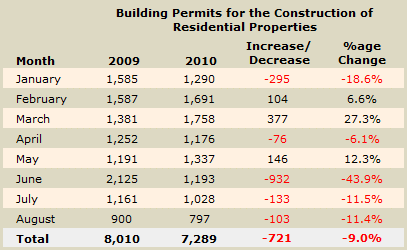
Focusing on the 397 permits issued for the construction of residential buildings, these were approved for 797 dwelling units – 351 single houses and 446 multiple housing units such as apartments and other residential complexes.

Compared to the August 2009 total of 900 dwelling units, this represents a fall of 11.4%.

Cyprus building permit numbers August 2010
Source: Cyprus Statistical Service

Between January and August 2010 building permits were issued for the construction of 7,289 residential properties. Compared to the same period last year, when permits were issued for the construction of 8,010 residential units; a fall of 9.0%.

According to the Cyprus Statistical Service, building permits constitute a leading indicator of future activity in the construction sector.

Cyprus rating cut on banks’ Greece exposure

STANDARD and Poor’s cut Cyprus’ long-term sovereign credit rating on Tuesday from A+ to A with a negative outlook, due to the credit risk of the island state’s external assets and domestic loan.

The downgrade reflects our opinion of increased vulnerabilities from embedded credit risk of the Cypriot financial system’s external assets and domestic loan book, and the impact these could ultimately have on public finances,” said Standard & Poor’s credit analyst Benjamin Young.

The banking index on the Cyprus Stock Exchange fell 4.48 percent on the news, according to the Cyprus News Agency, while the main market index closed down 4.41 percent.

Standard and Poor’s said after a decade of rapid expansion, the banks’ balance sheets now exceeded 700 percent of GDP, including both domestic and foreign institutions. During the past ten years, the Cypriot financial system’s total exposure to Greek customers and securities of the Greek government and corporations has grown to exceed 2.5 times of the nation’s GDP.

Although the system reports high capital levels, the sheer size of Cyprus’ financial centre poses funding risks in our view,” said the statement.

In addition, the relative size of Cyprus’ domestic credit, which stands at 280 percent of GDP, is among the highest in Europe. Much of it is collateralized by property assets, which have suffered an overall decline in value in the last two years, the rating agency added.

The Cyprus Finance Minister Charilaos Stavrakis insisted that local banks were well capitalised and able to absorb any shocks from Greece. However he did acknowledge that local banks had “some” exposure to Greece.

It is clear now that they (S&P) worry less about public finances, and much more about the perceptive risks of the Cypriot banking system,” he said.

Asked about bank exposure to Greece, he said: “I have seen the numbers myself and there is some exposure to Greek government bonds … even however in the very theoretical scenario that there was a problem with Greece, the banks of Cyprus have solid capitalisation and could absorb such losses.

Meanwhile, President Demetris Christofias urged the nation and its political parties to show understanding and responsibility to help the country get out of the financial crisis.

Cyprus’ 2010 fiscal deficit is expected to remain largely unchanged at 6 percent of GDP, compared with 2009 levels. The government has introduced austerity measures, new duties and taxes in a bid to cut the deficit in 2011 to 4.5 percent of GDP.

Small moves and a bit of understanding can help the economy exit easily from this situation, just as it had entered. I therefore appeal to you all to help in this direction,” said the President when he addressed a meeting of local business people.

The European Commission requires that Cyprus bring its deficit to within the Maastricht Criterion of 3% of GDP by 2012.

British developer shatters Cyprus retirement dreams

YESTERDAY ‘Inside Out West’ reported on a British property developer with some serious questions to answer, having fled Cyprus after taking an alleged €2.5 million from his customers since 2004.

The BBC investigative team tracked down Adrian Mills, the Managing Director of MDE Nest Homes, to the Gloucestershire village of Dursley where they confronted him.

After numerous court hearings in Cyprus, the judicial system failed to bring Mills to justice. The criminal case against him was dropped by the authorities after he failed to appear in court.

Properties built in the Paphos village of Nata were never completed and many suffer from major structural problems. Mills sold more properties at Choletria, but work on these never started.

An independent surveyor who visited one of the properties at Nata in 2007 declared the site unsafe; Nest Homes had never completed the project.

Speaking to the reporter Jonathan Barnett, who bought a property off-plan in Choletria and who paid more than £200,000 up front, said: “He (Mills) is a complete fantasist, a pathological liar – I have nothing but contempt for the man!” adding that “It’s been a complete and utter nightmare. I have never suffered so much stress in my entire life and we see no end in sight.

Ann Hinton had a lucky escape. She cancelled her contract when she saw the state of her home as it was being built. Ann was one of four buyers who eventually won a civil court judgement in Cyprus against Nest Homes for more than €1 million and who have been chasing the money ever since.

A tearful Ms Hinton said “I would like to think that he (Mills) would be made to feel like he has made myself and others feel. But quite clearly, he has no conscience.

Mills owes tens of thousands of pounds in personal loans made by former friends. One of them, Bernie Bowhay, said: “I’m disgusted at the way he has treated me.

The investigative team also discovered that tens of thousands of pounds paid by the buyers went directly to Adrian Mills himself, sometimes in cash.

BBC video news report

[youtube=http://www.youtube.com/watch?v=N1ozfxxf5I0&w=470&rel=0]

The EU and the Cyprus property scandals

SINCE the Cyprus Mail article ‘Legal Lifeline for Cyprus Property Buyers’ following MEP Daniel Hannan’s question on the matter to the European Commission, many buyers have assumed that if their contract was signed before December 2007 that they were not covered by the law; however this may not be the case.

could have monumental implications

The Cyprus Property Action Group (CPAG) firmly believes that the actions of developers in holding on to Title Deeds and especially taking out mortgages which encumber them is also an infringement of EU Directive 2005/29/EC and the Cyprus law 103 (I) /2007 which transposed it, regardless of when any sales contract was signed. This could have monumental implications.

To quote: “This Directive shall apply to unfair business-to-consumer commercial practices, as laid down in Article 5 (Prohibition of unfair commercial practices), before, during and after a commercial transaction in relation to a product”.

In order to support consumer confidence the general prohibition should apply equally to unfair commercial practices which occur outside any contractual relationship between a trader and a consumer or following the conclusion of a contract and during its execution.” We consider that until a clean Title Deed is transferred to the buyer any developer is infringing this law.

transfer title immediately a property has been paid for

The Directive also states that “Financial services and immovable property, by reason of their complexity and inherent serious risks, necessitate detailed requirements, including positive obligations on traders. For this reason, in the field of financial services and immovable property, this Directive is without prejudice to the right of Member States to go beyond its provisions to protect economic interests of consumers.” Clearly this means that buyers of immovable property should be protected even more stringently by the Government of Cyprus, which is ultimately responsible for consumer protection. We also believe that a positive obligation on a developer would be to transfer an individual Title Deed immediately a property is fully paid for, as happens elsewhere.

Furthermore, the Directive states “A commercial practice shall be unfair if: it is contrary to the requirements of professional diligence”, and also that “professional diligence’ means that the standard of special skill and care which a trader may reasonably be expected to exercise towards consumers, commensurate with honest market practices and/or the general principle of good faith in the trader’s field of activity.” We would argue that it is neither honest market practice nor good faith to deny buyers their Title Deeds or to allow them to illegally move into a property without a Completion Certificate, both of which can involve considerable risk for the buyers and especially so if the developer has a mortgage on the development.

pushing the EU lawmakers to rule on developers’ practices

The Directive itself has an annex which currently details 31 different commercial practices which in all circumstances are considered unfair and CPAG, through its supporting MEPs, will be pushing for the EU lawmakers to rule on the developer practices rather than these being tested in the failing Cyprus courts.

Since the Directive came into force, and due entirely to a spectacular lack of enforcement by the Government, this law has also been broken at sales time, by the various players through omission of material fact – i.e. developer mortgages – meaning that literally thousands of cases of infringements by developers, lawyers, banks and estate agents have taken place.

The Directive states “Member States shall ensure that adequate and effective means exist to combat unfair commercial practices in order to enforce compliance with the provisions of this Directive in the interest of consumers.

lawyers have not been advised of the law

It also appears that the Government failed in its responsibilities to even publicise these consumer protection laws as the Directive mandates: “Member States shall take appropriate measures to inform consumers of the national law transposing this Directive and shall, where appropriate, encourage traders and code owners to inform consumers of their codes of conduct.” When I started researching this law even the lawyers I contacted had not heard about it – two years after it had been transposed into law!

To quote further: “It is necessary that Member States lay down penalties for infringements of the provisions of this Directive and they must ensure that these are enforced. The penalties must be effective, proportionate and dissuasive.

As much of the basic information on these infringements, including buyers’ details, can be obtained from Land Registry records CPAG will be advocating that the European Union obtains full breakdown of the data gathering and monitors the punishment of the transgressors. Potentially this could provide massive funding towards any rescue plan – and any dodgy businesses will be more quickly culled.

no buyers should be forced to repay a developer’s debt

Finally, in the face of what could be massive sanctions from the EU, we believe that the Cyprus Government should quickly mitigate against this by guaranteeing that no buyer should be forced to settle a developer’s debt or taxes in the case of their developer going bust and that all buyers should be issued with a fully legal temporary certificate of registration (Title) forthwith.

They should then start taking this toxic developer debt out of the banking system for the good of everyone concerned and perhaps the property market would then have at least a fighting chance of some recovery.

Editor’s notes

Further Reading (English)

Directive 2005/29/EC ‘Unfair Commercial Practices Directive’

UK Office of Fair Trading ‘Consumer Protection from Unfair Trading’

Further Reading (Greek)

?????? 2005/29/EK «?????? ??? ??? ???????? ????????? ?????????»

? ????? ??????? 103(?) ??? 2007

? ????? ??????? 98(I) ??? 2007