ITV documents O’Dwyer case

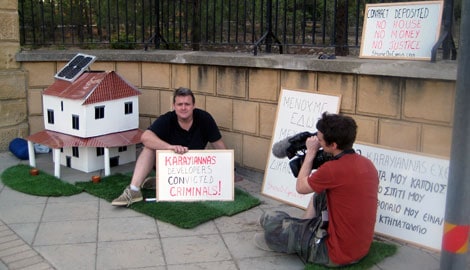
Conor O'Dwyer protesting outside the Presidential Palace in Nicosia with ITV crew

BRITISH national Conor O’Dwyer worked with the TV crew for two full days on Sunday and Monday as it documented the lengthy legal battle he has been involved in with a Paralimni-based developer since 2005.

The programme mainly focused on the fact that the contract to my property is currently in the Land Registry, my money is in the developer’s bank, while someone else is living in my house,” said O’Dwyer.

His legal battle began five years ago after he signed a property deal with Karayiannas property developer in Frenaros for the cost of £163,000.

O’Dwyer claims that after he purchased the house it was then resold without his knowledge by the developers.

Additionally, he says that soon after he purchased the house, the developers went back on their promise that an empty lot to the side of his property would not be built on. The developer, however, argued in court that this was never stated in the contract and they had already committed to building another property.

ITV also recorded O’Dwyer staging a one- man camping protest outside the Presidential Palace, which began on Monday and is set to and today, intended to highlight a criminal case being brought against him by the state for publishing his story online.

O’Dwyer is set to appear before a Paralimni court as a defendant on November 23 accused of publishing slanderous video footage of his developers on his website.

The reason for this demonstration is to highlight what some Cypriot local developers are doing to foreign investors and how the state is letting them get away with it,” said O’Dwyer.

Additionally, Attorney General Petros Clerides has filed an appeal against a court decision regarding the assault of O’Dwyer by his developers.

Paralimni court recently sentenced 55-year old Christoforos Karayiannas and his son Marios, 35, to a 10-month suspended jail term for assaulting O’Dwyer in 2008.

A third man was also found guilty of assault and was ordered to pay a €3,000 fine.

The court found the men guilty of causing actual bodily harm (ABH) but Clerides has appealed for a more serious sentence of grievous bodily harm (GBH), which carries a maximum of seven years.

During the trial, the court heard how the three men rammed into O’Dwyer’s car in Frenaros village and then beat him, resulting in him being hospitalised for a week.

ITV documents Conor O'Dwyer case

Shots fired at British TV crew

Shots fired at British TV crew investigating property scams in CyprusACCORDING to reports in a number of Greek language newspapers, shots were apparently fired in the direction of a British TV crew filming in Cyprus for the upcoming ITV series ‘Homes from Hell’.

The incident occurred last Sunday when the crew travelled to Frenaros to film the property at the centre of the Conor O’Dwyer case. While filming at the rear of the house they heard gunfire and the sound of shotgun pellets landing in their vicinity.

At the front of the house the film crew were confronted by a number of men. They were told that they were on private property and were ordered to stop filming.

The TV crew reported the incident to the Famagusta Divisional Police Headquarters. But apparently the Police declined to visit the scene saying that the shots probably came from hunters in an area near the property where hunting is allowed.

We shall bring you more news on this story as it unfolds. The TV crew are flying back to the UK this evening and we hope to speak with them early next week.

Long queues at Paphos land registry

A NUMBER of government offices in Paphos are still short staffed despite assurances from the state that these problems would be resolved.

A lack of staff in both the town planning department and the Land Registry offices in particular has meant that the public have been subject to continuing delays and long queues.

According to local MP Fidias Sarikas, considerable pressure to improve staffing levels was put on the relevant government departments by Paphos authorities months ago, but little has changed.

He said that although the town planning department received a few new staff, the Land Registry were given none.

The MP added there are long queues at the Land Registry department every day.

This is not just caused by bureaucracy and red tape, but also by a severe shortage of staff,” he said, adding that the number of new employees at town planning was still insufficient to make any real difference

Sarikas added that he will meet with the district manager of the Land Registry to discuss the matter and try to come up with a solution.

In the meantime, Nicolas Lemonaris, on behalf of the Association of Estate Agents, said Paphos was being discriminated against.

Other towns are afforded a better service provided to them from the Land Registry department,” he said, calling on the general public and local officials to react in a ‘dynamic way’ to get results.

Dinos Demitriou is a 34-year-old professional working within the construction industry in Paphos. He said that regular weekly and sometimes daily visits to the town planning department and the land registry offices are required as part of his job. He describes them as “hell on earth”.

The staff do their best but they are just overwhelmed,” he said. “The only way to get anything done is to go to the offices really early, but even then there are generally people waiting, especially at the Land Registry.

The government really must do something to change the situation. Procedures take far too long to follow, and staff are at breaking point.

Bombers target Cyprus developer

ACCORDING to police reports the bomb, which was placed outside the offices of Famagusta Developers, went off at around 9:00pm; fortunately no-one was injured by the blast.

The explosion shattered the company’s front window and caused minor damage to the entrance of the building. The total cost of the damage was estimated to be in the region of €1,000.

In August, the Cyprus police announced the company was under investigation in connection with eight complaints filed against it since 2007 – seven in Famagusta and one in Larnaca. The cases mainly concern alleged forgery, obtaining money and property under false pretences and usurping property belonging to another person. In one of the cases, the developer allegedly sold the same flat twice and when was asked to return the money to one of the buyers he issued him a dud cheque twice.

Shortly after, the company and its director Kypros Kyprianou filed a suit against Phileleftheros demanding over €2 million for “written slander and or libel and or damaging lies” for one of its reports entitled “Famagusta in Court.

Are we about to see justice for all?

THE CRASH of the stock market, in which thousands lost their life savings or ended up with huge debts that they are still paying off today, ensured that very few people would ever again view the Cyprus Stock Exchange as a trustworthy institution. The CSE authorities may have introduced tighter controls and tougher regulations after the fiasco but, 10 years on, investing in the shares of companies listed on the exchange is still considered risky activity by the majority of people.

Once the damage is done, it is very difficult to change people’s perceptions, more so when the authorities fail to take punitive action against the culprits, professionals who knowingly misled investors with cooked accounts and unrealistic forecasts. The overriding impression created was that the law offered no effective protection to investors from dishonest businessmen looking to make a fast buck at the expense of gullible people.

Making the same mistake again

THIS SAME MISTAKE has now been made in the property market, which also went through a ‘bubble phase’, attracting all sorts of cowboys, posing as developers, who saw an opportunity to make a quick profit. Most of the buyers were foreigners and therefore easy prey as they were not aware of the Cyprus laws and were not guaranteed reliable legal advice.

The results are well-known and far from flattering for Cyprus. One couple recently lost their flat, some buyers were sold properties that had already been sold, others ended up in flats without electricity and there are close to 10,000 foreigner property-buyers without Title Deeds, praying that the developer would not go bankrupt and the bank takes over their property. There has been one positive case in which owners sued a lawyer who had misled them and were paid damages in the region of €100,000.

This mess has received extensive media coverage abroad, particularly in Britain from which most buyers of holiday homes came. British MEPs have raised the issue of Title Deeds at the European Parliament, thus making the problem known across Europe. It was the worst possible publicity the struggling holiday home market could have received as it amplified the effects of the recession and jeopardised the future of many developers.

Given that government proposals on the Title Deeds issue, which also affects some 90,000 Cypriots, will solve none of the old problems, there was only one way for Cyprus to rebuild its tarnished image – taking a tough line in cases of developers deceiving buyers that were brought before justice. It was critically important to show that the law offered protection to foreigners who had been deceived by locals; the case of the lawyer who had to pay damages to his clients was a step in the right direction.

But in the last week this good work has been undone by the case of Conor O’Dwyer who had been assaulted by three men (a developer he was in dispute with, the developer’s son and an associate) and was hospitalised for a week. His three attackers were found guilty of causing actual bodily harm by the court but the judge did not give a custodial sentence. Father and son were given a 10-month suspended prison sentence while the third man was fined €3,000. The developer had also crashed his car into O’Dwyer’s but for that misdemeanour the court gave him two penalty points, instead of three that would have caused him to lose his licence.

The court’s leniency towards O’Dwyer’s attackers was quite astonishing and will not boost the confidence of foreigners in our justice system. It is more likely to encourage the view, rightly or wrongly, that the courts are not very tough on crimes by Cypriots against foreigners. To add insult to injury, O’Dwyer now faces criminal charges for posting offensive and harassing messages “without reasonable cause”, for publishing personal data and for threatening violence.

The Attorney-general may have been obliged to charge O’Dwyer after the police received a complaint, but it seems bizarre that the state would prosecute for alleged offences committed six years ago. On Friday it was reported that the Attorney-general would lodge an appeal against the court’s decision and lenient sentence in the O’Dwyer case. One prosecutor told the Cyprus Mail: The Attorney-general’s position is that nothing changes because he is British or any other nationality. Justice is for all.”

The authorities may have finally realised the damage being done to Cyprus’ image by our system’s failure to protect property buyers, but unfortunately, this seems like a case of too little too late.

Are we about to see justice for all

Cyprus public debt reaches 105 percent of GDP

ACCORDING to the latest figures to be released, Cyprus’ debt to domestic and foreign creditors in the third quarter of 2010 reached €17.8 billion. This corresponds to 105% of the Island’s Gross Domestic Product and places Cyprus second in the list of the most ‘in debt’ countries in the euro area behind Italy.

However, the official calculation of the public debt in 2009 as reported in the Eurostat tables was 58%; one of the lowest in the euro area.

According to StockWatch, the discrepancy between the two calculations is mostly due to the “invisible” debt to the Social Securities Fund. Unlike the corresponding pension funds in developed countries, the Social Securities Fund is relatively new and still shows annual surpluses and an accumulated reserve estimated in excess of €7 billion.

The government has borrowed a large part of this reserve at an exceptionally low interest rate. For example, in the third quarter of 2010, the government borrowed €7.1 billion.

This is regarded as intergovernmental borrowing and achieved via 13-week bills, which explains why it is not included in the official public debt calculations. In addition, Cyprus is one of the few countries able to make this accounting “trick”.

So although the total public debt has reached €17.8 billion, the “official” debt is approximately €10.5 billion, which corresponds to 62% of the Island’s GDP.

The debt to the Social Securities Fund is increasing and must be repaid. To achieve this, the government decided to invest around €200 million/annum into other forms of investment. Since June 2009, it has invested €337 million in corporate bonds that receive an average rate of return of 4% compared to the 1.5% that the Fund currently receives.

However, the government’s debt to the Fund continues to grow.

In the past few years, a new intergovernmental borrowing has appeared, which is included in the state books as borrowing from the “Funds Under Management”. According to the Ministry’s technocrats, those funds include the Agricultural Insurance Organization, the Human Resource Development Authority of Cyprus etc.

Until recently, the state borrowing from those funds was zero.

Since 2008, there has been a sharp increase in this type of borrowing and according to latest data, the government debt in those funds stood at €199 million.

The comparatively high debt of Cyprus has been discussed by the European Commission.