Are property developers breaking EU law?

European Parliament in session
The European Parliament

VICE-PRESIDENT Reding’s reply to a request to send a fact-finding mission to Cyprus is very interesting as it would appear that there is at least one European Union Law that property developers, estate agents and others selling property are choosing to ignore, namely the Unfair Commercial Practices Directive 2005/29/EC.

The Unfair Commercial Practices Directive concerns unfair business-to-consumer commercial practices in the internal European Union market and covers goods and services including immovable property, rights and obligations.

Article 7 of the Directive discusses ‘Misleading omissions’ and states that a commercial practice shall be regarded as misleading if:

in its factual context, taking account of all its features and circumstances and the limitations of the communication medium, it omits material information that the average consumer needs, according to the context, to take an informed transactional decision and thereby causes or is likely to cause the average consumer to take a transactional decision that he would not have taken otherwise.

In layman’s terms what this means is that if you bought something (let’s say a property) and the person selling it to you failed to disclose information (about the property) that would have resulted in you not buying it, they were misleading you and would therefore be breaking European Union Law.

We know from the results of our mini-poll that we published in August that 98 percent of those who responded would not have bought a property in Cyprus had they known that their developer had mortgaged the land on which it was built.

Mini-poll results buying property on mortgaged land
Poll results - Buying property in Cyprus built on mortgaged land.

Of course, I cannot say categorically whether or not property developers (or banks who have granted mortgages to buyers of properties built on land that they knew was mortgaged) have broken the laws of the European Union; only the European Commission can answer that question.

So if you are one of those who has bought a property in Cyprus and subsequently discovered to your horror that the land on which it was built was mortgaged, I suggest that you write to your MEP and ask him/her to raise a question in the European Parliament.

British residents will find contact details for their MEPs on the website of the UK Office of the European Parliament.

Residents of other European Union member states can find contact details for their MEPs on the website of the European Parliament.

Can the Cyprus banks pursue me in the UK?

IN MAY last year I published an article ‘HELP – I can’t pay the mortgage!’ offering advice to those who were having difficulties in making mortgage repayments on properties they had bought in Cyprus.

More recently I have received numerous emails from people who have received letters at their UK homes from developers and banks in Cyprus who granted them mortgages to purchase property on the Island.

These letters warn that legal action will be taken against them in the UK courts if they fail to maintain their mortgage repayments. Some people who have received these warning letters were totally unaware that they even had a mortgage; all are very concerned of the threat of losing their homes!

It appears that lawyers (allegedly) acting on their behalf arranged mortgages after buyers had signed Power of Attorney documents that gave their lawyer very wide ranging powers to do just about anything on their behalf (including taking out mortgages they did not want, ask for, or need).

If you have received one of these letters, take heart. The laws in Cyprus are very specific on the certification of Power of Attorney documents:

Firstly, Power of Attorney documents must be signed in the presence of a Certifying Officer.

Secondly, if the person signing the document is not known to the Certifying Officer then either:

  1. That person must show the Officer their ID card or passport as proof of their identity and the Officer will then compare their photograph and signature or
  2. Their identity must be confirmed by two people who are known to the Officer personally and who will then sign the document as witnesses.

Thirdly, any shortfall in the observance of the law by the Certifying Officer may result in the Power of Attorney and any transactions done with its use, such as signing Contracts of Sale and obtaining mortgages, to be declared null and void.

(The Certifying Officer may also be held personally liable to pay damages to the person whose signature he certified without knowing him/her).

I advise those who have received letters threatening legal action by the banks in Cyprus to seek advice from their UK lawyer – and in particular their views on the outcome of a court case based on the information above.

Have the banks got wind?

It appears that the banks in Cyprus may have got wind of the situation and are aware of these invalid Power of Attorney documents and some other issues.

Some of them are sending mortgage application forms to people living in the UK even though they already have a mortgage.

By completing and returning a mortgage application form you would compromise any argument you may have that your Power of Attorney document is invalid.

The Cyprus banks are also sending out letters to those with mortgages asking them to sign statements confirming that they were advised of the dangers regarding exchange rate fluctuations and possible increases in other currencies interest rates.

What is clear is that by signing any such statements and returning them to the bank you would probably prejudice your case.

Furthermore, if you were advised to buy in Cyprus and to take a mortgage by a UK-based registered financial advisor who ‘witnessed’ your signature on a Power of Attorney document it obviously be considered as being an illegal document which would nullify any transactions done with its use.

You may wish to check with the Financial Services Authority (FSA) to see if your UK-based advisor is registered with them. If he or she is registered you may complain to the FSA and make a claim against your advisor on the basis that if you had been advised of the full facts about your potential purchase, you would not have gone ahead and bought. This would be especially so in the case where you later discovered that the developer had mortgaged the site on which he was building.

Should your advisor be unable to meet such a claim the Financial Services Compensation Scheme (FSCS) may very well be able to assist.

Cyprus court awards couple €100,000 in property case

Cyprus construction workTHE FAMAGUSTA district court has awarded a British couple €100,000 in damages for losses incurred through breaches of their contractual agreement with a developer who sold to them in the Famagusta district.

This could be the highest amount awarded by a court in Cyprus for such a case in recent years, if not longer, legal sources said yesterday.

Simon and Jennifer Penney filed a suit against FK & S (Varoshia) Properties Ltd in 2007, claiming the company had breached the contract regarding the sale of a two-bedroom villa in the coastal township of Paralimni.

The couple said the company had constructed the villa with an interior area 13.7 square metres smaller than what was agreed and it had also failed to deliver it on the agreed date.

The sales contract had been signed on January 18, 2005 and the house was supposed to be delivered in July 2005.

The Penneys eventually entered their problem-riddled home in July 2006.

The plaintiffs said there was a delay in connecting the villa with the water network while the developer failed to provide electricity.

The house was still not connected to the grid on the day the court issued its decision three days ago.

Throughout that time, the plaintiffs were forced to use a low-voltage generator for several hours a day and were unable to operate various appliances at the same time.

In fact – in her decision – judge Elena Efrem issued a statement saying it was the plaintiffs’ right for their villa to be officially connected to the Electricity Authority grid.

The Penneys, who were represented in court by Alexandros Coucounis of the Andreas Coucounis & Co. law office, also said the developer had failed to construct the villa properly, noting the shoddy workmanship and incomplete work.

FK & S (Varoshia) Properties Ltd is partly owned – 40 per cent – by K & M Famagusta Developers, which acted as the contractor and helped with the sales of the housing complex where the villa was located.

The plaintiffs said the villa was sold to them by Kypros Kyprianou although the defence denied he had anything to do with the company.

During her cross-examination, Jennifer Penney said Kyprianou – who later testified as a defence witness — presented the two companies as one.

She also presented a business card Kyprianou had given her with the name of the company, Famagusta Developers, his name and title – general manager.

The judge upheld Jennifer Penney’s testimony, saying she “left a good impression as a reliable and sincere witness.” That was not the case for Kyprianou’s testimony.

Thus, the testimony of defence witness one is rejected as unreliable in its entirety,” the judge said.

The plaintiffs also presented a well-documented case, presenting photographs and documents of every stage.

In its decision, the court upheld the plaintiffs’ claim that in addition to the losses they sustained due to the delays, incomplete work and faulty workmanship, they also suffered further loss due to the decrease in the goodwill of the complex, which in turn knocked down the value of their villa.

Cyprus court awards couple €100,000 in property case

Cyprus overseas property market review

A DRAMATIC slump in property sales over the past few years has left thousands of unsold villas and apartments littering the Island’s once popular hot-spots with some developers offering 30 percent price reductions in their attempts to attract buyers.

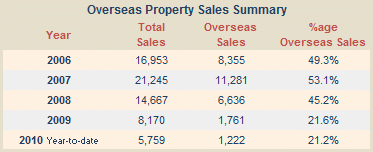
The monthly statistics published by the Department of Lands and Surveys reveal the extent of the problem:

In 2006, sales of property to overseas buyers accounted for 49.3 percent of the total market; and in 2007, more than half the number of properties sold were bought by buyers from overseas. As well as keeping the construction industry humming, overseas sales brought in billions of Euros of revenue to Cyprus, adding significantly to the Island’s economic well-being.

But during the first quarter of 2008, property sales to both local and overseas buyers started to decline. And in 2009, overseas sales had dwindled to a mere 1,761 compared to the 11,281 sold during the heady days of 2007.

Cyprus overseas property sales summary
Derived from figures published by the Cyprus Statistical Service

So what has caused the spectacular decline in Cyprus’ once prosperous and thriving overseas property market?

  • The fall in the value of Sterling against the Euro over the past two years means that British buyers, who account for some 50% of foreign buyers, have less equity at their disposal. At the beginning of 2007 a pound Sterling would buy you €1.47; today it will buy you around €1.20, making investments in the eurozone that much more expensive.
  • The worldwide economic turmoil has also changed the characteristics of the ‘typical’ overseas property buyer. British buyers are now being much more cautious about their investment decisions. Many have little confidence in the sales brochure marketing hype and developers’ off-plan deals and have all but deserted Cyprus in favour of safer places to invest their money.
  • Reports about the potential problems faced by buyers have become more widely publicised. Details of the Title Deed fiasco and developers abusing the island’s antiquated property laws have appeared on UK national television and made headlines in the press and elsewhere around the globe.
  • Having been contacted by many disgruntled buyers, MEPs and the European Commission are focussing their attention onto the goings-on in the Cyprus property industry and the government’s attempts to rectify the situation.
  • Where some other countries have lowered their mortgage interest rates and property taxes to encourage overseas investors, mortgage interest rates in Cyprus are amongst the highest in Europe and the government is talking about increasing property taxes it charges large land owners; a charge that will no doubt be passed on to those buying property. This approach is an anathema in other countries where governments have taken steps to reduce the costs associated with property ownership to encourage investment.

A major factor in reversing the collapse in the overseas property market is the ability of the Cyprus Government to develop, introduce and enforce effective legislation to deal with the many problems in the Island’s real eastate, banking and legal sectors.

Although the Cyprus parliament is discussing legislation, pundits believe that its scope is too limited and that it suffers from inherent defects.

In the meantime Chairman of the Estate Agents Association of Cyprus, Solomon Kourouklides, has stressed the need to find new markets for Cyprus, such as China, the Arabic countries and Iran.

Why Title Deed legislation cannot work

THE new legislation will neither correct the Title Deeds problem per se nor all its inter-related problems because it cannot do so, owing to its limited scope and its inherent defects. It is, in effect, nothing more than another planning amnesty designed to protect developers who have failed to obtain proper planning permission.

In particular, the new legislation will not address the following critical factors:

  1. The developer mortgage debt bubble hanging over Cyprus, estimated at €5.9bn in March 2009 and now probably €7bn, which, under the present flat market conditions and one-third drop in property prices, will deter the authorities, banks and developers from closing existing mortgages and issuing long overdue Title Deeds.
  2. Compliance with any requirements on developers will be essentially voluntary with no enforcement mechanism and minimal or no penalties for non-compliance i.e. the legislation will be unenforceable.
  3. The banks will not be barred from continuing their current practices of issuing or extending developer mortgages against properties that have already been sold; property buyers will still be expected to indemnify the bank if the developer goes bust; there is no automatic protection against errant banks that collude and connive with errant developers and their lawyers.
  4. The issue of rogue and negligent lawyers and the ineffectiveness of the Cyprus Bar Association in (a) setting and policing strict property conveyancing standards and (b) disciplining and removing errant members. (See Gavin Jones’s open letter to the Attorney General, for example).
  5. Perversities in the justice system, with the police generally barred by the Attorney General from investigating allegations of property fraud (a recent rare exception being the K & M Famagusta Developers case where Cypriot rather than foreign buyers were the alleged victims, implying that Cypriots are treated more fairly than foreigners).
  6. The tardy and ineffective justice system in which alleged property fraud victims are forced to take long-winded and costly civil cases against alleged perpetrators.
  7. The long standing gross inefficiency of the numerous government departments and municipal functions involved in the processing of all the many stages required before Title Deeds are issued; a system clogged with new applications and a huge pre-existing backlog may prove to be the main practical downfall of the new legislation.
  8. No obvious anti-corruption mechanisms are included.
  9. The legislation will not be retrospective; therefore the current backlog of buyers of 130,000+ properties (some 40,000 estimated to be British) still awaiting their Title Deeds typically 5-15 years so far, will receive no protection; if a developer mortgage exists on the land and the developer goes bust or is unable to service his mortgage debt, they could be subject to bank repossession.
  10. The new tiered system of Title Deeds is doomed to failure; for example, as only a fool would buy a property that did not have full, clean and unconditional Title Deeds, how will developers be able to sell their properties including their huge glut of unsold properties? This will put extra pressure on their gearing and liquidity and in turn on the banks. Also, many buyers who bought in good faith some years ago may suddenly find that their property has been devalued owing to the issue of an imperfect Title Deed. Who would want to buy their property with such a curse on it?

Buyer protection? It will still be virtual, not real.

Tax hikes to cut budget deficit

CYPRUS Finance Minister, Charilaos Stavrakis has put forward a series of measures designed to bring the Island’s 2011 budget deficit within the European Union limit of 4.5%. The budget deficit currently stands at 5.4% and the government is looking for a further €150 million to plug the gap.

Measures under discussion include:

  • A new tax calculation system for large landowners.
  • An increase in the Corporation Tax paid by Cypriot companies.
  • Some form of taxation on the banks.
  • Tax hikes on cigarettes and alcohol.
  • Imposition of 5% VAT on foodstuffs and pharmaceuticals.
  • Measures to restrain the state payroll.
  • Review of the public and quasi-public sector pension and bonus systems.

Pushing through these measures with government coalition partners will be difficult.

According to press reports, DIKO spokesman Fotis Fotiou has made clear that his party will not approve what it rejected three months ago (the increase in Corporation Tax and the taxation of properties).

Just a few days ago, the civil servants union PASYDY boycotted a meeting between the Finance Minister and the unions. Its head, Glafcos Hadjipetrou, refused to attend the meeting accusing Mr Stavrakis of showing “contempt” for the powerful union.

Whatever the outcome of the negotiations, you can be sure that the cost of living in Cyprus is set to rise. And those who have bought property from ‘large landholders’ and who have yet to receive their Title Deeds could well see their costs rise as developers try to minimise the impact of the new taxes.