THE Cyprus Statistical Service (CYSTAT) has announced that the number of building permits authorized by the Municipal Authorities and the District Administration Offices during June 2010 was 792, comprising:
Residential buildings – 563 permits
Non-residential buildings – 125 permits
Civil engineering projects – 35 permits
Road construction – 5 permits
Division of plots of land – 64 permits
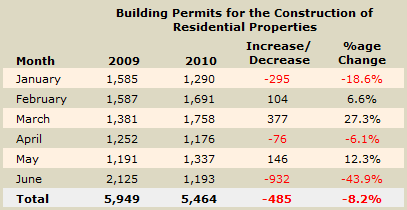
Focusing on the 563 permits issued for the construction of residential buildings, these were approved for 1,193 dwelling units – 479 single houses and 714 multiple housing units such as apartments and other residential complexes. Compared to the June 2009 total of 2,125 dwelling units, this represents a fall of nearly 44%.
Source: Cyprus Statistical Service
Between January and June 2010 building permits were issued for the construction of 5,464 residential properties. Compared to the same period last year, when permits were issued for the construction of 5,949 residential units; a fall of 8.2%.
According to the Cyprus Statistical Service, building permits constitute a leading indicator of future activity in the construction sector.
LEGISLATION designed to tackle the bane of unlicensed constructions across the island, as well as spelling out who is responsible for what in real estate transactions could be ready by next month and may at long last bring relief to thousands of ‘trapped’ property buyers.
It’s estimated there are some 100,000 Cypriots and foreigners without Title Deeds for their properties, the majority because of building permit violations.
Politicians are working on a cluster of bills involving a so-called ‘town planning amnesty’ and at the same time accelerating the issuing of building and town planning permits, which under the present circumstances takes years.
The bills should be ready to go to the plenum by mid-October, chairman of the House Interior Committee Yiannos Lamaris said yesterday.
“The town-planning regulations have two directions,” Lamaris said. “One leads to simplification of the procedures for issuing Title Deeds and of all those practices to which we had become accustomed so far.”
The second direction will allow people to ‘buy out’ minor violations, thus enabling the acquisition of a final certificate of approval for building and the Title Deed itself.
In certain cases, the violations will be disclosed on the Title Deed so that when a property is sold the buyer knows what they’re getting, Lamaris said.
Subsequently, the fact that such violations had existed would not impact the status of the structure, its functionality or the facilities available to the occupants.
“There shall be no arrangement which facilitates one person and inconveniences another,” Lamaris remarked.
One idea being mulled over is to have chartered surveyors furnish the property owner with a certificate attesting that construction works have been completed.
The Land Registry meanwhile is tasked with drawing up a ‘price list’ for violations which can be ‘bought out’ and thus ‘legalised’.
The list would class violations by type and by area, Lamaris said, although it was too early to say what the corresponding buyout fees would be. The cost list, when completed, would not require ratification by parliament.
DISY MP Christos Stylianides said that legislation to regulate town planning matters was long overdue, adding that it would “restore, finally, the relationship between the state and its citizens and the relationship between the buyer and the seller”.
He stressed that a solution to the problem was imperative to the island’s economic growth “but also, more importantly, to our country’s image and our efforts to maintain our credibility among tourists”.
“The ongoing discussion [at the House committee] is taking place in a consensual climate…and we feel that in the end, and with the assistance of government technocrats, we shall come up with a radical solution to a problem which for years has dogged our society and which sends out the worst possible messages abroad regarding the state of real estate development, Title Deeds and final certificates of approval in Cyprus.”
The backbone of the economy, the real estate sector has become heavily reliant on foreign buyers, particularly retirees. But the local market’s reputation has been dealt a blow after a series of allegations of property fraud, highlighted by the Cyprus Property Action Group (CPAG).
And earlier this year, a British couple won a landmark Supreme Court ruling by which they were awarded €120,000 as a result of their lawyer’s negligence in a property case.
The couple had sued their Cypriot lawyer for negligently handling a property contract in 1999, which led to them losing a significant amount of money while never getting the property. The lawyer had failed to inform the couple that the property had been twice mortgaged and had a charge registered against it. The developer who signed the contract subsequently went bankrupt and never finished the house.
THIS is the third publication of RICS Cyprus’ Property Price Index, a quarterly price and rental index which is based on methodology produced by the University of Reading, UK.
The Index tracks property and rental prices across all districts and main property types.
Introduction & Commentary
During the first half of 2010 Cyprus bore the brunt of the global economic crisis, with the economy slowing down and the government’s income decreasing. There was a significant reduction in property transactions, particularly from overseas buyers whose local economies, e.g. the UK and Russia, continued to suffer from the economic slowdown.
Towards the end of the second quarter, there were some early signs of stabilisation, with local buyers returning to the market taking advantage of lower prices for holiday homes. Also, some landmark projects received planning permission (Tersefanou Golf Course) or started construction (Limassol Marina).
These early positive signs need to be viewed within the wider context of a continuing curtailing of loans by banks and other financing institutions for property purchases, and to a change in people’s expectations of future changes in capital values and holding investment as an asset class.
Market Capital Values
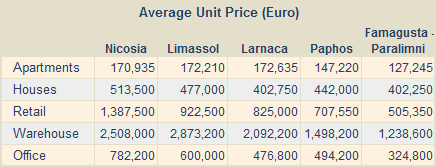
The Property Price Index has recorded a varied behaviour in property prices across Cyprus’ major urban areas, with residential prices falling across all districts and commercial prices fluctuating.
Residential prices for both houses and flats fell by an average of 2.5%, with the biggest drop for houses taking place in Paphos (-4.0%) and for flats in Paralimni (-3.3%). Values of commercial properties generally fell across all cities by an average of 0.5% for retail and 2.1% for offices. The exceptions were warehouses which rose by an average of 0.4%, greatly influenced by warehouses in Limassol which rose by 4.5%.
Source: RICS Cyprus Property Price Index
Market Rental Values
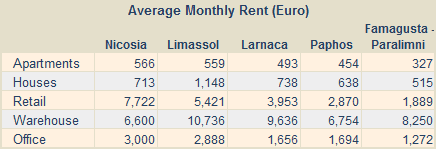
Across Cyprus, rental values for apartments rose marginally by 0.3%, whilst rents on houses, retail units, warehouses and offices fell by a respective average of 2.1%, 0.8%, 0.2%, and 2.1%.
The distribution of rental changes shows an interesting dichotomy between Nicosia, which continues to be stable, and the coastal cities. Rents for all property types fell in Paphos probably indicating the continuing woes of the city. Similarly rents in Limassol, except for warehouses, also decreased; a sign that the crisis in now beginning to affect the Limassol market.
Source: RICS Cyprus Property Price Index
Investment Yields
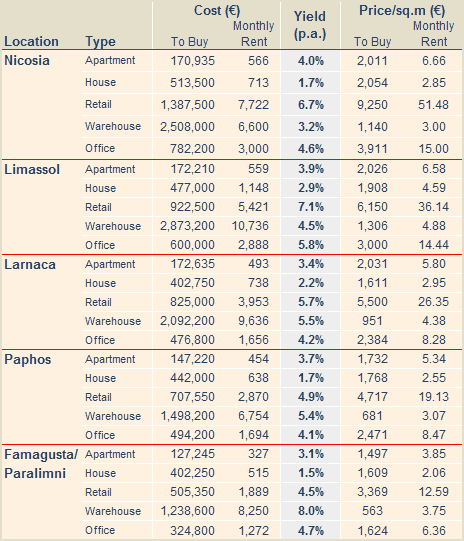
Yields are a useful tool showing the relationship between rent and property prices. Initial yields on commercial property increased slightly, and now stand at 6.0% for retail, 4.7% for offices, and 4.9% for warehouses. Yields on residential property are at a very low of 3.6% for apartments and 2.0% for houses, showing that prices relative to rents remain at multiples which are considerably above that of other European countries and that there is still room for rebalancing to take place.
Investment Yields (derived from the RICS Cyprus Property Price Index)
Outline of properties used to calculate the index
Apartments: Residential, two bedroom, 85sqm, Medium quality.
Houses: Residential, three bedroom with garden, Semi-detached, 250sqm, Medium quality.
Retail: High-street retail, 100sqm ground floor area with 50sqm mezzanine.
TOWARDS the end of last month, the Greek Language newspaper Phileleftheros (? ????????????) published a story on its front page about the problems faced by those who bought property from the company operating the Froiber brand in Cyprus, A&G Property Wise Development Ltd, that collapsed and went into liquidation last year.
We have received a letter, written by one of the Froiber buyers, describing the financial demands being placed on them by the Banks and the Cyprus Inland Revenue Department referring to the Froiber liquidation article in the Phileleftheros.
Dear Sir / Madam,
I would like to refer the following article to your attention.
The article outlines the unfair treatment of buyers of apartments sold to them by the Real Estate Developer Froiber. The unfair treatment concerns the banks to which Froiber currently owns millions of Euros (the company owns 4.7 million to one bank specifically) and them expecting the buyers to settle the loans. The unfair treatment also concerns the Inland Revenue Cyprus which also demands that the final buyers of the apartments settle taxes owed to the Inland Revenue by Froiber.
The situation has reached the proportions of extortion since the Inland Revenue and the banks threaten the buyers that they will not receive their title deeds of ownership to the apartments which they have paid for in full already, unless they contribute a ‘symbolic amount’ of at least 8,000 Euros per apartment to the banks and a few more thousand to the Inland Revenue. The problem is that the buyers are not receiving any protection from the law considering the fact that they were purchasing the apartments in good faith and have no responsibility or knowledge whatsoever regarding the mortgage of properties and amounts owed to the banks and IR by Froiber.
The banks have issued the loans to Froiber and it is the bank that should bear the risks of these loans. It is about time that the Cyprus legislation is updated to reflect these issues. For the banks the amounts mentioned in the article are symbolic, but to the buyers these are substantial amounts, and the banks have even gone so far as to offer loans to the buyers at “preferential terms”, so that they have a way of finding the money that Froiber owes them.
Unfortunately I am one of the buyers and I feel that this should be heard, since there are 17 blocks of flats that were built by Froiber and are facing the same problem, and we could say that they were built illegally if Froiber had no intention of settling the loans. I would like to request a program to be dedicated to this specific Froiber issue or the general title deeds and banks issue in Cyprus, since this is a big problem and the situation will be repeated in the future affecting more buyers.
I would like to propose for representatives of the various parties to be invited as guests of the program; representatives of banks, the Inland Revenue, the buyers, the government, the lawyers, the liquidator and others affected (i.e. Cyprus Property Action Group created by foreigners who bought property in Cyprus) in order for everyone to hear how these people are planning to tackle this serious issue, and exactly how the future will be affected if no action is taken for those who are already in this situation.
Lots of articles were published stating the complains of the buyers and the responses they had from banks, government and lawyers but not even one article was written with direct discussion with them and making clear their positions and what kind of legislation they base them on. Lots of lawyers are willing to discuss the problem and future outcome but when you enter their office all you hear is to pay when you are already in the situation. Their only suggestion is to consult a lawyer before buying. I am aware of the fact that you need to consult a lawyer before buying property so that I know if the land on which the property is built is mortgaged, and which I did, but the truth is that all the lands are mortgaged and the real estate developers are allowed by legislation to sell apartments for which they do not have the title deeds yet.
If someone wants to purchase a new flat, then they know that the land is mortgaged and there are no title deeds. If you want to purchase an apartment with title deeds, you need to purchase property which has been built over 10 years ago. When I was searching to buy an apartment I only could find one apartment with title deeds which was 20 years old, people do not have much options than believe that the title deeds will be issue or simply rent. Also another issue is that if you want to sell a property without title deeds you need to go through the developer, so he can cancel the contract of sale with you and enter a new one with the new buyer, in all cases developers agree to provide their signature only if they get a parentage of the selling price with the disguise of “service fee”. If you don’t agree then you cannot proceed. It is very difficult for me to understand why developers and banks are treated so preferentially comparing to the final buyer who by the end of the date face all the problems created by the previously mentioned parties and on top of that no matter to who they turn to i.e. banks, lawyers, tax representatives the only thing you hear is just pay, without much explanation, they don’t even want to enter into conversation to explain what kind of laws allow the current situation.
I would like to be able to get an honest answer regarding this problem because all the experts are simply advising the buyers (including me) to just pay and not enter the ‘trouble’ of dealing with it in another way, the interesting thing is that none of them ever told it publicly.
My question is: Can we actually go against the government for not offering protection to buyers of real estate in Cyprus? How far must a person go in Cyprus to receive his rights, which are so normal in other countries?
I would like to remain anonymous and for my identity to be kept secret.
IN COMMON with many people who have contacted me, Gavin Jones has considerable difficulties in getting an answer to a complaint he has lodged with the Disciplinary Board of Advocates. (You may also find the article by Antonis Louizou entitled ‘Well meaning or crooked lawyers’ interesting).
IN JUNE this year, you were interviewed by the Sunday Mail and were quoted as saying that ‘my only goal is to leave this post and have a good name, nothing more‘. In order to assist you in achieving this ambition, I would ask you to consider some serious issues which may well prevent you from realising your objective, together with some suggestions for removing these constraints.
I should, however, declare that I have a number of grievances with the justice system in Cyprus that are but examples of a generic malaise of which countless others are also casualties.
Twelve months ago almost to the day, I sent you, in your role as President of the Disciplinary Board of Advocates, all the corroborative evidence that would have enabled the Board to seriously consider striking off, fining and launching criminal proceedings for gross malpractice and fraud against the lawyer of my late Cypriot mother. Despite my original letter, follow-up correspondence and telephone calls, I have heard nothing.
It would appear that the Disciplinary Board has chosen to ignore the detailed evidence laid before it and has allowed a member of the Cyprus Bar Association to continue practicing.
Does the Disciplinary Board have any intention of ever addressing the fact that my deceased mother’s lawyer submitted false affidavits to the court without a death certificate and eliminated me as an executor of her will?
He also stated that he couldn’t locate me and that she’d died in England in 1998 when in reality she died in Paphos in 2007. Will there be an investigation as to how Paphos District Court authorised this lawyer to obtain ‘legal’ control over my mother’s affairs without demanding sight of a death certificate which would have proved conclusively that his affidavits were fraudulent?
Will I be recompensed for the inconvenience of having to obtain legal advice, return to court, remove my mother’s lawyer as sole executor and have myself reinstated as executor?
Are we to believe that the Disciplinary Board doesn’t take its duties seriously enough and is so overloaded with complaints that it is unable to process these within a reasonable timescale?
The Board presides over a body of barely 2,000 members and yet it has taken 52 weeks and no resolution to my case has been forthcoming.
Some would say that my mother’s and other lawyers who have been cited for fraudulent and negligent behaviour may well have powerful and influential allies. I’d like to think that this isn’t the case but inaction naturally invites such speculation.
As the Board gives the impression of acting in the best interests of its members rather than protecting their clients and the public, it suggests that this reticence to speedily confront fraud head-on within the profession has become institutionalised
You and your Board members may be unaware of the general consensus that a great many Cypriot lawyers are considered self-serving and untrustworthy pariahs and that their professional body, the Cyprus Bar Association, puts their interests firmly above those of the public.
This cosy modus operandi might have been the norm and considered acceptable when Nicosia, Limassol and Paphos were nothing more than oversized villages. In those days our ancestors ‘fixed’ situations with impunity. But times have changed and standards and expectations have risen
If you wish to leave the post of Attorney General with ‘a good name, nothing more’, the Disciplinary Board of Advocates and the Cyprus Bar Association should take a good look at themselves and make the necessary changes so that they’re seen to be part of the solution and not part of the problem.
An avalanche of questions is being raised in the European Parliament about many negative aspects of the administration and delivery of justice here.
The choices are clear-cut. The current judicial regime can remain untouched or else reforms can be introduced which will inject some extra credibility into the legal system to ensure that justice is done and seen to be done.
As a reformist, you will most certainly leave the post of Attorney General with ‘a good name’. I therefore urge you and your colleagues to make the right choice.
IN A REPLY to questions raised by MEP Ashley Fox in the European Parliament the Commission has replied positively saying that misleading claims made by unscrupulous developers concerning Cyprus’ planning and building regulations is an unfair commercial practice and therefore in breach of the ‘Unfair Commercial Practices Directive’, 2005/29/EC.
Building and planning regulations fall within the competence of the authorities of the Member State which should ensure their appropriate application and enforcement (monitoring and control of application and inspection).
The EU’s intervention is only justified in cases of potential discrepancy regarding the conformity of the national practices with the principles of the Treaty and EU secondary law, in particular in the domains of the Internal Market of construction products, energy efficiency and renewable energy sources, natural resources and environmental protection as well as health and safety at work.
According to the principles of the Treaty, all the provisions of building and planning regulations should be applied in an impartial, transparent and proportionate manner on the territory of competence of the authorities, whatever undertaking or citizen is concerned by these provisions.
As to the possibilities of judicial redress which expatriates living in Cyprus might have after being sold an illegal construction, the type of action available and the way to introduce it are governed by the national procedural law of the Member State where the competent court is located. European Union legislation only intervenes to determine which court is competent in a dispute involving two or more Member States and ensures that a judgement rendered in one Member State can be recognized and declared enforceable in another Member State. More specifically, Regulation 44/2001 on jurisdiction and the recognition and enforcement of judgements in civil and commercial matters1, provides that a claimant can bring an action for damages against the other party either at his place of domicile or at the place where the damage occurred unless the parties have agreed that a specific court should have jurisdiction to settle their dispute. Where the dispute concerns rights in immoveable property, e.g. the transfer of ownership, only the courts at the place where the immovable property is located are competent to hear the case. From the limited facts submitted to the Commission, it would seem that where British nationals residing in Cyprus are seeking redress against the seller of an illegal construction, an action for damages would have to be brought in the Cypriot courts unless the parties have agreed in the contract of sale or otherwise that their dispute should be settled in the courts of another Member State.
Directive 2005/29/EC2 provides a legal framework applicable against unfair business-to-consumer practices, including those for immovable property. Claiming that a planning or a building approval has been authorised by a public or private body when this is not the case, or not complying with the terms of such an approval, endorsement or authorisation is considered an unfair commercial practice. According to the Directive, Member States shall ensure that adequate and effective means exists to combat unfair commercial practices. However, the Directive leaves to Member States the choice of the concrete legal and administrative measures to be put in place. Cyprus has adopted such transposition measures by the Law on the Control of Misleading and Comparative Advertising of 2007 and the Law on the Unfair Commercial Practices from Businesses to Consumers of 2007.
References
1 OJ L 12, 16.1.2001 2 OJ L 149, 11.6.2005
Further reading: Property in Cyprus (click on the ‘Answers’ box to the right of the question)