Opinion: Cyprus Title Deed law changes

THE FIRST drafts of the laws designed to resolve the Title Deed problem were opposed by the Cyprus Bar Association that said they would “lead us into a labyrinth without solving the problem“.

In the Interior Minister’s statement on Title Deeds that we published in July last year, the Minister said that “Our policy aims to boost the property market in Cyprus, introducing effective and comprehensive practices for solving this (Title Deed) problem.

The most serious problem of all faced by existing buyers is that of outstanding developer mortgages. Both Cypriots and non-Cypriots have been duped into buying property built on land that their developer has previously mortgaged. However, the latest draft laws before parliament fail to address this vital issue.

People who find themselves in this invidious situation face the very real prospect of losing their homes to the banks if their development company fails (like Yiannis Liasides and A&G Property Wise Developments, whose buyers have been left to the mercy of the banks).

Another significant problem, highlighted by the Cyprus Bar Association and others, is that the ownership of a property is linked to the myriad rules and regulations regarding planning and building permits.

Whether you buy an un-roadworthy vehicle, a tumbled down village house, a box of melted chocolates, or a flea infested animal, you should be able to claim it as rightfully yours; irrespective of whether it is fit for use or violates some safety regulations or rules.

But yet again, the revised laws fail to disentangle ownership of a property from the complexities of the planning system and the government plans to introduce yet another level of bureaucracy, a Commission, to sort out the mess (or should I call it a Gordian Knot).

In cases where there are ‘significant’ construction irregularities, a prohibition is to be placed on the property’s Title Deed preventing it being sold, transferred, mortgaged, etc.

Is anyone in their right mind going to pay the government’s estimated average cost of €8,000 in transfer fees and taxes to secure ownership of something they cannot sell?

Furthermore, such a law may also result in the government losing much needed revenue. A property that cannot be sold will have no market value and as such, the Inland Revenue may unable to collect Immovable Property Tax from its owner.

And what about the banks; will they be willing to loan money to purchase property that could, potentially, have no market value?

Another ‘hidden’ problem revolves around the owner having to apply for a Certificate of Final Approval within 21 days of completing a project. On the face of it, this seems a sound suggestion. However, when you consider that the completion of a project may take 8 to 18 years after its building permit has been issued, buyers could still find themselves waiting for 18 years to get their Title Deeds.

Positive changes

The revised laws will be of benefit to new purchasers in that properties being sold must be free of a mortgage and any other encumbrance. Also, where a property or a building site is being sold, the contract must be accompanied by a building or division permit.

These changes are very positive and will no doubt encourage sales of new property. (Although it could still take up to 18 years for Title Deeds to be issued).

The planning amnesty is also a positive move. It will help those who have purchased property with ‘minor’ construction irregularities to secure their Title Deeds. But it will only succeed if property developers and others who have contravened the planning regulations are prepared to pay the price for their misdemeanours.

Opinion

THE ONLY people to benefit significantly from these new laws are the banks, property developers, lawyers and the Cyprus government’s coffers.

The fact that future sales will be mortgage free and contracts will be accompanied by the required permits will encourage people to buy new property leading to more business for property developers, banks, and lawyers.

But the new laws will take away the responsibility for protecting existing buyers from the state and place them firmly in the hands of a new level of bureaucracy (the Commission), and the Cypriot judicial system.

It took the judicial system eleven years to reach the Landmark Ruling by the Supreme Court, in which a Cypriot lawyer was found guilty of professional negligence. Is this a sufficient and timely remedy to the mortgage-related Title Deed problem that is such a grave concern for so many people?

As Dr. Andonis Vassiliades Professor of Law, Criminology & Penal Justice commented on the initial proposals last yearno social or legal prosthetics and general plastic surgery can alter or camouflage the fact that the body underneath – the basic legal structure and framework – is rotten.

Bigger and more strident Cyprus campaign group?

ON LEARNING of the recent gagging order and closure of the Cyprus Property Action Group (CPAG) in its current form, a leading Cypriot lawyer commented to me that this appalling turn of events would create a nightmare situation for Cyprus developers and the government.

As he noted, if it had not been for Denis O’Hare and CPAG, the government would never have decided at long last to try to bring some order and control into the chaos and scandal of Cyprus title deeds and developer mismanagement. If CPAG decamps to another country, there will no longer be available a solid anchor on the ground representing foreign and Cypriot buyers. This is not something for bad developers and their supporters to crow about – far from it. The good developers will suffer along with the bad.

Having attacked and antagonised CPAG instead of seeking co-operation, some of the worst developers have now created a formidable enemy beyond their reach. CPAG has always shown how sophisticated, agile and media-savvy it is in protecting property buyers and challenging the vested interests and bad practices of the property industry. But, as a non-funded self-help group it had no real teeth.

Now it is reported that the new CPAG will be an entirely different organisation, with substantial funding and backing, a far more ‘strident’ strategy and a global reach in terms of communication and influence. I interpret this to mean that CPAG will be going for the jugulars of bad Cyprus developers and will not be taking any prisoners. Not good news for Cyprus’ image or fortunes.

There is also the question of the banks’ role in the whole sorry mess and the new CPAG is unlikely to ignore that. As the recent Toscafund Asset Management report on Cyprus emphasised Cyprus banks are vulnerable to the inevitable further slide in property values which may involve a sharp correction.

The banks would then be forced to either liquidate immovable property at fire-sale prices or extend loans but with the risk of creating a massive toxic debt bubble already thought to be in excess of €7bn.

Perhaps the worst aspect of all this is the emergence of libel suits, asset seizure orders and arrest warrants against property buyers who dare to complain about bad treatment by developers. It is rare for anything like this to happen in any other sector – after all, if customers really are a company’s greatest asset they need to be treated with respect not bullied.

If legal action against dissatisfied buyers becomes a trend, it will be the final nail in the coffin of the Cyprus property market. Who would want to buy here with such appalling intimidation? I quote one analyst’s recent view from outside Europe: “…..the property market situation in Cyprus continues to spiral downward unabated i.e. straight into the toilet!

About the author

Dr Alan Waring is an international risk management consultant with extensive experience in Europe, Asia and the Middle East with industrial, commercial and governmental clients.

Contact: [email protected]

©2010 Alan Waring

Changes to Cyprus Title Deed laws revealed

THE FIVE draft bills designed to alleviate problems preventing the issue of Title Deeds have been approved by the Council of Ministers and are now with the House of Representatives.

Often referred to as a ’Planning Amnesty’, the draft bills influence other aspects of the Title Deed problem and change the following laws:

  • The Streets and Buildings Regulations Law, Cap 96
  • The Planning Law 90/1972.
  • The Immovable Property (Tenure, Registration and Valuation) Law, Cap. 224
  • The Sale of Land (Specific Performance) Law, Cap 232
  • The Contract Law, Cap. 249

The main provisions of the changes are outlined below.

The Streets and Buildings Regulations Law, Cap 96

To speed up the whole procedure of issuing Title Deeds, changes to the law require:

  1. the simultaneous issuing of a division permit and a building permit;
  2. the application by the owner, within 21 days of the completion of the project, to the appropriate authority for the issuing of a Certificate of Approval, otherwise an administrative penalty may be imposed. (Another source reports that the ‘completion of the project’ may be 8 to 18 years after its building permit has been issued).

Where projects have not been completed, a partial Certificate of Approval can be issued.

Where projects do not conform to the permits issued for their construction (i.e. they have constructional irregularities), a Certificate of Approval can be issued together with a notification of those irregularities.

Where construction irregularities are ‘significant’, a certificate of unauthorised works is issued. This will result in a prohibition being placed on the Title that will prevent the affected property being sold, transferred, mortgaged, etc.

Regarding the planning amnesty, the changes to the law provides for the creation of a Commission that will examine applications and decide accordingly.

The Commission can impose a fee as a set-off for the irregularity and when the fee is paid any notices of irregularity on the Certificate of Approval and/or the Title are lifted.

The planning amnesty is only applicable to existing developments, and the owner of the property needs to apply to the Commission within one year of the law being passed.

The Planning Law 90/1972.

This contains similar provisions to those outlined above for the Streets and Buildings Regulations Law, Cap 96.

The Immovable Property (Tenure, Registration and Valuation) Law, Cap. 224

Changes to the law enable up-to-date Title Deeds to be issued following an application by the owner of the property or through discretionary powers vested in the Director of the Lands and Surveys Department. If the owner of a property fails to co-operate with the Director, an administrative penalty can be imposed.

As mentioned above, the Title Deed to be issued may be burdened with a “notice of irregularity” and/or a prohibition on any dealing of the property, on the basis of the relevant certificate of approval or a “certificate of unauthorised works”.

The Sale of Land (Specific Performance) Law, Cap 232

Changes to the law require that, where a unit or a building site is sold, the contract must be accompanied by a building or division permit, respectively. Also, the property being sold must be free of any mortgages and all other encumbrances.

The Contract Law, Cap. 249

Changes to the law require that, for any contract of sale of immovable property to be valid, it must be in writing and it must be deposited at a District Lands Office.

Before any of the above changes can become law, they need to be debated by Parliament (the House of Representatives) – and they may be changed, strengthened or watered down during this democratic process. It should also be remembered that the previous planning amnesty was a complete and abject failure.

Cyprus property sales statistics (April 2010)

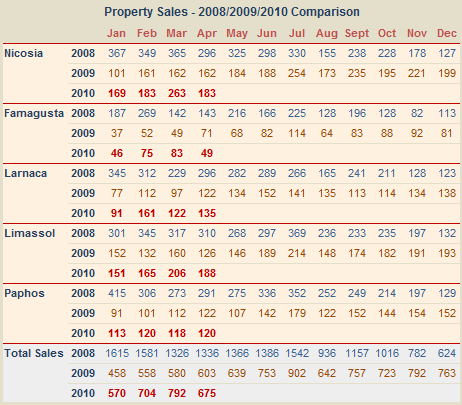
ACCORDING to the latest figures from the Department of Lands and Surveys, property sales were up in April by 11% compared to last year and by 25% over the first four months of this year compared to last.

These latest figures indicate a slowdown in the market’s recovery reported last month; March figures showed sales had increased by 37% over the previous year and the year-to-date figures showed that sales had increased by 31% during the first three months of the year.

Throughout the first four months of 2010 the number of contracts of sale deposited at Land Registries throughout Cyprus amounted to 2,741 compared to 2,741 during the same period last year; an increase of 25%.

The slowdown may be as the result of Cyprus’ worsening economic situation or perhaps the opportunities highlighted by Solomon Kourouklides a couple of months ago have been exhausted (see ‘Latest property sale figures for Cyprus’ )

Cyprus property sale figures 2008/20099/2010 comparision
Source: Department of Lands and Surveys

Overseas sales

On a brighter note, the growth in property sales to foreign buyers reported last month has been maintained with the overall year-to-date growth standing at 3%. However, sales are still down by more than 60% compared to the number sold during the same period in 2008.

There are a number of factors that may be affecting the market in both directions:

  • The UK is slowly emerging from recession and Sterling has strengthened considerably against the Euro, mainly as a result of the financial crisis in Greece and the possible result of the general election being held in the UK tomorrow (property sales in some parts of Spain are reportedly up by 200% this year). But for some reason, the Cyprus real estate market does not appear to be benefitting from the improving economic situation in the UK, the strengthening of Sterling or improving investor confidence in overseas property markets.
  • The bad news stories about the Cyprus property market continue to make headlines in the UK. Most recently the writ against Denis O’Hare by property developer Leptos resulting in the closure of the Cyprus Property Action Group website, the Leptos Property Action Group ‘Title Deed’ protest in Paphos and Conor O’Dwyer’s protest outside ‘A Place in the Sun’ overseas property exhibition in London have all been reported in the UK media.
  • During April the Icelandic volcanic ash cloud resulted in the cancellation of many flights in and out of the UK and other European counties, starving Cyprus of tourists – some of whom would have been potential property buyers.
Cyprus property sales to foreigners 2008/20099/2010 comparision
Source: Department of Lands and Surveys

Protester vows to fight Cyprus legal action

LEPTOS Estates has filed a libel claim against Denis O’Hare of the Cyprus Property Action Group in response to a page of the association’s website.

The company says the site made false claims about the issuing of Title Deeds on Leptos projects and that it is acting to protect its reputation and existing customers.

I will defend any libel claims vigorously,” O’Hare told OPP. “I am absolutely shocked and dismayed at this action.

“All I’ve tried to do is lobby the government, help buyers and fix the property problems in Cyprus for everyone’s benefit. This is a sad day for the Cyprus property industry.

Uncertain future

The organisation has spent the last few years campaigning on behalf of homeowners who have not been issued title deeds – a problem that is thought to affect around 100,000 people in Cyprus, including 30,000 foreign nationals. Legislation to speed up the title deed process is currently going through the Cypriot parliament.

CPAG has now taken down the website, which is owned and maintained by O’Hare. A message from the group warned it would no longer be able to help buyers in its current form, but said that some members were looking into a setting up a limited liability company outside Cyprus.

According to the Cyprus Mail newspaper, a Cypriot court ordered O’Hare to remove the webpage and banned him from repeating the allegations, threatening arrest and confiscation of his property if he did not comply.

A statement from Leptos Estates said: “We were forced eventually to take these legal measures which were also the demand by hundreds of our clients. They strongly felt their interests and the values of their properties were irreparably damaged by these defamatory publications.

“In those publications, numerous of our company’s projects were described as problematic due to issue of separate title deeds for the properties therein. However, these properties had separate title deeds actually long before those publications.

Editors note

There are approximately 130,000 properties awaiting Title Deeds, rather than 100,000 people as stated in the report. Similarly ‘30,000 foreign nationals’ should be ‘30,000 properties purchased by foreign nationals’.

Bearing in mind that properties are often bought in joint names, the number of people affected by this problem could well be in excess of 200,000.

When you consider that the population of the free areas of the Republic is approximately 800,000, the Title Deed problem could be affecting a quarter of those living here.

Cyprus Bar Association to mull over landmark ruling

THE CYPRUS Bar Association will meet next week to discuss the implications of the first ever case of compensation awarded for a lawyer’s negligence by the Supreme Court last month.

Bar Association President Doros Ioannides said yesterday the association would meet on May 13 to decide what position to take on the matter. On April 21, the Supreme Court ruled that Paphos lawyer Nicos Papacleovoulou had negligently carried out his duties on behalf of a British couple in a property transaction in 1999. The top court ordered the lawyer to pay €120,000 to the couple for money lost as a result of the transaction.

Ioannides noted this was the first ever case involving a lawyer’s negligence and needed further examination by the association. It also marks a precedent in that a lawyer agreed to represent clients suing another lawyer for the first time while in its ruling, the Supreme Court laid down, again for the first time, the duties and obligations of a lawyer in property transactions.

The judgement has ruffled a few feathers in the legal profession as lawyers who dabbled in unsafe practices in the past, particularly regarding searches in property transactions, are now liable to similar charges of negligence.

Cyprus Bar Association to mull over landmark ruling