Title Deed bills to Cyprus parliament today

YESTERDAY, the Council of Ministers approved six bills concerning reforms to the legal framework governing building permits and the issue of Title Deeds.

In a statement made after the meeting, spokesman for the Cyprus government Stephanos Stephanou said that the six bills aim to solve the problem of Title Deeds and that the improvements will also bring respectable revenues to the state.

The bills will be submitted to Parliament tomorrow (Thursday) and all the necessary procedures will be followed”, he said.

On the question whether this approval is linked to the urban planning amnesty, Mr. Stephanou said that it includes the urban planning amnesty too.

Further details of the bills will be released by the Interior Minister. The Interior Ministry has been working on this complicated issue for year and a half”, he added.

Mr. Stephanou also outlined that the bills have been formed in an open way with the use of modern technology in the sense that the proposals were on the Internet.

Responding to questions, Mr. Stephanou said that the state revenue largely depends on the number of the Title Deeds that will be issued.

In a statement last November, the Cyprus Interior Minister Neoclis Sylikiotis said “If you assume an average €8,000 charge to complete the issue of the final Title Deed and considering that we expect 20,000 units to be processed through 2010, then it’s safe to assume that the government could receive up to €160 million next year alone, plus more revenue in the following years.

An estimated 130,000 units (houses, flats, hotels) in Cyprus are currently without Title Deeds.

Sales up on last year but foreigners holding back

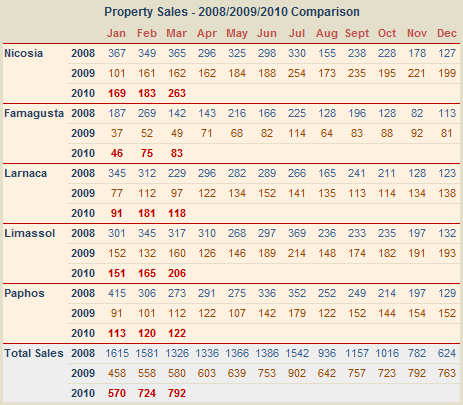
ACCORDING to the latest figures from the Department of Lands and Surveys, property sales were up in March by 37% compared to last year and by 31% over the whole of the first quarter.

During the first quarter of 2010 the number of contracts of sale amounted to 2,086 compared to 1,596 during the same period last year; an increase of 31%.

Cyprus: All property sales March 2010
Source: Department of Lands and Surveys

Overseas sales

Although overall sales are up, foreign buyers are still holding back. With the exception of Famagusta, where sales were up 39% during the first quarter of this year, foreign buyers have yet to return in any great numbers to the key tourist areas of Paphos, Larnaca and Limassol.

However, foreigners are buying in the capital, Nicosia, where sales during the first quarter are up 169% compared to last year. But it is likely that these will be business acquisitions as Nicosia is not a destination favoured by tourists and holidaymakers.

But there are some encouraging signs in Paphos and Limassol where sales during March exceeded those of last year.

Cyprus: Foriegn property sales March 2010
Source: Department of Lands and Surveys

Pundits believe that during 2010 the Cyprus real estate market will stabilise after a period of uncertainty and doubt. The property industry is also hoping that the long-awaited changes to Planning and Title Deed legislation will help restore investor confidence in the market.

As previously reported, some property developers are developing new marketing strategies in the hope of attracting a more up-market overseas clientele.

Title Deed legislation in parliament by month end

LEGISLATION to clear the backlog of title deeds will be tabled to Parliament if not around April 20, at least by the end of the month, Interior Minister Neoclis Sylikiotis said yesterday.

Giving a news conference to mark his two years in office, Mr Sylikiotis referred to the title deeds issue as a ‘Gordian knot’.

He said having been through a consultation process involving all groups representing interested parties, the five pieces of amending legislation designed to help clear the backlog of unissued deeds have now been finalised. He expects them to be tabled for consideration by the House of Representatives around April 20, and “certainly no later than the end of the month,” he said.

Speaking in general, Sylikiotis said the challenges facing both the Interior Ministry and the government as a whole is to fulfil the commitment they have made to provide solutions to various problems facing ordinary people.

Our credibility, our targeted policies and strategic positions for covering the needs, concerns and aspirations of the public are tested against the effectiveness and capability with which, on the one hand, we deal with the various problems, and on the other, we produce political results.

Sylikiotis said that three primary policy axes formed the mainstay all of his Ministry’s activity:

  • introducing new strategies for implementing social and economic measures into Development Plans;
  • modernising local government and simplifying administrative procedures;
  • promoting specific institutional changes that will allow decades-old problems to be overcome, at the same time giving real meaning and substance to principles such as transparency, public dialogue and participatory democracy.

Referring in particular to the ten-year (2012-2021) Local Government Restructuring Programme, the Minister said its basic aims are “the decentralisation, restructuring and strengthening of local authorities with new responsibilities and powers, their operational modernisation, clarification of their role, the improvement of the relations between local authorities and the state, and the redrawing of their boundaries”.

One specific aim of the programme, he added, is to formulate a Uniform Code for local government, which among other things will provide for a layer of regional councils that will be responsible for co-ordinating water and waste services across municipal boundaries.

Regarding town-planning policy, Sylikiotis said that significant progress had been made in updating a number of specific local development plans, but the ultimate aim is to have a single policy approach across the whole island, enshrined in a revised “Cyprus Development Plan”.

One aspect of the Ministry’s activity that has seen significant progress over the last two years is the modernisation and improvement of the provision of services to the public, with computerisation and new office buildings playing a crucial role. Sylikiotis said that “improving the staffing of services is not just about increasing numbers; it also means improving the focus and quality of service to the public.

The issue of migration, both legal and illegal, has been especially important in the Interior Ministry’s activity, based on two axes: first of all, full participation in the EU process of formulating a coherent EU-wide migration policy and asylum system, with particular focus on the fact that four of the EU’s Mediterranean countries bear an unfair share of the migrant and refugee burden.

The second axis has been to offer a complete response to the challenge of immigration, within the framework of EU policy and international agreements. Sylikiotis said that the time it takes to process an asylum request has been greatly reduced. He added that, given the increasing importance to all EU countries of immigrant labour, his Ministry has co-ordinated a multi-ministry initiative to produce a national action plan for integrating migrants, covering 2010-12. The plan should be ready to be submitted to the Council of Ministers by the end of the month.

Finally, Sylikiotis said that Cyprus can be proud of the fact that its efforts to revise the work visa process over the last eighteen months, together with improved measures for combating people trafficking and for protecting the victims of trafficking, has seen the island being taken off the black-list it has been on for too many years.

Revised property taxes and planning amnesty

INTERIOR Minister Neoclis Silikiotis has stated that the planned revaluation of property values will be completed in 3-5 years and stressed that a tax system based on current values, rather than those of 1980, aims to right the wrong that burdens tax payers.

Mr. Silikiotis, who was speaking at a press conference, said that there are properties whose current value is 25 times greater that their 1980 values although they continue to pay taxes and duties on the basis of their assessed value at 1st January 1980.

Avoiding saying who will be mostly affected by the measures, the Minister said that they will address those whose properties have multiplied in value from their 1980 levels. He also emphasized that in some areas properties are taxed or pay duties on the basis that they are vacant plots, while in reality they consist of large developments and building complexes.

The Minister anticipates that the revaluation will take between 3 and 5 years.

We elaborated on the provisional proposals on the basis of a study carried out by the Land Registry Department until the completion of the revaluation. We forwarded them to the Finance Minister, who will have talks with the parties and the social partners on the issue”, he said.

Planning amnesty bills

As for the five bills concerning the urban planning amnesty, he said that they are ready and will be submitted to the Council of Ministers at its next meeting. By the 20th April they will be forwarded to Parliament so that they may be approved before the summer holidays.

Cyprus submits stability programme to EU

ACCORDING to an official announcement issued on Tuesday by the Ministry of Finance, the Stability Programme was submitted to the Commission on Thursday, 1st of April, through the due process and it is already in the hands of the competent officials.

As it is noted, the Stability Programme is a living document, which beyond its fundamental structure and measures, is open to change, adding that it is imperative to continue the dialogue both with parties and the social partners as well as the European Commission.

The Ministry’s announcement points out that the government remains committed to the efforts to reach consensus solutions on the economy in order to address the chronic structural problems to help economic recovery.

Therefore, after tomorrow’s meeting between the Finance Minister and the leaders and representatives of all parliamentary parties, meetings with all social partners and other organized groups will follow in the next days in the context of the dialogue and discussions that have been going on for some time now, the announcement concludes.

The four main targets of the Stability Programme relate to tax evasion, cutting down operational costs and non productive expenses in the civil service, boosting development and consolidating a more effective social state.

In his remarks last week, the Finance Minister Charilaos Stavrakis expressed hope that the main bulk of the Programme will satisfy the Commission, noting though that there are always recommendations and amendments suggested by Brussels.

Cypriot developer reveals new marketing strategy

THE COMPANY has launched its latest development, Panorama Residences in Pissouri, in an attempt to attract buyers from the high-end of the market, a move that mirrors the actions of other developers in the country.

Aristo is also awaiting government approval on a scheme it says will be the biggest the island has ever seen. Called Venus Rock, it is intended to be a €1 billion project covering around 10 million sq.m. of land.

The two developments are to be marketed separately from the company’s other products, which are aimed at mid to low-end buyers and now referred to as ‘Aristo Classic’. The company has no plans to launch any more ‘Classic’ projects this year.

We felt we needed to rebrand and categorise our developments to identify specific marketing strategies for each type of property,” group marketing manager Panayiotis Michaelides told OPP. “They have different clientele and we need to use different marketing channels.

The company is hoping to attract buyers from the UK, Scandinavia, central Europe and Russia, but also hopes to take advantage of the growing demand for overseas property among Arabic buyers.

We have extended our marketing investment in Arab countries and are about to establish collaboration agreements with agents in Saudi Arabia, Kuwait and Qatar,” said Michaelides.